
NUC-430 · Lesson 10 of 12 · 21 min
Decommissioning
Marcel Thibodeau's last assignment before retiring is to help plan the decommissioning of the reactor where he started his career. He takes Hana to the turbine hall, silent now, its big machines already drained. "People think decommissioning is demolition," he says. "It is the opposite. It is the most carefully planned work we ever do, because we are taking apart a system that was built never to be taken apart. And it is a licensed activity, with a safety case, just like operation."
What decommissioning involves
Decommissioning covers all the administrative and technical actions taken to remove some or all of the regulatory controls from a nuclear facility at the end of its life. For a power reactor it includes removing the fuel, draining and decontaminating systems, dismantling contaminated and activated equipment and structures, packaging and shipping waste, remediating the site and surveying it to show that it meets the release criteria. It can take a decade or more, cost hundreds of millions to more than a billion dollars per reactor, and produce large volumes of mostly low-level waste. Planning for it begins at the design stage and continues throughout operation.
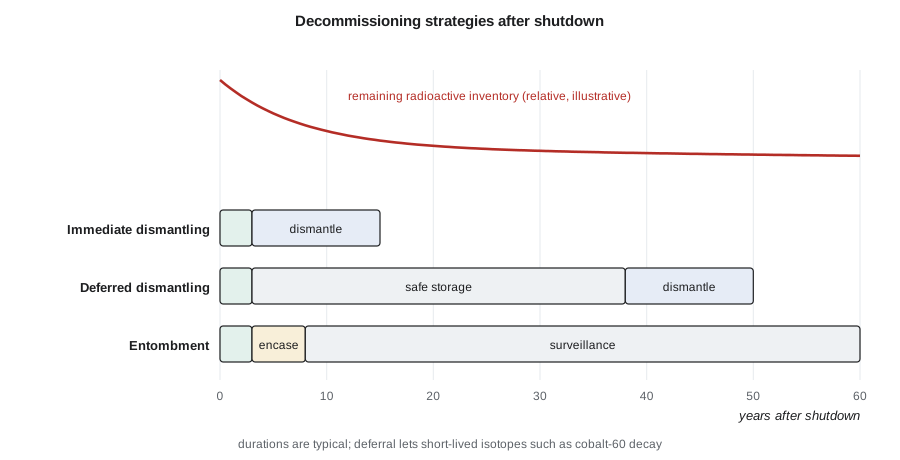
Most of the radioactivity in a shut-down reactor, apart from the fuel, is in two forms. Activation products are created when neutrons strike the steel and concrete near the core, making isotopes such as cobalt-60, nickel-63 and, in CANDU reactors, carbon-14 and tritium in the moderator and structures. Contamination is radioactive material deposited on the inside surfaces of systems and occasionally on floors and walls. Activation is bulk and cannot be washed off; contamination can often be removed by chemical or mechanical decontamination. The inventory falls with time as short-lived isotopes decay, which is the main argument for waiting before dismantling.
Strategies
The IAEA describes three broad decommissioning strategies. Immediate dismantling begins soon after shutdown, using the existing workforce and their knowledge of the plant, and returns the site for other use within one or two decades. Deferred dismantling places the facility in a safe storage state, with the fuel removed and systems drained, and waits several decades for radioactivity to decay before dismantling. Entombment encases the facility in a durable structure so that it becomes a disposal site, an approach generally not considered acceptable for power reactors except in special circumstances. The IAEA's safety standards express a preference for immediate dismantling where practicable, but the choice depends on the availability of waste disposal, funds, workforce and the plans for other reactors on the same site.
In Canada, power reactor owners have generally planned deferred dismantling, partly because the reactors share sites with operating units, partly because there is not yet a disposal facility for most of the waste, and partly because of the cost advantage of letting radioactivity decay. The Gentilly-2 station in Quebec, shut down at the end of 2012, was placed in safe storage, and the CNSC issued Hydro-Québec a licence to decommission it in 2016. The early prototype reactors at Douglas Point, Rolphton and Gentilly-1 are managed by Canadian Nuclear Laboratories in storage with surveillance, and options for their final decommissioning have been studied. At Pickering, Units 1 and 4 shut down in 2024, and OPG's plans for the station's future depend on the outcome of its application to refurbish Units 5 to 8.
Planning and licensing
CNSC licensees must maintain a decommissioning plan throughout the life of the facility. REGDOC-2.11.2, Decommissioning, and the CSA standard N294 set out the requirements: a preliminary decommissioning plan from the start of operation, updated at least every five years, that describes the strategy, the end state, the major activities, the waste and the cost estimate; and a detailed decommissioning plan before decommissioning begins, which supports the application for a licence to decommission. The licence to abandon, issued at the end, releases the site once the licensee has shown that the end state has been reached.
| Document | When | Content |
|---|---|---|
| Preliminary decommissioning plan | from start of operation, updated every 5 years | strategy, end state, cost estimate |
| Financial guarantee | maintained throughout life | funds sufficient for decommissioning |
| Detailed decommissioning plan | before decommissioning | work packages, waste, safety analysis |
| Licence to decommission | start of decommissioning | authorization with conditions |
| End-state report and licence to abandon | end | evidence the end state is met |
Paying for it
The NSCA framework requires licensees to provide a financial guarantee for decommissioning that the CNSC accepts, so that the money will be available even if the licensee no longer exists. REGDOC-3.3.1 sets out the requirements. For OPG's stations, the guarantee rests mainly on segregated funds established under the Ontario Nuclear Funds Agreement between OPG and the province, one for decommissioning and low and intermediate level waste and one for used fuel, together with a provincial guarantee. The funds are invested, and their adequacy is reviewed against updated cost estimates every five years.
The essential calculation is a present-value one. A decommissioning cost incurred decades in the future can be covered by a smaller sum invested today, because the fund earns a return. But costs also escalate, often faster than general inflation, and estimates tend to rise as plans become more detailed. If the fund's real return falls short or costs grow, the fund will fall short. Regulators therefore require regular updates of both the cost estimate and the fund balance.
# Present value of decommissioning strategies and the annual contribution needed (illustrative, real terms).
r = 0.025                     # real discount rate
def pv(amount, year): return amount / (1 + r) ** year
# immediate: 1200 M spread evenly over years 1-12 after shutdown
immediate = sum(pv(1200 / 12, y) for y in range(1, 13))
# deferred: 8 M per year safe storage for 30 years, then 1000 M over years 31-42
deferred = sum(pv(8, y) for y in range(1, 31)) + sum(pv(1000 / 12, y) for y in range(31, 43))
print(f"present value at shutdown: immediate {immediate:7.0f} M  deferred {deferred:7.0f} M")
# annual contribution over 40 operating years to reach the immediate-strategy PV at shutdown
for ret in (0.025, 0.0125):
    n = 40; factor = ((1 + ret) ** n - 1) / ret
print(f"real return {ret:.2%}: annual contribution {immediate / factor:5.1f} M per year for {n} years")present value at shutdown: immediate 1026 M deferred 575 M real return 2.50%: annual contribution 15.2 M per year for 40 years real return 1.25%: annual contribution 19.9 M per year for 40 years
The output shows two things. First, deferring the work lowers its present value substantially, because a real discount rate applied over decades shrinks the cost, even though the deferred strategy adds annual safe storage costs. Second, a modest annual contribution over a long operating life can build a large fund. The result is sensitive to the assumed real return: halving it raises the needed contribution considerably. Marcel points out that the present value advantage of deferral is only part of the decision; the loss of experienced staff and the burden on future generations count against it.
Worked problem
Fund growth
A fund holds 400 million dollars and earns a real return of 2 percent per year. With no further contributions, what is it worth in real terms after 20 years?
Show solution
- Value = 400 × 1.02²⁰.
- 1.02²⁰ ≈ 1.486.
- Value ≈ 594 million dollars.
Answer: About 594 million dollars in today's money.
Release criteria and the end state
At the end of decommissioning the site must meet an end state agreed with the CNSC. Unrestricted release means the site can be used for any purpose; restricted release means some controls on land use remain. Release criteria are set as dose limits for the people who may use the site in future, with the expectation that doses be kept as low as reasonably achievable, together with criteria for contamination in soil and buildings derived from them. A final survey, designed with statistical methods, demonstrates that the criteria are met.
Waste from decommissioning
Decommissioning a large reactor produces tens of thousands of cubic metres of waste, most of it concrete, steel and soil with little or no radioactivity. Managing this waste well is one of the keys to cost. Material that meets clearance levels, set by the regulator as concentrations below which material can be released from regulatory control, can be recycled or sent to ordinary landfill. Low-level waste goes to a licensed disposal facility where one exists, or to storage where it does not. A smaller volume of intermediate-level waste, such as reactor internals and, for CANDU reactors, pressure tubes and calandria tubes, needs shielding and more robust disposal. The used fuel, removed early in the process, goes to the storage and disposal path described in the fuel cycle course.
The lack of a disposal facility for low and intermediate level waste is one of the reasons Canadian owners have favoured deferred dismantling. The Nuclear Waste Management Organization has been given responsibility for planning for these wastes as well as for used fuel, and Canadian Nuclear Laboratories was authorized in 2024 to build a near-surface disposal facility at Chalk River for low-level waste, mostly from its own sites. Integrated planning of waste and decommissioning is a central theme of the federal policy on radioactive waste updated in 2023.
Safety during decommissioning
A shut-down reactor without fuel cannot have a criticality or core damage accident, so many of the hazards of operation disappear. But others remain or become more prominent: radiation exposure to workers cutting activated components, airborne contamination during demolition, industrial hazards from heavy lifting, cutting and working at height, fire, and the management of large volumes of waste. While fuel remains in the pool after shutdown, the safety case must also cover loss of pool cooling and inventory. The decommissioning safety case addresses these hazards and is reviewed by the regulator like any other.
Marcel tells Hana about the techniques used. Remote tools, such as underwater cutting with abrasive water jets or plasma torches, let workers stay at a distance from the most activated components. Chemical decontamination of a reactor's primary circuit before dismantling can remove most of the contamination and greatly reduce doses. Detailed three-dimensional models of radiation fields help plan each cut. "The dose budget for a decommissioning project is set the same way as for an outage," he says. "We plan each job, estimate the dose, and track it. If a job runs over, we stop and ask why."
Licence transfers and community concerns
In Canada, decommissioning has so far been carried out mainly by the original owners or by Canadian Nuclear Laboratories for federal sites, with the knowledge and staff of the operating organization. A notable federal project is the shutdown of the NRU research reactor at Chalk River in 2018 after more than sixty years of operation, followed by planning for its decommissioning. Communities near stations have a strong interest in decommissioning plans because of jobs, the local tax base and the long-term use of the site, and the CNSC expects licensees to engage them as part of planning.
How decommissioning has gone in practice
Experience from dozens of completed power reactor decommissioning projects around the world shows that the work can be done safely, with worker doses and environmental releases well within limits, and that sites can be returned to other use. In the United States, sites such as Maine Yankee, Trojan, Rancho Seco and Zion have been decommissioned, with only the dry storage installation for used fuel remaining under licence. In Germany and Spain, several large reactors have been or are being dismantled under immediate strategies. Projects have faced cost overruns, often because the extent of contamination was greater than expected, waste disposal routes changed or the regulatory end state was renegotiated. The lesson drawn by the industry is that good records from operation, early characterization of the plant and a stable end state are the best ways to control cost.
At the end of their visit Marcel shows Hana the plant's operating logs from its first decade, kept in a vault and now being scanned. "Every spill, every leak, every repair," he says. "The people who wrote these are mostly gone. But their notes tell us where to look for contamination under the floor. That is why record keeping during operation is a decommissioning requirement too."
Decommissioning from the design stage
Modern design requirements in both countries ask designers to consider decommissioning from the start. Choosing materials with low levels of impurities such as cobalt reduces activation; designing systems so that large components can be removed in one piece reduces cutting; avoiding embedded piping that is hard to survey reduces the risk of hidden contamination; and keeping good records of the as-built plant makes characterization easier decades later. Many SMR designs go further, proposing to remove the whole reactor module at the end of life and return it to a central facility for dismantling, which would leave the site with little more than conventional demolition. Whether that model works will depend on transport licensing and on the availability of a facility to receive the modules, questions regulators are only beginning to address.
Common mistakes
MistakeDecommissioning starts when the plant shuts down.
InsteadPlanning and funding start at the design stage and continue throughout operation.
MistakeDeferred dismantling is always cheaper.
InsteadIt has a lower present value but adds storage costs and loses experienced staff.
MistakeDecommissioning ends when the buildings are demolished.
InsteadIt ends when the site is shown to meet the release criteria and controls are removed.
Summary and key terms
- Decommissioning removes regulatory controls from a facility at the end of its life.
- Activation and contamination make up most of the non-fuel radioactivity.
- Strategies are immediate dismantling, deferred dismantling and entombment.
- Licensees maintain preliminary and detailed decommissioning plans and a financial guarantee.
- Fund adequacy depends on present-value calculations and regular updates.
- Decommissioning
- Actions to remove regulatory controls at the end of a facility’s life.
- Activation
- Radioactivity induced in materials by neutrons.
- Deferred dismantling
- Safe storage for decades before dismantling.
- Financial guarantee
- Assurance that decommissioning funds will be available.
- End state
- The condition of the site at the end of decommissioning.
- Licence to abandon
- The final licence releasing a site from CNSC control.
Practice problems
Work each problem on paper first, then reveal the answer to check.
Name the three decommissioning strategies.
Show answer
Immediate dismantling, deferred dismantling, entombment.
Why does deferral reduce radiation doses to workers?
Show answer
Short-lived isotopes such as cobalt-60 decay during storage.
How often must a preliminary decommissioning plan be updated?
Show answer
At least every five years.
What is 100 million dollars worth after 35 years at a 3 percent real return?
Show answer
About 281 million dollars.
Which REGDOC covers financial guarantees?
Show answer
REGDOC-3.3.1.
Lesson quiz · 5 questions
Score 60% or more to complete this lesson.
Create a free account to save your progress, take quizzes and earn a certificate.