
NUC-420 · Lesson 3 of 12 · 20 min
Conversion and enrichment
Hana's next task is commercial rather than technical. A utility client wants to understand why its fuel bill changed so much over three years. "For a CANDU utility the answer is mostly the price of uranium and conversion," Amara says, "because there is no enrichment. But our client also buys enriched uranium for a research reactor and is looking at small modular reactors that need it, so you need to understand the whole front end. Start with how fuel buyers think about it: kilograms of uranium, kilograms of conversion and units of separative work."
Refining and conversion
Uranium ore concentrate from a mill is not pure enough to use directly. A refinery dissolves it and purifies it to nuclear grade, removing impurities that absorb neutrons or would harm the fuel. What happens next depends on the reactor. For natural uranium reactors such as CANDU, the purified uranium is converted to uranium dioxide powder, ready to be pressed into pellets. For reactors that need enriched fuel, it is converted instead to uranium hexafluoride, UF₆, a compound that becomes a gas at modest temperatures and is the feed material for all commercial enrichment plants.
Canada has one of the world's main conversion industries. Cameco's Blind River refinery in Ontario purifies uranium concentrate to uranium trioxide, and its Port Hope conversion facility converts that to uranium dioxide for CANDU fuel and to uranium hexafluoride for export to enrichment plants abroad. Port Hope also hosts one of Canada's largest historical waste cleanups, the Port Hope Area Initiative, which is relocating low-level radioactive waste from early refining operations into engineered mounds.
Uranium hexafluoride is handled in large steel cylinders designed and certified for the purpose. It is a solid at room temperature and pressure and is heated to become a liquid or gas for transfer. Its main hazard is chemical rather than radiological: if released, it reacts with moisture in the air to form hydrogen fluoride, which is highly toxic and corrosive, and uranyl fluoride particles. Plants that handle it are designed and regulated as chemical as well as nuclear facilities, with containment, detection and emergency plans for releases.
What enrichment does
Natural uranium is about 99.3 percent uranium-238 and 0.71 percent uranium-235. Enrichment increases the fraction of uranium-235. Commercial power reactor fuel is low-enriched uranium, defined internationally as containing less than 20 percent uranium-235, and in practice today's light water reactor fuel is enriched to between about three and five percent. Some advanced reactor designs plan to use high-assay low-enriched uranium, called HALEU, enriched to between five and just under twenty percent. Material above twenty percent is classed as highly enriched uranium and is subject to the strictest controls.
Almost all commercial enrichment today uses the gas centrifuge, in which uranium hexafluoride gas spins at high speed and the slightly heavier molecules containing uranium-238 move outward, so that gas drawn from near the axis is slightly richer in uranium-235. A single machine changes the composition only a little, so plants link very large numbers of machines together. The technology is among the most sensitive in the nuclear field because the same principle could in principle be used to reach high enrichments, and its details are controlled by national export rules and international agreements. This course treats enrichment as an industrial service bought by the kilogram, which is how utilities and regulators see it.
Enrichment plants operate in the United States, the United Kingdom, the Netherlands, Germany, France, Russia and China. Canada has no enrichment industry, because its reactors do not need it; uranium hexafluoride from Port Hope is shipped abroad for enrichment for foreign customers.
| Category | Uranium-235 content | Typical use |
|---|---|---|
| Depleted uranium | below 0.711 percent | tails from enrichment; counterweights, shielding, storage for future use |
| Natural uranium | about 0.711 percent | CANDU fuel |
| Low-enriched (LEU) | up to about 5 percent today | light water reactor fuel |
| High-assay LEU (HALEU) | 5 to just under 20 percent | some research and advanced reactors |
| Highly enriched | 20 percent and above | strictly controlled; being phased out of civilian use |
Separative work: the unit of enrichment
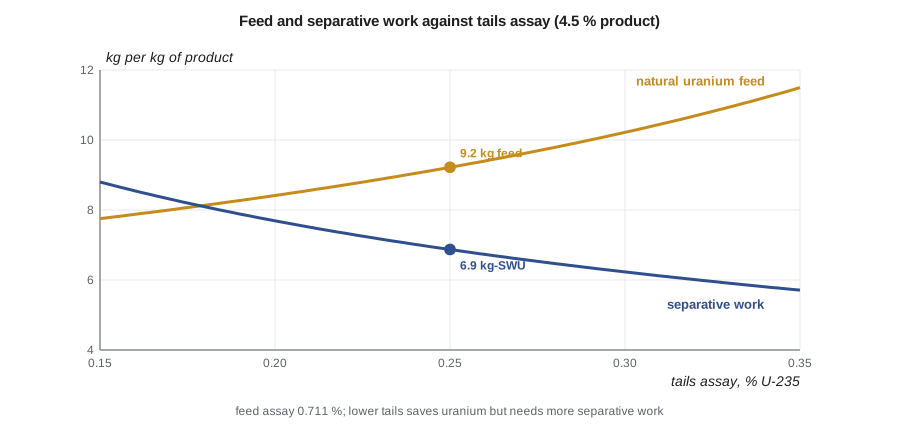
Enrichment is sold in separative work units, written SWU and pronounced like 'swoo'. A SWU is a measure of the effort needed to separate a quantity of uranium into a richer product and a leaner tails stream; it is to enrichment what kilowatt-hours are to electricity. The SWU needed depends on the product assay, the feed assay and the tails assay, through a standard function called the value function. Buyers use it to compare offers and to choose the best tails assay: a lower tails assay saves natural uranium but needs more separative work, and the economic optimum shifts as the prices of uranium and SWU change.
In the equations, F is the kilograms of natural uranium feed needed for each kilogram of product, x is the assay as a fraction of uranium-235, and the subscripts p, f and t mean product, feed and tails. The first equation is simply a mass balance on uranium-235. The second gives the separative work per kilogram of product. These are the formulas in every fuel buyer's spreadsheet and in regulators' economic analyses, and they say nothing about how the work is done in a plant.
# Front-end fuel cost per kilogram of low-enriched uranium (LEU).
# The separative work (SWU) value function is the standard economic accounting tool.
# Prices are illustrative.
import math
def V(x):                       # value function of an assay x (a fraction)
    return (2 * x - 1) * math.log(x / (1 - x))
xf, xp, xt = 0.00711, 0.045, 0.0025     # feed, product and tails assays (commercial LEU)
F = (xp - xt) / (xf - xt)              # kg natural uranium feed per kg of product
T = F - 1                              # kg tails per kg of product
SWU = V(xp) + T * V(xt) - F * V(xf)    # kg-SWU per kg of product
price_U3O8_lb, conv, swu_price, fab = 80.0, 15.0, 150.0, 400.0
u_cost = F * price_U3O8_lb * 2.20462 * 1.1792   # dollars of uranium per kg product
total = u_cost + F * conv + SWU * swu_price + fab
print(f"feed {F:.2f} kg U and {SWU:.2f} kg-SWU per kg of product at {xp*100:.1f} %")
print(f"uranium {u_cost:6.0f}  conversion {F*conv:5.0f}  enrichment {SWU*swu_price:5.0f}  fabrication {fab:4.0f}")
print(f"total about {total:,.0f} dollars per kg of fuel uranium")
for t in (0.0020, 0.0030):
    F2 = (xp - t) / (xf - t); S2 = V(xp) + (F2 - 1) * V(t) - F2 * V(xf)
print(f"tails {t*100:.2f} %: feed {F2:.2f} kg, {S2:.2f} kg-SWU")feed 9.22 kg U and 6.87 kg-SWU per kg of product at 4.5 % uranium 1917 conversion 138 enrichment 1031 fabrication 400 total about 3,486 dollars per kg of fuel uranium tails 0.20 %: feed 8.41 kg, 7.69 kg-SWU tails 0.30 %: feed 10.22 kg, 6.23 kg-SWU
With the illustrative prices in the program, uranium is about half the front-end cost, enrichment about a third, and conversion and fabrication the rest. Lowering the tails assay from 0.25 to 0.20 percent saves almost a kilogram of natural uranium per kilogram of product but costs almost one more SWU. When uranium is expensive relative to enrichment, buyers ask the enricher to strip the tails lower; when enrichment is expensive, they accept higher tails. This trade is one reason why the price of uranium and the price of SWU move together over the long run.
Worked problem
Feed and separative work for a reload
A reload needs 20 t of uranium enriched to 4.4 percent, with feed at 0.711 percent and tails at 0.25 percent. How much natural uranium feed is needed?
Show solution
- F = (0.044 − 0.0025) / (0.00711 − 0.0025) = 0.0415 / 0.00461 = 9.00.
- Feed = 9.00 × 20 t = 180 t of natural uranium.
- Tails = 180 − 20 = 160 t of depleted uranium.
Answer: About 180 tonnes of natural uranium feed, leaving about 160 tonnes of depleted uranium tails.
Depleted uranium
Enrichment leaves behind large amounts of depleted uranium, usually stored as uranium hexafluoride in steel cylinders at the enrichment sites. Worldwide stocks amount to well over a million tonnes. Some of it may be re-enriched in future when uranium prices are high, some is converted to a stable oxide for long-term storage or disposal, and small amounts are used for shielding and counterweights. Its radioactivity is low, but its chemical form and sheer volume make it a significant long-term management task, and the deconversion plants that turn it into oxide are an often-overlooked part of the fuel cycle.
Regulation, safety and safeguards at front-end plants
Conversion and enrichment plants are licensed nuclear facilities with safety cases built around criticality safety, chemical hazards, fire and radiological protection. Criticality safety, keeping enriched material in amounts and shapes that cannot sustain a chain reaction, governs the design of containers, piping and storage arrays and the procedures for moving material. Enrichment plants are also among the most heavily safeguarded facilities in the world. International inspectors verify that a plant produces only the declared enrichment levels, using measurements, seals, cameras and unannounced inspections, as lesson 12 describes. A commercial enrichment plant that produced more than its declared assay would be detected, and the international community treats any such deviation very seriously.
The market for nuclear fuel services
Each step of the front end is a separate commercial market. Utilities buy uranium concentrate from mining companies or traders, pay a converter to turn it into UF₆, pay an enricher for separative work and pay a fabricator to make fuel. Most of this is done under long-term contracts lasting five to ten years, because security of supply matters more to a reactor operator than the lowest possible price. A smaller spot market handles short-term purchases. Prices are published by independent market reporting firms, and are quoted in dollars per pound of U₃O₈ for uranium, dollars per kilogram of uranium for conversion and dollars per SWU for enrichment.
The markets for conversion and enrichment are concentrated: only a handful of companies in a few countries provide these services. This concentration has made supply security a policy concern, particularly since 2022, when Russia's invasion of Ukraine raised questions about the reliance of Western utilities on Russian conversion and enrichment, which supplied a large share of world capacity. Governments and companies in North America and Europe have since announced expansions of conversion and enrichment capacity, and several advanced reactor developers have sought domestic sources of HALEU.
Canada is in a strong position in this market. It is one of the world's largest uranium producers and has one of the few commercial conversion plants outside Russia and China at Port Hope. CANDU reactors use natural uranium and so need no enrichment, which insulates Canadian utilities from the enrichment market. Canada does not enrich uranium, and Canadian uranium destined for light water reactors abroad is enriched in other countries under nuclear cooperation agreements.
| Service | Unit of sale | Typical contract |
|---|---|---|
| Uranium concentrate | dollars per pound of U₃O₈ | long-term, with some spot purchases |
| Conversion | dollars per kilogram of uranium as UF₆ | long-term |
| Enrichment | dollars per SWU | long-term |
| Fabrication | dollars per kilogram of uranium in fuel | tied to a specific reactor design |
Regulation of conversion and enrichment
Conversion and enrichment plants are licensed nuclear facilities. Their main hazards are chemical: UF₆ reacts with moisture to form hydrogen fluoride, which is highly toxic and corrosive. Plants are designed to contain UF₆ in the event of a cylinder or process leak, and they have emergency plans coordinated with local authorities. Criticality safety is another requirement, met by limits on enrichment, mass and geometry. Enrichment plants are under IAEA safeguards, as lesson 12 explains, which verify that they produce only the declared enrichment and do not divert material. The transport of UF₆ in cylinders is regulated under international transport rules based on the IAEA's transport regulations, with cylinders designed and tested to withstand accident conditions.
Depleted uranium, the tails of the enrichment process, accumulates in large quantities, stored as UF₆ in steel cylinders at enrichment sites. Because UF₆ is chemically hazardous, the preferred long-term form is an oxide, which is stable and much less reactive. Deconversion plants turn depleted UF₆ into uranium oxide and recover the fluorine as hydrofluoric acid for industrial use. Small amounts of depleted uranium are used as shielding, counterweights and in MOX fuel, but most is stored for possible future use or disposal as low-level waste.
Common mistakes
MistakeEnrichment changes uranium-238 into uranium-235.
InsteadIt only separates existing isotopes; no transmutation takes place.
MistakeA lower tails assay is always cheaper.
InsteadIt saves uranium but needs more separative work; the optimum depends on prices.
MistakeUranium hexafluoride is mainly a radiological hazard.
InsteadIts main hazard on release is chemical: it forms toxic hydrogen fluoride with moist air.
Summary and key terms
- Refining purifies concentrate; conversion makes uranium dioxide for CANDU fuel or uranium hexafluoride for enrichment.
- Commercial power fuel is low-enriched uranium, typically 3 to 5 percent; HALEU is 5 to just under 20 percent.
- Enrichment is bought in separative work units calculated with the value function.
- The tails assay trades natural uranium against separative work.
- Front-end plants are regulated for criticality and chemical safety and are closely safeguarded.
- Conversion
- Chemical transformation of purified uranium to uranium dioxide or uranium hexafluoride.
- Uranium hexafluoride
- UF₆, the gaseous feed for enrichment plants.
- Low-enriched uranium
- Uranium with less than 20 percent uranium-235.
- HALEU
- High-assay low-enriched uranium, 5 to just under 20 percent uranium-235.
- Separative work unit
- The standard measure of enrichment effort, used for pricing.
- Tails assay
- The uranium-235 fraction in the depleted stream leaving an enrichment plant.
Practice problems
Work each problem on paper first, then reveal the answer to check.
Why does a CANDU fuel buyer pay nothing for enrichment?
Show answer
CANDU uses natural uranium, so no enrichment is needed.
Calculate F for a product of 5 percent, feed 0.711 percent and tails 0.3 percent.
Show answer
F = (0.05 − 0.003)/(0.00711 − 0.003) ≈ 11.4.
What happens if uranium hexafluoride leaks into moist air?
Show answer
It forms hydrogen fluoride and uranyl fluoride, which are toxic and corrosive.
What is HALEU?
Show answer
Uranium enriched to between 5 and just under 20 percent uranium-235.
When is a lower tails assay favoured?
Show answer
When natural uranium is expensive relative to separative work.
Lesson quiz · 5 questions
Score 60% or more to complete this lesson.
Create a free account to save your progress, take quizzes and earn a certificate.