
NUC-420 · Lesson 5 of 12 · 22 min
Spent fuel characteristics
Hana stands on the walkway above a used fuel bay at Darlington. Twelve metres below, through clear water, rows of storage modules hold thousands of bundles that left the reactors over the past few years. The water glows faintly blue near the newest bundles. "Everything about how we store and dispose of this fuel follows from three properties," Amara says beside her. "How radioactive it is, how hot it is, and how both of those change with time. Learn those curves and the rest of the back end makes sense."
What is in used fuel
When fuel leaves a reactor it has changed. A few percent of the heavy metal has fissioned, and the fission fragments have become a mixture of hundreds of radioactive and stable isotopes of about forty elements, from krypton and strontium to iodine, caesium and the lanthanides. Some uranium-238 has captured neutrons and become plutonium and, in smaller amounts, the heavier elements neptunium, americium and curium, called minor actinides. The rest, about 95 percent of the mass, is uranium, with a uranium-235 content below that of the fresh fuel. The cladding and structural parts have also been activated by neutrons, producing nuclides such as cobalt-60 in steel and some carbon-14.
The composition depends on burnup, on the fuel type and on how long the fuel has cooled. Higher burnup means more fission products and more transuranic elements per tonne. CANDU fuel at its low burnup has a smaller concentration of fission products than light water reactor fuel but, because far more fuel mass is used, a CANDU station discharges a similar amount of fission products per unit of electricity. For waste management the useful quantities are the inventory of each important nuclide, the total activity, the decay heat and the radiotoxicity, all as functions of time after discharge.
| Group | Examples | Why it matters |
|---|---|---|
| Short-lived fission products | iodine-131, barium-140 | dominate activity and heat for the first months |
| Medium-lived fission products | caesium-137, strontium-90 | dominate heat and gamma for decades to about 300 years |
| Long-lived fission products | iodine-129, technetium-99, caesium-135 | mobile in groundwater; important for repository safety cases |
| Actinides | plutonium-239, americium-241 | dominate radiotoxicity after a few hundred years |
| Activation products | cobalt-60, carbon-14, chlorine-36 | in cladding and hardware; matter for handling and disposal |
Decay heat
Radioactive decay releases energy, and in a freshly shut-down reactor that energy is about six or seven percent of the full operating power immediately after shutdown. It falls quickly: to about one percent after an hour, a fraction of a percent after a day, and to tiny values after years. For a large reactor even tiny fractions are a lot of heat, which is why used fuel must be cooled actively in pools for the first several years, and why storage casks and repositories are designed around heat limits. A simple empirical expression, the Way-Wigner formula, captures the shape of the curve well enough for estimates.
Here P is the decay power, P₀ the operating power, t the time since shutdown in seconds and T the time the fuel operated, also in seconds. The formula is accurate to within a few tens of percent over a wide range of times, which is good enough to understand trends. Licensing calculations use detailed inventory codes and standards such as ANS-5.1, which track each nuclide.
# Decay heat after shutdown by the Way-Wigner approximation:
# P/P0 = 0.0622 * (t^-0.2 - (t + T)^-0.2), t = seconds after shutdown, T = seconds of operation.
P0 = 3000.0                      # MW thermal before shutdown (illustrative large reactor)
T = 3 * 365 * 86400              # three years of operation
def frac(t):
    return 0.0622 * (t ** -0.2 - (t + T) ** -0.2)
for label, t in [("1 hour", 3600), ("1 day", 86400), ("1 month", 30*86400),
                 ("1 year", 365*86400), ("10 years", 3650*86400)]:
    print(f"{label:9s} after shutdown: {frac(t)*100:6.3f} % of full power = {frac(t)*P0:8.2f} MW")
print("decay heat falls fast at first, then slowly: years of cooling are needed before dry storage")1 hour after shutdown: 1.051 % of full power = 31.54 MW 1 day after shutdown: 0.483 % of full power = 14.48 MW 1 month after shutdown: 0.167 % of full power = 5.02 MW 1 year after shutdown: 0.048 % of full power = 1.43 MW 10 years after shutdown: 0.006 % of full power = 0.19 MW decay heat falls fast at first, then slowly: years of cooling are needed before dry storage
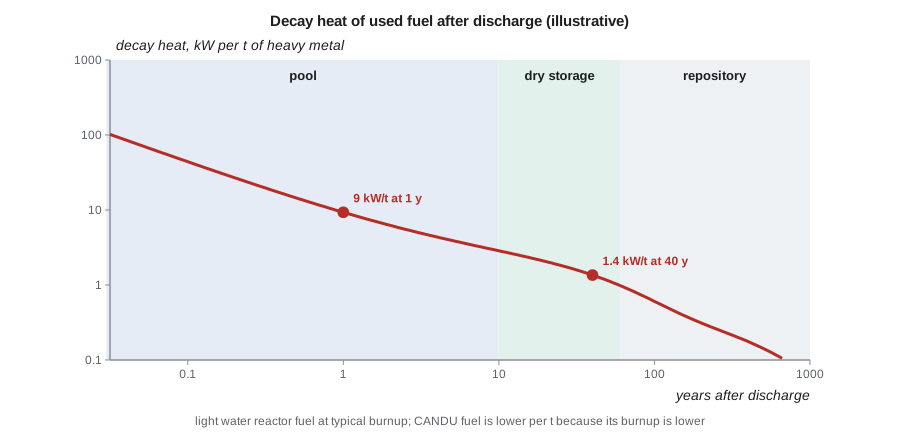
The program shows the steep early drop and the long tail. After one month the reactor core still produces about five megawatts; after ten years, about two hundred kilowatts. Spread over a reactor's worth of fuel, a few hundred kilowatts is modest, but it is concentrated in a small volume of dense material, so storage designs must still carry it away. A typical light water reactor assembly ten years out of the reactor produces roughly a kilowatt, and a CANDU bundle a few watts.
Radioactivity and radiotoxicity
The total activity of used fuel follows a similar pattern. For the first century or so, caesium-137 and strontium-90 and their short-lived daughters dominate both activity and gamma radiation. After a few hundred years they have decayed by a large factor, and the remaining activity is dominated by the actinides, plutonium and americium, and their decay chains. Those decay slowly: plutonium-239 has a half-life of about 24 000 years.
Activity alone is not the best measure of hazard, because different nuclides deliver very different doses if they are ingested or inhaled. Radiotoxicity weights each nuclide's activity by a dose coefficient to give the dose that would result if it were ingested. It is a measure of potential hazard, not of actual risk, because it ignores whether the material can reach people. A common comparison is with the radiotoxicity of the natural uranium ore that was mined to make the fuel. For once-through light water reactor fuel, the radiotoxicity falls to the level of that ore after something like a hundred thousand years, with the actinides responsible for the long tail. Separating and recycling the actinides, as lesson 7 discusses, would shorten that time, though not remove the need for long isolation.
Worked problem
Caesium-137 decay
Caesium-137 has a half-life of 30.1 years. What fraction remains after 100 years and after 300 years?
Show solution
- Fraction remaining = 2^(−t/30.1).
- After 100 years: 2^(−3.32) = 0.100.
- After 300 years: 2^(−9.97) = 0.00099.
Answer: About 10 percent remains after a century and about 0.1 percent after three centuries, which is why fission product heat and gamma dominate only the first few hundred years.
Physical condition of used fuel
Used fuel is also physically changed. Pellets crack during the first heat-up and continue to restructure. Fission gases, mainly xenon and krypton, partly escape from the pellets into the gap and plenum, raising the internal pressure of the rod. The cladding has corroded slightly on the outside and absorbed some hydrogen. High-burnup pellets develop a porous rim with fine grains. These changes matter for storage and transport, because the cladding remains an important barrier, and regulators require evidence that it will not be damaged during drying, storage and handling. Hydride reorientation, in which hydrogen in the cladding precipitates as radial platelets on cooling under stress, is one mechanism studied closely for high-burnup fuel.
CANDU fuel is less demanding in this respect because of its low burnup and modest internal pressure. Decades of experience in CANDU dry storage containers show bundles in good condition. Canada's used fuel inventory is large in number of bundles, more than three million, but each bundle is small and has a low heat output after a few years of cooling, which makes it relatively easy to store dry and to package for disposal.
Radiation fields from used fuel
Freshly discharged fuel produces intense gamma and neutron radiation. Standing unshielded within a metre of a recently discharged assembly would give a lethal dose in seconds to minutes. The gamma radiation comes mainly from fission products such as caesium-137 with its daughter barium-137m, cobalt-60 in structural materials, and, at early times, many shorter-lived nuclides. Neutrons come mainly from spontaneous fission of curium-244 and from reactions of alpha particles with oxygen. Over the decades, the gamma field falls as the medium-lived fission products decay, and after several hundred years the fuel's radiation field is much lower, though still well above levels that would allow unshielded handling.
This radiation affects every step of the back end. Fuel must be handled remotely and under water or in shielded casks; transport casks must limit dose rates at their surfaces and at two metres to values set by transport regulations; and storage facilities must keep doses to workers and the public as low as reasonably achievable. The radiation field also provides some protection against theft, a point that matters in the non-proliferation discussion of lesson 12.
Changes inside the fuel during irradiation
Irradiation changes the fuel's physical structure as well as its composition. Uranium dioxide pellets crack during the first rise to power because of thermal stresses. At high burnup, a porous region called the rim structure forms at the outer edge of light water reactor pellets, where plutonium builds up most and the local burnup is highest. Some fission products, such as caesium and iodine, migrate towards cooler regions, and a fraction of the fission gases is released into the gap and plenum. Others, such as molybdenum, ruthenium and palladium, form small metallic particles in the fuel. These changes affect how the fuel behaves in storage and in a repository: the fraction of radionuclides in the gap and at grain boundaries can be released quickly if the cladding fails and water reaches the fuel, while the rest is released only as the uranium dioxide matrix slowly dissolves.
CANDU fuel reaches a much lower burnup than light water reactor fuel, so its changes are smaller. Its fission gas release is low, and the rim structure seen in high-burnup fuel is largely absent. For repository safety assessments, the NWMO uses an instant release fraction, the share of certain nuclides assumed to be released immediately if a container fails, based on measurements of CANDU fuel.
| Change | Cause | Importance for the back end |
|---|---|---|
| Pellet cracking | thermal stress during operation | larger surface area for dissolution |
| Fission gas release | diffusion of xenon and krypton | internal rod pressure during storage |
| Rim structure | high local burnup at the pellet edge | faster release of some nuclides |
| Hydrides in cladding | hydrogen absorbed from coolant corrosion | cladding ductility in storage and transport |
| Metallic particles | insoluble fission products | stable in repository conditions |
Using decay heat data
Engineers rarely rely on simple correlations such as the one in this lesson for licensing work. Instead, they use standards such as ANSI/ANS-5.1 for decay heat soon after shutdown, and depletion and decay codes that track hundreds of nuclides for long cooling times. These tools give the decay heat, radiation source terms and nuclide inventories of each assembly or bundle from its known irradiation history, and their results are validated against measurements, such as calorimeter tests of real assemblies carried out in Sweden. The simple correlation is useful for understanding trends and for quick estimates, as the earlier code showed.
Worked problem
Heat from a full pool
A pool holds fuel discharged over 15 years. On average, the fuel produces 2 kW per tonne of heavy metal, and the pool holds 1200 t. What is the total heat load the pool cooling system must remove?
Show solution
- Heat = 2 kW per tonne × 1200 t = 2400 kW = 2.4 MW.
Answer: About 2.4 MW, mostly from the most recently discharged fuel. Without cooling, the pool water would heat up steadily, which is why loss of pool cooling is analysed in the safety case and why pools have backup cooling and makeup water.
Common mistakes
MistakeUsed fuel is hazardous for the same length of time in every respect.
InsteadHeat and gamma radiation fall by large factors within a few hundred years; long-term radiotoxicity is dominated by actinides.
MistakeRadiotoxicity measures actual risk.
InsteadIt measures potential hazard if ingested; risk depends on whether material can reach people.
MistakeDecay heat stops a few days after shutdown.
InsteadIt falls quickly but continues for centuries at decreasing levels.
Summary and key terms
- Used fuel contains fission products, actinides and activation products, but is still about 95 percent uranium.
- Decay heat starts at about six percent of full power and falls by orders of magnitude over decades.
- Caesium-137 and strontium-90 dominate heat and gamma for about three centuries.
- Actinides dominate long-term radiotoxicity.
- Cladding condition matters for storage, especially for high-burnup fuel.
- Decay heat
- Heat produced by radioactive decay after a reactor shuts down.
- Radiotoxicity
- Activity weighted by ingestion dose coefficients; a measure of potential hazard.
- Minor actinides
- Neptunium, americium and curium formed in fuel.
- Fission products
- The nuclides formed when heavy nuclei fission.
- Activation products
- Nuclides formed when structural materials absorb neutrons.
- Way-Wigner formula
- An empirical expression for decay heat after shutdown.
Practice problems
Work each problem on paper first, then reveal the answer to check.
Which nuclides dominate decay heat between about 10 and 300 years?
Show answer
Caesium-137 and strontium-90 and their daughters.
Using Way-Wigner, roughly what fraction of full power is decay heat one day after a long run?
Show answer
About 0.5 percent.
Why is radiotoxicity compared with that of the original ore?
Show answer
It gives a reference point for when the potential hazard falls to a natural level.
What is hydride reorientation?
Show answer
Precipitation of hydrogen in cladding as radial platelets on cooling under stress, which can embrittle it.
Why does higher burnup increase decay heat per tonne?
Show answer
More fission products and actinides are present per tonne of heavy metal.
Lesson quiz · 5 questions
Score 60% or more to complete this lesson.
Create a free account to save your progress, take quizzes and earn a certificate.