
NUC-420 · Lesson 4 of 12 · 22 min
Fuel fabrication
Hana spends a week at a CANDU fuel plant with a quality assurance auditor from Meridian. The plant presses uranium dioxide powder into pellets the size of a fingertip, loads them into thin zirconium alloy tubes and assembles thirty-seven of those elements into a bundle about half a metre long. "Every bundle that leaves here will sit in a pressure tube at full power for months," the auditor tells her. "If one element leaks, the station sees it within hours. Our job is to make sure that almost never happens."
From powder to pellet
Fuel fabrication turns purified uranium into a precisely engineered product. For enriched fuel, the first step is to convert enriched uranium hexafluoride back to uranium dioxide powder, usually by a dry process that reacts the gas with steam and hydrogen. Natural uranium for CANDU fuel arrives as uranium dioxide powder from the conversion plant. The powder is blended for uniform properties, pressed into cylindrical pellets in high-speed presses, and sintered in hydrogen furnaces at about 1700 °C to form a dense ceramic with about 95 percent of the theoretical density. The pellets are then ground to a precise diameter, inspected and dried.
The ceramic form matters. Uranium dioxide has a very high melting point, around 2800 °C, is chemically stable in hot water, and retains most fission products inside its crystal grains. Its main weakness is low thermal conductivity, which makes the centre of a pellet much hotter than its surface in a reactor, as the thermal hydraulics course explained. Pellet density, grain size, chamfers and dishes on the ends are all controlled to manage swelling and fission gas release, and some fuel uses small additions, such as chromia, to enlarge the grains.
Cladding and assembly
Finished pellets are loaded into tubes made of a zirconium alloy, chosen because zirconium absorbs few neutrons and resists corrosion in hot water. The tubes are filled with helium, sealed by welding end caps, and leak-tested. The sealed tube, called a fuel element or fuel rod, is the second of the barriers in defence in depth, after the pellet itself. Elements or rods are then assembled into the fuel unit the reactor uses, with spacers, end plates or grids holding them in a precise geometry so that coolant can flow between them.
| Feature | CANDU 37-element bundle | PWR 17 × 17 assembly |
|---|---|---|
| Length | about 0.5 m | about 4 m |
| Number of elements or rods | 37 | 264 fuel rods plus guide tubes |
| Uranium per unit | about 19 kg | about 0.45 t |
| Enrichment | natural, 0.71 percent | about 3 to 5 percent |
| Cladding | thin Zircaloy-4, collapsible | Zircaloy-4, ZIRLO or M5 |
| Time in reactor | about 12 to 18 months | about 4 to 6 years |
| Discharge burnup | about 7.5 GWd per tonne | about 45 to 60 GWd per tonne |
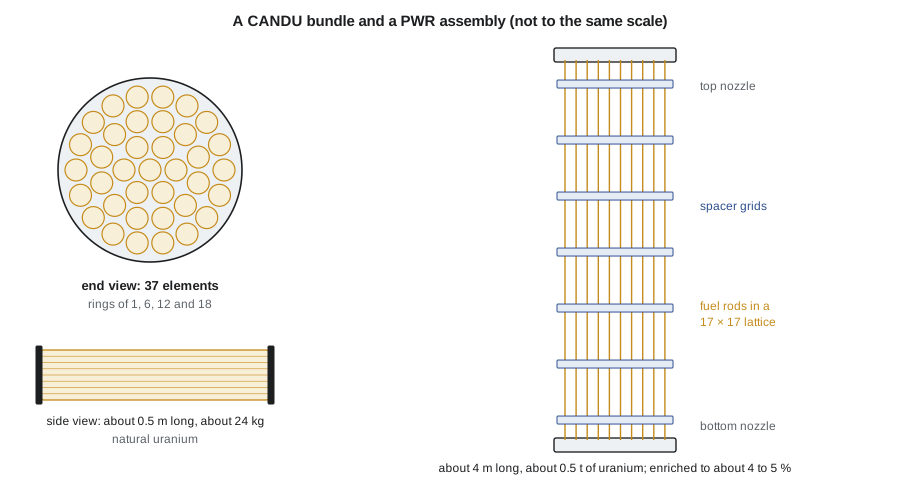
In Canada, CANDU fuel is made by BWXT Nuclear Energy Canada at Toronto and Peterborough and by Cameco Fuel Manufacturing at Port Hope. The bundle design is simple and robust: short elements with thin cladding that collapses onto the pellets under coolant pressure, brazed spacers and bearing pads, and end plates welded to the elements. The simplicity helps keep fuel costs low, and it suits on-power refuelling, where bundles are pushed through the channel by the fuelling machines.
# Energy content of a fuel bundle and an assembly at their discharge burnups.
# Masses and burnups are rounded public values used for illustration.
fuels = [("CANDU 37-element bundle", 19.2, 7500),       # kg U, MWd per t U
         ("PWR 17x17 assembly", 460.0, 50000)]
eff = 0.33
for name, kgU, bu in fuels:
    heat_MWd = kgU / 1000 * bu
    elec_MWh = heat_MWd * 24 * eff
    homes = elec_MWh / 10.0       # an average home uses roughly 10 MWh per year
    print(f"{name:26s} heat {heat_MWd:8.0f} MWd  electricity {elec_MWh:9.0f} MWh  ~{homes:6.0f} home-years")
fissions_per_MWd = 1e6 * 86400 / (200e6 * 1.602e-19)
print(f"one MWd of heat corresponds to about {fissions_per_MWd:.2e} fissions")
print("about 1 g of heavy metal is fissioned for each MWd of heat")CANDU 37-element bundle heat 144 MWd electricity 1140 MWh ~ 114 home-years PWR 17x17 assembly heat 23000 MWd electricity 182160 MWh ~ 18216 home-years one MWd of heat corresponds to about 2.70e+21 fissions about 1 g of heavy metal is fissioned for each MWd of heat
The output shows why the two industries look so different. A CANDU bundle delivers about 1100 megawatt-hours of electricity, enough for about a hundred homes for a year, and a large station uses tens of thousands of bundles a year. A PWR assembly delivers more than 150 times as much, and a reactor loads fewer than a hundred new assemblies per refuelling. Both numbers are large compared with fossil fuels: a single CANDU bundle replaces several hundred tonnes of coal.
Quality assurance
Fuel fabrication is a precision manufacturing business governed by nuclear quality assurance programs. Pellet dimensions, density and enrichment are checked by sampling; cladding tubes are inspected ultrasonically for defects; welds are inspected by radiography or ultrasonic methods; rods are leak-tested with helium; and finished assemblies are checked for dimensions and straightness. Each unit carries a serial number that links it to the records of every batch of powder and every inspection. The aim is a failure rate in the reactor of a few units per million or fewer, and modern plants achieve it.
Fuel defects matter because a leaking element releases fission gases and iodine into the coolant, raising radiation fields and requiring the defective bundle to be located and removed. CANDU stations can find and discharge a defective bundle while operating, which is one advantage of on-power refuelling. Common historical causes of defects include debris fretting, manufacturing flaws, and stress corrosion cracking during power increases, which CANDU fuel designers address with a graphite coating on the inside of the cladding.
Mixed oxide and advanced fuels
Some fuel plants make mixed oxide fuel, called MOX, in which plutonium recovered from used fuel is combined with depleted or natural uranium to replace enriched uranium. MOX is made in France and used in reactors in France and a few other countries. Its fabrication must be done in sealed glove boxes because plutonium is an alpha emitter that is hazardous if inhaled, and it is subject to strict security. MOX is discussed further in lesson 7. Other advanced fuels include the accident-tolerant fuels covered in the materials course, metallic fuels for fast reactors, and the TRISO particle fuel used in high-temperature gas reactors, which needs HALEU.
Worked problem
Pellets in a bundle
A CANDU fuel element contains 30 pellets, each 12.2 mm in diameter and 16.4 mm long, at a density of 10.6 g/cm³ of uranium dioxide. How much uranium does a 37-element bundle contain? Uranium is 88.1 percent of the mass of uranium dioxide.
Show solution
- Pellet volume: π × (0.61 cm)² × 1.64 cm = 1.917 cm³.
- Pellet mass: 1.917 × 10.6 = 20.3 g of uranium dioxide.
- Element: 30 × 20.3 = 610 g; bundle: 37 × 610 = 22.6 kg of uranium dioxide.
- Uranium: 22.6 × 0.881 = 19.9 kg.
Answer: About 20 kg of uranium per bundle, consistent with the rounded value of about 19 kg used elsewhere in this course.
Safety and regulation in fabrication
Fresh low-enriched fuel is only mildly radioactive, and workers can handle sealed fuel assemblies with gloves. The main hazards in a fabrication plant are inhalation of uranium dioxide powder, chemical hazards from uranium hexafluoride and hydrogen, fire, and criticality. Criticality is controlled by limiting the mass, geometry and moderation of enriched material at every step, for example by using favourable-geometry containers and by keeping water away from powder storage. Natural uranium cannot become critical in light water at all, so criticality is a much smaller concern in CANDU fuel plants than in plants handling enriched uranium.
Fuel performance in the reactor
Once loaded, fuel must perform reliably under intense conditions. The centre of a fuel pellet can reach temperatures above 1500 °C while the outside of the cladding is near the coolant temperature of about 300 °C. As burnup increases, the pellet swells, cracks and releases some of its gaseous fission products, mainly xenon and krypton, into the space inside the cladding, raising the internal pressure. The cladding creeps down onto the pellet under the coolant pressure, and the two may come into contact. Fuel designers use computer codes, validated against irradiation tests, to show that fuel stays within its design limits for temperature, internal pressure, cladding strain and corrosion throughout its life.
Fuel defects are now rare. In the 1970s and 1980s, failures caused by pellet-cladding interaction during power changes, hydriding from moisture left inside the rods, and fretting by debris or vibration were more common. Improvements such as graphite coatings inside CANDU sheaths, barrier liners in boiling water reactor cladding, debris filters at the bottom of light water reactor assemblies and better manufacturing controls have reduced failure rates to a few rods per million in the best fleets. When a defect does occur, fission products leak into the coolant and are detected by monitoring systems.
CANDU stations can remove a defective bundle while the reactor is at power, using the fuelling machines, so a defect has little effect on operation. Delayed neutron and gaseous fission product monitors identify the channel with the failed bundle.
Accident tolerant fuels
After the Fukushima accident, in which the zirconium cladding reacted with steam at high temperature and produced large amounts of hydrogen, the industry and governments began developing accident tolerant fuels. These aim to give operators more time in a severe accident by slowing the cladding's reaction with steam and keeping the fuel intact at higher temperatures. Near-term options include zirconium cladding coated with a thin layer of chromium, and pellets doped with chromium oxide to improve their behaviour. Longer-term options include cladding made of iron-chromium-aluminium alloys or silicon carbide composites.
In Canada, research on enhanced CANDU fuels has looked at similar coatings and at fuels that could reach higher burnups. CANDU fuel bundles are small and cheap, so new designs can be tested in power reactors relatively easily, a few bundles at a time.
| Concept | Main benefit | Status |
|---|---|---|
| Chromium-coated zirconium cladding | slower reaction with steam, less hydrogen | lead test rods in commercial reactors |
| Doped uranium dioxide pellets | better fission gas retention | in commercial use in some reactors |
| Iron-chromium-aluminium cladding | much slower oxidation at high temperature | testing |
| Silicon carbide composite cladding | very high temperature resistance | research and development |
Worked problem
Fuel cost per unit of electricity
A light water reactor fuel assembly costs about 1.6 million dollars including uranium, conversion, enrichment and fabrication. It produces about 1.8 × 10⁵ MWh of thermal energy, and the plant converts heat to electricity at 33 % efficiency. What is the fuel cost per megawatt-hour of electricity?
Show solution
- Electricity = 0.33 × 1.8 × 10⁵ = 5.9 × 10⁴ MWh.
- Cost per MWh = 1 600 000 ÷ 59 000 = 27 dollars.
Answer: About 27 dollars per megawatt-hour, a modest share of the total cost of nuclear electricity, most of which is the capital cost of the plant.
Transport and receipt of new fuel
New fuel is only mildly radioactive and can be handled without heavy shielding, so its transport is simpler than that of used fuel. CANDU bundles are packed in boxes and shipped by truck from the fabrication plants to the stations. Light water reactor assemblies are shipped in robust containers designed to protect them from damage, because even small bends or scratches can lead to rejection. At the station, each bundle or assembly is inspected on receipt, its identity checked against the records, and it is stored in a new fuel storage area until it is needed. These records begin the accounting trail that follows the fuel through the reactor and into storage, as lesson 12 describes.
Fuel fabrication is also where the cycle's quality culture is most visible. Every pellet lot, tube and weld is traceable to its raw materials, test records and inspectors, so that if a problem appears in a reactor years later, its cause can be traced back. This traceability is required by regulators in both countries and by the quality assurance standards used across the nuclear industry.
Common mistakes
MistakeFresh fuel is as radioactive as used fuel.
InsteadFresh fuel is only mildly radioactive; used fuel is millions of times more radioactive because of fission products.
MistakeA pellet's centre and surface are at similar temperatures in a reactor.
InsteadLow thermal conductivity makes the centre far hotter than the surface.
MistakeFuel defects are unavoidable and frequent.
InsteadWith good quality assurance and debris control, modern failure rates are a few per million rods or fewer.
Summary and key terms
- Fabrication converts uranium to uranium dioxide pellets, seals them in zirconium alloy cladding and assembles bundles or assemblies.
- CANDU bundles are short, light and natural uranium; PWR assemblies are long, heavy and enriched.
- Quality assurance and traceability keep in-reactor failure rates very low.
- MOX fuel uses recycled plutonium and is made in sealed glove boxes.
- Criticality and powder inhalation are the main hazards in plants handling enriched uranium.
- Sintering
- Heating pressed powder to form a dense ceramic.
- Cladding
- The sealed metal tube that contains the fuel pellets.
- Fuel bundle
- The CANDU fuel unit of 37 short elements.
- Fuel assembly
- The light water reactor fuel unit of several hundred rods held by grids.
- MOX
- Mixed oxide fuel of plutonium and uranium dioxide.
- Criticality safety
- Controls that keep fissile material from forming a self-sustaining chain reaction.
Practice problems
Work each problem on paper first, then reveal the answer to check.
Why is uranium dioxide used as the fuel material?
Show answer
It has a very high melting point, is stable in hot water and retains most fission products.
Why can CANDU stations remove a defective bundle while operating?
Show answer
On-power refuelling lets the fuelling machines locate and discharge it without a shutdown.
How much electricity does a PWR assembly at 50 GWd per tonne and 0.46 t deliver at 33 percent efficiency?
Show answer
About 1.8 × 10⁵ MWh.
Name one common cause of fuel rod failure.
Show answer
Debris fretting, grid-to-rod fretting, manufacturing flaws or pellet-cladding interaction.
Why is criticality less of a concern in a CANDU fuel plant?
Show answer
Natural uranium cannot become critical in light water.
Lesson quiz · 5 questions
Score 60% or more to complete this lesson.
Create a free account to save your progress, take quizzes and earn a certificate.