
NUC-420 · Lesson 8 of 12 · 22 min
Waste classification
Hana's next task is to help sort the waste inventory for a refurbishment project at Darlington. The list runs to hundreds of lines: protective clothing, filters, ion-exchange resins, cut-up pressure tubes, calandria tubes and end fittings. "Every item has to go into a class," Amara says, "because the class decides how it is packaged, where it is stored and what kind of facility it will end up in. Get the class wrong and you either spend far too much on something harmless or put something hazardous where it does not belong."
Why classify waste
Radioactive waste varies enormously. Some is barely distinguishable from ordinary rubbish; some is so radioactive that it must be handled remotely and generates enough heat to need cooling. Classification groups wastes with similar hazards so that each group can be managed in a way that matches the risk. The main factors are how radioactive the waste is, which is measured by its activity concentration in becquerels per gram, how long its hazard lasts, which depends on the half-lives of the nuclides it contains, and whether it produces significant heat.
A useful principle is that the disposal facility must isolate the waste for as long as it remains hazardous. Waste that decays to harmless levels in a few decades can go into a near-surface facility designed to last a few hundred years. Waste containing long-lived nuclides at significant concentrations needs a deeper facility, and high-level waste and used fuel need a deep geological repository that isolates them for hundreds of thousands of years.
The IAEA scheme
The IAEA's General Safety Guide GSG-1, Classification of Radioactive Waste, published in 2009, defines six classes that many countries use as a reference. Exempt waste meets the criteria for clearance and can be released from regulatory control. Very short-lived waste can be stored for a few years until it decays and then cleared; it typically comes from medicine and research. Very low-level waste has slightly more activity and can go to a landfill-type facility with limited controls. Low-level waste contains limited amounts of long-lived nuclides and can go to engineered near-surface facilities. Intermediate-level waste contains enough long-lived nuclides that it needs greater isolation, typically at depths of tens to hundreds of metres, but produces little heat. High-level waste is so radioactive that its decay heat must be considered in disposal design; it goes to a deep geological repository.
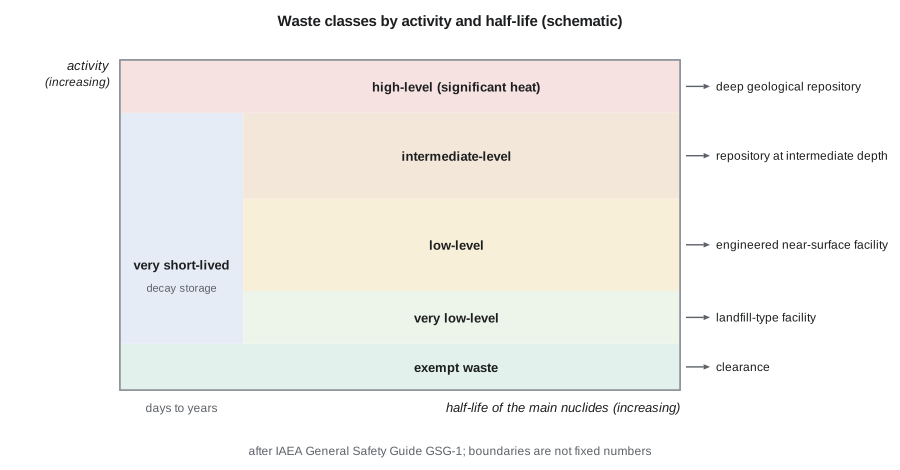
Canada follows a scheme close to the IAEA one. The CSA standard N292.0, General principles for the management of radioactive waste and irradiated fuel, and the CNSC's regulatory document REGDOC-2.11.1 describe the classes: low-level waste, including very short-lived and very low-level waste; intermediate-level waste; high-level waste, which in Canada essentially means used fuel; and uranium mine and mill waste, which forms its own category because of its large volume and low activity concentration. The federal Policy for Radioactive Waste Management and Decommissioning, updated in 2023, sets out the roles of government and waste owners.
Classification in practice
In practice, classification depends on the nuclides present and their concentrations, which are found by measurement, sampling and calculation. Many difficult-to-measure nuclides, such as nickel-63, carbon-14 or technetium-99, are estimated from easily measured key nuclides such as cobalt-60 or caesium-137 using scaling factors derived from sampling. Waste generators then compare the inventory with the acceptance criteria of a storage or disposal facility.
# Clearance and classification by activity concentration (illustrative thresholds, Bq per gram).
# Real limits depend on the nuclide and the national rules; this shows the logic only.
waste = [("lab gloves and paper", 0.3), ("ion-exchange resin", 4e4),
         ("pressure tube section", 3e6), ("used fuel", 1e10)]
def classify(a):
    if a < 1: return "clearance level: may be released from regulatory control"
    if a < 1e3: return "very low-level waste"
    if a < 1e5: return "low-level waste"
    if a < 1e8: return "intermediate-level waste (needs shielding, long-lived content)"
    return "high-level waste or used fuel (heat-generating)"
for name, a in waste:
print(f"{name:24s} {a:9.1e} Bq/g -> {classify(a)}")lab gloves and paper 3.0e-01 Bq/g -> clearance level: may be released from regulatory control ion-exchange resin 4.0e+04 Bq/g -> low-level waste pressure tube section 3.0e+06 Bq/g -> intermediate-level waste (needs shielding, long-lived content) used fuel 1.0e+10 Bq/g -> high-level waste or used fuel (heat-generating)
The output places protective clothing at clearance levels, ion-exchange resin in the low-level class, a section of pressure tube in the intermediate class and used fuel in the high-level class. The thresholds in the code are illustrative only. Real criteria use nuclide-specific limits; for example, a waste with a modest concentration of a long-lived alpha emitter may be classed as intermediate even if its total activity is lower than that of a short-lived low-level waste.
| Class | Typical examples | Heat | Disposal route |
|---|---|---|---|
| Exempt or cleared | lightly contaminated paper or metal after decontamination | none | conventional landfill or recycling |
| Very short-lived | medical waste with short half-lives | none | decay storage, then clearance |
| Very low-level | soil and concrete from decommissioning | none | landfill-type facility |
| Low-level | protective clothing, filters, some resins | negligible | engineered near-surface facility |
| Intermediate-level | reactor components, some resins and filters | low | facility at intermediate depth |
| High-level | used fuel, vitrified reprocessing waste | significant | deep geological repository |
Volumes and activity
A striking feature of radioactive waste is the inverse relation between volume and activity. Low-level waste makes up most of the volume of radioactive waste but a tiny fraction of the activity. High-level waste and used fuel make up a small fraction of the volume but almost all of the activity. In the IAEA's global figures, more than 95 % of the volume of solid radioactive waste is very low-level or low-level waste, while high-level waste and used fuel account for well over 95 % of the activity.
In Canada, the Inventory of Radioactive Waste, published by Natural Resources Canada and updated every three years, reports the volumes held by waste owners. Most of the low- and intermediate-level waste by volume is held by AECL and its contractor Canadian Nuclear Laboratories at Chalk River and other legacy sites, and by OPG at the Western Waste Management Facility near the Bruce site. The used fuel inventory, though small in volume, holds most of the activity.
Worked problem
Using a scaling factor
A drum of resin is measured to contain 2.0 × 10⁵ Bq of cobalt-60. Sampling has shown a scaling factor of 0.05 for nickel-63 relative to cobalt-60. Estimate the nickel-63 activity.
Show solution
- Ni-63 activity = scaling factor × Co-60 activity.
- = 0.05 × 2.0 × 10⁵ Bq = 1.0 × 10⁴ Bq.
Answer: About 10 000 Bq of nickel-63. The estimated value is then compared with the acceptance criteria for the disposal facility.
Waste acceptance criteria
Every storage or disposal facility has waste acceptance criteria, which set out what it will accept and in what form. Typical criteria include limits on the total activity and on the concentrations of specific nuclides, the absence of free liquids and of materials that could react, burn or explode, limits on dose rates at the package surface, requirements for the strength and durability of the container, and complete documentation of the contents. A waste generator must show, through measurements and records, that each package meets the criteria before it is shipped. A package that does not meet them must be treated, repackaged or sent elsewhere.
Acceptance criteria link classification to practice. A waste might be low-level by the national scheme but still be refused by a particular facility because it contains too much carbon-14 or a reactive chemical. This is why waste characterisation begins as early as possible, ideally when the waste is created, and why generators keep detailed records that may be needed for decades.
The CNSC requires licensees to keep records of their radioactive waste, and the facilities at the Bruce site, Chalk River and elsewhere have their own acceptance criteria. As the NWMO develops its intermediate-level repository, it will set acceptance criteria that current waste owners must consider when they condition and package their waste.
Mixed and special wastes
Some wastes are both radioactive and chemically hazardous. These mixed wastes, such as contaminated solvents, lead shielding or mercury from old instruments, must meet the rules for both radioactive and hazardous waste, which makes them among the most difficult and expensive to manage. Other special wastes include sealed radioactive sources from medicine and industry, which can have high activity in a very small volume, and naturally occurring radioactive material from industries such as oil and gas, phosphate fertiliser and mineral processing. Sealed sources that are no longer used are returned to their suppliers where possible, and national programs collect disused sources so that they do not become orphan sources outside regulatory control.
Worked problem
Checking a package against acceptance criteria
A facility accepts low-level waste packages with up to 4 × 10⁴ Bq/g of Cs-137 and up to 1 × 10² Bq/g of C-14. A resin drum contains 1.2 × 10⁴ Bq/g of Cs-137 and 250 Bq/g of C-14. Can it be accepted?
Show solution
- Cs-137: 1.2 × 10⁴ is less than 4 × 10⁴, so it meets the limit.
- C-14: 250 is more than 100, so it exceeds the limit.
Answer: No. The drum is within the caesium limit but exceeds the carbon-14 limit, so it must be sent to a facility designed for longer-lived waste or managed in another way. When several nuclides are limited, facilities often use a sum-of-fractions rule, requiring that the sum of each nuclide's concentration divided by its limit be no greater than one.
The sum-of-fractions rule is worth noting because it is widely used. In the example, the fractions are 1.2 × 10⁴ ÷ 4 × 10⁴ = 0.3 for caesium and 250 ÷ 100 = 2.5 for carbon-14, giving a sum of 2.8. Even if the carbon-14 had been just within its limit, the two fractions together could still exceed one. The rule ensures that a package with several nuclides, each close to its limit, does not exceed the overall safety basis of the facility.
| Waste type | Examples | Special difficulty |
|---|---|---|
| Mixed waste | contaminated solvents, lead, mercury | must meet both radioactive and hazardous waste rules |
| Disused sealed sources | cobalt-60 and caesium-137 sources from medicine and industry | high activity in a small volume; security |
| Naturally occurring radioactive material | scale from oil and gas pipes, phosphogypsum | large volumes, often outside nuclear industry |
| Legacy waste | historic research and defence waste | poor records, mixed forms |
Exemption and clearance
Not all material from a nuclear site is radioactive waste. Clearance levels, set by regulators based on IAEA guidance, define the activity concentrations below which material can be released for ordinary use or disposal, because the resulting doses to anyone would be trivial, typically of the order of 10 microsieverts a year. Clearance allows large volumes of decommissioning concrete and metal to be recycled or disposed of conventionally, saving disposal capacity for genuinely radioactive waste. Releasing material requires careful measurement and documentation, and is sometimes contentious with the public even when doses are trivial.
Classification of used fuel
Used fuel occupies a special place in classification. In Canada, Finland and Sweden, which do not reprocess, used fuel is the high-level waste. In countries that reprocess, used fuel is considered a resource until it is reprocessed, and the high-level waste is the vitrified residue. In the United States, used fuel is legally classed as high-level waste for disposal, though it is commonly called spent nuclear fuel. These different definitions matter in international comparisons and treaties, such as the Joint Convention on the Safety of Spent Fuel Management and on the Safety of Radioactive Waste Management, which covers both and requires each party to report regularly on its inventories and programs.
Common mistakes
MistakeWaste class depends only on total activity.
InsteadHalf-lives, specific nuclides and heat output also matter.
MistakeLow-level waste contains most of the activity.
InsteadIt is most of the volume but a small share of the activity.
MistakeThe US and Canadian schemes are identical.
InsteadCanada follows a scheme close to the IAEA's; the US uses origin-based definitions and Classes A, B, C and greater-than-Class C.
Summary and key terms
- Classification groups wastes by hazard and lifetime so each group gets a matching disposal route.
- The IAEA scheme has six classes from exempt to high-level waste.
- Canada uses CSA N292.0 and REGDOC-2.11.1; the US uses origin-based definitions and NRC Classes A, B and C.
- Difficult-to-measure nuclides are estimated with scaling factors.
- Low-level waste is most of the volume; high-level waste and used fuel hold most of the activity.
- Activity concentration
- Activity per unit mass, in becquerels per gram.
- Clearance
- Release of material from regulatory control because its activity is trivial.
- Low-level waste
- Waste with limited long-lived content, suitable for near-surface disposal.
- Intermediate-level waste
- Waste with long-lived content needing deeper disposal but producing little heat.
- High-level waste
- Heat-generating waste, including used fuel, that needs a deep geological repository.
- Scaling factor
- A ratio used to estimate a hard-to-measure nuclide from a key nuclide.
Practice problems
Work each problem on paper first, then reveal the answer to check.
Name the three main factors that decide a waste's class.
Show answer
Activity concentration, half-lives of the nuclides and heat output.
What class would a waste containing long-lived nuclides but little heat usually fall into?
Show answer
Intermediate-level waste.
A drum has 5 × 10⁴ Bq of Cs-137 and a scaling factor of 0.002 for Tc-99. Estimate the Tc-99 activity.
Show answer
100 Bq.
Why is uranium mill waste a separate category in Canada?
Show answer
It has a very large volume and low activity concentration, needing a different management approach.
Where does US transuranic waste go?
Show answer
The Waste Isolation Pilot Plant in New Mexico.
Lesson quiz · 5 questions
Score 60% or more to complete this lesson.
Create a free account to save your progress, take quizzes and earn a certificate.