
NUC-420 · Lesson 12 of 12 · 20 min
Non-proliferation and safeguards
Two IAEA inspectors arrive at Darlington on short notice, and Hana is assigned to accompany the station's safeguards officer while they work. They check the seals on the dry storage containers, review the records of bundles moved from the reactor to the pool, and download data from cameras that watch the fuel transfer route. "The point of all this," the officer tells her, "is that the world does not have to take our word for it. Every bundle is accounted for, and someone independent checks."
The non-proliferation regime
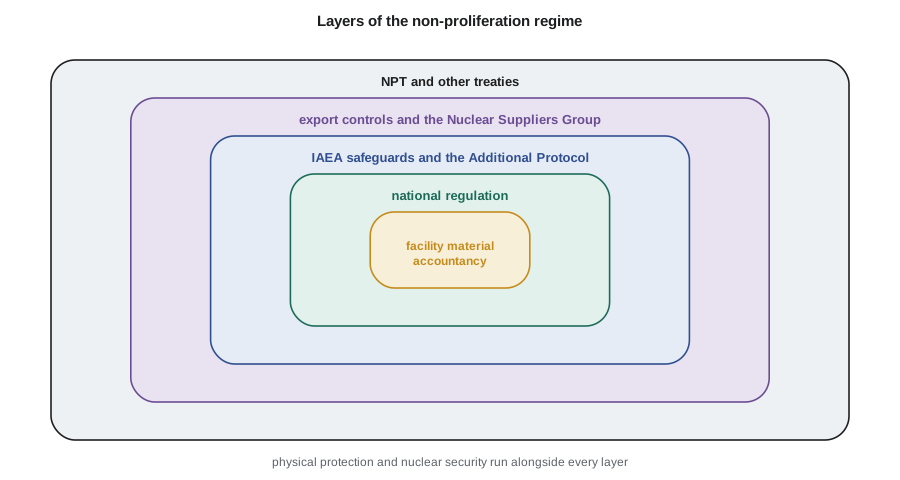
The peaceful use of nuclear energy depends on confidence that civil nuclear materials and facilities are not being used to make nuclear weapons. The international non-proliferation regime provides that confidence through treaties, verification, export controls and physical protection. Its centrepiece is the Treaty on the Non-Proliferation of Nuclear Weapons, the NPT, which opened for signature in 1968 and entered into force in 1970. Almost every country in the world is a party. The treaty recognises five nuclear-weapon states, the United States, Russia, the United Kingdom, France and China, which undertake not to help other states acquire nuclear weapons and to pursue disarmament. Non-nuclear-weapon states undertake not to acquire nuclear weapons and to accept IAEA safeguards on all their nuclear material. All parties have the right to peaceful uses of nuclear energy.
Canada is a non-nuclear-weapon state under the NPT. It was one of the first countries with the technical ability to build nuclear weapons that chose not to, and it has been a strong supporter of the treaty and of the IAEA since their beginnings.
IAEA safeguards
Safeguards are the technical measures the IAEA uses to verify that states are meeting their commitments. Under a comprehensive safeguards agreement, based on the IAEA document INFCIRC/153, a non-nuclear-weapon state declares all its nuclear material and facilities, keeps accounting records and reports to the IAEA, and allows inspectors to verify the declarations. The IAEA's objective is the timely detection of any diversion of significant quantities of nuclear material from peaceful activities, and deterrence of diversion by the risk of early detection.
After it was discovered in 1991 that Iraq had run a secret weapons program at undeclared sites despite inspections at its declared facilities, the IAEA strengthened the system. The Model Additional Protocol, adopted in 1997 as INFCIRC/540, requires states to provide much broader information about their nuclear fuel cycle activities, including mining, research and manufacturing of related equipment, and gives inspectors complementary access to sites at short notice. Together, a comprehensive agreement and an additional protocol allow the IAEA to give assurance not only that declared material has not been diverted but also that there is no undeclared material or activity in the state.
Canada's comprehensive safeguards agreement entered into force in 1972 and its additional protocol in 2000. In 2005, after the IAEA had drawn the broader conclusion that all nuclear material in Canada remained in peaceful activities, Canada moved to integrated safeguards, which use the information from the additional protocol to make inspections more efficient while keeping assurance high. The CNSC is responsible for implementing the agreements in Canada, and its regulatory document REGDOC-2.13.1, Safeguards and Nuclear Material Accountancy, sets the requirements for licensees.
Nuclear material accountancy
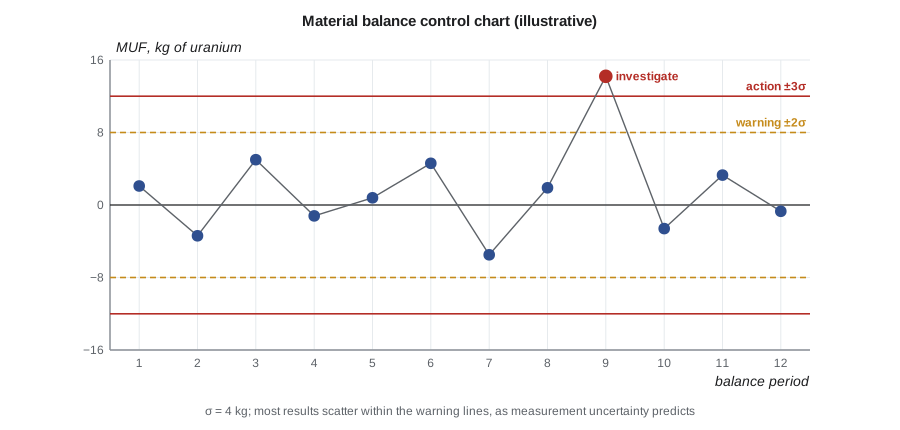
Nuclear material accountancy is the foundation of safeguards. Each facility is divided into material balance areas, and every transfer of nuclear material into or out of an area is measured and recorded. Periodically, the operator takes a physical inventory, measuring all the material present. The difference between the book inventory, which is the beginning inventory plus receipts minus shipments, and the measured physical inventory is called material unaccounted for, or MUF. Because every measurement has some uncertainty, MUF is rarely exactly zero. The question is whether it is consistent with the known measurement uncertainty.
Here I_begin and I_end are the beginning and ending physical inventories, R is the receipts and S is the shipments during the period. The operator and the IAEA each estimate the standard deviation of MUF, written σ_MUF, from the uncertainties of the measurements that went into it. A MUF within about two or three standard deviations is normal; a larger one must be investigated and explained.
# Material balance accounting: inventory difference and its statistical test (illustrative numbers).
# MUF (material unaccounted for) = beginning inventory + receipts - shipments - ending inventory.
begin, receipts, shipments, end = 12000.0, 3500.0, 3400.0, 12095.0    # kg uranium in a fabrication plant
muf = begin + receipts - shipments - end
sigma = 4.0                                                           # kg, combined measurement uncertainty
print(f"MUF = {muf:.1f} kg U   sigma = {sigma:.1f} kg")
z = muf / sigma
print(f"MUF / sigma = {z:.2f}")
print("within normal measurement uncertainty" if abs(z) < 3 else "investigate: larger than expected")
for kg in (5.0, 15.0):
print(f"if MUF were {kg:4.1f} kg the ratio would be {kg/sigma:.2f}")MUF = 5.0 kg U sigma = 4.0 kg MUF / sigma = 1.25 within normal measurement uncertainty if MUF were 5.0 kg the ratio would be 1.25 if MUF were 15.0 kg the ratio would be 3.75
The output shows a MUF of 5 kg of uranium with a combined uncertainty of 4 kg, a ratio of 1.25, which is well within normal measurement variation. A MUF of 15 kg with the same uncertainty would be nearly four standard deviations and would trigger an investigation, which usually finds a measurement error, a recording mistake or material held up in equipment, such as powder in ducts or filters. Plants work to reduce holdup and improve measurements so that their MUF stays small and well understood.
Containment, surveillance and verification
Accountancy is supported by containment and surveillance. Seals placed by the IAEA on containers, casks and equipment show whether they have been opened. Cameras record movements of material at key points. Inspectors verify the operator's records, measure items with portable instruments, take samples for analysis at IAEA laboratories and compare their results with the declarations. Environmental sampling, in which inspectors take swipes from surfaces to look for traces of undeclared activities, is a powerful tool introduced in the 1990s.
CANDU reactors pose a particular safeguards task because they are refuelled on power, so fuel moves in and out of the core continually. The IAEA uses unattended monitoring systems at CANDU stations, including bundle counters on the fuel discharge route and core discharge monitors, together with cameras and seals, to keep continuity of knowledge without stationing inspectors at every station. Used fuel in dry storage containers is sealed and periodically verified. The IAEA has also developed methods to verify fuel before it is transferred to the repository, where it will become inaccessible.
| Measure | Purpose | Examples |
|---|---|---|
| Material accountancy | track all nuclear material | material balance areas, physical inventories, MUF evaluation |
| Containment | show that material has not been accessed | tamper-indicating seals on casks and containers |
| Surveillance | record movements | cameras and unattended monitors |
| Inspection | verify declarations | item counting, measurements, sampling |
| Additional Protocol | detect undeclared activities | expanded declarations, complementary access |
| Environmental sampling | detect traces of undeclared activities | surface swipes analysed in laboratories |
Export controls and physical protection
Safeguards are complemented by export controls. The Nuclear Suppliers Group, formed in 1974 after India's nuclear test, coordinates national export controls on nuclear materials, equipment and technology, and on dual-use items, so that exports go only to states with safeguards in place. Physical protection is a separate obligation: under the Convention on the Physical Protection of Nuclear Material, strengthened by an amendment that entered into force in 2016, states must protect nuclear material and facilities against theft and sabotage, with stronger protection for more sensitive material.
Canada's nuclear non-proliferation policy, in place since 1974, requires that countries buying Canadian uranium, equipment or technology be parties to the NPT or otherwise accept full-scope safeguards, and sign a bilateral nuclear cooperation agreement with Canada. These agreements give Canada rights over the reprocessing, enrichment above 20 % or retransfer of Canadian-origin material. The Nuclear Non-proliferation Import and Export Control Regulations, administered by the CNSC, implement the controls.
Safeguards and the future fuel cycle
New technologies bring new safeguards tasks. Advanced reactors using HALEU, small modular reactors deployed in many places, and possible recycling facilities will all need safeguards designed in from the start, an approach called safeguards by design. A deep geological repository raises its own questions, because the fuel inside will become inaccessible: the IAEA and national authorities are developing methods to verify the fuel before emplacement and to monitor the site so that no undeclared excavation takes place. Finland's ONKALO and Sweden's Forsmark repository are the first to apply these methods.
Worked problem
Evaluating a material balance
A fabrication plant starts a period with 8200 kg of uranium, receives 2400 kg and ships 2350 kg. The ending physical inventory is 8238 kg, and σ_MUF is 6 kg. Is the MUF within normal limits?
Show solution
- Book inventory = 8200 + 2400 − 2350 = 8250 kg.
- MUF = 8250 − 8238 = 12 kg.
- MUF ÷ σ_MUF = 12 ÷ 6 = 2.0.
Answer: The MUF is two standard deviations, within normal limits but large enough that the plant would review its measurements and holdup.
The role of the national regulator
States implement safeguards through a national system of accounting for and control of nuclear material. The national authority keeps a central record of all nuclear material in the country, receives reports from facilities, carries out its own inspections, and sends the required reports and declarations to the IAEA. It also coordinates the IAEA's inspections and complementary access visits, and ensures that inspectors have the access, visas and support they need. A strong national system makes the IAEA's work more efficient and gives the state credibility.
In Canada, the CNSC's safeguards division performs this role. Licensees must have a safeguards program, provide accounting reports, allow IAEA and CNSC inspectors access, install and maintain IAEA equipment and give the CNSC early information about design changes that could affect safeguards. The CNSC also licenses imports and exports of nuclear material and checks that each shipment is covered by an appropriate agreement.
Nuclear security
Safeguards address diversion by states; nuclear security addresses theft and sabotage by individuals or groups. The two are related but separate. Nuclear security includes physical protection of facilities and materials in use, storage and transport, protection of sensitive information and computer systems, detection of nuclear material out of regulatory control, and response to incidents. Physical protection is graded: the most sensitive materials receive the strongest protection, with layers of barriers, detection systems, armed response forces and strict personnel screening. The IAEA's Nuclear Security Series provides guidance, and states report trafficking incidents to its Incident and Trafficking Database.
In Canada, the Nuclear Security Regulations made under the Nuclear Safety and Control Act set physical protection requirements for high-security sites, including nuclear power stations, and require on-site nuclear response forces. The CNSC also regulates the security of radioactive sealed sources.
| Aspect | Safeguards | Nuclear security |
|---|---|---|
| Main concern | diversion by a state | theft or sabotage by individuals or groups |
| Main framework | NPT and IAEA safeguards agreements | CPPNM and its amendment, national laws |
| Verification | IAEA inspections | national regulators; IAEA advisory missions |
| Typical measures | accountancy, seals, cameras, inspections | barriers, guards, access control, cyber security |
Together, safeguards, export controls and nuclear security underpin public and international confidence in the peaceful use of nuclear energy. For engineers working on the fuel cycle, they are part of everyday practice: designing facilities so that material can be measured and verified, keeping accurate records, and supporting the inspectors whose independent checks make that confidence possible.
Safeguards and the repository
Disposal creates a new safeguards question: once used fuel is placed underground and the tunnels are backfilled, it can no longer be inspected. The IAEA's approach is to verify the fuel thoroughly before it is encapsulated, using instruments that measure gamma and neutron signals to confirm that each bundle or assembly is what the records say it is, and to maintain continuity of knowledge, using seals and surveillance, from the encapsulation plant to the placement room. After closure, the site will be monitored, for example by satellite imagery and seismic sensors, to detect any undeclared excavation. Finland's ONKALO is the first repository to apply this approach in practice.
Common mistakes
MistakeSafeguards are designed to stop a determined state by force.
InsteadSafeguards detect and deter diversion; responding to a violation is a matter for the IAEA Board and the UN Security Council.
MistakeA non-zero MUF means material has been diverted.
InsteadMeasurement uncertainty makes small MUFs normal; only an unexplained large MUF needs investigation.
MistakeThe Additional Protocol only adds more inspections at declared facilities.
InsteadIt expands declarations and allows complementary access to detect undeclared activities.
Summary and key terms
- The NPT is the foundation of the non-proliferation regime; non-nuclear-weapon states accept IAEA safeguards on all nuclear material.
- Comprehensive safeguards verify declarations; the Additional Protocol extends assurance to the absence of undeclared activities.
- Material accountancy compares book and physical inventories; MUF is judged against measurement uncertainty.
- Containment, surveillance, inspection and environmental sampling support accountancy.
- Export controls and physical protection complete the regime.
- NPT
- The Treaty on the Non-Proliferation of Nuclear Weapons, in force since 1970.
- Safeguards
- Technical measures used by the IAEA to verify that nuclear material is not diverted.
- Additional Protocol
- An agreement giving the IAEA broader information and access.
- Material balance area
- A defined area in which all transfers of nuclear material are measured.
- MUF
- Material unaccounted for: book inventory minus physical inventory.
- Containment and surveillance
- Seals, cameras and monitors that maintain continuity of knowledge.
Practice problems
Work each problem on paper first, then reveal the answer to check.
What are the two main undertakings of non-nuclear-weapon states under the NPT?
Show answer
Not to acquire nuclear weapons, and to accept IAEA safeguards on all nuclear material.
What led to the Additional Protocol?
Show answer
The discovery in 1991 of Iraq's undeclared weapons program.
Beginning inventory 5000 kg, receipts 1000 kg, shipments 900 kg, ending inventory 5096 kg. What is the MUF?
Show answer
4 kg.
Why are CANDU stations a particular safeguards task?
Show answer
They are refuelled on power, so fuel moves continually; unattended monitors are used.
What does the Nuclear Suppliers Group do?
Show answer
Coordinates national export controls on nuclear and dual-use items.
Lesson quiz · 5 questions
Score 60% or more to complete this lesson.
Create a free account to save your progress, take quizzes and earn a certificate.