
NUC-360 · Lesson 8 of 12 · 20 min
Small modular reactors
Dr. Malik Osei calls the plant systems group together to brief them on a new client: a provincial utility outside Ontario that wants an independent review of small modular reactor options. "OPG is building BWRX-300s at Darlington, and Saskatchewan has picked the same design," he says. "But this client wants to know what else is out there, what is real, and what it might cost. Hana, you will build the comparison table." Hana spends the next two weeks reading licensing documents and vendor papers.
What makes a reactor small and modular
The International Atomic Energy Agency describes small modular reactors as reactors of up to about 300 MWe per unit, designed so that major components can be built in a factory and shipped to the site. Reactors below about 10 to 20 MWe are often called microreactors and are the subject of lesson 12. The idea is not new: early commercial reactors were small, and naval reactors have always been compact. What is new is the attempt to make small reactors economic by changing how they are built, rather than by making them bigger.
Large reactors gained economies of scale: a 1 100 MWe unit does not cost four times as much as a 275 MWe unit. Small modular reactors try to replace economies of scale with economies of series production. If many identical units are built, factory fabrication, standard designs, shorter construction schedules and learning from one unit to the next can lower cost. Smaller units also have smaller decay heat and fission product inventories, which make passive safety easier, and they can fit grids, sites and industrial uses that cannot take a large unit. The challenge is that the first units of each design lose the economies of scale without yet having the economies of series production.
Scaling and learning
A common rough rule for the capital cost of process plants is a power law: total cost grows with size raised to an exponent n of about 0.6 to 0.7. Cost per kilowatt then falls with size. A learning curve describes how the cost of each successive unit falls as more are built: each doubling of the cumulative number of units cuts the unit cost by a fixed fraction, the learning rate.
The program below combines the two effects with illustrative numbers. It is not a cost estimate; real costs depend on design, site, financing, regulation, supply chain and labour, and published figures vary widely. It shows why small modular reactor developers emphasize fleet deployment.
# SMR economics: scaling, learning and factory build (illustrative numbers only).
import math
def scale_cost(P, P_ref=1100.0, C_ref=6000.0, n=0.6):
    """Overnight cost per kWe for a plant of P MWe using a power-law scaling exponent n."""
    total_ref = C_ref * P_ref * 1000
    total = total_ref * (P / P_ref) ** n
    return total / (P * 1000)
for P in (1100, 600, 300, 77):
    print(f"{P:5d} MWe by scaling alone: {scale_cost(P):7.0f} dollars per kWe")
# Learning: each doubling of units built cuts unit cost by a learning rate
def learn(first, units, rate):
    b = math.log2(1 - rate)
    return [first * (k ** b) for k in range(1, units + 1)]
for rate in (0.05, 0.10, 0.15):
    c = learn(scale_cost(300), 8, rate)
print(f"learning rate {rate:4.0%}: unit 1 {c[0]:6.0f}, unit 4 {c[3]:6.0f}, unit 8 {c[7]:6.0f} dollars per kWe")1100 MWe by scaling alone: 6000 dollars per kWe 600 MWe by scaling alone: 7646 dollars per kWe 300 MWe by scaling alone: 10089 dollars per kWe 77 MWe by scaling alone: 17382 dollars per kWe learning rate 5%: unit 1 10089, unit 4 9106, unit 8 8650 dollars per kWe learning rate 10%: unit 1 10089, unit 4 8172, unit 8 7355 dollars per kWe learning rate 15%: unit 1 10089, unit 4 7289, unit 8 6196 dollars per kWe
With scaling alone, a 300 MWe unit costs much more per kilowatt than a 1 100 MWe unit. Learning over eight units at a 10 to 15 percent learning rate recovers a large part of that penalty. Whether real projects achieve such learning is the central economic question for the industry. OPG's published estimates for Darlington show a lower expected cost for the second to fourth units than for the first, in the direction that learning would predict.
Light water small modular reactors
The designs closest to deployment are light water reactors, because they use familiar fuel, materials, codes and regulatory experience. Integral PWRs place the steam generators, pressurizer and sometimes the pumps inside the reactor vessel, eliminating the large primary pipes whose rupture is the design basis accident for large PWRs. Small BWRs simplify the plant further with natural circulation and passive decay heat removal.
| Design | Vendor | Type | Output per unit | Status (2026) |
|---|---|---|---|---|
| BWRX-300 | GE Vernova Hitachi | natural circulation BWR | about 300 MWe | under construction at Darlington; construction permit for Clinch River; selected by SaskPower |
| NuScale US460 | NuScale Power | integral PWR, natural circulation, modules in a shared pool | about 77 MWe per module | NRC standard design approval in 2025 |
| AP300 | Westinghouse | single-loop PWR derived from AP1000 | about 300 MWe | in pre-licensing |
| SMR-300 | Holtec | compact PWR | about 300 MWe | proposed in the United States, in licensing |
| ACP100 (Linglong One) | CNNC | integral PWR | about 125 MWe | under construction in China |
NuScale's design shows how far integration can go. Each module is a tall, slender steel vessel containing the core, helical-coil steam generators and pressurizer, inside a steel containment vessel, and the whole module sits in a large pool of water shared by six modules in the US460 plant, or twelve in the earlier design. Coolant circulates naturally, with no reactor coolant pumps. Decay heat is removed passively, first to the pool and ultimately by boiling the pool water if all other cooling is lost. The original 50 MWe module received NRC design certification in 2023, and the uprated 77 MWe US460 design received standard design approval in 2025.
The BWRX-300 at Darlington is the first grid-scale small modular reactor under construction in a G7 country. The CNSC issued the licence to construct in April 2025, OPG took its final investment decision the following month, and the reactor building basemat was placed in its shaft in April 2026. OPG plans four units, with the first targeted to connect to the grid around the end of 2030. SaskPower has selected the same design for its first nuclear plant, near Estevan, with a first unit targeted in the mid-2030s.
Advanced small modular reactors
Many small modular designs are not light water reactors. High-temperature gas reactors, such as X-energy's Xe-100, use helium coolant and TRISO fuel to reach outlet temperatures near 750 °C, useful for industrial process heat. Sodium-cooled fast reactors, such as TerraPower's Natrium, and molten salt reactors, such as Terrestrial Energy's IMSR and Kairos Power's fluoride salt-cooled design, aim at higher efficiency, low-pressure operation and new fuel cycles. Lessons 9 to 11 cover these technologies as plant systems. Their fuel supply is often different: many need high-assay low-enriched uranium, enriched to between 5 and 20 percent uranium-235, which is not yet produced commercially at scale in North America.
Siting, regulation and deployment
Small modular reactors aim to fit sites that a large reactor cannot: retiring coal plant sites with existing transmission, remote communities, industrial facilities needing steam, and mining operations. Their smaller source term may justify a smaller emergency planning zone, a question both the CNSC and the NRC have addressed in their regulations and guidance for new reactors. Regulators have also worked on how to license factory-built modules and fleets of identical units. The CNSC offers a pre-licensing vendor design review, and the NRC offers design certification, standard design approval and construction permit paths, as well as a newer framework for advanced reactors.
Worked problem
Cost per kilowatt by scaling
A reference 1 100 MWe plant costs 6 000 dollars per kWe. Using a scaling exponent n = 0.6, estimate the cost per kWe of a 300 MWe plant built the same way.
Show solution
- Total reference cost: 6 000 × 1.1 × 10⁶ kW = 6.6 billion dollars.
- Total at 300 MWe: 6.6 × (300/1 100)^0.6 ≈ 6.6 × 0.459 ≈ 3.03 billion dollars.
- Cost per kWe: 3.03 × 10⁹/3.0 × 10⁵ ≈ 10 100 dollars per kWe.
Answer: Scaling alone makes the smaller plant about two thirds more expensive per kilowatt, matching the program; factory production and learning must make up the difference.
Modularity in practice
Modularity has two meanings in the SMR context. The first is the reactor itself as a module: a unit small enough to build in a factory and ship, and to add one at a time as demand grows. The second is modular construction of the plant: building large sections of the plant, such as structural modules, piping assemblies and equipment skids, in a fabrication shop and assembling them on site. Large reactors such as the AP1000 already use modular construction extensively. The BWRX-300 is too large to ship as a complete reactor, but its vessel and many plant sections are fabricated off site, and its below-grade reactor building uses steel-plate composite modules. The NuScale module is designed to be shipped largely complete.
Experience has shown that the benefits of modular construction depend on a mature design and supply chain. Several recent large projects in Europe and the United States suffered major cost overruns and delays, partly because designs were not complete when construction started and modules arrived late or needed rework. SMR developers emphasize completing detailed design before construction, using standard designs without site-specific changes, and building several units in a row. OPG's approach at Darlington, licensing a single site for four identical units and coordinating with other utilities deploying the same design, follows this logic.
Non-electric applications
Smaller reactors are well matched to uses other than grid electricity. District heating, as studied in MEC-440 for the Northgate district energy system, needs heat at modest temperature near cities. Desalination needs heat and electricity near coasts. Industrial process steam is needed by chemical plants, refineries and oil sands operations. Hydrogen production by electrolysis or, at higher temperatures, by thermochemical cycles could use nuclear heat and power. Each application favours different designs: light water SMRs suit district heat and electricity, while high-temperature designs suit industrial steam and hydrogen.
Supply chain and fuel
A fleet of SMRs needs a supply chain able to make reactor vessels, steam generators, fuel and instrumentation in series. For light water SMRs, fuel is similar to existing LWR fuel and can come from existing fabrication plants. For advanced SMRs, high-assay low-enriched uranium production is a bottleneck: enrichment capacity above 5 percent is limited outside Russia, and the United States and allied countries have programs to establish domestic production. Canada's SMR Action Plan and the US Department of Energy's advanced reactor programs both address supply chain readiness.
Comparing designs fairly
Hana's comparison table has to compare designs at very different levels of maturity. A design under construction with a regulatory licence has detailed cost estimates and a known schedule risk. A design in pre-licensing has preliminary estimates that are usually optimistic, because many costs only appear in detailed design. Malik asks her to add columns for licensing status, fuel availability and supply chain readiness, and to present costs as ranges with their sources, rather than single numbers. He also asks her to separate first-of-a-kind costs from the costs expected for later units, because a client that builds one unit pays the first-of-a-kind price.
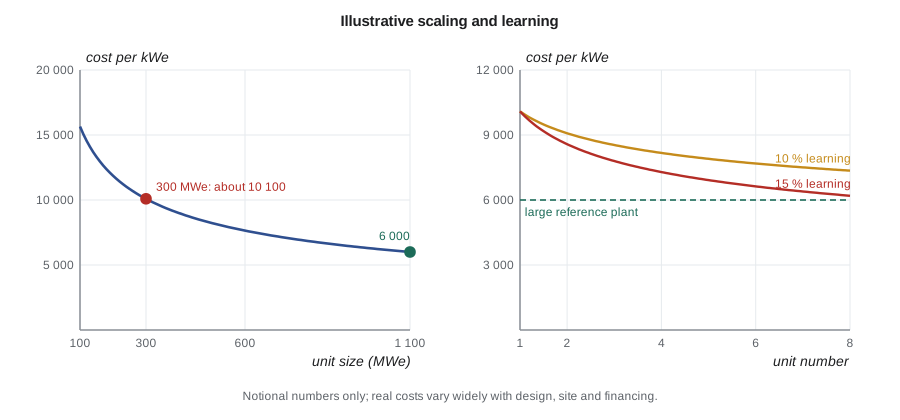
The figure shows the two effects together. The left curve is the penalty of small size; the right curves show how far learning must go to recover it. Hana notes in her table that the learning rates seen in real nuclear construction programs have varied widely, from strong cost reductions in some national fleets built with standard designs and stable teams to cost increases in others where regulation, design and supply chains changed between units. A fleet strategy only delivers learning if the design, the supply chain and the construction teams stay the same from one unit to the next.
Common mistakes
MistakeSmall modular reactors are cheaper per kilowatt because they are small.
InsteadScaling works against small units; any cost advantage must come from series production, simplification and learning.
MistakeAll small modular reactors are light water reactors.
InsteadMany are gas-cooled, sodium-cooled or molten salt designs.
MistakeSMRs need no regulatory review because they are small.
InsteadThey are licensed by the same regulators, with paths adapted for new designs and fleets.
Summary and key terms
- Small modular reactors are up to about 300 MWe per unit, built largely in factories.
- They replace economies of scale with economies of series production and learning.
- Integral PWRs and natural circulation BWRs are closest to deployment.
- The BWRX-300 is under construction at Darlington and planned at Clinch River and in Saskatchewan.
- Advanced SMRs often need high-assay low-enriched uranium.
- Small modular reactor
- A reactor of up to about 300 MWe per unit designed for factory fabrication.
- Integral PWR
- A PWR with its steam generators and pressurizer inside the reactor vessel.
- Learning rate
- The fractional reduction in unit cost each time cumulative production doubles.
- Scaling exponent
- The exponent relating total plant cost to size in a power-law cost model.
- HALEU
- High-assay low-enriched uranium, enriched to between 5 and 20 percent uranium-235.
- Standard design approval
- An NRC approval of a reactor design that can be referenced in later applications.
Practice problems
Work each problem on paper first, then reveal the answer to check.
Why do small reactors lose economies of scale?
Show answer
Total cost grows less than proportionally with size, so cost per kilowatt rises as size falls.
What design feature removes the large-break loss-of-coolant accident in integral PWRs?
Show answer
Placing the steam generators and pressurizer inside the vessel, eliminating large primary pipes.
What is a learning rate of 10 percent?
Show answer
Each doubling of units built cuts unit cost by 10 percent.
What is HALEU?
Show answer
Uranium enriched to between 5 and 20 percent uranium-235.
Name two small modular reactor designs that use natural circulation.
Show answer
The BWRX-300 and the NuScale module.
Lesson quiz · 5 questions
Score 60% or more to complete this lesson.
Create a free account to save your progress, take quizzes and earn a certificate.