
NUC-360 · Lesson 12 of 12 · 21 min
Microreactors
The last row in Hana's table is the smallest. A northern mining company has asked the client whether a reactor of a few megawatts could replace the diesel generators that power and heat a remote mine. "Diesel up there is flown or trucked in on winter roads, and it is expensive and carbon-intensive," Malik says. "Microreactors are pitched exactly at that market. Finish the table with them, then write the summary for the client." Hana's summary will draw on every lesson of the rotation.
What a microreactor is
Microreactors are very small reactors, typically from about 1 to 20 MWe, designed to be built entirely in a factory, transported by truck, rail or ship, installed with minimal site work, and run for years without refuelling. Many are designed to need few or no on-site operators, with automatic control and passive safety. Their intended markets are remote communities and mines that now depend on diesel, military bases, data centres, industrial sites needing heat, and disaster recovery. A microreactor is not simply a smaller power plant: it is closer to a sealed piece of equipment that is delivered, operated and eventually returned to the factory with its fuel inside.
Because the core is small, microreactors usually need fuel with higher enrichment than large light water reactors, often high-assay low-enriched uranium up to just under 20 percent uranium-235, and fuel forms that tolerate high temperatures, such as TRISO particles or metal fuel. Their cores are small enough that neutron leakage is large, so reflectors around the core, often beryllium or graphite, and control drums, rotating cylinders with an absorber on one side, are common ways to control reactivity.
| Design or project | Developer | Coolant or heat transport | Fuel | Approximate size |
|---|---|---|---|---|
| eVinci | Westinghouse | sodium heat pipes | TRISO | about 5 MWe, 15 MW thermal |
| Micro Modular Reactor (MMR) | Global First Power proposal | helium, with molten salt heat storage | TRISO in prismatic blocks | about 15 to 45 MW thermal proposed |
| Project Pele prototype | BWX Technologies for the US Department of Defense | helium gas | TRISO | about 1 to 5 MWe |
| MARVEL | Idaho National Laboratory | sodium-potassium | metal fuel | about 85 kW thermal test reactor |
| Other company designs | several developers | sodium or heat pipes | metal or TRISO | about 1 to 15 MWe |
Heat pipe reactors
A heat pipe is a sealed tube containing a working fluid, such as sodium or potassium, and a wick along its inner wall. At the hot end, in the reactor core, the fluid evaporates; the vapour travels to the cold end, where it condenses and releases heat to a heat exchanger; the liquid returns through the wick by capillary action. A heat pipe has no moving parts and carries large amounts of heat with a very small temperature drop. In a heat pipe reactor, hundreds or thousands of heat pipes are embedded in a solid core block, each removing heat from the fuel around it. If some heat pipes fail, their neighbours take up the extra load, and the solid core spreads heat between them.
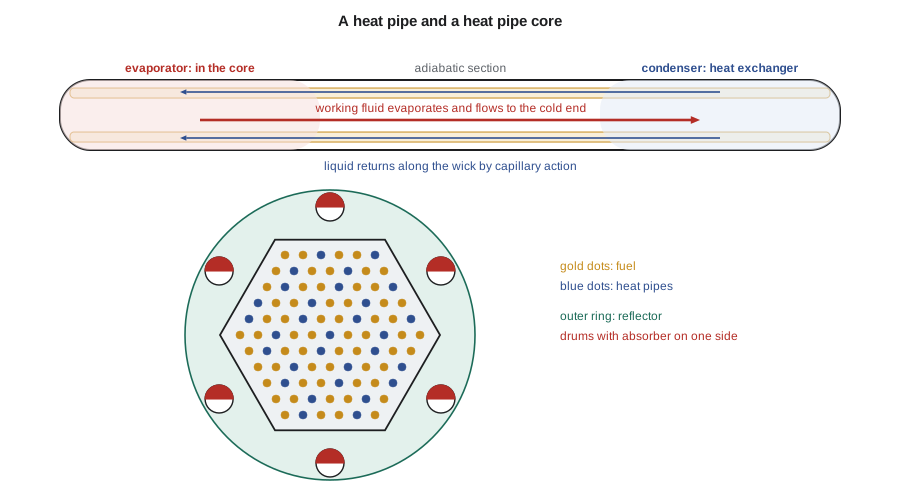
Each heat pipe has a capacity limit set by the rate at which the wick can return liquid and by the vapour speed, and that limit depends on temperature. Designers size the number of heat pipes so that the core can tolerate the loss of a fraction of them while staying within every pipe's limit.
# Heat pipe microreactor: heat pipe count and capacity margin (illustrative).
Q = 15e6                        # W thermal, eVinci-like scale
q_pipe = 15e3                   # W per sodium heat pipe at design temperature (rough)
n = Q / q_pipe
print(f"heat pipes needed at design: {n:5.0f}")
for failed in (0.0, 0.05, 0.10):
    load = q_pipe / (1 - failed)
    print(f"{failed:4.0%} of pipes failed: neighbours each carry {load/1000:5.1f} kW")
# Capacity limit falls if the pipe runs cooler; check margin at 90 percent of design temperature
limit = 25e3
print(f"capacity limit {limit/1000:4.1f} kW: margin at design {limit/q_pipe:4.2f} times")
# Core life: energy released over eight years at full power
E_core = 15e6 * 8 * 365.25 * 86400      # J, eight years at full power
print(f"core energy for eight years at full power: {E_core/3.6e12:6.0f} GWh thermal")heat pipes needed at design: 1000 0% of pipes failed: neighbours each carry 15.0 kW 5% of pipes failed: neighbours each carry 15.8 kW 10% of pipes failed: neighbours each carry 16.7 kW capacity limit 25.0 kW: margin at design 1.67 times core energy for eight years at full power: 1052 GWh thermal
Worked problem
Heat pipe load after failures
A 15 MW thermal core has 1 000 heat pipes, each normally carrying 15 kW. If 10 percent of the pipes fail and their heat is shared evenly by the rest, what does each surviving pipe carry, and is there margin to a 25 kW limit?
Show solution
- Surviving pipes: 900.
- Load per pipe: 15 MW/900 ≈ 16.7 kW.
- Margin: 25/16.7 ≈ 1.5, so each pipe stays well below its limit.
Answer: Even losing a tenth of the heat pipes leaves margin, because the load is spread over many pipes; in reality the neighbours of a failed pipe carry more than the average, which detailed analysis checks.
Gas-cooled and other microreactors
Other microreactors use helium cooling with TRISO fuel, scaled down from the HTGRs of lesson 9. Their high outlet temperatures suit industrial heat, and the TRISO fuel provides a robust barrier. Some designs store heat in molten salt tanks to separate the reactor from the varying load. Small sodium-cooled designs, such as those based on the experience of EBR-II, are also proposed. Many microreactor designs use an air-cooled power conversion system, such as an open air Brayton cycle, so that they need no cooling water at remote sites.
Safety and security
Microreactors have very small fission product inventories and decay heat, a few tens to hundreds of kilowatts shortly after shutdown, which can be removed passively by conduction through the core block and convection or radiation from the vessel surface. Strongly negative temperature feedback and control drums that fail to a safe position are typical features. The small size also makes physical security, transport safety and licensing of factory-fuelled, transportable reactors important topics. Regulators in both countries are developing approaches to microreactor emergency planning, staffing, remote monitoring and transport, and to how a reactor can be licensed for manufacture and shipment to many sites.
Global First Power applied to the CNSC in 2019 for a licence to prepare a site for a Micro Modular Reactor at Chalk River Laboratories, which would supply process heat through a molten salt system to an adjacent plant, and the environmental assessment began that year. Canada's SMR Roadmap identified remote communities and mines as a key market, and several microreactor vendors have entered the CNSC's vendor design review.
The client summary
Hana's summary pulls the course together. For grid electricity in the next decade, the client's realistic options are large light water or CANDU units and light water small modular reactors such as the BWRX-300, with the strongest regulatory and supply chain readiness. For industrial heat above 500 °C, high-temperature gas reactors and salt-cooled designs offer a better match, with first-of-a-kind risk. Sodium-cooled fast reactors offer high efficiency, thermal storage and long-term fuel resource benefits, with sodium handling as their main engineering challenge. Microreactors fit remote, diesel-dependent sites, but their cost per megawatt is high and their regulatory frameworks are still being completed. Across all of them, the same plant systems questions apply: where the heat goes in normal operation, where it goes when everything fails, and what keeps the fission products in place. Malik reads the draft and adds a single line at the top: "Every design here is a heat source, a heat sink and the barriers in between."
Power conversion for remote sites
A microreactor at a remote mine or community must produce electricity and often heat with little water and minimal maintenance. Open-air Brayton cycles heat compressed air in a heat exchanger and expand it through a turbine, rejecting heat directly to the atmosphere; closed Brayton cycles with helium, nitrogen or supercritical carbon dioxide offer higher efficiency in a compact package. Steam cycles are possible but add water treatment and freezing concerns in cold climates. Waste heat at a few hundred degrees Celsius is valuable for space heating and mineral processing, and a combined heat and power arrangement can raise the useful fraction of the reactor's output well above its electrical efficiency.
Transport, installation and return
The intended life cycle of a microreactor differs from that of a power plant. The reactor is manufactured and, in many concepts, fuelled at the factory. It is transported to the site in one or a few packages that must meet transport safety requirements, including radiation shielding and robustness against accidents in transit. Site work is limited to a foundation, connections and security features. After a core life of several years to a decade or more, the reactor is shut down, allowed to cool and shipped back to a central facility for refuelling or decommissioning, with its spent fuel. Each step raises regulatory questions about transport of fuelled reactors, licensing of manufacturing facilities and of operation at many sites, and the responsibilities of the vendor and the site operator.
Staffing and remote operation
Large plants have control room crews around the clock. Microreactor developers propose much smaller staffs, with automatic control, inherent safety features that do not depend on operator action, and remote monitoring from a central operations centre. Regulators in both countries are considering how to set staffing requirements based on what the design actually needs operators to do, and how to secure remote communications against cyber threats. Physical security for a small reactor at a remote site, with a small security force, must rely more on robust design and delay features.
Economics of very small reactors
By the scaling relationship of lesson 8, a microreactor's cost per kilowatt is high, often several times that of a large plant. Microreactors compete not with grid electricity but with diesel, whose delivered cost in remote locations, including transport by air or winter road, can be several times higher than grid power. For these markets, avoided fuel deliveries, price stability, reduced emissions and energy security may outweigh a high capital cost. The first deployments will test whether factory production at volume can bring costs down.
Hana's reflection
At the end of the rotation, Hana writes a short note for her own records. Each reactor type she studied answered the same questions in a different way. The water reactors use a coolant that boils, and so they need high pressure and large containments, but they have the deepest operating experience. CANDU trades enriched fuel for heavy water and on-power refuelling. Gas, sodium and salt reactors run hotter and at lower pressure, with new materials and supply chain challenges. Microreactors push the logic of factory production to its limit. In each case, the systems that move heat in normal operation, remove decay heat after shutdown and keep fission products inside their barriers define the design, and those systems were what she spent her time analysing. Her note ends with a list of questions she still cannot answer, about graphite life, salt chemistry and factory licensing, which Malik says is exactly what a good engineer's notes should end with.
Fuel and core life
A long core life is central to the microreactor concept. A reactor that runs for eight to ten years without refuelling must start with enough excess reactivity to compensate for fuel depletion and fission product buildup over that time, controlled by the drums and often by burnable absorbers. The fuel must withstand the corresponding burnup and fast neutron dose, and the core block, heat pipes and reflector must survive the same period. The program in this lesson estimates the total thermal energy for an eight-year life; dividing that energy by the mass of uranium in the core gives the burnup, which designers compare with what the fuel has been qualified for. At the end of life, the core still contains a large amount of uranium-235 because the reactor stops when reactivity runs out, not when the fissile material is used up.
Common mistakes
MistakeMicroreactors are just small versions of large power plants.
InsteadThey are designed as factory-built, transportable units with long core lives and minimal site work.
MistakeHeat pipes need pumps to move their working fluid.
InsteadCapillary action in the wick returns the liquid; there are no moving parts.
MistakeMicroreactors can use the same fuel as large light water reactors.
InsteadMost need higher enrichment and high-temperature fuel forms such as TRISO.
Summary and key terms
- Microreactors of about 1 to 20 MWe aim to replace diesel at remote sites and serve industry and defence.
- They are factory-built, transportable and designed to run for years without refuelling.
- Heat pipes remove heat passively from solid cores; some designs use helium or sodium.
- Small inventories and decay heat allow passive cooling and simple safety systems.
- Licensing for transport, staffing and emergency planning is still developing.
- Microreactor
- A very small reactor, about 1 to 20 MWe, designed for factory fabrication and transport.
- Heat pipe
- A sealed tube that transfers heat by evaporation and condensation, with liquid returned by a wick.
- Control drum
- A rotating cylinder in a reflector with absorber on one side, used to control reactivity.
- Wick
- A porous structure that returns liquid in a heat pipe by capillary action.
- Reflector
- Material around a core that scatters escaping neutrons back into it.
- Factory fuelling
- Loading fuel into a reactor at the factory before it is shipped to the site.
Practice problems
Work each problem on paper first, then reveal the answer to check.
Why do microreactors usually need higher enrichment?
Show answer
Their small cores have high neutron leakage, so more fissile material is needed to reach criticality.
How does a heat pipe return liquid to the hot end?
Show answer
By capillary action in the wick.
What happens to the load on remaining heat pipes if some fail?
Show answer
It rises roughly in proportion, and designs keep margin to each pipe's limit.
Name two intended markets for microreactors.
Show answer
Remote communities or mines on diesel, and military or industrial sites.
What did Global First Power propose at Chalk River?
Show answer
A Micro Modular Reactor supplying process heat through molten salt.
Lesson quiz · 5 questions
Score 60% or more to complete this lesson.
Create a free account to save your progress, take quizzes and earn a certificate.