
NUC-360 · Lesson 1 of 12 · 21 min
Reactor plant overview
Hana Okoye's next rotation at Meridian Nuclear Engineering is with the plant systems group. On her first morning, Dr. Teodora Vasquez hands her a one-page sketch of the Darlington station: four CANDU units on the shore of Lake Ontario, each with its reactor, steam generators, turbine and condenser, and the new BWRX-300 units being built beside them. "For the next three months you will learn how the whole plant works, not just the core," Teodora says. "Physics, thermal hydraulics and materials only matter because they serve a machine that turns fission heat into electricity safely. Start by explaining this sketch to me, box by box."
From fission heat to electricity
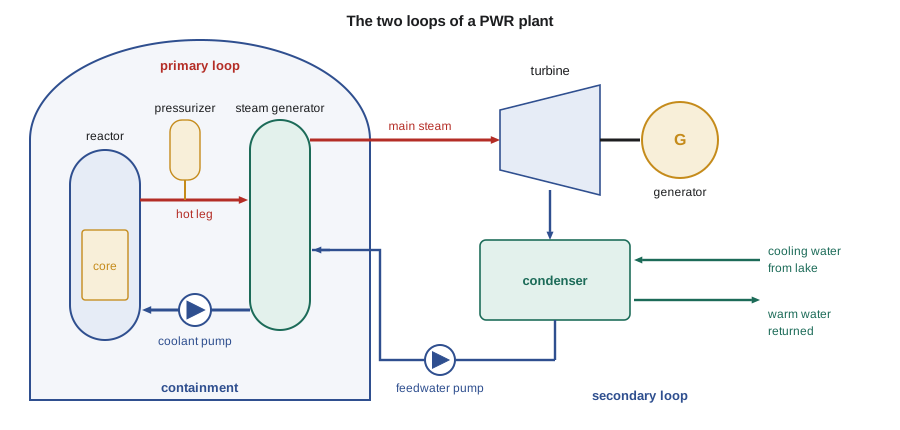
Every nuclear power plant in commercial service today is a heat engine. Fission in the fuel releases energy, almost all of which appears as heat in the fuel itself. A coolant carries that heat out of the core. In most plants the heat is passed to a separate water circuit that boils to make steam; in a boiling water reactor the coolant boils in the core and the steam goes directly to the turbine. The steam expands through a turbine that drives a generator, and the exhaust steam is condensed back to water in a condenser cooled by a lake, river, sea or cooling tower. Pumps return the water to be heated again. This is a Rankine cycle, the same cycle used in coal and gas-fired steam plants. What makes a nuclear plant different is the heat source and everything that must be done to keep it safe.
A useful way to read any plant diagram is to follow the heat. Start in the fuel, where it is generated. Follow it into the coolant, through the primary circuit, into the steam generators or directly into the steam lines, through the turbine where part of it becomes work, and into the condenser where most of what remains is rejected to the environment. At each step, ask what keeps the heat moving under normal conditions, and what keeps it moving if a pump stops, a pipe breaks or the electrical supply is lost. The second question is the subject of the safety systems lessons later in this course, but it is worth asking from the first day.
The main families of power reactors
Commercial power reactors are classified mainly by their coolant and moderator. The moderator slows fission neutrons down to thermal energies, where they are most likely to cause further fission in uranium-235. The coolant removes heat. In light water reactors, ordinary water does both jobs. In CANDU reactors, heavy water is used as both moderator and coolant, but in separate circuits: a large, cool, low-pressure tank of heavy water moderates the neutrons, and hot, pressurized heavy water flows through pressure tubes to cool the fuel. Gas-cooled reactors use carbon dioxide or helium as coolant and graphite as moderator. Fast reactors have no moderator at all and use liquid metal, gas or salt to cool a compact core.
| Type | Coolant | Moderator | Fuel | Typical pressure | Examples |
|---|---|---|---|---|---|
| Pressurized water reactor (PWR) | light water, not boiling | light water | enriched UO₂, about 3 to 5 % | about 15.5 MPa | Westinghouse four-loop, AP1000, EPR |
| Boiling water reactor (BWR) | light water, boiling in core | light water | enriched UO₂ | about 7 MPa | BWR/4, ABWR, ESBWR, BWRX-300 |
| Pressurized heavy water reactor (PHWR) | heavy water in pressure tubes | heavy water in a separate tank | natural UO₂ | about 10 MPa in the tubes | CANDU 6, Darlington, Bruce |
| Gas-cooled reactor | carbon dioxide or helium | graphite | enriched UO₂ or TRISO particles | 4 to 7 MPa | UK AGR, HTR-PM, Xe-100 |
| Sodium-cooled fast reactor | liquid sodium | none | enriched metal or oxide | near atmospheric | BN-600, BN-800, Natrium |
| Molten salt reactor | fluoride or chloride salt | graphite or none | dissolved in salt, or TRISO in solid form | near atmospheric | MSRE, IMSR, Kairos Hermes |
Light water reactors make up most of the world's operating fleet, with pressurized water reactors the largest single group. Pressurized heavy water reactors, most of them CANDU units or designs derived from CANDU, are the second technology in many countries, including Canada, India, South Korea, Argentina, Romania and China. Gas-cooled reactors have a long history in the United Kingdom. Fast reactors operate in Russia and are under construction or development in several countries. Molten salt reactors were demonstrated in the 1960s and are now the subject of several development programs. Small modular reactors, the subject of lesson 8, come in nearly every one of these families.
Thermal efficiency and heat rejection
A water-cooled reactor produces steam at a modest temperature, around 280 to 300 °C, because the coolant must stay liquid at a pressure the pressure boundary can safely hold. That limits the thermodynamic efficiency of the steam cycle to about 33 to 36 percent. Coal plants with supercritical steam reach over 40 percent, and combined-cycle gas plants reach about 60 percent. For a nuclear plant, a lower efficiency means a larger turbine and condenser for each megawatt of output and more heat rejected to the environment. For every megawatt of electricity, a light water reactor rejects about two megawatts of heat to its cooling water or cooling tower.
Thermal efficiency is the ratio of electrical output to thermal power. Plants report gross output at the generator terminals and net output after the station's own loads, called house load, are subtracted. The main house loads are the reactor coolant pumps, the feedwater pumps, the condenser circulating water pumps and the ventilation systems. The program below calculates gross and net efficiency and the heat rejected for three plants using round, illustrative numbers.
# Plant heat balance for three reactor types (illustrative round numbers).
# Thermal power in, electrical power out, heat rejected to the condenser.
plants = [
    # name, thermal MW, gross electric MW, house load MW
    ("CANDU unit (Darlington-like)", 2776, 935, 57),
    ("Four-loop PWR", 3411, 1180, 55),
    ("BWRX-300", 870, 300, 15),
]
for name, qt, eg, house in plants:
    en = eg - house
    eta_g, eta_n = eg / qt, en / qt
    rejected = qt - eg
    print(f"{name}:")
    print(f"  gross efficiency {eta_g:5.1%}, net efficiency {eta_n:5.1%}")
    print(f"  heat to condenser about {rejected:5.0f} MW, {rejected/eg:4.2f} MW rejected per MW generated")
# Cooling water needed to reject the PWR's waste heat with a 10 K rise
cp, dT = 4.18, 10.0                       # kJ/(kg K), K
m = (3411 - 1180) * 1000 / (cp * dT)      # kg/s
print(f"PWR condenser cooling water at a 10 K rise: about {m/1000:5.1f} m3/s")CANDU unit (Darlington-like): gross efficiency 33.7%, net efficiency 31.6% heat to condenser about 1841 MW, 1.97 MW rejected per MW generated Four-loop PWR: gross efficiency 34.6%, net efficiency 33.0% heat to condenser about 2231 MW, 1.89 MW rejected per MW generated BWRX-300: gross efficiency 34.5%, net efficiency 32.8% heat to condenser about 570 MW, 1.90 MW rejected per MW generated PWR condenser cooling water at a 10 K rise: about 53.4 m3/s
All three plants come out near one third efficiency. The cooling water flow needed is large: tens of cubic metres per second for a large unit. That is why nuclear plants are sited on lakes, rivers and coasts, or use cooling towers. The thermal discharge is regulated as an environmental release, and in hot summers some river-cooled plants have had to reduce power to keep discharge temperatures within their permits.
Darlington uses once-through cooling from Lake Ontario, with long intake and discharge structures designed to limit the effect on fish and the lake. The CNSC and the province regulate the thermal plume, and OPG monitors lake temperatures around the outfall.
Worked problem
Heat rejected by a PWR
A unit produces 3 411 MW thermal and 1 180 MW gross electric. How much heat goes to the condenser, and what cooling water flow gives a 10 K temperature rise?
Show solution
- Heat rejected: 3 411 − 1 180 = 2 231 MW.
- Mass flow: ṁ = Q/(c_p ΔT) = 2.231 × 10⁹/(4 180 × 10) ≈ 53 400 kg/s.
- Volume flow: about 53 m³/s .
Answer: The condenser cooling water flow is about 53 m³/s, which matches the program output and is comparable to the flow of a small river.
Defence in depth and the plant layout
Nuclear plants are designed around the principle of defence in depth: several independent layers of protection, so that the failure of one does not lead to harm. The physical layers are often described as a series of barriers between the radioactive fission products and the public. The first barrier is the ceramic fuel pellet, which retains most fission products. The second is the fuel cladding, a sealed zirconium alloy tube. The third is the reactor coolant pressure boundary: the vessel or pressure tubes, the piping, the pumps and the steam generator tubes. The fourth is the containment building. Each barrier is protected by systems that keep it within its design limits, and the procedures and organization of the plant add further layers.
The site layout reflects these layers. The reactor and its primary circuit sit inside the containment. The turbine hall is outside containment, separated from the reactor building, and in a PWR or CANDU plant it handles only non-radioactive steam under normal conditions. Auxiliary buildings house the systems that clean and control the coolant chemistry, treat radioactive waste and supply emergency power and cooling water. Spent fuel is stored in water-filled pools and later moved to dry storage. The control room, protected against fire, radiation and other hazards, is where operators run the plant around the clock.
In a multi-unit CANDU station such as Darlington or Pickering, the units share a common vacuum building, a large concrete structure held below atmospheric pressure. A pressure relief duct connects each unit's reactor building to the vacuum building, so that steam released in an accident is drawn in and condensed. Lesson 7 returns to this feature.
Load following and grid service
Large nuclear units have traditionally run at full power as base load, because their fuel cost is low and their capital cost is high, so every hour at full power counts. Most designs can follow load to some extent: light water reactors in France have long varied their output daily, and CANDU units can reduce power by bypassing steam to the condenser or reducing reactor power. Load following has costs: xenon transients must be managed, thermal cycling adds fatigue to components and fuel, and fuel performance limits constrain how fast power can be raised. As wind and solar generation grow, the ability of nuclear plants to vary their output is attracting renewed attention, and several small modular designs advertise it as a feature.
Where this course goes
The next six lessons examine the established water-cooled technologies: the pressurized water reactor, the boiling water reactor and the CANDU pressurized heavy water reactor, followed by the steam generators and turbines they share, the safety systems that protect the core, and the containment that is the last physical barrier. Lessons 8 to 12 look at small modular reactors and at advanced designs cooled by helium, sodium and molten salt, ending with very small microreactors. The advanced designs are covered here at the level of plant systems: configuration, coolant, heat transport and safety features. Their fuel cycles, economics and the wider Generation IV program are taken up in NUC-450 Fusion Energy and Advanced Reactors.
Capacity factor and reliability
A plant's capacity factor is the energy it actually generates over a year divided by the energy it would generate running at full rated power all year. Well-run nuclear units achieve capacity factors above 90 percent, among the highest of any generating technology, because their fuel is cheap and they are kept online except during planned refuelling or maintenance outages and occasional forced outages. A PWR typically has a refuelling outage of three to five weeks every 18 to 24 months. A CANDU unit refuels on power but still takes planned maintenance outages, usually every two to three years, and Darlington units also take part in station-wide outages for vacuum building inspection. Reliable plant systems, from feedwater pumps to transformers, matter as much to capacity factor as the reactor itself.
Common mistakes
MistakeA nuclear plant converts fission energy to electricity directly.
InsteadIt is a heat engine: fission heats a coolant, steam drives a turbine, and most of the heat is rejected in the condenser.
MistakeLight water reactors are less efficient because uranium releases less energy.
InsteadEfficiency is limited by the modest steam temperature that water-cooled designs can produce.
MistakeThe turbine hall of a PWR handles radioactive steam.
InsteadIn a PWR or CANDU plant the secondary steam is normally non-radioactive; only a BWR sends reactor steam to the turbine.
Summary and key terms
- Nuclear plants are Rankine-cycle heat engines with a fission heat source.
- Reactor families are distinguished by coolant and moderator.
- Water-cooled plants reach about one third efficiency and reject about two units of heat per unit of electricity.
- Defence in depth places several independent barriers between fission products and the public.
- Plant layout separates the reactor and primary circuit inside containment from the turbine and support systems.
- Moderator
- A material that slows fission neutrons to thermal energies, such as light water, heavy water or graphite.
- Primary circuit
- The coolant loop that passes through the reactor core.
- Secondary circuit
- The steam and feedwater loop heated by the steam generators in a PWR or CANDU plant.
- House load
- Electrical power used by the station itself.
- Defence in depth
- The use of several independent layers of protection so that no single failure leads to harm.
- Condenser
- The heat exchanger in which turbine exhaust steam is condensed by cooling water.
Practice problems
Work each problem on paper first, then reveal the answer to check.
Name the four physical barriers between fission products and the public.
Show answer
Fuel pellet, cladding, reactor coolant pressure boundary and containment.
Why is the efficiency of a water-cooled reactor limited to about one third?
Show answer
The steam temperature is limited by the pressure the coolant boundary can hold.
What is house load?
Show answer
Electricity consumed by the plant itself, mainly pumps and ventilation.
A unit makes 870 MW thermal and 300 MW gross. What is its gross efficiency?
Show answer
300/870 = 34.5 percent.
Which reactor type sends coolant steam directly to the turbine?
Show answer
The boiling water reactor.
Lesson quiz · 5 questions
Score 60% or more to complete this lesson.
Create a free account to save your progress, take quizzes and earn a certificate.