
NUC-360 · Lesson 4 of 12 · 21 min
CANDU pressurized heavy water reactors
Hana has worked on Darlington for most of her time at Meridian, but always on one part at a time: the core physics, the channels, the materials. Now Marcel Thibodeau walks her along the reactor face during an outage, past the end fittings of hundreds of fuel channels. "Each one of these is a small pressure vessel," he says. "Four hundred and eighty of them, cooled in two loops, sitting in a cold tank of heavy water. That is the whole idea of CANDU in one sentence."
Why heavy water and pressure tubes
CANDU stands for CANada Deuterium Uranium. The design was developed in Canada from the 1950s by Atomic Energy of Canada Limited, Ontario Hydro and Canadian industry, starting with the Nuclear Power Demonstration reactor at Rolphton and the Douglas Point station. The key choices were made to suit Canada's situation at the time: abundant uranium, no enrichment industry, and a strong heavy water program from wartime research. Heavy water absorbs far fewer neutrons than light water, so a heavy-water-moderated reactor can reach criticality with natural uranium, which contains only 0.7 percent uranium-235. That removes the need for enrichment.
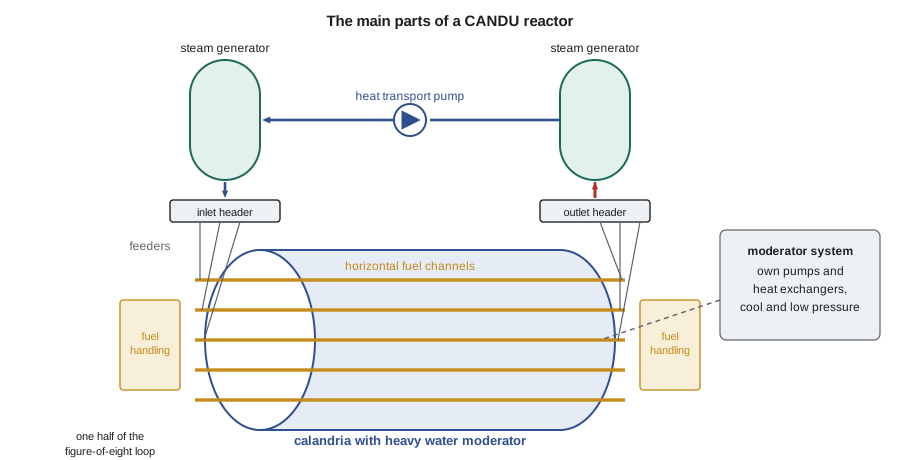
Using natural uranium means the core must be large, with a lot of moderator between fuel channels, and the fuel must be replaced often because natural uranium has little excess reactivity to burn. Instead of a single large pressure vessel, which Canadian industry could not then forge, CANDU uses hundreds of horizontal pressure tubes passing through a large tank, called the calandria, filled with cool, low-pressure heavy water moderator. Each pressure tube holds a string of fuel bundles and the pressurized hot coolant that cools them. Fuelling machines at each end of the reactor connect to a channel while the reactor is at power, push new bundles in at one end and receive used bundles at the other.
The fuel channel
Each fuel channel is an assembly of nested tubes. The pressure tube, made of zirconium-2.5 percent niobium alloy about 103 mm in inside diameter and about 6 m long, carries the coolant at about 10 MPa and about 265 to 310 °C. Around it, separated by a gap filled with carbon dioxide gas, is the calandria tube, which forms the boundary with the cold moderator. The gas gap insulates the hot pressure tube from the moderator, which runs near 70 °C. Garter spring spacers keep the pressure tube from sagging into contact with the calandria tube. At each end, the pressure tube is rolled into a stainless steel end fitting that connects to a feeder pipe and to the fuelling machine. As NUC-340 described, pressure tubes creep, grow and pick up hydrogen in service, and their fitness for service is assessed against CSA N285.8.
A Darlington-type core has 480 channels, each holding 13 fuel bundles, of which 12 sit in the heated length. A CANDU fuel bundle is short, about 0.5 m long and 0.1 m in diameter, made of 37 elements of natural UO₂ pellets in thin zirconium alloy sheaths, welded to end plates. The short bundle and the horizontal channel are what make on-power refuelling practical: a fuelling machine can push a few bundles through a channel, against or with the flow, and the reactor never needs to shut down to refuel.
The primary heat transport system
The heat transport system circulates pressurized heavy water through the fuel channels. Coolant from the inlet headers flows through individual feeder pipes into each channel, along the fuel string, out through another feeder to the outlet header, and on to the steam generators. A Darlington unit has two loops, each serving half the core, and each loop is arranged as a figure of eight: the coolant passes through half of that loop's channels in one direction, through a steam generator and pump, then through the other channels in the opposite direction and through a second steam generator and pump. Adjacent channels carry coolant in opposite directions, which evens out the axial power and temperature distribution.
Because each channel's power depends on its position in the core, the inlet feeders are fitted with orifices that set the flow in each channel. Central channels with the highest power get more flow. The outlet coolant is close to saturation at the outlet header, and a small amount of boiling at the channel exit is allowed in some designs. A pressurizer connected to the outlet headers controls pressure, much as in a PWR, and a degasser condenser removes non-condensable gases.
# CANDU primary heat transport: channel flow and outlet conditions (illustrative).
channels = 480
Q = 2776e6                       # W core thermal power to coolant (most of it)
moderator_share = 0.045          # fraction deposited in the moderator
Q_ht = Q * (1 - moderator_share)
T_in, T_out = 266.0, 310.0       # deg C, inlet and outlet headers near 10 MPa
cp = 5300.0
m_total = Q_ht / (cp * (T_out - T_in))
print(f"heat transport flow {m_total/1000:5.2f} t/s, average channel flow {m_total/channels:5.1f} kg/s")
print(f"heat to the moderator about {Q*moderator_share/1e6:4.0f} MW")
# Channel power varies across the core; central channels run hotter
for P in (4.0e6, 6.0e6, 7.0e6):
    m_ch = 24.0                  # kg/s, flow set by orifices in this channel
    rise = P / (m_ch * cp)
    print(f"channel at {P/1e6:3.1f} MW, {m_ch:4.1f} kg/s: temperature rise {rise:4.1f} K")
# Heavy water inventory and its value per tonne (illustrative price)
inv_t = 280 + 200                # tonnes moderator + heat transport, rough
print(f"rough heavy water inventory {inv_t} t; at a notional 500 dollars per kg that is "
f"{inv_t*500/1e3:5.0f} million dollars")heat transport flow 11.37 t/s, average channel flow 23.7 kg/s heat to the moderator about 125 MW channel at 4.0 MW, 24.0 kg/s: temperature rise 31.4 K channel at 6.0 MW, 24.0 kg/s: temperature rise 47.2 K channel at 7.0 MW, 24.0 kg/s: temperature rise 55.0 K rough heavy water inventory 480 t; at a notional 500 dollars per kg that is 240 million dollars
Worked problem
Channel temperature rise
A central channel produces 7.0 MW with a flow of 24 kg/s and c_p ≈ 5 300 J/kg·K. What is the coolant temperature rise along the channel?
Show solution
- ΔT = P/(ṁ c_p) = 7.0 × 10⁶/(24 × 5 300).
- ΔT ≈ 55 K.
- With an inlet near 266 °C the outlet is near 321 °C, at or near saturation at the outlet header pressure.
Answer: High-power channels approach saturation at their outlets, which is why channel flows and dryout margins are watched closely, as NUC-330 described.
The moderator system
The calandria holds roughly 250 to 300 tonnes of heavy water moderator at low pressure and about 70 °C. About 4 to 5 percent of the reactor's thermal power is deposited directly in the moderator, by neutron slowing down and by gamma rays, and this heat is removed by moderator pumps and heat exchangers cooled by light water service water. The moderator is also an important heat sink in accidents: if a fuel channel loses cooling, heat can flow through the pressure tube and calandria tube into the moderator. Surrounding the calandria is a shield tank, the calandria vault, filled with light water, which provides another heat sink and radiation shielding.
Moderator chemistry matters for reactivity. Gadolinium nitrate or boric acid can be dissolved in the moderator, for example to compensate for excess reactivity in a fresh core or to hold the reactor shut down during outages. Dissolved gadolinium is also the injection poison for the second shutdown system. Tritium builds up in the moderator from neutron capture in deuterium, and Darlington operates a tritium removal facility to reduce the inventory, which also lowers worker dose.
Reactivity control and shutdown
CANDU reactivity control uses devices that enter the low-pressure moderator, not the high-pressure coolant. Liquid zone controllers, compartments of light water in vertical tubes, adjust their water levels to control bulk power and the power in each zone of the core. Adjuster rods, normally fully inserted, flatten the flux and can be withdrawn to provide extra reactivity, for example to override xenon after a short shutdown. Mechanical control absorbers can be driven in for fast power reductions. Two independent shutdown systems provide trip protection: shutdown system 1 drops spring-assisted cadmium rods into the core, and shutdown system 2 injects gadolinium nitrate solution into the moderator through horizontal nozzles. Either system alone can shut the reactor down.
One feature of CANDU physics that receives particular attention is the positive coolant void reactivity. If the heavy water coolant in the channels boils or is lost, reactivity increases slightly, because the coolant contributes to neutron absorption and to the neutron energy spectrum in a way that, on balance, makes voiding add reactivity. The effect is managed by design: the moderator, which provides almost all the moderation, is separate and stays in place; the two fast, independent shutdown systems act within seconds; and the prompt neutron lifetime in a heavy water lattice is relatively long, which slows the power rise. Safety analyses show the shutdown systems terminate such events with large margins.
Darlington's four units were built in the late 1980s and early 1990s, each producing about 880 MWe net. The refurbishment program replaced all 1 920 fuel channels and 3 840 feeder pipes across the four units, and the fourth unit returned to service in 2026, extending the station's life by about 30 years.
The fuel handling system
CANDU fuelling machines are among the most complex mechanical systems in any power plant. Each reactor face has a fuelling machine on a bridge that can be positioned at any channel. To refuel a channel, the two machines lock onto the end fittings at the two ends of the channel, pressurize to match the heat transport system, remove the channel closure plugs and shield plugs, and push a number of new bundles into one end while receiving the same number of used bundles at the other. Darlington typically uses an eight-bundle shift. Used bundles are transferred to a discharge bay and then to the irradiated fuel bay, a water pool, where they cool for years before being moved to dry storage containers. Several channels are refuelled each day, chosen by the physics team as NUC-350 described.
On-power refuelling has several consequences for the plant. The reactor never needs a refuelling outage, which helps capacity factor. The core carries little excess reactivity, so control devices can be small and the reactor is less sensitive to reactivity accidents from control device failures. Failed fuel can be located and removed while the reactor operates. On the other hand, the fuelling machines must be maintained and are a potential source of forced outages, and the many end fittings and feeders add to the inspection work during outages.
CANDU variants and successors
The CANDU line has several branches. Pickering and Bruce are earlier multi-unit stations with different numbers of channels and bundle designs. The CANDU 6, a single-unit design of about 700 MWe, was built at Point Lepreau in New Brunswick, Gentilly-2 in Quebec, and in Argentina, South Korea, Romania and China. The Enhanced CANDU 6 and the Advanced CANDU Reactor were later evolutionary designs. India developed its own pressurized heavy water reactors from an early CANDU design, and they form most of its fleet.
Inspection and life management
The fuel channels are the components that most limit the life of a CANDU reactor. Each pressure tube creeps, growing longer and wider, and sags slightly over decades at temperature and under neutron irradiation. It also picks up deuterium from corrosion, which raises its hydrogen-equivalent concentration and reduces its fracture toughness. Garter springs keep each pressure tube from touching its surrounding calandria tube; if contact occurred, the cooler calandria tube could cause hydride blisters to form at the contact point. Plants inspect a sample of channels in each outage with tools that measure diameter, wall thickness, sag and gap, and take small scrape samples to measure hydrogen content. These measurements feed fitness-for-service assessments that show the channels remain safe until the next inspection or until replacement.
When the channels approach the end of their life, typically after about 25 to 30 years of operation, the reactor is refurbished. Refurbishment replaces all the pressure tubes, calandria tubes and feeders, and typically includes steam generator work, turbine and generator overhaul and many safety upgrades, giving the unit about 30 more years of operation. The Darlington refurbishment, carried out unit by unit from 2016, replaced 480 channels per unit.
Common mistakes
MistakeCANDU uses enriched uranium like a PWR.
InsteadIt uses natural uranium, made possible by the low neutron absorption of heavy water.
MistakeThe moderator and coolant are the same water.
InsteadThey are separate heavy water systems: cool, low-pressure moderator and hot, pressurized coolant.
MistakeCANDU reactors must shut down to refuel.
InsteadFuelling machines refuel channels while the reactor is at power.
Summary and key terms
- CANDU uses natural uranium, heavy water moderator and pressurized heavy water coolant in pressure tubes.
- A Darlington core has 480 horizontal channels, each with 12 or 13 short fuel bundles.
- The figure-of-eight heat transport loops carry heat to steam generators.
- The cool moderator is a separate system and an important heat sink.
- Liquid zone controllers and adjusters control reactivity; two independent shutdown systems provide trip protection.
- Calandria
- The large horizontal tank of heavy water moderator through which the fuel channels pass.
- Pressure tube
- The zirconium-niobium tube that holds the fuel and pressurized coolant in a CANDU channel.
- Calandria tube
- The outer tube separating a fuel channel from the moderator, with an insulating gas gap.
- Feeder
- A pipe connecting a fuel channel end fitting to an inlet or outlet header.
- Liquid zone controller
- A compartment of light water whose level is adjusted to control power in a core zone.
- Coolant void reactivity
- The reactivity change if the coolant in the channels voids; slightly positive in CANDU.
Practice problems
Work each problem on paper first, then reveal the answer to check.
Why can CANDU use natural uranium?
Show answer
Heavy water absorbs very few neutrons, so a large heavy-water lattice reaches criticality without enrichment.
What separates the hot pressure tube from the cool moderator?
Show answer
The calandria tube and a gas-filled annulus.
How does a figure-of-eight loop help the core?
Show answer
Adjacent channels flow in opposite directions, evening out axial power and temperature.
What are the two CANDU shutdown systems?
Show answer
Spring-assisted shutoff rods and gadolinium nitrate injection into the moderator.
About what fraction of reactor power is deposited in the moderator?
Show answer
About 4 to 5 percent.
Lesson quiz · 5 questions
Score 60% or more to complete this lesson.
Create a free account to save your progress, take quizzes and earn a certificate.