
NUC-340 · Lesson 9 of 12 · 20 min
Graphite and heavy water moderators
Malik takes Hana to see the Darlington heavy water management team. Heavy water is the moderator and coolant of every CANDU reactor, and it is also a material with its own ageing story: it slowly becomes tritiated, it can be degraded by light water leaking in, and it must be kept extremely pure. "People think of moderators as physics," Malik says. "But a moderator is a material that sits in a neutron field for decades. Graphite cracks and changes shape; heavy water collects tritium. Both have to be managed."
What a moderator must do
A thermal reactor needs a moderator to slow fast fission neutrons to thermal energies, where uranium-235 fission is most likely. A good moderator has light nuclei, which take a large fraction of a neutron's energy per collision, a high scattering cross section and a very low absorption cross section. The moderating ratio, the slowing-down power divided by the macroscopic absorption cross section, compares moderators on this basis.
| Moderator | Moderating ratio (approximate) | Advantages | Drawbacks |
|---|---|---|---|
| Light water (H₂O) | about 60 to 70 | cheap; also the coolant; compact cores | absorbs enough neutrons to require enriched fuel |
| Heavy water (D₂O) | thousands (depends strongly on isotopic purity) | very low absorption; natural uranium fuel | expensive; tritium production; leaks must be recovered |
| Graphite (carbon) | about 200 | solid; high temperature capability; cheap per tonne | large cores; radiation damage; oxidation; dust |
| Beryllium and its oxide | about 130 to 160 | compact | toxic; swells and embrittles under irradiation |
Light water and heavy water moderators are also fluids, so their materials questions are about chemistry and isotopes rather than mechanical damage. Graphite is a solid structural material inside the core, so it suffers radiation damage like any other structural material, with a few unusual features.
Heavy water in CANDU reactors
In a CANDU reactor, heavy water fills the calandria vessel at low pressure and about 70 °C as the moderator, and a separate heavy water circuit at high pressure is the primary coolant. The moderator absorbs about 4 to 5 percent of the reactor's thermal power from neutron and gamma heating and conduction across the calandria tubes, which is removed by moderator heat exchangers.
Isotopic purity matters greatly. Heavy water must be kept above about 99.8 percent D₂O by mass, because every molecule of light water adds hydrogen atoms whose absorption cross section is hundreds of times that of deuterium. Small leaks of light water, for example from heat exchangers, reduce the purity, and upgrading plants at the stations distil the heavy water back to reactor grade. Leaks of heavy water to the outside are collected by drying systems, both to save an expensive material and because of tritium.
Tritium in heavy water
Deuterium nuclei absorb neutrons to form tritium, a radioactive isotope of hydrogen with a half-life of about 12.3 years:
Tritium accumulates in the heavy water, approaching an equilibrium where production balances decay. Because the moderator has a higher neutron flux and a larger inventory than the primary coolant, it accumulates more tritium. Tritium raises dose to workers, mainly by inhalation and skin absorption of tritiated water vapour, and it is a component of airborne and waterborne emissions, as NUC-320 discussed.
where P is the production rate per kilogram per unit time and λ the decay constant. With an illustrative production of 0.08 TBq per kg per year, the equilibrium is about 1.4 TBq/kg, reached to within a few percent after about forty years.
Ontario Power Generation operates a tritium removal facility at Darlington, which extracts tritium from heavy water from the Ontario CANDU stations and immobilises it, lowering the tritium concentration of the moderator and coolant and the resulting worker dose and emissions.
Worked problem
Tritium build-up in a moderator
Using an illustrative production rate of 0.08 TBq per kg per year and a half-life of 12.32 years, estimate the moderator tritium concentration after 10 and 40 years of operation, without removal.
Show solution
- Decay constant λ = ln 2 / 12.32 ≈ 0.0563 per year; equilibrium P/λ ≈ 1.42 TBq/kg.
- After 10 years: 1.42 × (1 − e^(−0.563)) ≈ 1.42 × 0.43 ≈ 0.61 TBq/kg.
- After 40 years: 1.42 × (1 − e^(−2.25)) ≈ 1.42 × 0.89 ≈ 1.27 TBq/kg.
Answer: About 0.6 TBq/kg after 10 years and 1.3 TBq/kg after 40. Tritium removal holds the concentration well below these values.
Graphite as a moderator
Nuclear graphite is a manufactured polycrystalline material made from petroleum or pitch coke and a binder, formed, baked and graphitised at about 2800 °C. Its crystals are hexagonal layers of carbon atoms, strongly bonded within each layer and weakly bonded between layers. Bulk graphite is porous, with about 20 percent porosity, and contains cracks between and within its crystallites that accommodate thermal expansion.
Graphite has moderated many reactors: the early production reactors, the British Magnox and advanced gas-cooled reactors (AGRs), the Soviet RBMK design, and high-temperature gas-cooled reactors (HTGRs), including several designs now proposed in North America. In HTGRs, graphite blocks or pebbles also form the fuel elements and core structure, so its behaviour directly affects the core geometry.
Radiation damage in graphite
Fast neutrons displace carbon atoms from the crystal layers. Interstitials gather between layers, pushing them apart, so each crystal expands along its c-axis and contracts within the layers. At first, the c-axis expansion is absorbed by the pores and cracks, so bulk graphite shrinks. With continued dose, the internal porosity fills up, new cracks form, and the shrinkage slows, reverses and turns into growth. This turnaround behaviour sets the life of graphite components.
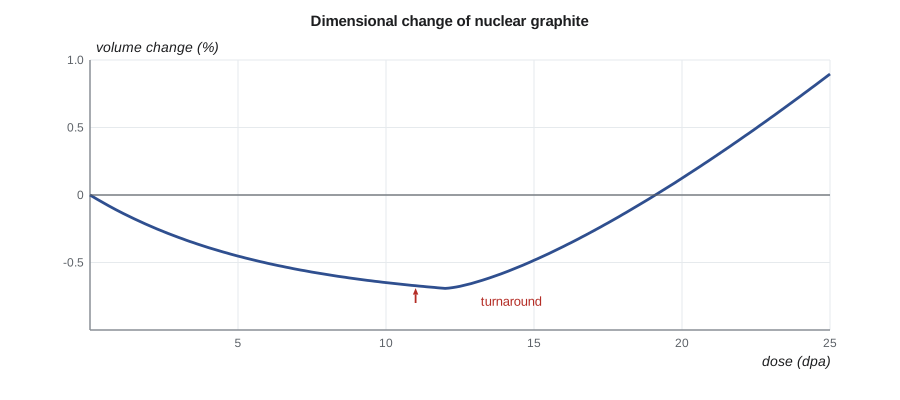
| Property | Typical change with dose | Consequence |
|---|---|---|
| Dimensions | shrinkage, then turnaround and growth | stresses between blocks; bowing; change of channel geometry |
| Thermal conductivity | falls sharply, by a factor of several at low temperature | higher temperatures in fuel and blocks |
| Strength and stiffness | rise at first, then fall after turnaround | cracking of blocks late in life |
| Stored energy (Wigner energy) | large at low irradiation temperatures | risk of sudden release on heating; managed by annealing in early reactors |
| Irradiation creep | significant | relaxes stresses from uneven shrinkage |
Stored energy is a historical lesson. Graphite irradiated near room temperature stores energy in displaced atoms; heating releases it. During a planned annealing at the Windscale piles in the United Kingdom in 1957, an uncontrolled release contributed to a fire. Modern reactors operate graphite well above about 300 °C, where defects anneal as they form and stored energy remains small.
# Moderators: graphite dimensional change and tritium build-up in heavy water.
import math
# Graphite: shrinkage then turnaround and swelling with fast neutron dose (illustrative curve)
def graphite_dim_change(dose_dpa):
    return -0.8 * (1 - math.exp(-dose_dpa / 6.0)) + 0.06 * max(0.0, dose_dpa - 12.0) ** 1.3
for d in (0, 5, 10, 15, 20, 25):
    print(f"dose {d:2d} dpa: volume change {graphite_dim_change(d):+5.2f} %")
# Tritium in heavy water: D(n,gamma)T production with radioactive decay, approaching equilibrium
half_life = 12.32
lam = math.log(2) / half_life
prod = 0.08     # tritium added each year of operation, TBq per kg of heavy water (illustrative)
A = 0.0
for year in range(1, 41):
    A = A * math.exp(-lam) + prod / lam * (1 - math.exp(-lam))
    if year in (1, 5, 10, 20, 30, 40):
print(f"year {year:2d}: moderator tritium about {A:5.2f} TBq/kg (equilibrium {prod/lam:4.2f})")dose 0 dpa: volume change +0.00 % dose 5 dpa: volume change -0.45 % dose 10 dpa: volume change -0.65 % dose 15 dpa: volume change -0.48 % dose 20 dpa: volume change +0.12 % dose 25 dpa: volume change +0.90 % year 1: moderator tritium about 0.08 TBq/kg (equilibrium 1.42) year 5: moderator tritium about 0.35 TBq/kg (equilibrium 1.42) year 10: moderator tritium about 0.61 TBq/kg (equilibrium 1.42) year 20: moderator tritium about 0.96 TBq/kg (equilibrium 1.42) year 30: moderator tritium about 1.16 TBq/kg (equilibrium 1.42) year 40: moderator tritium about 1.27 TBq/kg (equilibrium 1.42)
Oxidation and design rules for graphite
Graphite reacts with oxygen above about 400 °C and with steam at higher temperatures. In AGRs, radiolytic oxidation by the carbon dioxide coolant slowly removes mass from the graphite, reducing its strength; it is controlled by adding methane and carbon monoxide to the coolant. In helium-cooled HTGRs, impurities are kept very low, and the main oxidation concerns are air or water ingress accidents. Graphite dust from wear of pebbles is another HTGR issue, because dust can carry fission products.
Because graphite is brittle and its properties change so much, design codes treat it differently from metals, using probabilistic failure criteria based on the scatter in its strength. ASME Section III, Division 5 includes rules for graphite core components, which are being used in the licensing of new HTGR designs in North America. In Canada, graphite has not been used in power reactors, but HTGR and other advanced designs have entered the CNSC's pre-licensing vendor design review.
The calandria and moderator system
The structures that hold a heavy water moderator are themselves materials problems. The calandria vessel of a CANDU reactor is a large horizontal austenitic stainless steel tank, pierced by hundreds of calandria tubes of Zircaloy-2 rolled into its end shields. It operates at low pressure and temperature, but its tubesheets and the calandria tubes receive high neutron doses over the reactor's life. At about 70 °C, irradiation hardens the stainless steel and reduces its ductility, while helium from transmutation of boron and nickel accumulates. Calandria tubes creep and sag under their own weight and that of the pressure tubes they surround, which is one reason the gap between pressure and calandria tubes is measured.
Moderator heat exchangers, pumps and piping are stainless steel, and the moderator cover gas, helium above the heavy water surface, is monitored for deuterium produced by radiolysis, which must be recombined to avoid a flammable mixture. A small amount of gadolinium or boron dissolved in the moderator serves as a poison for reactivity control and for the second shutdown system's poison injection. Each of these chemistry features has to be compatible with the materials it touches.
Heavy water leaks are found early by monitoring. Tritium-in-air monitors in reactor building rooms, dew point and moisture monitors on drying systems, and tritium analysis of the cooling water on heat exchangers all show small leaks long before they become significant. A leak from a moderator heat exchanger, for example, shows up as a rise of tritium in its cooling water. Finding and repairing leaks quickly saves heavy water, limits worker dose and limits emissions, which is why heavy water management is treated as part of both the materials program and the radiation protection program at a CANDU station.
Light water: the moderator that renews itself
In light water reactors, the moderator is the coolant. It is continuously purified by ion exchange and replaced in part at each outage, so it does not age in the way heavy water or graphite does. Its materials questions are the chemistry questions of Lesson 8: boric acid concentration and its interaction with lithium, crud deposits on fuel that can cause axial offset anomalies in power distribution, and radiolysis. Boron itself is a consumable: boric acid absorbs neutrons by the boron-10 (n, α) reaction, and some plants use boric acid enriched in boron-10 to reduce the amount of boric acid needed and ease the chemistry burden.
Lessons from graphite reactors
Most experience with graphite moderators comes from the United Kingdom's gas-cooled reactors, whose graphite cores are now near the end of their lives. As graphite in the AGR cores passed turnaround, inspections found cracks in the keyway roots of some fuel channel bricks, where stresses from uneven dimensional change concentrate. Operators extended inspection programs, carried out extensive testing of irradiated graphite, and showed by analysis and experiment that the core could still allow control rods to enter and keep the fuel cooled even with many cracked bricks, before eventually retiring the reactors. This experience, together with research on newer graphite grades, informs the design of the graphite cores of the HTGRs now proposed, which are designed for replaceable reflector and fuel elements and for lower doses to permanent structures.
| Moderator | Main ageing concern | How it is managed |
|---|---|---|
| Heavy water | tritium build-up; isotopic downgrading | tritium removal; upgrading; leak recovery |
| Graphite | dimensional change, cracking, conductivity loss, oxidation | inspection; replaceable components; coolant chemistry |
| Light water | chemistry and crud | purification; boron and lithium control |
Hana's notes from the week end with a short comparison: a moderator that is a liquid can be cleaned, upgraded and replaced; a moderator that is a solid structure must be designed to tolerate its own ageing. That difference shapes the safety cases of every reactor type.
Summary and key terms
- A moderator slows neutrons with light nuclei and low absorption; the moderating ratio compares candidates.
- Heavy water's very low absorption allows natural uranium fuel, but purity must be kept above about 99.8 percent.
- Deuterium absorbs neutrons to make tritium, which builds up toward an equilibrium and raises dose; removal facilities reduce it.
- Nuclear graphite shrinks under irradiation, then turns around and grows, while its conductivity falls and its strength changes.
- Stored Wigner energy is a concern at low irradiation temperatures; modern designs run graphite hot enough to avoid it.
- Graphite oxidises at high temperature; design rules for graphite use probabilistic criteria.
- Moderating ratio
- Slowing-down power divided by macroscopic absorption cross section.
- Isotopic purity
- The fraction of heavy water molecules that are D₂O, expressed by mass.
- Upgrading
- Distillation of downgraded heavy water back to reactor-grade purity.
- Turnaround
- The dose at which graphite stops shrinking and begins to grow.
- Wigner energy
- Energy stored in displaced atoms of graphite irradiated at low temperature.
- Radiolytic oxidation
- Oxidation of graphite driven by radiation in the coolant gas.
Practice problems
Work each problem on paper first, then reveal the answer to check.
Why can CANDU reactors use natural uranium?
Show answer
Heavy water absorbs very few neutrons, so the neutron economy allows unenriched fuel.
What reaction produces tritium in heavy water?
Show answer
Neutron capture by deuterium.
What is the tritium concentration after one half-life, as a fraction of equilibrium?
Show answer
\(1 - e^{-\ln 2} = 0.5\), half the equilibrium value.
Why does bulk graphite shrink at first under irradiation?
Show answer
Crystal expansion along the c-axis is absorbed by pores and cracks, while in-plane contraction shows.
Why do modern reactors operate graphite above about 300 °C?
Show answer
Defects anneal as they form, so little Wigner energy is stored.
Lesson quiz · 5 questions
Score 60% or more to complete this lesson.
Create a free account to save your progress, take quizzes and earn a certificate.