
NUC-340 · Lesson 12 of 12 · 20 min
Ageing management
For the last weeks of her rotation, Malik gives Hana a capstone task. She is to draft the outline of an ageing management plan for the fuel channels and feeders of a refurbished Darlington unit, covering the period from now to the end of its planned operating life, and present it to the group. "Everything you have learned in this course comes together here," he says. "Which mechanisms matter, how fast they act, how we will see them coming, and what we will do about them. The tubes are new, but the clock started the day the unit returned to service."
What ageing management is
Ageing management is the set of engineering, operations and maintenance activities that keep the degradation of structures, systems and components within acceptable limits throughout a plant's life. It recognises that every component ages, by the mechanisms described in this course and others such as cable insulation degradation and concrete deterioration, and that safety depends on understanding, monitoring and controlling that ageing rather than assuming components stay as built.
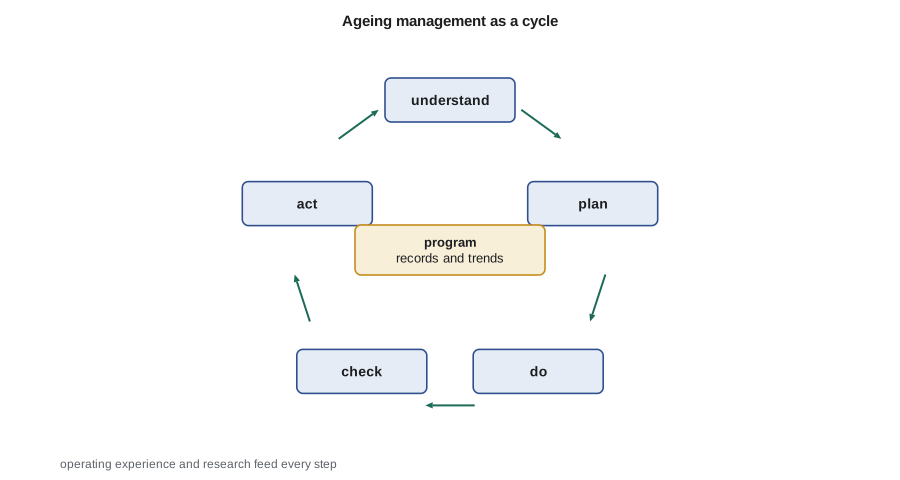
An effective ageing management program typically follows a cycle:
| Step | Activities | Course link |
|---|---|---|
| Understand | identify components, materials, environments and degradation mechanisms; collect operating experience and research | Lessons 1 to 11 |
| Plan | choose programs, inspection methods and frequencies; set acceptance criteria | this lesson |
| Do | operate within limits; maintain chemistry; minimise stressors | Lessons 4, 6, 8 |
| Check | inspect, test, monitor and trend; assess against criteria | Lessons 4, 6, 7, 8 |
| Act | repair, replace, mitigate, or change operation; update the program | this lesson |
The Canadian framework
In Canada, REGDOC-2.6.3, Aging Management, sets the CNSC's expectations. Licensees must have an integrated ageing management framework that covers all structures, systems and components important to safety, with component-specific programs for the most critical ones, such as fuel channels, feeders, steam generators and the reactor containment structure. Standards in the CSA N285 series set specific requirements: CSA N285.4 for periodic inspection of CANDU components and CSA N285.8 for fitness-for-service evaluation of pressure tubes. Periodic safety reviews, carried out roughly every ten years and in support of licence renewal and refurbishment, assess whether ageing is being managed and whether the plant remains safe compared with modern standards.
The elements of a program
Regulators in both countries describe an acceptable ageing management program in similar terms. A common formulation has ten elements:
| Element | Question it answers |
|---|---|
| Scope | Which components does the program cover? |
| Preventive actions | What prevents or slows the degradation? |
| Parameters monitored | What property or condition is measured? |
| Detection of ageing effects | Which method, where and how often, will find degradation before it matters? |
| Monitoring and trending | How are results tracked to predict future condition? |
| Acceptance criteria | What values trigger action? |
| Corrective actions | What is done when criteria are not met? |
| Confirmation process | How do we know corrective actions worked? |
| Administrative controls | How is the program documented, reviewed and approved? |
| Operating experience | How do lessons from this and other plants change the program? |
Prioritising by risk
A plant has thousands of components, and not all deserve the same attention. Programs prioritise by combining the likelihood of significant degradation with its consequences. Likelihood depends on the mechanism, its rate and the margin remaining; consequence depends on the safety function and on whether degradation could be detected and corrected in time. A simple scoring scheme multiplies the two on scales of one to five and maps the score to an inspection interval. Real programs use more detailed methods, including risk-informed inspection approaches, but the logic is the same.
Worked problem
Ranking components and setting intervals
Score likelihood and consequence from 1 to 5 for: pressure tubes (3, 5), feeder pipes (3, 4), Alloy 600 nozzle welds (3, 4), vessel beltline (2, 5), steam generator tubes (2, 4), buried service water piping (3, 2) and cables in containment (2, 3). Map scores of 15 or more to a 2-year interval, 10 to 14 to 4 years, 6 to 9 to 6 years, and below 6 to 10 years.
Show solution
- Pressure tubes score 15, so every 2 years.
- Feeders and nozzle welds score 12, and the vessel beltline 10, so every 4 years.
- Steam generator tubes score 8, and service water piping and cables 6, so every 6 years.
Answer: The ranking puts the pressure boundary components with fast-acting mechanisms first. In practice, intervals are set by codes and standards as well as by risk, and the scheme is a starting point for discussion, not a substitute for them.
# Ageing management: rank components by risk and set inspection intervals.
# Score = likelihood (1-5) x consequence (1-5); interval shortens as score rises.
comps = [
    ("pressure tubes: hydrogen equivalent and flaws", 3, 5),
    ("feeder pipes: wall thinning", 3, 4),
    ("steam generator tubes: cracking", 2, 4),
    ("reactor vessel beltline: embrittlement", 2, 5),
    ("Alloy 600 nozzle welds: stress corrosion cracking", 3, 4),
    ("buried service water piping: corrosion", 3, 2),
    ("electrical cables in containment: insulation ageing", 2, 3),
]
def interval_years(score):
    if score >= 15: return 2
    if score >= 10: return 4
    if score >= 6: return 6
    return 10
for name, L, Cq in sorted(comps, key=lambda c: -c[1] * c[2]):
    s = L * Cq
    print(f"{name:52s} score {s:2d} -> inspect every {interval_years(s)} years")
# Remaining-margin trend: hydrogen equivalent in a pressure tube rising at a steady rate
Heq_now, rate, limit = 32.0, 1.6, 120.0     # ppm, ppm per year, example acceptance value
print(f"years until example hydrogen equivalent limit is reached: {(limit - Heq_now) / rate:.0f}")pressure tubes: hydrogen equivalent and flaws score 15 -> inspect every 2 years feeder pipes: wall thinning score 12 -> inspect every 4 years Alloy 600 nozzle welds: stress corrosion cracking score 12 -> inspect every 4 years reactor vessel beltline: embrittlement score 10 -> inspect every 4 years steam generator tubes: cracking score 8 -> inspect every 6 years buried service water piping: corrosion score 6 -> inspect every 6 years electrical cables in containment: insulation ageing score 6 -> inspect every 6 years years until example hydrogen equivalent limit is reached: 55
Capstone: fuel channels and feeders
Hana's draft plan for the fuel channels of the refurbished unit follows the ten elements. Its scope covers all 480 pressure tubes, their calandria tubes, garter springs and end fittings, and the feeders. Preventive actions include coolant chemistry control to limit corrosion and deuterium pickup, limits on heat-up and cool-down rates when hydrogen equivalent is high, and avoiding fuelling-machine damage. Monitored parameters are diameter, wall thickness, length, sag, pressure-to-calandria-tube gap, garter spring positions, hydrogen equivalent from scrape samples, and flaws, measured with the channel inspection tools of Lesson 7 on a sampling plan meeting CSA N285.4. Trending compares each channel with creep and hydrogen models, and acceptance criteria come from CSA N285.8 fitness-for-service rules and the licensing basis. Corrective actions include channel repositioning, garter spring repositioning, flaw evaluation and, ultimately, replacement. For feeders, the plan adds wall-thickness measurements at the bends most prone to flow-accelerated corrosion and crack inspections at the most stressed locations, even though the replacement feeders use higher-chromium steel.
Malik's main comment on her draft is about time. A program must look far enough ahead to act before limits are reached, and it must be able to tell when its predictions are wrong. For each mechanism, Hana adds a line showing the margin remaining, the current rate, and the year at which the margin would be used up if the rate continued. Where that year falls within the planned life, the plan includes either more frequent inspection or a mitigation step now.
Beyond metals
Not all ageing is in metals. Electrical cables in containment age by heat and radiation, which embrittle their polymer insulation; they are managed by environmental qualification and condition monitoring, such as measuring insulation elongation or indenter modulus. Concrete structures age by alkali-silica reaction, corrosion of reinforcing steel and, in containments, loss of prestressing force; they are managed by inspection and tendon testing. Obsolescence of instrumentation and control equipment is a form of ageing too, managed by replacement planning. A complete program covers all of them.
Hana presents her plan at the group meeting. The discussion runs long, mostly about inspection intervals and how much margin to keep. Afterwards, Malik tells her that is exactly what a good ageing management meeting looks like: not a recital of procedures but an argument, grounded in mechanisms and data, about how to keep a plant safe for decades.
Repair, replace or run
When degradation approaches a limit, a plant has three broad options: repair or mitigate the component, replace it, or accept a shorter life for the plant. The choice is partly technical and partly economic. Small components such as valves or sections of piping are routinely replaced. Large components, such as steam generators and reactor vessel heads, have been replaced at many plants. A few, such as PWR vessels, are effectively irreplaceable, so their ageing management aims to keep them within limits for the whole planned life.
CANDU reactors are unusual in that their most life-limiting core components, the pressure tubes and feeders, can be replaced. Refurbishment replaces all of them, together with other major components, after roughly 25 to 30 years of operation, giving the unit a further 30 or more years. At Darlington, refurbishment of all four units, including replacement of 1,920 fuel channels and 3,840 feeder pipes, was completed in 2026. Ageing management of the new channels began on the day each unit returned to service, using the same mechanisms and models as before, informed by forty years of data on the original tubes.
| Option | Typical examples | Main considerations |
|---|---|---|
| Mitigate | stress improvement of welds; peening; chemistry changes; fluence reduction | proven effectiveness; effect on other components |
| Repair | weld overlays; sleeving or plugging of steam generator tubes; local replacement of pipe | code acceptance; inspection afterwards |
| Replace | steam generators; vessel heads; pressure tubes and feeders in CANDU | cost, outage length, dose to workers |
| Accept a shorter life | retire the plant or component earlier | economics; replacement capacity |
Inspection and monitoring technology
Ageing management depends on being able to see degradation. Inspection technology has improved steadily: phased-array ultrasonic probes give images of welds and can size cracks a few millimetres deep; eddy current arrays inspect steam generator tubes quickly; guided wave methods screen long runs of buried or insulated pipe; remote and robotic tools inspect locations that people cannot reach because of dose or access. Online monitoring, such as acoustic leak detection, vibration monitoring, fatigue monitoring of transients and chemistry sensors, gives continuous information between outages. Each inspection method has a probability of detection that depends on flaw size and type, and programs must use methods qualified for the flaws they are looking for.
Projecting margins: a worked timeline
Hana's plan includes a table for each mechanism with three numbers: today's value, the rate of change, and the acceptance value. Dividing the remaining margin by the rate gives the year when action is needed if nothing changes. For hydrogen equivalent in the lead pressure tubes, for example, an illustrative value of 32 ppm rising at 1.6 ppm per year against an example limit of 120 ppm gives about 55 years, comfortably beyond the planned life. For a feeder bend thinning at 0.08 mm per year with 1.5 mm of allowance, the figure is about 19 years at the measured rate, or about 9 years with a safety factor of 2 on the rate, which falls inside the planned life and therefore needs a decision now: either more frequent measurements to confirm the rate, or planned replacement.
Such projections are only as reliable as the rates behind them. Rates change when operating conditions, chemistry or materials change, and they are uncertain when based on few measurements. Good programs therefore update projections after every inspection, use conservative rates where data are sparse, and record the assumptions so that a later engineer can see why a decision was made.
Knowledge management
Ageing management spans longer than a career. The original design data, fabrication records, inspection results and the reasoning behind past decisions must remain available and understandable to engineers decades later. Records of material heats, weld procedures and surveillance results are kept as quality records. Equally important is the knowledge in people's heads, which plants capture through mentoring, documented technical bases and programs like the rotation Hana has just completed. Malik ends the course by giving her a binder of his own notes on pressure tubes and vessel steels, saying that the best ageing management program in the world fails if the next generation of engineers does not understand why it is built the way it is.
Summary and key terms
- Ageing management keeps degradation within acceptable limits through understanding, monitoring and control over a plant's life.
- In Canada, REGDOC-2.6.3, CSA N285.4 and CSA N285.8 and periodic safety reviews frame ageing management for CANDU plants.
- Effective programs cover scope, prevention, monitoring, detection, trending, acceptance criteria, corrective actions, confirmation, administration and operating experience.
- Components are prioritised by combining likelihood and consequence of degradation.
- Plans must project margins forward and act before they are used up.
- Ageing management also covers cables, concrete and obsolescence, not only metals.
- Ageing management program
- A structured set of activities that detects and controls the ageing of components.
- Time-limited ageing analysis
- A calculation that depends on the assumed plant life, such as fatigue or embrittlement, re-evaluated for extended operation.
- Fitness-for-service
- An evaluation showing that a degraded component remains acceptable until the next inspection or its end of life.
- Periodic safety review
- A comprehensive review of plant safety carried out at intervals, including ageing.
- Acceptance criteria
- Values of monitored parameters that trigger corrective action.
- Operating experience
- Lessons from events and findings at this and other plants.
Practice problems
Work each problem on paper first, then reveal the answer to check.
What are the five steps of the ageing management cycle?
Show answer
Understand, plan, do, check, act.
Give two examples of time-limited ageing analyses.
Show answer
Fatigue usage and vessel embrittlement projections, or environmental qualification of cables.
A component scores 4 for likelihood and 3 for consequence. What interval does the lesson's scheme give?
Show answer
A score of 12, so 4 years.
Why must a program project margins forward?
Show answer
So that action can be taken before a limit is reached, not after.
Name one ageing concern that is not in metals.
Show answer
Cable insulation embrittlement, concrete degradation or obsolescence.
Lesson quiz · 5 questions
Score 60% or more to complete this lesson.
Create a free account to save your progress, take quizzes and earn a certificate.