
NUC-340 · Lesson 2 of 12 · 20 min
Radiation damage
Malik starts Hana's materials training where all irradiation effects start: with a single fast neutron striking a single atom. "Everything you will see later, hardening, embrittlement, growth, swelling, creep, begins with this," he says, sketching a lattice of dots on the whiteboard. "One collision knocks an atom out of place. That atom knocks out hundreds more in a few trillionths of a second. Most of them fall back. The few that do not are what we spend our careers worrying about."
Displacement damage
When a fast neutron collides with a nucleus in a metal, it transfers part of its kinetic energy. For elastic scattering, the maximum energy transferred to a nucleus of mass number A is
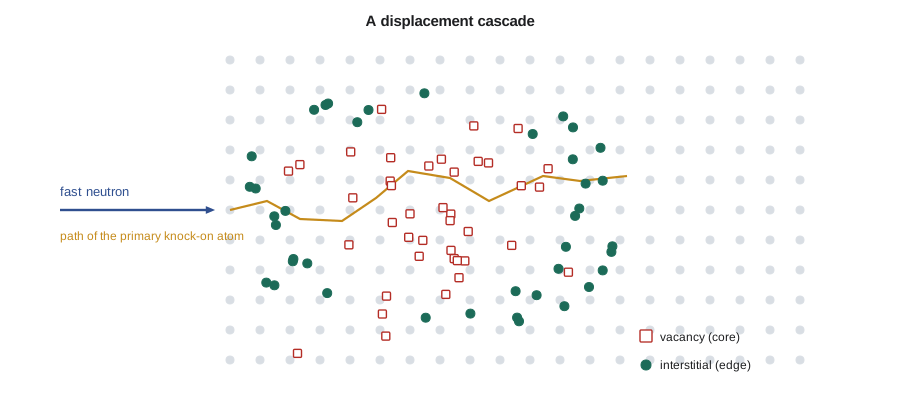
For iron (A = 56) and a 1 MeV neutron, this is about 70 keV, far more than the 25 to 40 eV needed to displace an atom permanently from its lattice site. The struck atom, called the primary knock-on atom, recoils through the lattice and collides with others, which in turn displace further atoms. The result is a displacement cascade: a small, dense region, a few nanometres across, in which hundreds of atoms are briefly knocked out of place. The cascade lasts only picoseconds. Most displaced atoms recombine with vacancies almost at once, leaving a smaller number of surviving defects.
Two kinds of point defect survive: vacancies, empty lattice sites, and self-interstitials, extra atoms squeezed between normal sites. At reactor temperatures both are mobile. They can recombine, migrate to sinks such as dislocations and grain boundaries, or cluster into larger defects. The long-term effects of irradiation are largely the effects of these defects and clusters on the material's microstructure.
Measuring dose: fluence and displacements per atom
Two measures of radiation dose to materials are in common use. Fluence is the time-integrated neutron flux, usually counted for neutrons above a stated energy, such as E > 1 MeV, in neutrons per square centimetre or per square metre. Fluence is easy to calculate from the reactor physics and is used in many engineering correlations, including the vessel embrittlement trend curves of Lesson 6.
Displacements per atom (dpa) is a more physical measure: the average number of times each atom has been displaced from its lattice site. It accounts for the neutron spectrum and the material, so it allows damage in different reactors, or in test reactors and power reactors, to be compared. The standard way to estimate the number of displacements from one primary knock-on atom is the Norgett–Robinson–Torrens (NRT) model:
where the damage energy T_dam is the part of the recoil energy not lost to electronic excitation, and E_d is the threshold displacement energy, about 40 eV for iron and zirconium. The dpa rate is the product of the flux and a displacement cross section that folds the NRT model into the spectrum. Molecular dynamics simulations show that the number of defects that actually survive the cascade is only about a third of the NRT number, but the NRT dpa remains the standard exposure unit because it is reproducible and widely tabulated.
| Component | Typical lifetime dose | Comment |
|---|---|---|
| PWR vessel wall at the beltline | about 0.05 to 0.15 dpa over 60 years | low dose, but enough to raise the transition temperature |
| CANDU pressure tube | roughly 10 to 20 dpa or more over a tube lifetime | drives creep, growth and hardening |
| Fuel cladding | several to about 10 dpa over a few years in core | high dose, short residence |
| PWR core baffle bolts and internals | tens of dpa near the core | irradiation-assisted cracking, swelling |
| Fast reactor cladding and ducts | over 100 dpa | swelling-resistant ferritic steels needed |
Worked problem
Counting displacements
A primary knock-on atom in iron has a damage energy of 20 keV. Estimate the number of displaced atoms by the NRT model with E_d = 40 eV.
Show solution
- Substitute into the NRT formula: N_d = 0.8 × 20 000 / (2 × 40).
- N_d = 16 000 / 80 = 200 displacements.
Answer: About 200 atoms are displaced by one recoil, though only about a third of these survive as isolated defects after the cascade cools.
# Displacements per atom (dpa) with the NRT model.
# Number of displacements per primary knock-on atom: N = 0.8 * T_dam / (2 * E_d)
E_d = {"iron": 40.0, "zirconium": 40.0, "graphite (carbon)": 30.0}   # eV, typical values
def nrt(T_dam_eV, Ed):
    if T_dam_eV < Ed: return 0.0
    if T_dam_eV < 2.5 * Ed: return 1.0
    return 0.8 * T_dam_eV / (2.0 * Ed)
# A 20 keV damage energy cascade in iron:
print(f"NRT displacements for 20 keV in iron: {nrt(20e3, E_d['iron']):.0f}")
# dpa rate = flux (fast) x displacement cross section
sigma_d = 1000e-24          # cm2, about 1000 barn-scale displacement cross section for fast neutrons in steel
cases = {"PWR vessel wall (inner surface)": 3e10, "CANDU pressure tube": 3.5e13, "PWR fuel cladding": 1e14}
seconds_per_year = 3.156e7 * 0.9      # 90 percent capacity factor
for name, phi in cases.items():
    rate = phi * sigma_d               # dpa per second
print(f"{name:34s} fast flux {phi:.1e} n/cm2/s -> {rate*seconds_per_year:.3g} dpa per year")NRT displacements for 20 keV in iron: 200 PWR vessel wall (inner surface) fast flux 3.0e+10 n/cm2/s -> 0.000852 dpa per year CANDU pressure tube fast flux 3.5e+13 n/cm2/s -> 0.994 dpa per year PWR fuel cladding fast flux 1.0e+14 n/cm2/s -> 2.84 dpa per year
From defects to microstructure
Surviving defects reorganise into features that can be seen with a transmission electron microscope. The most important for water-cooled reactor materials are:
| Feature | How it forms | Effect on properties |
|---|---|---|
| Dislocation loops | interstitials (or vacancies) cluster into small discs bounded by dislocations | hardening; anisotropic growth in zirconium |
| Solute clusters and precipitates | irradiation speeds diffusion, so solute atoms such as copper, nickel and manganese cluster | hardening and embrittlement of steels |
| Voids and bubbles | vacancies cluster into cavities, often stabilised by helium | swelling, mainly at higher temperatures |
| Radiation-induced segregation | defect flows to grain boundaries drag or deplete solutes | chromium depletion and cracking in stainless steels |
| Amorphisation or phase change | second-phase particles dissolve or become disordered | changes in corrosion behaviour of zirconium alloys |
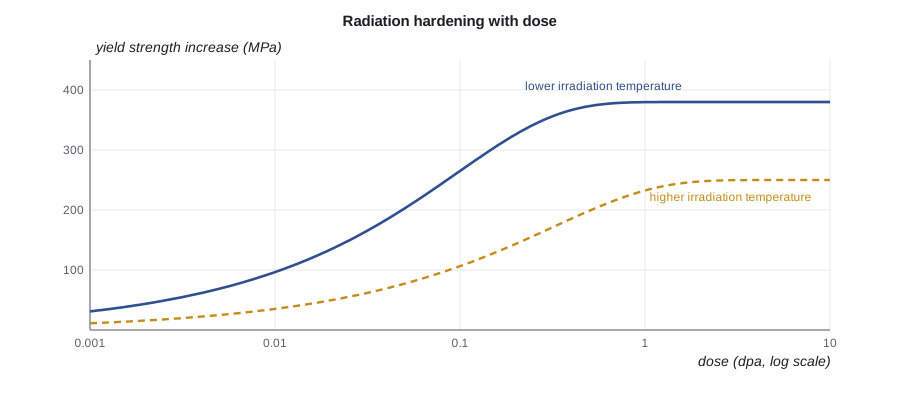
Temperature controls which features dominate. At low temperatures, below about a third of the melting point on the absolute scale, vacancies are barely mobile and small defect clusters accumulate, causing hardening. At intermediate temperatures, vacancies and interstitials both move, and loops, solute clusters and segregation develop. At high temperatures, vacancies cluster into voids, and the material may swell. For water reactors at about 300 °C, steels and zirconium alloys sit in the low to intermediate range, so hardening, embrittlement, creep and growth are the main concerns, while swelling matters mainly for stainless steel internals close to the core and for fast reactors.
Effects on mechanical properties
The small defect clusters and precipitates act as obstacles to dislocation motion. A metal deforms plastically when dislocations glide; if they meet obstacles, a higher stress is needed. Irradiation therefore raises the yield strength, an effect called radiation hardening. The increase rises rapidly at first and then tends to saturate with dose. Ultimate strength rises less than yield strength, so the margin between them narrows, uniform elongation falls and the material loses some ability to strain-harden. In steels with a ductile-to-brittle transition, hardening raises the temperature at which the transition occurs, which is the embrittlement of Lesson 6.
The dispersed-barrier formula above estimates the hardening from N obstacles of size d per unit volume, with the shear modulus μ, the Burgers vector b, an obstacle strength α and the Taylor factor M. It explains why many small obstacles harden more than a few large ones, and why hardening grows roughly as the square root of the obstacle density.
Transmutation and helium
Neutrons also change the composition of materials by nuclear reactions. In nickel-bearing alloys, the two-step reaction of nickel-58 through nickel-59 produces helium by an (n, α) reaction, which collects in bubbles at grain boundaries and can reduce ductility at high temperatures. Boron impurities produce helium and lithium. In zirconium alloys, transmutation is small, but in fuel the fission products themselves are the ultimate transmutation effect: new elements, including gases, accumulate inside the ceramic. Hydrogen from corrosion is not transmutation, but it is equally important in zirconium alloys, as Lesson 4 shows.
Annealing and recovery
Because many defects are not stable at higher temperatures, heating an irradiated material can restore much of its original properties. This is the basis of thermal annealing of reactor vessels, which has been done at a few plants, mainly in Eastern Europe, by heating the beltline to about 450 °C for a week or more. After annealing, embrittlement begins again with further irradiation, so re-embrittlement must also be predicted. Annealing is rarely used in North America, where vessels have generally been managed by fluence reduction, careful operation and analysis.
At the end of the day, Malik points Hana to a drawer of small square bars: Charpy specimens from a surveillance capsule. "Each of these was in the reactor for years. When you break them next week, you will be measuring the result of trillions of those cascades."
Where the data come from
Radiation damage data come from three kinds of irradiation, each with strengths and limits. Materials test reactors provide high fast fluxes, so specimens can reach many dpa in a few years, and their temperature and environment can be controlled closely. Surveillance programs in power reactors expose specimens to the real spectrum, temperature and dose rate, but they accumulate dose slowly and only at a few locations. Ion beams from accelerators can produce tens of dpa in hours, which makes them valuable for studying mechanisms and screening new alloys, but the damage is confined to a layer a few micrometres deep and the dose rate is thousands of times higher than in a reactor.
| Source | Dose rate | Strength | Limitation |
|---|---|---|---|
| Power reactor surveillance | low, the same as the component | real spectrum, temperature and chemistry | slow; few locations |
| Materials test reactor | higher, often ten times or more | high dose quickly; instrumented capsules | spectrum and dose rate differ from service |
| Ion irradiation | very high | fast, cheap, no induced activity | shallow damage layer; no transmutation helium unless added |
A recurring question is whether damage at a high dose rate is equivalent to damage at a low dose rate reaching the same dpa. For many properties it is close, but not always. In steels, the formation of solute clusters depends on how far defects can diffuse before they recombine or reach a sink, and at very low dose rates, as at a vessel wall, more embrittlement may occur at a given fluence than test reactor data suggest. This flux effect is one reason why surveillance data from the power reactor itself carry so much weight, and why recent embrittlement trend models were fitted mainly to power reactor surveillance data rather than test reactor results.
Computer models of damage
Computer simulation now plays a large part in understanding radiation damage. Molecular dynamics follows every atom in a cascade over picoseconds and gives the number and arrangement of surviving defects. Kinetic Monte Carlo and rate theory models then follow how those defects diffuse, cluster and annihilate over years. Dislocation dynamics models predict how the resulting obstacles raise strength. Linking these scales, from atoms to components, is the aim of multiscale modelling. The models do not replace testing, but they help interpret data, extrapolate trends cautiously and design alloys that are more resistant to irradiation, for example by adding many fine sinks, such as nanometre-scale oxide particles, that absorb defects before they cluster.
Hana notes in her logbook that every number she will use in later lessons, from a shift in transition temperature to a creep rate, is in the end a correlation fitted to measured data, sometimes supported by these models. Malik's advice is simple: always know which data set a correlation was fitted to, and be cautious whenever you extrapolate beyond it.
Summary and key terms
- Fast neutrons transfer energy to atoms, creating displacement cascades in which hundreds of atoms are briefly displaced.
- Surviving vacancies and interstitials migrate, recombine or cluster into loops, voids and solute clusters.
- Dose is measured by fast fluence or by displacements per atom (dpa), commonly estimated with the NRT model.
- Small obstacles raise yield strength (radiation hardening), reduce ductility and raise the ductile-to-brittle transition temperature.
- Temperature controls which microstructural features dominate; swelling mainly matters at higher temperatures and doses.
- Transmutation produces helium in some alloys, and annealing can restore properties, though re-embrittlement follows.
- Displacement cascade
- The burst of atomic displacements caused by one energetic recoil atom.
- Primary knock-on atom
- The first atom struck by a neutron, which then displaces others.
- Fluence
- Time-integrated neutron flux, usually counted above a stated energy.
- dpa
- Displacements per atom, a measure of radiation damage dose.
- Radiation hardening
- The rise in yield strength caused by irradiation-produced obstacles to dislocation motion.
- Void swelling
- Volume increase from vacancy clusters forming cavities in a material.
Practice problems
Work each problem on paper first, then reveal the answer to check.
What is the maximum fraction of a neutron's energy that can be transferred to an iron nucleus in an elastic collision?
Show answer
\(4A/(1+A)^2\) with A = 56, about 0.069.
Why is dpa preferred over fluence for comparing different reactors?
Show answer
It accounts for the neutron spectrum and the material, so damage can be compared directly.
What fraction of NRT displacements typically survive the cascade?
Show answer
About one third.
Why does irradiation raise yield strength?
Show answer
Defect clusters and precipitates obstruct dislocation motion.
Why does thermal annealing not end embrittlement permanently?
Show answer
Further irradiation creates new defects, so the material re-embrittles.
Lesson quiz · 5 questions
Score 60% or more to complete this lesson.
Create a free account to save your progress, take quizzes and earn a certificate.