
NUC-300 · Lesson 9 of 12 · 23 min
Reactivity and criticality
So far Hana has calculated \(k_{\text{eff}}\) as a number close to one. In the control room nobody talks about \(k\). They talk about reactivity, in milli-k, pcm or dollars, about rod worth, shutdown margin and excess reactivity. Teodora explains that reactivity is simply a more convenient way of saying how far \(k\) is from one, and that almost every safety requirement of a reactor core is written in reactivity terms. This lesson builds that vocabulary and the bookkeeping behind it.
Defining reactivity
Reactivity \(\rho\) is the fractional departure of the multiplication factor from one:
A critical reactor has \(\rho = 0\), a supercritical one has \(\rho > 0\) and a subcritical one has \(\rho < 0\). For \(k\) close to one, \(\rho \approx k - 1\). Reactivity is a small number, so several units are used. One milli-k (mk) is \(10^{-3}\), the unit traditionally used in Canada. One pcm, per cent mille, is \(10^{-5}\), used widely in light water reactor work, so 1 mk equals 100 pcm. Reactivity is also expressed in dollars and cents, in units of the delayed neutron fraction \(\beta\): one dollar of reactivity equals \(\beta\), and one cent is a hundredth of that. Lesson 10 shows why the dollar is the natural unit for reactor dynamics.
Operators and physicists at the Darlington CANDU station use milli-k throughout: zone controllers are worth a few mk, adjuster rods together about 15 mk, and the shutoff rods and liquid poison injection of the two shutdown systems each many tens of mk.
| Unit | Value | Common use |
|---|---|---|
| Δk/k | 1 | General physics |
| Milli-k (mk) | 10⁻³ | Canadian practice, CANDU reactors |
| Per cent mille (pcm) | 10⁻⁵ | Light water reactor practice |
| Dollar | β (about 0.0065 for U-235 fuel) | Reactor kinetics and safety analysis |
| Cent | β/100 | Small changes in kinetics experiments |
Adding reactivities
Independent changes, such as moving a rod and changing temperature, have reactivities that add, to first order. Strictly the multiplication factors multiply: if one change multiplies \(k\) by \(k_1\) and another by \(k_2\), the result is \(k_1 k_2\). For small changes \(\ln(k_1k_2) = \ln k_1 + \ln k_2\), and since \(\rho \approx \ln k\) near one, reactivities add. The program shows the size of the error: combining +2 mk and −3 mk by multiplication gives −1.007 mk rather than the simple sum of −1.013 mk, a difference far smaller than the uncertainty in either. For large changes, such as the worth of all control rods together, the interaction between devices matters, and reactivities do not simply add.
Worked problem
Converting between units
A fresh light water core has \(k_{\text{eff}} = 1.005\) with all rods withdrawn and no boron. Express the excess reactivity in mk, pcm and dollars with \(\beta = 0.0065\).
Show solution
- \(\rho = 0.005/1.005 = 0.004975\).
- In mk: 4.98 mk. In pcm: 498 pcm.
- In dollars: \(0.004975/0.0065 = 0.77\) dollars.
Answer: Just under eighty cents of excess reactivity, less than prompt critical, as lesson 10 will make clear.
# Reactivity units and conversions.
beta = {'U-235 core (fresh LWR)': 0.0065, 'CANDU, natural U with plutonium build-up': 0.0058, 'Pu-239 rich core': 0.0021}
def rho(k): return (k - 1) / k
for k in (0.99, 0.999, 1.001, 1.005):
    r = rho(k)
    print(f"k = {k:.3f}: rho = {r:+.5f} = {r * 1e5:+7.1f} pcm = {r * 1e3:+6.2f} mk = {r / 0.0065:+.3f} dollars (beta 0.0065)")
print()
for name, b in beta.items():
    print(f"{name}: 1 dollar = {b * 1e3:.2f} mk = {b * 1e5:.0f} pcm")
# combining two independent changes: reactivities add (to first order), k's multiply
k1, k2 = 1.002, 0.997
print(f"\nk combined = {k1 * k2:.5f}, rho combined = {rho(k1 * k2) * 1e3:+.3f} mk, sum = {(rho(k1) + rho(k2)) * 1e3:+.3f} mk")k = 0.990: rho = -0.01010 = -1010.1 pcm = -10.10 mk = -1.554 dollars (beta 0.0065) k = 0.999: rho = -0.00100 = -100.1 pcm = -1.00 mk = -0.154 dollars (beta 0.0065) k = 1.001: rho = +0.00100 = +99.9 pcm = +1.00 mk = +0.154 dollars (beta 0.0065) k = 1.005: rho = +0.00498 = +497.5 pcm = +4.98 mk = +0.765 dollars (beta 0.0065) U-235 core (fresh LWR): 1 dollar = 6.50 mk = 650 pcm CANDU, natural U with plutonium build-up: 1 dollar = 5.80 mk = 580 pcm Pu-239 rich core: 1 dollar = 2.10 mk = 210 pcm k combined = 0.99899, rho combined = -1.007 mk, sum = -1.013 mk
The output shows that the dollar shrinks as plutonium replaces uranium-235, because plutonium-239 emits fewer delayed neutrons per fission. A CANDU core at equilibrium, with much of its power from plutonium, has a dollar of about 5.8 mk rather than the 6.5 mk of fresh uranium fuel, and a core with mainly plutonium would have a dollar near 2 mk. The same reactivity in mk is a larger fraction of a dollar in plutonium-rich fuel, which is one reason kinetics data are updated as fuel burns.
Excess reactivity, control and shutdown margin
A reactor cannot run for months on a fuel load that is only just critical, because fuel burns and fission products build up. The fresh core must therefore carry excess reactivity, positive reactivity above zero with all controls withdrawn, which is held down by control. The total worth of all control means, \(\rho_{\text{control}}\), must exceed the excess reactivity, and the difference is the shutdown margin:
Regulators require that the reactor can be made subcritical by a stated margin in every credible condition, including the most reactive point in the fuel cycle, the coldest moderator, the most reactive xenon state, and with the most effective single rod assumed stuck out of the core. That last condition, the stuck rod criterion, ensures that one mechanical failure cannot prevent shutdown.
In a CANDU reactor, on-power refuelling means the core carries only a small excess reactivity, a few mk, at any time. The two independent shutdown systems, mechanical shutoff rods and liquid gadolinium nitrate injected into the moderator, each have worth far larger than that excess. the Canadian Nuclear Safety Commission (CNSC) requires that the design meet its deterministic safety analysis requirements, set out in REGDOC-2.4.1, which cover the shutdown systems' effectiveness for each design basis event.
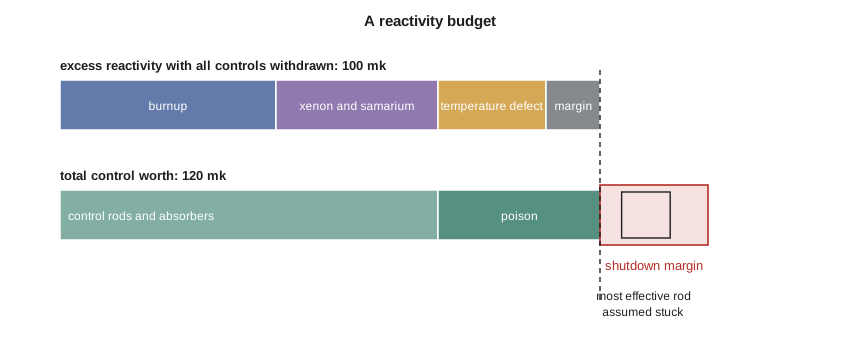
Where excess reactivity goes
Teodora walks Hana through the budget for a fresh core. Part of the excess pays for burnup over the cycle. Part pays for xenon and samarium, fission product poisons that build up within days of starting the reactor and are covered in Reactor Physics II. Part pays for the temperature defect, the reactivity lost as the core heats from cold to hot operating conditions, which lesson 12 explains. The remainder is a margin for operation and control. Each item can be tens of mk in a light water reactor; in a CANDU, the burnup allowance is small because the core is refuelled continuously, which is why CANDU control devices can be modest in worth.
Measuring reactivity
Reactivity cannot be measured with a gauge; it is inferred from the behaviour of the neutron population. The main methods are the following. The period method measures the stable period after a small positive step and converts it to reactivity with the inhour equation of lesson 11. The rod drop method inserts a rod quickly and analyses the fall in flux. Inverse kinetics computes reactivity continuously from the measured power history by solving the point kinetics equations backwards; digital reactivity meters at new-core start-ups do exactly this. Subcritical multiplication measurements estimate how far below critical a core is from the source count rate, as in lesson 1. Each method gives reactivity in dollars, because the neutron population responds to reactivity relative to \(\beta\); converting to mk or pcm requires a calculated value of \(\beta\).
Control rod worth and flux weighting
How much reactivity an absorber is worth depends on where it is. Perturbation theory shows that a small change in absorption \(\delta\Sigma_a\) at position \(\mathbf{r}\) changes reactivity by an amount proportional to \(\delta\Sigma_a\,\phi\,\phi^\dagger\), where \(\phi^\dagger\) is the adjoint flux or importance, which in one-group theory is the same shape as the flux itself. An absorber is therefore worth roughly in proportion to the square of the local flux. Moving a rod to the core centre, where the flux is highest, multiplies its worth several times over an edge position.
A long rod inserted from the top of a core gains worth slowly at first, where the flux is low, then faster through the middle and slowly again near the bottom, giving the familiar S-shaped integral rod worth curve. Its slope, the differential worth, is largest near mid-core. Operators use differential worth curves to know how much reactivity each step of rod motion adds or removes.
Worked problem
Rod worth from a period measurement
In a start-up test, a rod bank is withdrawn by a small step and the power rises with a stable period of 98 s. Using the six-group inhour result of lesson 11 for uranium-235 fuel, this period corresponds to about 0.1 dollars. Express the step in pcm.
Show solution
- 0.1 dollars \(\times\) 0.0065 = \(6.5 \times 10^{-4}\).
- In pcm: 65 pcm; in mk: 0.65 mk.
Answer: The step was worth about 65 pcm. Repeating the measurement step by step builds the bank's integral worth curve.
Criticality as a calculated quantity
Before any core is loaded, its critical condition is predicted by calculation, and at start-up the prediction is checked. A light water reactor's predicted critical boron concentration and a CANDU's predicted zone controller levels are compared with the measured values; agreement within a few tenths of a percent in reactivity is typical of modern methods. Persistent differences, called biases, are tracked over many cycles and folded into future predictions. Hana now understands why Teodora keeps a long spreadsheet of predicted and measured critical conditions going back decades: it is the best evidence of how good the group's methods really are.
A reactivity balance in the control room
Teodora takes Hana to the simulator to see reactivity bookkeeping as operators live it. The simulated core is at full power and steady. An operator reduces power by 10 percent; the fuel and coolant cool slightly, which adds reactivity through the negative power coefficient, so the control system must insert absorber to stay critical at the lower power. Over the next hours xenon builds up after the power reduction, removing reactivity, and the control system slowly withdraws absorber again. At every moment, the sum of all reactivity contributions, from control devices, temperatures, xenon and burnup, is zero.
Hana starts to read the control system's actions as entries in a ledger. When the operators raise power, the power defect is paid by withdrawing absorber. When fuel burns, the burnup loss is paid the same way, until the absorber is used up and refuelling is needed. When a shutdown is ordered, the shutdown systems add a large negative entry, and the net reactivity falls tens of mk below zero. The language of reactivity, she realizes, is the language in which every operating decision is recorded.
Criticality safety outside the reactor
The same reactivity ideas apply wherever fissile material is handled outside a reactor: in fuel fabrication plants, during transport and in spent fuel storage. There the goal is the opposite of reactor operation. Every configuration must be kept safely subcritical with a margin, typically \(k_{\text{eff}} \le 0.95\) including uncertainties, by controlling geometry, spacing, moderation, absorbers and the amount and enrichment of fissile material. Spent fuel pools, for example, use fixed borated absorber panels between assemblies. Criticality safety analysts use the same transport codes as core designers, but with the aim of demonstrating subcriticality rather than predicting criticality.
Common mistakes
MistakeTreating reactivity and k − 1 as always equal.
Insteadρ = (k − 1)/k; they agree only when k is close to one.
MistakeAssuming a dollar is the same size in every core.
InsteadA dollar equals β, which falls as plutonium contributes more fissions.
MistakeAdding the worths of many rods to get the total bank worth.
InsteadRods interact; large worths must be calculated together.
MistakeAssuming shutdown margin is checked only at the start of a cycle.
InsteadIt must hold at the most reactive condition, often cold and at a particular point in the cycle.
Summary and key terms
- Reactivity ρ = (k − 1)/k expresses how far a core is from critical.
- Units: 1 mk = 10⁻³ = 100 pcm; one dollar equals β.
- Small reactivities add; strictly, multiplication factors multiply.
- Shutdown margin is control worth minus excess reactivity, with the most effective rod assumed stuck.
- Reactivity is measured through the neutron population's response, in dollars.
- Absorber worth scales roughly with the square of the local flux; rod worth curves are S-shaped.
- Reactivity
- The fractional departure of k from one, (k − 1)/k.
- Milli-k
- A reactivity of 10⁻³, used in Canadian practice.
- Pcm
- Per cent mille, a reactivity of 10⁻⁵.
- Dollar
- A reactivity equal to the effective delayed neutron fraction β.
- Excess reactivity
- The reactivity of a core with all control withdrawn.
- Shutdown margin
- The amount by which a core would be subcritical with all control inserted, less the most effective rod.
- Differential rod worth
- The reactivity change per unit of rod motion at a given position.
- Inverse kinetics
- Calculating reactivity from a measured power history using the kinetics equations.
Practice problems
Work each problem on paper first, then reveal the answer to check.
k = 0.995. Find ρ in mk and pcm.
Show answer
ρ = −0.005/0.995 = −5.03 mk = −503 pcm.
Express 300 pcm in dollars for β = 0.0065.
Show answer
0.003/0.0065 = 0.46 dollars.
Using the program, what is one dollar in mk for the CANDU equilibrium case?
Show answer
5.80 mk.
Control worth is 85 mk and excess reactivity 62 mk; the most effective rod is worth 9 mk. Find the shutdown margin with one rod stuck.
Show answer
85 − 9 − 62 = 14 mk.
An absorber moved from a position with relative flux 0.5 to one with 1.0 changes worth by about what factor?
Show answer
About four, since worth scales with flux squared.
Why must reactivity measured by period be converted with a calculated β?
Show answer
The neutron response gives reactivity in dollars; mk or pcm need β.
Lesson quiz · 5 questions
Score 60% or more to complete this lesson.
Create a free account to save your progress, take quizzes and earn a certificate.