
NUC-300 · Lesson 1 of 12 · 22 min
Neutron population and multiplication
Hana Okoye has moved from the public information team at Meridian Nuclear Engineering into the core physics group in Oshawa. Her new lead, Dr. Teodora Vasquez, has spent twenty years running reactor physics calculations for the Darlington CANDU station and now reviews the core design for the BWRX-300 planned at Darlington. On Hana's first morning Teodora gives her a single sheet of paper with one question on it: if a thousand neutrons are born in the core right now, how many will there be one generation from now, and where do the others go? Everything in this course, she says, is a more careful answer to that question.
Reactor physics is the study of how a population of free neutrons behaves inside a reactor core: how neutrons are born in fission, how they slow down, travel, leak out or get absorbed, and how the population as a whole grows, shrinks or holds steady. The engineering goal is simple to state. A power reactor must hold its neutron population exactly steady at the power the operators want, change it slowly and smoothly when they ask, and shut it down quickly and reliably whenever needed. The physics in this course is what makes those three tasks possible and predictable.
Neutrons as a population
A large power reactor contains roughly \(10^{9}\) free neutrons per cubic centimetre at full power, moving at speeds from a few kilometres per second down to about 2.2 km/s for thermal neutrons. We never follow individual neutrons in design work. Instead we treat them as a population, much like a demographer treats the people of a country, and ask about births, deaths and migration. Births come almost entirely from fission, plus a small contribution from photoneutrons and spontaneous sources. Deaths are absorptions, whether in fuel, coolant, moderator, structure or control devices. Migration is leakage out of the core boundary.
The life of a typical neutron in a thermal reactor runs through a recognizable cycle. It is born fast, with an average energy of about 2 MeV. It collides many times with moderator nuclei and loses energy, passing through the resonance region of uranium-238 where some neutrons are captured. It reaches thermal energies, around 0.025 to 0.1 eV, and diffuses until it is absorbed. If it is absorbed in a fissile nucleus and causes fission, two or three new fast neutrons appear and the cycle begins again. The time for one cycle, the prompt neutron lifetime, is about \(10^{-4}\) s in a light water reactor and closer to \(10^{-3}\) s in a heavy water reactor, because neutrons in heavy water take longer to slow down and survive longer once they are thermal.
The multiplication factor
The central quantity of the subject is the effective multiplication factor, \(k_{\text{eff}}\), defined as the ratio of the number of neutrons in one generation to the number in the generation before. It can equally be written as a ratio of rates: the rate at which neutrons are produced by fission divided by the rate at which they are lost by absorption and leakage.
Three cases matter. When \(k_{\text{eff}} = 1\) the reactor is critical: each generation exactly replaces itself and the power stays constant. When \(k_{\text{eff}} > 1\) it is supercritical and the population grows. When \(k_{\text{eff}} < 1\) it is subcritical and the population dies away, except for whatever is sustained by an external source. Critical does not mean dangerous; it is the normal, steady operating state of every power reactor. A reactor running at full power and one running at a thousandth of full power are both exactly critical. The difference between them is only the size of the population.
If a reactor were left alone with a constant \(k\), the population after \(m\) generations would be
With a generation time of \(10^{-4}\) s, even \(k = 1.001\) would multiply the population by \(e^{10} \approx 22\,000\) in one second if every neutron were born promptly. Real reactors do not behave like this, because a small fraction of fission neutrons is emitted seconds to a minute after fission. Lesson 10 shows how these delayed neutrons stretch the time scale from fractions of a millisecond to many seconds, which is what makes reactors controllable by mechanical devices and human operators. For now, the generation picture is the right way to think about which neutrons go where.
The infinite and effective multiplication factors
It is useful to separate two questions. First, if the core were infinitely large so that nothing leaked out, would the material itself multiply neutrons? The answer is the infinite multiplication factor \(k_\infty\), a property of the fuel, moderator and coolant mixture alone. Second, how much of that multiplication survives once a real, finite core loses neutrons through its surface? The fraction of neutrons that do not leak is the non-leakage probability \(P_{\text{NL}}\), and
A designer therefore needs a lattice with \(k_\infty\) comfortably above one, and a core large enough that leakage does not eat the whole margin. Lesson 2 breaks \(k_\infty\) into factors that each describe one stage of the neutron cycle, and lessons 4 to 7 compute \(P_{\text{NL}}\) from diffusion theory. A typical fresh power reactor lattice has \(k_\infty\) between about 1.1 and 1.4 and a non-leakage probability above 0.95, leaving an excess that must be held down by control rods, soluble boron, burnable absorbers or, in a CANDU reactor, light water zone controllers and absorber rods.
Worked problem
A neutron balance
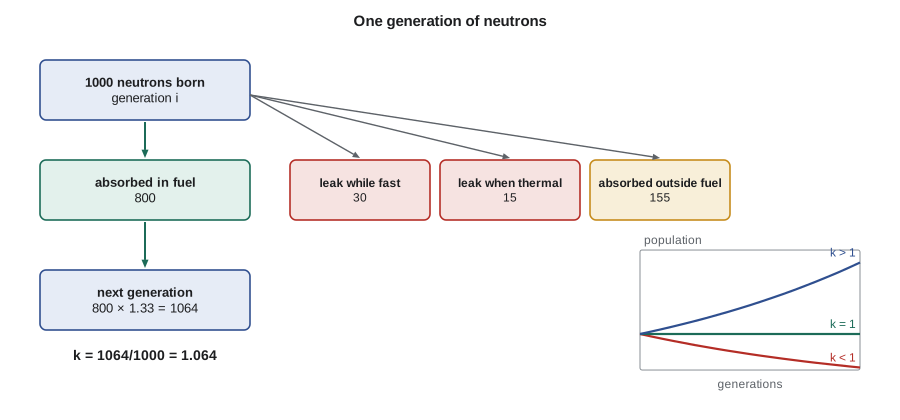
Of 1000 neutrons born in a large core, 30 leak out while fast, 15 leak out after thermalizing, and 155 are absorbed in moderator, coolant, structure and control material. The rest are absorbed in fuel, and each absorption in fuel yields on average 1.33 new fission neutrons. Find \(k_{\text{eff}}\).
Show solution
- Absorptions in fuel: \(1000 - 30 - 15 - 155 = 800\).
- Next generation: \(800 \times 1.33 = 1064\) neutrons.
- \(k_{\text{eff}} = 1064/1000 = 1.064\).
Answer: \(k_{\text{eff}} \approx 1.064\). To run steadily, about 6 percent more neutrons must be absorbed in control material, for example by inserting absorbers or adding boron.
# Neutron generations: population growth for different multiplication factors.
# Illustrative only; a real reactor's response is set by delayed neutrons (lesson 10).
def generations(k, n0=1000.0, steps=10):
    n = n0; out = [n]
    for _ in range(steps):
        n *= k; out.append(n)
    return out

for k in (0.98, 1.000, 1.002):
    pops = generations(k)
    print(f"k = {k:.3f}: " + "  ".join(f"{p:7.1f}" for p in pops[::2]))

# Neutron balance for one generation in a large core (per 1000 neutrons born)
born = 1000
leak_fast, leak_thermal = 30, 15
absorbed_nonfuel = 155   # moderator, coolant, structure, control
absorbed_fuel = born - leak_fast - leak_thermal - absorbed_nonfuel
nu_over_absorb = 1.33    # neutrons per absorption in fuel, eta (illustrative)
next_gen = absorbed_fuel * nu_over_absorb
print(f"\nabsorbed in fuel: {absorbed_fuel}, next generation: {next_gen:.0f}")
print(f"k = {next_gen / born:.4f}")
print(f"generations to double at k = 1.002: {__import__('math').log(2) / __import__('math').log(1.002):.0f}")k = 0.980: 1000.0 960.4 922.4 885.8 850.8 817.1 k = 1.000: 1000.0 1000.0 1000.0 1000.0 1000.0 1000.0 k = 1.002: 1000.0 1004.0 1008.0 1012.1 1016.1 1020.2 absorbed in fuel: 800, next generation: 1064 k = 1.0640 generations to double at k = 1.002: 347
The program shows how slowly a population changes over ten generations when \(k\) is close to one, and how many generations are needed to double the population at \(k = 1.002\). Note that at \(k = 0.98\) the population falls by about 2 percent per generation; a reactor shut down with a few percent of negative margin loses its neutrons quickly, but not instantly, and the decline is then governed by delayed neutrons and any source present.
Subcritical multiplication and sources
A subcritical core is not empty. Spontaneous fission, reactions of alpha particles with oxygen-17 and oxygen-18 in oxide fuel, photoneutrons from gamma rays acting on deuterium, and dedicated start-up sources all supply neutrons. If a source emits \(S\) neutrons per generation into a core with \(k < 1\), the steady population is the sum of a geometric series:
The factor \(M = 1/(1-k)\) is the subcritical multiplication. At \(k = 0.95\), \(M = 20\); at \(k = 0.99\), \(M = 100\). As \(k\) approaches one, \(M\) grows without limit, which is why start-up instruments are watched closely during the approach to criticality. Operators raise reactivity in steps, wait for the count rate to settle, and plot the inverse count rate against rod position or boron concentration. The inverse count rate falls toward zero as criticality approaches, and extrapolating the line predicts where criticality will occur before it is reached. This is the inverse multiplication or 1/M method, used at first start-up of every new core.
In a CANDU reactor, deuterium in the heavy water moderator gives a strong photoneutron source from the gamma rays of fission products. After the reactor has operated at power, this source keeps the neutron population, and therefore the start-up instrument readings, well above zero for weeks after shutdown. Operators at the Darlington CANDU station use that to their advantage during a restart.
Neutron economy: why designs differ
The phrase neutron economy describes how carefully a design spends its neutrons. Every neutron absorbed in something other than fuel, or lost through the surface, is a neutron that cannot cause the next fission. Designs that waste few neutrons can run on less fissile material; designs that waste more must make up the difference with enrichment.
CANDU reactors are the classic example of a tight neutron economy. Natural uranium contains only 0.72 percent uranium-235, so there is little margin to spare. The design therefore uses heavy water as moderator and coolant, because deuterium absorbs about six hundred times fewer thermal neutrons than ordinary hydrogen, and it keeps structural materials in the core to a minimum, using zirconium alloys for pressure tubes, calandria tubes and fuel sheaths. The core is also large, about 7 m across, to keep leakage low. The result is a lattice that is critical on natural uranium, at the cost of a large core and a costly moderator inventory.
Neither choice is better in every respect. A good neutron economy reduces fuel cost and allows natural uranium, while enrichment allows a compact, high-power-density core and long fuel cycles. Throughout this course Hana will compare the two families side by side, because the same equations describe both and the differences come down to the numbers that go into them.
What controls k in practice
Almost everything an operator does changes \(k\) by changing one of the terms in the balance. Inserting a control rod adds absorption. Diluting soluble boron in a pressurized water reactor removes absorption. Raising the fuel temperature broadens uranium-238 resonances and increases capture, lowering \(k\) at once. Changing coolant density changes moderation and absorption, by an amount and direction that depend on the design. As fuel burns, fissile atoms are used up, plutonium is produced and fission products that absorb neutrons build up. A reactor physicist's daily work is tracking all of these effects so that the core stays critical where wanted and has enough shutdown margin in every condition.
Teodora sums up the morning with a sentence Hana writes at the top of her notebook: keep the books balanced, neutron by neutron. Production must equal losses at every moment the reactor runs at steady power, and every design decision either adds to production, adds to losses or moves neutrons from one column to the other.
| Quantity | Symbol | Typical value |
|---|---|---|
| Prompt neutron lifetime, light water reactor | l | about 10⁻⁴ s |
| Prompt neutron lifetime, heavy water reactor | l | about 10⁻³ s |
| Average fission neutron energy | E | about 2 MeV |
| Neutrons per fission (U-235, thermal) | ν | about 2.43 |
| Infinite multiplication, fresh lattice | k∞ | 1.1 to 1.4 |
| Non-leakage probability, large power core | P_NL | 0.95 to 0.98 |
Common mistakes
MistakeThinking that critical means a dangerous or runaway condition.
InsteadCritical means a steady, self-sustaining population; every operating reactor is critical.
MistakeUsing the prompt generation time to predict how fast power changes.
InsteadDelayed neutrons set the real time scale; see lessons 10 and 11.
MistakeTreating k∞ as a property of the whole core.
Insteadk∞ describes the lattice material; leakage depends on core size and shape.
MistakeAssuming a subcritical core has no neutrons.
InsteadSources and subcritical multiplication S/(1 − k) keep a measurable population.
Summary and key terms
- Reactor physics treats free neutrons as a population with births (fission), deaths (absorption) and migration (leakage).
- The effective multiplication factor k_eff is the ratio of successive generations, or of production to losses.
- k_eff = 1 is critical and steady; k_eff > 1 grows; k_eff < 1 dies away apart from sources.
- k_eff = k∞ × P_NL separates the lattice material from the leakage of a finite core.
- Subcritical multiplication S/(1 − k) underlies the 1/M approach to criticality.
- Delayed neutrons, not the prompt lifetime, set the time scale of power changes.
- Effective multiplication factor
- The ratio of neutrons in one generation to the previous one in a real, finite core.
- Infinite multiplication factor
- The multiplication of the lattice material if no neutrons leaked out.
- Critical
- A state with k_eff = 1, in which the neutron population is self-sustaining and steady.
- Non-leakage probability
- The fraction of neutrons that are absorbed in the core rather than leaking out.
- Prompt neutron lifetime
- The average time from the birth of a prompt neutron to its absorption.
- Subcritical multiplication
- The factor 1/(1 − k) by which a subcritical core multiplies a neutron source.
- Inverse multiplication method
- Plotting 1/M against reactivity changes to predict where criticality will occur.
Practice problems
Work each problem on paper first, then reveal the answer to check.
A core has k_eff = 0.97 and a source of 10⁶ neutrons per generation. Find the steady population per generation.
Show answer
10⁶/(1 − 0.97) = 3.3 × 10⁷.
k∞ = 1.15 and P_NL = 0.96. Find k_eff.
Show answer
1.15 × 0.96 = 1.104.
How many generations does it take to double a population at k = 1.001?
Show answer
ln 2/ln 1.001 ≈ 693 generations.
A subcritical count rate rises from 200 to 800 counts per second as rods are withdrawn. By what factor did 1/M change?
Show answer
It fell to one quarter, so the core is much closer to critical.
Using the program, what is the population after ten generations at k = 0.98, starting from 1000?
Show answer
About 817.
Name three ways an operator can reduce k_eff.
Show answer
Insert control rods, add soluble boron or other absorber, or let fuel temperature rise; in a CANDU, raise zone controller water levels or insert absorber rods.
Lesson quiz · 5 questions
Score 60% or more to complete this lesson.
Create a free account to save your progress, take quizzes and earn a certificate.