
NUC-300 · Lesson 2 of 12 · 23 min
The four- and six-factor formulas
Teodora's second assignment is a page from an old design manual with a column of six numbers on it, each between about 0.7 and 1.9, and their product at the bottom. Hana recognizes the six-factor formula from her undergraduate notes but has never used it on a real lattice. Teodora explains that nobody designs a modern core with it, yet every reactor physicist still reaches for it first, because it says in plain terms where the neutrons go and which part of the design is responsible for each loss.
Following one generation of neutrons
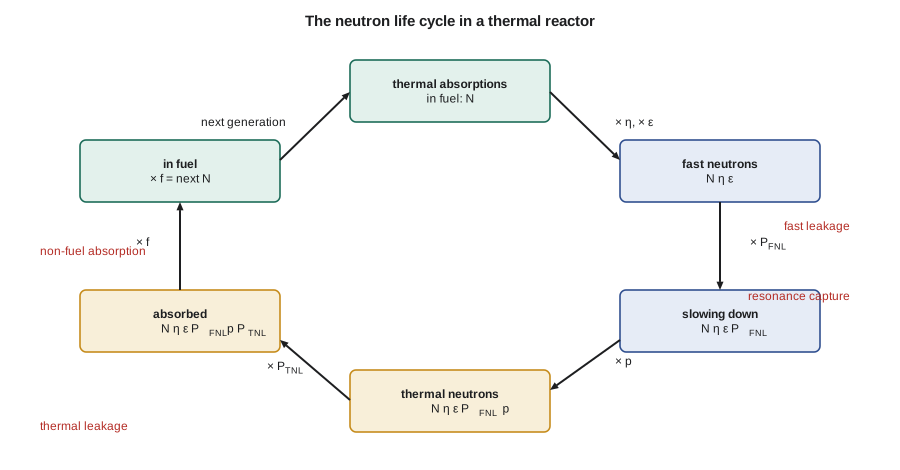
The six-factor formula follows a generation of neutrons through a thermal reactor stage by stage. Start with \(N\) thermal neutrons absorbed in fuel. They cause fission and release fast neutrons. A few of those fast neutrons cause fission in uranium-238 before slowing down, adding more. Some fast neutrons leak from the core. The survivors slow down, and on the way some are captured in uranium-238 resonances. The neutrons that reach thermal energy may leak while diffusing. The rest are absorbed, either in fuel, which starts the next generation, or in everything else. Each stage multiplies the population by a factor, and the product of all six is \(k_{\text{eff}}\).
The first four factors describe the material and together give \(k_\infty = \eta f p \varepsilon\), the four-factor formula. The last two are the fast and thermal non-leakage probabilities, which depend on the size and shape of the core and the migration properties of the lattice.
The reproduction factor, eta
The reproduction factor \(\eta\) is the average number of fission neutrons produced per thermal neutron absorbed in the fuel. It combines the neutrons per fission \(\nu\) with the chance that an absorption in fuel actually causes fission rather than capture:
Here the subscripts 25 and 28 are the traditional shorthand for uranium-235 and uranium-238. For pure uranium-235 at thermal energy, \(\eta \approx 2.43 \times 585/681 \approx 2.09\). Uranium-238 absorbs without fissioning at thermal energies, so diluting the fissile isotope lowers \(\eta\). For natural uranium the thermal value is about 1.33 to 1.35; at 3 to 5 percent enrichment it rises to about 1.85 to 1.93. These numbers set the basic economics of the two reactor families: a natural uranium lattice starts with only about 0.3 neutrons to spare per absorption in fuel, while an enriched lattice starts with nearly 0.9.
The thermal utilization factor, f
The thermal utilization factor \(f\) is the fraction of thermal neutrons absorbed in the fuel rather than in the moderator, coolant, cladding, structure or control material:
In a real lattice the thermal flux is depressed inside fuel pins, because fuel absorbs strongly, so the absorption rates use flux-weighted cross sections. The disadvantage factor, the ratio of average flux in the moderator to average flux in the fuel, enters \(f\) and is typically 1.05 to 1.3. Soluble boron in a pressurized water reactor and the light water in CANDU zone controllers both work mainly by lowering \(f\).
The resonance escape probability, p
While slowing down, neutrons pass through energies between about 6 eV and a few kilo-electronvolts where uranium-238 has very large capture resonances. The resonance escape probability \(p\) is the fraction of neutrons that reach thermal energy without being captured there. A widely used approximation relates it to the slowing-down power of the moderator and an effective resonance integral \(I\):
Lumping the fuel into rods or bundles, rather than mixing it uniformly with moderator, raises \(p\) greatly: neutrons at resonance energies are absorbed in the outer skin of the fuel, so the interior is shielded, an effect called self-shielding. That is why natural uranium can be critical in a heterogeneous heavy water or graphite lattice but never in a homogeneous mixture. The follow-on course, Reactor Physics II, treats resonance absorption in detail; here it is enough to know that more moderator per fuel atom raises \(p\) and lowers \(f\), and the best lattice balances the two.
The fast fission factor, epsilon
A few fast neutrons cause fission in uranium-238, whose fission threshold is about 1 MeV, before they slow down. The fast fission factor \(\varepsilon\) is the ratio of all fission neutrons to those from thermal fission. It is small in a CANDU lattice, about 1.02 to 1.03, because each bundle is surrounded by a large volume of heavy water and neutrons leave the fuel quickly. In a tightly packed light water lattice, where fuel occupies a larger share of the volume, it is larger, often quoted near 1.05 to 1.1 in textbook treatments, with higher values in some formulations that fold other fast effects into it.
The non-leakage probabilities
The fast non-leakage probability \(P_{\text{FNL}}\) is the fraction of fast neutrons that slow down inside the core, and the thermal non-leakage probability \(P_{\text{TNL}}\) is the fraction of thermal neutrons absorbed before leaking. Diffusion theory gives simple estimates: \(P_{\text{TNL}} \approx 1/(1 + L^2 B^2)\) and \(P_{\text{FNL}} \approx e^{-B^2 \tau}\), where \(L^2\) is the thermal diffusion area, \(\tau\) is the Fermi age (the slowing-down area) and \(B^2\) is the geometric buckling of the core. Lesson 5 derives these. Large cores have small \(B^2\) and therefore small leakage.
Worked problem
Six factors for two lattices
Use the illustrative values in the program to compare a natural uranium heavy water lattice (η = 1.32, f = 0.93, p = 0.89, ε = 1.03, non-leakage 0.985 and 0.975) with a low-enriched light water lattice (η = 1.65, f = 0.88, p = 0.75, ε = 1.07, non-leakage 0.97 and 0.99).
Show solution
- Heavy water: \(k_\infty = 1.32 \times 0.93 \times 0.89 \times 1.03 = 1.125\).
- Its non-leakage is \(0.985 \times 0.975 = 0.960\), so \(k_{\text{eff}} = 1.081\).
- Light water: \(k_\infty = 1.65 \times 0.88 \times 0.75 \times 1.07 = 1.165\), and \(k_{\text{eff}} = 1.165 \times 0.960 = 1.119\).
Answer: Both fresh lattices have excess reactivity that must be held by control: about 75 mk for the heavy water example and about 106 mk for the light water example. The light water lattice gets its margin from a high η despite a lower p; the heavy water lattice gets it from a high p and f despite a low η.
# Six-factor formula with illustrative textbook-style values for two lattices.
lattices = {
    # eta, f, p, epsilon, fast non-leakage, thermal non-leakage
    'CANDU-type (natural U, heavy water)': (1.32, 0.93, 0.89, 1.03, 0.985, 0.975),
    'PWR-type (low-enriched U, light water)': (1.65, 0.88, 0.75, 1.07, 0.97, 0.99),
}
for name, (eta, f, p, eps, PFNL, PTNL) in lattices.items():
    kinf = eta * f * p * eps
    keff = kinf * PFNL * PTNL
    print(name)
    print(f"  eta {eta:.2f}  f {f:.2f}  p {p:.2f}  epsilon {eps:.2f}")
    print(f"  k_infinity = {kinf:.4f}")
    print(f"  non-leakage = {PFNL * PTNL:.4f}")
    print(f"  k_effective = {keff:.4f}  (excess before control: {(keff - 1) / keff * 1000:.1f} mk)")

# Eta for natural and enriched uranium from thermal data (approximate)
nu, sf5, sa5, sa8 = 2.43, 585.0, 681.0, 2.68
for e in (0.0072, 0.03, 0.045):
    eta = nu * e * sf5 / (e * sa5 + (1 - e) * sa8)
print(f"enrichment {e * 100:4.2f} %: eta = {eta:.3f}")CANDU-type (natural U, heavy water) eta 1.32 f 0.93 p 0.89 epsilon 1.03 k_infinity = 1.1253 non-leakage = 0.9604 k_effective = 1.0807 (excess before control: 74.7 mk) PWR-type (low-enriched U, light water) eta 1.65 f 0.88 p 0.75 epsilon 1.07 k_infinity = 1.1652 non-leakage = 0.9603 k_effective = 1.1190 (excess before control: 106.3 mk) enrichment 0.72 %: eta = 1.353 enrichment 3.00 %: eta = 1.852 enrichment 4.50 %: eta = 1.927
Look at the last lines of the output. Raising enrichment from natural to 3 percent raises the thermal \(\eta\) from about 1.35 to 1.85, but going from 3 to 4.5 percent adds only another 0.08, because once uranium-235 dominates the absorption, \(\eta\) approaches its pure-isotope limit. The value 1.32 used in the heavy water example is slightly below the thermal estimate because spectrum effects are folded in.
Moderator-to-fuel ratio
The single most important lattice design choice is how much moderator to place around each unit of fuel. With too little moderator, neutrons slow down slowly through the resonances and \(p\) is low: the lattice is undermoderated. With too much, neutrons survive the resonances but too many are absorbed in the moderator itself, so \(f\) falls: the lattice is overmoderated. Plotting \(k_\infty\) against the moderator-to-fuel ratio gives a broad peak between these regions.
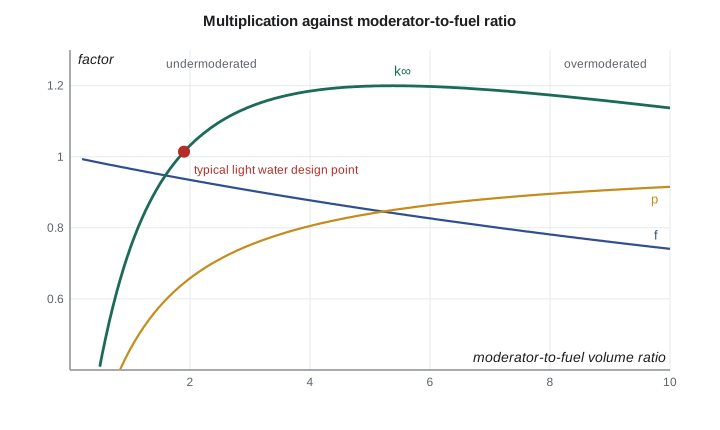
Light water reactors are designed slightly undermoderated on purpose. If the water heats up or boils and its density falls, the lattice moves further to the left of the peak and \(k\) drops, which is a built-in safety feature. CANDU lattices are designed with a large amount of heavy water around each fuel channel, but the coolant inside the channel is separate from the moderator. Losing coolant density in a CANDU channel raises \(k\) slightly, the positive coolant void effect, which the design handles with fast shutdown systems and careful safety analysis under the CNSC's requirements. Lesson 12 returns to this.
Using the factors to explain changes
The real value of the formula shows up when something changes. Teodora gives Hana four short cases from past work and asks her to name the factor that moves first in each one.
In the first case, the plant adds absorber to the core. Soluble boron in a pressurized water reactor, gadolinium in a fuel pin, or light water in a CANDU zone controller all add thermal absorption outside the fissile nuclei, so \(f\) falls. The other factors barely change, which is why reactivity worth of an absorber is roughly proportional to how much thermal absorption it adds in high-flux regions.
In the second case, the fuel heats up. The resonances of uranium-238 broaden with temperature, the Doppler effect, so more neutrons are captured while slowing down and \(p\) falls within milliseconds. This is the fastest and most reliable feedback in any thermal reactor, and lesson 12 is built around it.
In the third case, the coolant density drops. In an undermoderated light water lattice, less water means poorer moderation, so \(p\) falls more than \(f\) rises, and \(k\) drops. In a CANDU channel, where the moderator is separate, losing coolant changes the spectrum and fast fission inside the bundle; the net effect is a small positive change in \(k\) that safety analysis must account for.
In the fourth case, fuel burns. Uranium-235 is consumed, plutonium-239 and plutonium-241 are produced, and fission products that absorb neutrons build up. \(\eta\) changes because the fissile mixture changes, and \(f\) changes because fission products are absorbers that sit inside the fuel but do not fission. Reactor Physics II follows these changes over the life of the fuel.
Working through these cases, Hana notices that the factors almost never change alone. A change that lowers \(f\) usually shifts the spectrum slightly and nudges \(p\) and \(\eta\) too. The formula is still useful because one factor usually dominates, and identifying it tells the designer where to look in a detailed calculation.
Worked problem
Reactivity worth of added absorber
In the light water lattice of the program, soluble boron is added until thermal absorption outside the fuel rises by 20 percent. Before the change, absorptions per unit volume were 0.88 in fuel and 0.12 elsewhere. Estimate the new \(f\) and \(k_\infty\).
Show solution
- New non-fuel absorption: \(0.12 \times 1.2 = 0.144\).
- New \(f = 0.88/(0.88 + 0.144) = 0.859\).
- \(k_\infty = 1.65 \times 0.859 \times 0.75 \times 1.07 = 1.138\), down from 1.165.
Answer: About 23 mk of reactivity is removed, which illustrates why boron is the main tool for holding excess reactivity in a pressurized water reactor.
Limits of the formula
The six-factor formula is a bookkeeping device built on a two-energy picture, fast and thermal. Modern core design uses many energy groups and detailed transport calculations in each fuel assembly, as Reactor Physics II explains. The individual factors also depend on how they are defined, so values from different textbooks are not always comparable; some authors fold fast fission and fast absorption differently between \(\varepsilon\) and \(p\). What survives is the insight. When a lattice calculation code reports a change in \(k\), a physicist can still ask which factor moved, and that question usually points to the cause.
Common mistakes
MistakeMultiplying all six factors and calling the result k∞.
Insteadk∞ is the four-factor product; the two non-leakage probabilities turn it into k_eff.
MistakeAssuming more moderator always raises k.
InsteadPast the peak the lattice is overmoderated and f falls faster than p rises.
MistakeUsing η for pure uranium-235 for a real fuel.
InsteadUranium-238 absorption lowers η; use the fuel mixture's cross sections.
MistakeComparing factor values across textbooks without checking definitions.
InsteadAuthors split fast effects between ε and p differently.
Summary and key terms
- The six-factor formula follows one generation: k_eff = η f p ε P_FNL P_TNL.
- The four-factor product η f p ε is k∞, a property of the lattice.
- η depends on enrichment; f on competing absorbers; p on resonance capture; ε on fast fission in U-238.
- Lumping fuel raises p through self-shielding, which lets natural uranium go critical in heterogeneous lattices.
- k∞ peaks at an optimum moderator-to-fuel ratio; LWRs are designed undermoderated for negative void feedback.
- The formula is a bookkeeping tool; modern design uses multigroup lattice codes.
- Reproduction factor
- η, the fission neutrons produced per thermal neutron absorbed in fuel.
- Thermal utilization factor
- f, the fraction of thermal absorptions that occur in fuel.
- Resonance escape probability
- p, the fraction of neutrons that slow past U-238 resonances without capture.
- Fast fission factor
- ε, the ratio of total fission neutrons to those from thermal fission.
- Self-shielding
- Depression of the flux inside a strongly absorbing fuel lump at resonance or thermal energies.
- Undermoderated lattice
- A lattice with less moderator than the optimum, so that losing moderator lowers k.
- Disadvantage factor
- The ratio of average thermal flux in the moderator to that in the fuel.
Practice problems
Work each problem on paper first, then reveal the answer to check.
η = 1.85, f = 0.90, p = 0.80, ε = 1.05. Find k∞.
Show answer
1.85 × 0.90 × 0.80 × 1.05 = 1.399.
That lattice has P_FNL = 0.97 and P_TNL = 0.99. Find k_eff.
Show answer
1.399 × 0.960 = 1.343.
Thermal absorption rates per cm³ are 7.0 in fuel, 0.9 in moderator and 0.4 in structure. Find f.
Show answer
7.0/8.3 = 0.843.
Using the program's thermal data, estimate η at 3 percent enrichment.
Show answer
About 1.85.
Adding soluble boron changes which factor most directly?
Show answer
The thermal utilization factor f.
Why is a light water lattice designed undermoderated?
Show answer
So that a loss of water density lowers k, giving negative void and moderator temperature feedback.
Lesson quiz · 5 questions
Score 60% or more to complete this lesson.
Create a free account to save your progress, take quizzes and earn a certificate.