
NUC-300 · Lesson 8 of 12 · 23 min
Neutron spectra and thermalization
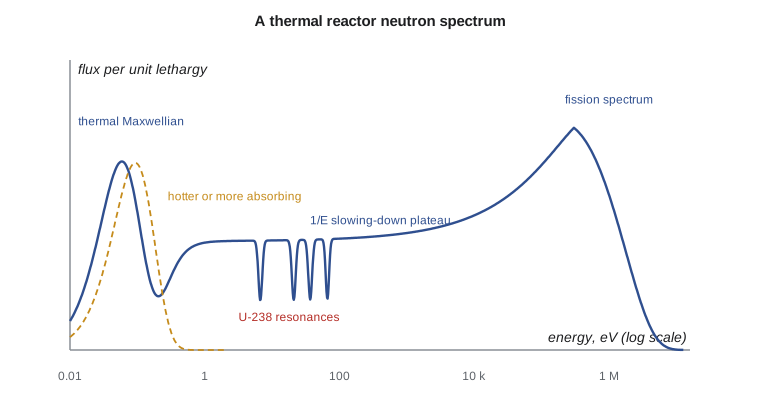
The two-group constants of lesson 7 are averages over the neutron energy spectrum, and Hana wants to know what that spectrum actually looks like. Teodora pulls up a calculated spectrum from a lattice code, flux per unit lethargy plotted against energy on a logarithmic axis from a hundredth of an electronvolt to ten mega-electronvolts. It has three distinct regions, a hump at the top from fission, a long flat plateau in the middle from slowing down, and a second hump at the bottom from thermal neutrons in near-equilibrium with the moderator. This lesson explains each region and how cross sections are averaged over them.
Three regions of a thermal reactor spectrum
At high energies, above about 0.1 MeV, the spectrum is dominated by neutrons newly born in fission, whose energies follow the fission spectrum \(\chi(E)\). A widely used fit for thermal fission of uranium-235 is the Watt spectrum, with a most probable energy near 0.7 MeV and an average near 2 MeV. In the intermediate or slowing-down region, from about 1 eV up to 0.1 MeV, neutrons lose energy in collisions with moderator nuclei, and in a weakly absorbing medium the flux per unit energy varies as \(1/E\). At the lowest energies, below about 1 eV, neutrons gain and lose energy in collisions with moderator atoms moving thermally, and their distribution approaches a Maxwellian.
The slowing-down region
In an elastic collision with a nucleus of mass number \(A\), a neutron loses on average a fixed fraction of its energy, which makes lethargy, \(u = \ln(E_0/E)\), the natural variable. The average increase in lethargy per collision, \(\xi\), is about 1 for hydrogen, 0.725 for deuterium and 0.158 for carbon. In an infinite medium with little absorption, the number of neutrons slowing down past each energy per second is constant, called the slowing-down density \(q\), and the flux is
The flux per unit lethargy, \(E\phi(E)\), is therefore flat across the slowing-down region, which is why spectra are usually plotted per unit lethargy. Resonance absorption by uranium-238 removes neutrons as they pass through its resonances, so \(q\) falls a little at each resonance, and the fraction surviving to thermal energies is the resonance escape probability \(p\) of lesson 2. Within each resonance the flux dips sharply, the energy self-shielding effect that makes resonance absorption in lumped fuel much less than a naive calculation would predict.
Thermalization and the Maxwellian
Once neutrons slow to energies comparable with the thermal motion of moderator atoms, about \(kT \approx 0.025\) eV at room temperature, collisions can raise as well as lower their energy. In a large, weakly absorbing moderator, they come into equilibrium with the moderator and their density follows the Maxwell-Boltzmann distribution. The corresponding flux distribution, which carries an extra factor of speed, is
The most probable energy in the neutron density distribution is \(kT/2\), and the energy corresponding to the most probable speed is \(kT\). At 20 °C, \(kT = 0.0253\) eV and the corresponding speed is 2200 m/s, the reference conditions for thermal cross section tables. The flux-weighted average energy is \(2kT\), as the program confirms numerically. In a hot moderator at about 300 °C, \(kT\) roughly doubles.
Spectrum hardening
A real thermal spectrum is never a perfect Maxwellian at the moderator temperature. Absorption preferentially removes slow neutrons, because most absorption cross sections rise as energy falls, and fresh neutrons keep arriving from above. The equilibrium distribution therefore shifts to slightly higher energies than the moderator temperature implies, an effect called spectrum hardening. It is often described by an effective neutron temperature \(T_n\) somewhat above the moderator temperature, with a common approximation
where the constant \(C\) is about 1.8 in older textbooks. Strongly absorbing, enriched light water lattices are noticeably hardened; weakly absorbing heavy water lattices are close to the moderator temperature. Hardening matters because it changes every averaged cross section, the plutonium breeding ratio and the temperature coefficients discussed in lesson 12.
Averaging cross sections over a Maxwellian
Reaction rates need cross sections averaged over the flux spectrum. For a 1/v absorber, \(\sigma(E) = \sigma_0\sqrt{E_0/E}\), the reaction rate \(\int\Sigma(E)\phi(E)\,dE\) is simply \(N\sigma_0 v_0\) times the total neutron density, independent of the spectrum shape. Averaged over a Maxwellian flux, the effective cross section is
At room temperature the factor is \(\sqrt{\pi}/2 = 0.886\), and it falls further as the neutron temperature rises. This is the origin of the factor 0.88 used for uranium-235 in lesson 3. Nuclides that depart from 1/v, such as uranium-235 slightly and plutonium-239 strongly because of its resonance at 0.3 eV, need correction factors; plutonium-239's resonance means its effective fission cross section actually rises as the spectrum hardens, a point that affects the temperature coefficients of high-burnup fuel.
Worked problem
Effective cross section at operating temperature
Uranium-235 has a 2200 m/s absorption cross section of 681 b. Treating it as a 1/v absorber, estimate its Maxwellian-averaged value at a neutron temperature of 573 K.
Show solution
- \(\bar{\sigma} = 0.886 \times 681 \times \sqrt{293.6/573}\).
- \(\sqrt{0.5124} = 0.716\).
- \(\bar{\sigma} = 0.886 \times 681 \times 0.716 = 432\) b.
Answer: About 432 b, roughly two thirds of the tabulated 2200 m/s value. Using the room-temperature number in an operating core would overestimate absorption rates badly.
# Maxwellian thermal spectrum: average energy, most probable energy, 1/v averaging.
import math
k_B = 8.617e-5   # eV/K
for T in (293.6, 573.0):
    kT = k_B * T
    # numerical averages over the Maxwellian flux spectrum, phi(E) ~ E exp(-E/kT)
    n = 4000; Emax = 20 * kT; dE = Emax / n
    w = s1 = sv = 0.0
    for i in range(1, n + 1):
        E = i * dE; m = E * math.exp(-E / kT)
        w += m; s1 += m * E; sv += m / math.sqrt(E)
    print(f"T = {T:5.1f} K: kT = {kT:.4f} eV, flux-weighted mean energy {s1 / w:.4f} eV (2kT = {2 * kT:.4f})")
    # flux-averaged 1/v cross section, with sigma(E) = sigma0 * sqrt(E0/E)
    sigma0, E0 = 681.0, 0.0253
    avg = sigma0 * math.sqrt(E0) * sv / w
    print(f"   averaged 1/v cross section {avg:.0f} b (formula {sigma0 * math.sqrt(math.pi) / 2 * math.sqrt(293.6 / T):.0f} b)")
print(f"\nspeed at 0.0253 eV: {math.sqrt(2 * 0.0253 * 1.602e-19 / 1.675e-27):.0f} m/s")T = 293.6 K: kT = 0.0253 eV, flux-weighted mean energy 0.0506 eV (2kT = 0.0506) averaged 1/v cross section 603 b (formula 604 b) T = 573.0 K: kT = 0.0494 eV, flux-weighted mean energy 0.0988 eV (2kT = 0.0988) averaged 1/v cross section 432 b (formula 432 b) speed at 0.0253 eV: 2200 m/s
The program integrates the Maxwellian numerically and recovers both the flux-weighted mean energy of \(2kT\) and the closed-form 1/v average at both temperatures, within rounding. The last line checks the reference speed: a neutron of 0.0253 eV travels at 2200 m/s.
Thermal scattering and the moderator
At thermal energies the moderator cannot be treated as free atoms at rest. Hydrogen in water is bound in molecules that rotate and vibrate, and those motions exchange energy with neutrons in discrete amounts. Graphite and heavy water have their own characteristic motions. The scattering cross section of bound hydrogen at very low energy is several times that of a free proton. Evaluated nuclear data libraries therefore provide thermal scattering laws, often written \(S(\alpha, \beta)\), for each common moderator, and lattice codes use them below a few electronvolts. They matter most for predicting how the spectrum and reactivity change with moderator temperature.
In a CANDU reactor the moderator and coolant are at very different temperatures: the heavy water moderator is kept cool, near 70 °C, by its own heat exchangers, while the coolant in the pressure tubes runs at about 260 to 310 °C. The thermal spectrum in the fuel therefore reflects a mix of both. Changes in moderator temperature and in coolant temperature are separate effects with separate reactivity coefficients, a feature unique to pressure-tube designs.
Fast and epithermal reactors
Not every reactor depends on thermal neutrons. Fast reactors, which use liquid metal, gas or molten salt coolants and no moderator, keep the spectrum in the hundreds of kilo-electronvolts. Their cross sections are smaller and their migration lengths longer, so they need more concentrated fissile material, but they waste fewer neutrons in captures and can convert more fertile material into fuel. Fusion Energy and Advanced Reactors, later in the program, covers them. For this course the thermal spectrum is the main case, and the methods of this lesson describe how its shape enters every calculation.
Measuring the spectrum
Spectra are inferred from reaction rates in foils with different energy responses. A classic method is the cadmium ratio. Cadmium absorbs almost every neutron below about 0.5 eV, the cadmium cutoff, and lets faster neutrons through. A gold foil irradiated bare responds to thermal neutrons and to its large resonance at 4.9 eV; the same foil inside a cadmium cover responds only to the resonance. The ratio of bare to covered activity, the cadmium ratio, measures how thermal the spectrum is. In a well-moderated heavy water lattice it is large; in a light water lattice it is smaller; in a fast spectrum it approaches one.
Sets of threshold foils, such as indium, nickel, aluminium and sulphur reactions that only occur above certain energies, map the fast part of the spectrum. Unfolding the full spectrum from a dozen foil activities is an inverse problem, solved with a calculated guess spectrum as a starting point. Research reactors such as the SLOWPOKE-2 research reactor at the Royal Military College in Kingston use these methods to characterize their irradiation sites, because users of neutron activation analysis need to know the thermal and epithermal fluxes separately.
Worked problem
Thermal flux from a cadmium ratio
A gold foil gives a bare activity of 1200 units and a cadmium-covered activity of 300 units after the same irradiation. Find the cadmium ratio and the fraction of the bare activity due to sub-cadmium neutrons.
Show solution
- Cadmium ratio \(= 1200/300 = 4.0\).
- Sub-cadmium activity \(= 1200 - 300 = 900\), so the thermal fraction is \(900/1200 = 0.75\).
Answer: Three quarters of the gold activation comes from thermal neutrons; the rest is from epithermal neutrons in the resonance region, which indicates a moderately hard spectrum.
Spectra in practice
Hana's lattice code divides the energy range into dozens of groups, with fine resolution through the resonances and the thermal region. For each group it computes a flux shape, averages cross sections, and finally collapses everything into the two groups used by the core simulator. The cutoff between fast and thermal groups, typically 0.625 eV, is chosen to lie above the region where upscattering is important and below the first large resonance of uranium-238 at 6.67 eV. Looking at the spectrum plot again, Hana can now point to each feature and say which part of the physics put it there.
Teodora adds one last practical point. Every cross section Hana uses from now on is an average over some spectrum, and the spectrum depends on the lattice, the temperature, the burnup and the position in the core. Near a water gap or a reflector the spectrum is softer; inside a fresh, highly enriched pin it is harder; near a control rod it is depleted of thermal neutrons. A cross section averaged for one place can be wrong for another. That is why core simulators carry tables of constants for each assembly type and condition, and why a physicist checking a hand calculation always asks first which spectrum the numbers came from.
With that warning, Hana's notebook entry for the week is short. Fission makes them fast, collisions make them slow, the moderator warms them up a little, absorption leans the distribution toward higher energies, and every averaged number depends on all four.
Common mistakes
MistakePlotting the spectrum per unit energy and concluding there are few slowing-down neutrons.
InsteadPlot per unit lethargy; the slowing-down plateau is flat.
MistakeUsing the 2200 m/s cross section with a Maxwellian flux at operating temperature.
InsteadApply the √π/2 √(T₀/T) correction or use group-averaged data.
MistakeAssuming the neutron temperature equals the moderator temperature.
InsteadAbsorption hardens the spectrum, raising the effective neutron temperature.
MistakeTreating bound moderator atoms as free at thermal energies.
InsteadUse thermal scattering laws for water, heavy water and graphite.
Summary and key terms
- A thermal reactor spectrum has a fission region, a 1/E slowing-down region and a near-Maxwellian thermal region.
- In the slowing-down region φ(E) = q/(ξΣ_s E), flat per unit lethargy, with dips at resonances.
- The Maxwellian flux is proportional to E e^(−E/kT); kT = 0.0253 eV corresponds to 2200 m/s.
- Absorption hardens the spectrum, raising the effective neutron temperature.
- For 1/v absorbers the Maxwellian-averaged cross section is (√π/2)σ₀√(T₀/T).
- Lattice codes use many groups and thermal scattering laws, then collapse to a few groups.
- Fission spectrum
- The energy distribution of neutrons at birth, averaging about 2 MeV.
- Lethargy
- u = ln(E₀/E), the natural energy variable for slowing down.
- Slowing-down density
- The number of neutrons slowing down past a given energy per cm³ per second.
- Maxwellian distribution
- The equilibrium energy distribution of neutrons in a moderator at temperature T.
- Spectrum hardening
- A shift of the thermal spectrum to higher energy caused by absorption.
- Neutron temperature
- The temperature of the Maxwellian that best fits a hardened thermal spectrum.
- Thermal scattering law
- Data describing neutron scattering by bound atoms in a moderator at low energy.
Practice problems
Work each problem on paper first, then reveal the answer to check.
Find kT at 600 K.
Show answer
8.617 × 10⁻⁵ × 600 = 0.0517 eV.
A 1/v absorber has σ₀ = 10 b. Find its Maxwellian average at 293.6 K.
Show answer
0.886 × 10 = 8.9 b.
Using the program, what is the averaged U-235 absorption cross section at 573 K?
Show answer
About 432 b.
Why is the spectrum plotted per unit lethargy?
Show answer
Because φ(E) ∝ 1/E in the slowing-down region, so Eφ(E) is flat and easy to read.
Why does plutonium-239's effective fission cross section rise as the spectrum hardens?
Show answer
Its large resonance near 0.3 eV catches more neutrons when the thermal distribution shifts upward.
Name one reason the fast-thermal cutoff is set near 0.625 eV.
Show answer
It lies below the first major U-238 resonance and above the region where upscattering matters.
Lesson quiz · 5 questions
Score 60% or more to complete this lesson.
Create a free account to save your progress, take quizzes and earn a certificate.