
NUC-300 · Lesson 6 of 12 · 25 min
Reflected reactors
No power reactor is bare. Around the CANDU core at the Darlington CANDU station sits a thick layer of heavy water inside the calandria; around a light water core sits a baffle, the core barrel and water. Teodora asks Hana to show, with one-group theory, why that surrounding material is worth so much, and to estimate how much smaller a core can be because of it. Along the way they visit the SLOWPOKE-2 research reactor at the Royal Military College in Kingston, whose beryllium reflector is the reason such a tiny core can be critical at all.
What a reflector does
A reflector is a region of non-multiplying, weakly absorbing, strongly scattering material surrounding the core. Neutrons that would otherwise leak out enter the reflector, scatter many times and some fraction of them diffuse back into the core. The fraction returned is called the albedo. Good reflector materials have large scattering, small absorption and, ideally, light nuclei that also moderate: water, heavy water, graphite and beryllium are the usual choices. Steel reflectors, used in some advanced light water designs, reflect fast neutrons well but absorb more thermal neutrons.
Reflectors bring three benefits. First, they reduce leakage, so less fuel or less enrichment achieves criticality. Second, they flatten the power distribution: the flux near the core edge is raised because neutrons return from the reflector, so the edge fuel works harder and the peak-to-average ratio falls. Third, in thermal reactors with moderating reflectors, fast neutrons that leak out slow down in the reflector and come back thermal, which produces a characteristic thermal flux peak just inside the reflector.
The one-group reflected slab
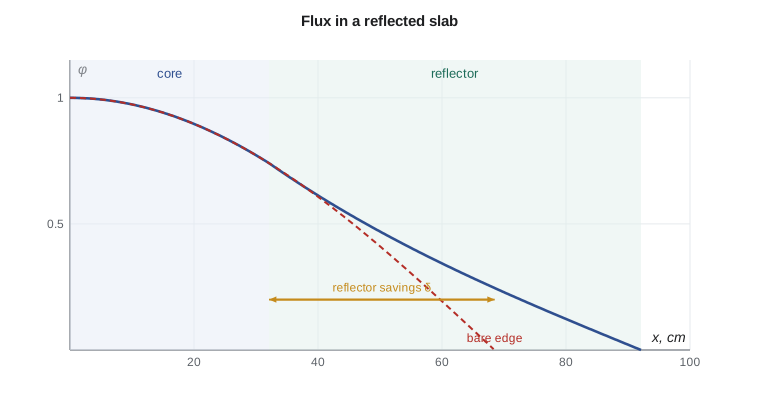
Consider a slab core of half-thickness \(a\) with a reflector of thickness \(T\) on each side. In the core, the flux satisfies the critical equation \(\phi'' + B_m^2\phi = 0\), so it is a cosine. In the reflector, with no fission source, the flux satisfies \(\phi'' - \phi/L_r^2 = 0\), so it is a combination of exponentials that falls to zero at the outer, extrapolated boundary:
Requiring the flux and the current to be continuous at the interface \(x = a\) gives two equations in \(A\) and \(C\). Dividing them eliminates both constants and leaves the criticality condition:
Given the materials and the reflector thickness, this transcendental equation is solved for the critical core half-thickness \(a\). For an infinitely thick reflector, \(\coth \to 1\) and the condition simplifies to \(D_c B_m \tan(B_m a) = D_r/L_r\).
Reflector savings
The reduction in critical half-thickness compared with the bare reactor is the reflector savings \(\delta\):
For a thick reflector and a core whose migration properties are similar to the reflector's, a simple approximation is \(\delta \approx L_r\, D_c/D_r\), but for a thin reflector the savings are smaller, approaching \(\delta \approx T\, D_c/D_r\). Engineers use the reflector savings to treat a reflected core as if it were a bare core enlarged by \(\delta\) on each face: calculate the geometric buckling with the core dimensions plus \(\delta\), and apply the bare-core formulas. This trick turns the two-region problem back into the one-region problem of lesson 5.
Worked problem
Reflector savings for a heavy water reflector
The core of lesson 5 (\(D_c = 0.95\) cm, \(B_m^2 = 5.26 \times 10^{-4}\ \text{cm}^{-2}\)) is surrounded by a heavy-water-like reflector with \(D_r = 0.85\) cm and \(\Sigma_{a,r} = 0.0003\ \text{cm}^{-1}\). The bare critical half-thickness is 68.5 cm. Find \(L_r\) and the critical half-thickness for a 60 cm reflector.
Show solution
- \(L_r = \sqrt{0.85/0.0003} = 53\) cm.
- Solve \(0.95 \times 0.0229 \tan(0.0229\, a) = (0.85/53)\coth(60/53)\) for \(a\).
- Bisection gives \(a \approx 32\) cm, so \(\delta \approx 68.5 - 32 = 36\) cm.
Answer: A 60 cm heavy water reflector roughly halves the critical half-thickness of this core. Each extra 10 cm of reflector gives less, because the reflector is already more than one diffusion length thick.
# Reflected slab core, one group: solve the criticality condition by bisection.
import math
Dc, Sac, nuSf = 0.95, 0.0165, 0.0170   # core (illustrative)
Dr, Sar = 0.85, 0.0003                  # heavy-water-like reflector (illustrative)
Bm = math.sqrt((nuSf / Sac - 1) / (Dc / Sac))
Lr = math.sqrt(Dr / Sar)

def mismatch(a, T):
    # core: cos(Bm x); reflector of thickness T: sinh((a+T-x)/Lr)
    return Dc * Bm * math.tan(Bm * a) - Dr / Lr / math.tanh(T / Lr)

bare_half = math.pi / (2 * Bm)
print(f"bare critical half-thickness (extrapolated): {bare_half:.1f} cm")
for T in (10, 30, 60, 100):
    lo, hi = 1.0, bare_half - 1e-6
    for _ in range(80):
        mid = (lo + hi) / 2
        if mismatch(mid, T) > 0: hi = mid
        else: lo = mid
print(f"reflector {T:3d} cm: core half-thickness {lo:6.1f} cm, reflector savings {bare_half - lo:5.1f} cm")bare critical half-thickness (extrapolated): 68.5 cm reflector 10 cm: core half-thickness 57.7 cm, reflector savings 10.8 cm reflector 30 cm: core half-thickness 41.9 cm, reflector savings 26.5 cm reflector 60 cm: core half-thickness 32.1 cm, reflector savings 36.4 cm reflector 100 cm: core half-thickness 28.5 cm, reflector savings 39.9 cm
The output shows diminishing returns. The first 10 cm of reflector saves about 11 cm of core; going from 60 to 100 cm saves less than 4 cm more. Once the reflector is a couple of diffusion lengths thick, few neutrons that would have returned are lost from its outer surface. Designers therefore pick reflector thickness by balancing reactivity gain against cost and vessel size.
Reflectors in real cores
In a CANDU reactor the reflector is simply heavy water moderator that extends about 65 cm beyond the outer fuel channels, inside the calandria vessel. Heavy water's tiny absorption and long diffusion length make it an excellent reflector, and it flattens the radial flux enough that the outer channels contribute a useful share of power. Light water reactors have a thinner water reflector between the outermost assemblies and the core barrel, and some newer designs add a heavy steel reflector to return fast neutrons and protect the vessel.
Research reactors rely on reflectors more than any other type, because their cores are small. The core of the SLOWPOKE-2 research reactor at the Royal Military College in Kingston is only a few tens of centimetres across, and its reflector raises the reactivity enough to make it critical with a modest fuel inventory. The reflector also hosts irradiation sites, where the thermal flux is high and the fast flux low, which is ideal for activation analysis.
Albedo: a simple way to think about return
Another way to describe a reflector is by its albedo \(\beta_A\), the fraction of neutrons that enter it and eventually come back. For an infinitely thick, non-multiplying reflector, one-group diffusion theory gives
For the heavy-water-like reflector of the example, \(2D_r/L_r = 2 \times 0.85/53 = 0.032\), so \(\beta_A \approx 0.94\): about 94 percent of the neutrons entering the reflector return. For light water, with \(D \approx 0.16\) cm and \(L \approx 2.8\) cm, \(2D/L = 0.11\) and \(\beta_A \approx 0.80\). For graphite, about 0.93. These numbers explain at a glance why heavy water and graphite are prized reflectors and light water is a good but lesser one.
Albedo also gives a quick estimate of the effect on leakage. If a fraction \(P_L\) of neutrons would leak from a bare core and a fraction \(\beta_A\) of those return, the net leakage is roughly \(P_L(1 - \beta_A)\), ignoring the fact that returned neutrons can leak again. With 10 percent bare leakage and an albedo of 0.9, only about 1 percent of neutrons are finally lost. The estimate is rough, but it shows why reflectors are so effective in small cores, where the bare leakage would be large.
Worked problem
Albedo of a water reflector
Estimate the albedo of a thick light water reflector with \(D = 0.16\) cm and \(L = 2.8\) cm, and the net leakage from a small core that would lose 25 percent of its neutrons if bare.
Show solution
- \(2D/L = 0.32/2.8 = 0.114\).
- \(\beta_A = (1 - 0.114)/(1 + 0.114) = 0.795\).
- Net leakage \(\approx 0.25 \times (1 - 0.795) = 0.051\), about 5 percent.
Answer: A water reflector cuts the leakage of this small core from about a quarter to about a twentieth, a gain of roughly 200 mk if the material could afford it.
The thermal flux peak in a moderating reflector
One-group theory cannot capture an important feature of thermal reactors. Fast neutrons leaking from the core slow down in a moderating reflector and become thermal there, outside the fuel. Because the reflector absorbs few thermal neutrons and contains no fuel to absorb them, the thermal flux just outside the core can exceed the thermal flux just inside it. The resulting thermal peak in the reflector raises the power of the outermost fuel. Lesson 7 shows how two-group theory reproduces this peak naturally, with the fast group feeding the thermal group in the reflector.
Hana runs one more case with the lesson program: replacing the heavy-water-like reflector with a light-water-like one of the same thickness reduces the savings markedly, because water's shorter diffusion length and higher absorption return fewer neutrons. The comparison matches the albedo values and makes the choice of reflector material concrete.
Reflector effects on control and safety
Because the reflector shapes the flux at the core edge, its condition affects reactivity. Changes in reflector temperature or density, or in reflector purity, change \(k\). In a heavy water reflector, a small amount of light water contamination raises absorption noticeably, so moderator isotopic purity is monitored and kept above about 99.8 percent. Absorbers placed in the reflector, such as some shutdown devices, are worth less than the same absorbers in the core centre, because the flux there is lower. Lesson 9 discusses reactivity worth more generally: an absorber is worth roughly in proportion to the square of the local flux, so devices near the centre of a core are far more effective than those near the edge.
Using reflector savings in practice
Teodora closes the session with a quick estimate that design engineers still use in early studies. Take the bare-core critical dimensions from lesson 5, subtract the reflector savings on each face, and the result is a first estimate of the reflected critical core. For the cylinder of lesson 5, a reflector savings of 30 cm on the radius and on each end would shrink the critical radius from about 123 cm to about 93 cm and the height from about 246 cm to about 186 cm. The volume falls by more than half, which means less fuel for the same multiplication. Detailed calculations then refine the answer with more energy groups and the real geometry.
Hana tries the estimate in reverse for an existing core and finds the reflector worth tens of milli-k. She concludes, as every student does, that the reflector is one of the cheapest sources of reactivity a designer has, and that a reactor's surroundings are part of its physics.
Worked problem
A quick reflected-core estimate
A bare cylinder of the lesson 5 material is critical at a radius of 125 cm and height 250 cm, extrapolated. A reflector gives savings of 30 cm on every face. Estimate the reflected critical dimensions and the fraction of the bare core volume they represent.
Show solution
- Radius: \(125 - 30 = 95\) cm; height: \(250 - 2 \times 30 = 190\) cm.
- Volume ratio: \((95/125)^2 \times (190/250) = 0.578 \times 0.76 = 0.44\).
Answer: The reflected core needs only about 44 percent of the bare core's volume of fuel-bearing material to reach criticality.
Common mistakes
MistakeAssuming a thicker reflector always gives proportionally more savings.
InsteadSavings saturate once the reflector is a few diffusion lengths thick.
MistakeTreating the reflector as a fission source.
InsteadA reflector returns neutrons but produces none; its flux decays outward.
MistakeUsing one-group theory to predict the reflector thermal peak.
InsteadThe peak needs at least two groups, with fast neutrons thermalizing in the reflector.
MistakeAssuming absorbers in the reflector are worth as much as in the core centre.
InsteadWorth scales roughly with the square of the local flux, which is lower at the edge.
Summary and key terms
- A reflector returns leaking neutrons to the core, reducing critical size and flattening the flux.
- In a one-group reflected slab, matching flux and current at the interface gives D_c B_m tan(B_m a) = (D_r/L_r) coth(T/L_r).
- Reflector savings δ is the reduction in critical half-thickness compared with a bare core.
- Savings grow with reflector thickness but saturate after a few diffusion lengths.
- Moderating reflectors create a thermal flux peak outside the core, captured by two-group theory.
- Reflector purity, temperature and absorbers placed in it all affect reactivity.
- Reflector
- A scattering, weakly absorbing region surrounding a core that returns leaking neutrons.
- Albedo
- The fraction of neutrons entering a reflector that return to the core.
- Reflector savings
- The reduction in critical dimension produced by a reflector, compared with a bare core.
- Thermal peak
- A local maximum of thermal flux in a moderating reflector just outside the core.
- Two-region problem
- A diffusion problem with different materials in the core and reflector, joined by interface conditions.
- Isotopic purity
- The fraction of hydrogen atoms in heavy water that are deuterium.
Practice problems
Work each problem on paper first, then reveal the answer to check.
A reflector has D_r = 0.9 cm and Σ_a = 0.0004 cm⁻¹. Find L_r.
Show answer
√(0.9/0.0004) = 47 cm.
For a thick reflector with D_c ≈ D_r, estimate the savings for that reflector.
Show answer
δ ≈ L_r ≈ 47 cm, an upper bound for a very thick reflector.
Using the program, what are the savings for a 30 cm reflector?
Show answer
About 26.5 cm.
Why does the 100 cm reflector give only about 3.5 cm more savings than the 60 cm reflector?
Show answer
The reflector is already more than a diffusion length thick, so few additional neutrons are returned.
Name two reasons a research reactor needs a reflector more than a power reactor.
Show answer
Its small core leaks heavily, and the reflector also provides high thermal flux irradiation sites.
Why is light water contamination of a heavy water reflector monitored?
Show answer
Hydrogen absorbs far more neutrons than deuterium, so contamination lowers reactivity and flux.
Lesson quiz · 5 questions
Score 60% or more to complete this lesson.
Create a free account to save your progress, take quizzes and earn a certificate.