
NUC-300 · Lesson 12 of 12 · 22 min
Temperature and void feedback
Teodora saves the most important lesson for last. Point kinetics says that a reactor with constant reactivity grows or decays exponentially forever. Real reactors do not, because reactivity is not constant: it depends on the temperatures and densities of the fuel, moderator and coolant, and those depend on the power. When the dependence is negative, a rise in power reduces reactivity and the reactor settles to a new steady state by itself. Feedback is what makes power reactors self-regulating, and its sign and size are among the first things a regulator asks about in any design.
Reactivity coefficients
A reactivity coefficient is the change in reactivity per unit change in some core parameter. The most important are the fuel temperature coefficient \(\alpha_F = \partial\rho/\partial T_F\), the moderator temperature coefficient \(\alpha_M = \partial\rho/\partial T_M\), the coolant temperature or density coefficient, the void coefficient \(\alpha_V = \partial\rho/\partial(\text{void fraction})\), and the power coefficient \(\alpha_P = d\rho/dP\), which combines all of them for a change in power. Coefficients are quoted in pcm or mk per kelvin, per percent void or per percent power.
Coefficients differ in speed as well as size. The fuel temperature responds to power within a fraction of a second, because fission energy is deposited in the fuel itself. The moderator and coolant respond over seconds to tens of seconds, as heat flows out of the fuel. A coefficient that acts promptly is far more valuable for safety than one that acts slowly, because it can limit a fast excursion before the coolant has time to heat.
Doppler broadening and the fuel temperature coefficient
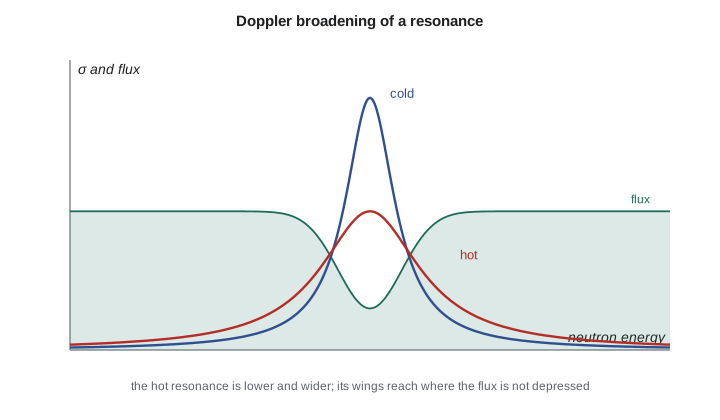
When fuel heats up, its uranium-238 nuclei vibrate faster. Seen from a neutron, each resonance becomes lower and wider, an effect called Doppler broadening. In a lumped fuel element, the centre of each resonance is already self-shielded, so lowering the peak changes little, while widening the wings exposes more neutrons to capture. Resonance absorption therefore increases with fuel temperature, the resonance escape probability \(p\) falls, and reactivity drops. The fuel temperature coefficient is negative in every thermal reactor fuelled with low-enriched or natural uranium, typically of order \(-1\) to \(-4\) pcm per kelvin. It acts within milliseconds, because the fuel heats as soon as power rises.
A common empirical form is that the effective resonance integral grows with the square root of the fuel temperature, so \(\alpha_F\) is largest in magnitude at low temperature and becomes somewhat smaller as fuel heats. Fuel temperature feedback is the main reason a reactor driven by a sudden reactivity insertion turns around by itself.
Moderator temperature and density
Raising the moderator temperature has two effects. The thermal spectrum hardens, which changes every averaged cross section, and the moderator expands, which lowers its density and so its moderating and absorbing power. In an undermoderated lattice, the density effect dominates: less moderator means less slowing down, more resonance capture and lower \(k\). That is why light water reactors are designed undermoderated, as lesson 2 explained. Soluble boron complicates the picture in a pressurized water reactor. When the water expands, boron atoms leave the core with it, removing absorption and adding reactivity. At high boron concentrations early in a cycle, the moderator temperature coefficient can be close to zero or, at hot zero power, slightly positive; designers limit the boron concentration, often with burnable absorbers, to keep it negative at power.
In a CANDU reactor the moderator is separate and cool, about 70 °C, and its temperature coefficient is small. The coolant is in the pressure tubes, next to the fuel. Heating or voiding the coolant changes the spectrum in the fuel, reduces resonance capture slightly and increases fast fission, and the net effect in natural uranium fuel is positive: the full-core coolant void reactivity is roughly +10 to +15 mk, varying with burnup and design. The fuel temperature coefficient remains negative and prompt, and the overall power coefficient is small. Because of the positive void effect, CANDU safety relies on two independent, fast, diverse shutdown systems, and safety analyses for the Darlington CANDU station under the CNSC's REGDOC-2.4.1 show that a large loss-of-coolant power pulse is terminated within a couple of seconds.
The power coefficient and the power defect
The power coefficient combines all feedbacks for a change in power at operating conditions. It is negative in every licensed power reactor. Integrating it from zero power to full power gives the power defect, the total reactivity lost in raising power, which in a light water reactor can be over a thousand pcm. Integrating the temperature coefficients from cold shutdown to hot zero power gives the temperature defect. Both must be covered by excess reactivity at start-up and appear in the reactivity budget of lesson 9. They also explain an important operating rule: reactivity added by cooling the core, for example by a large steam line break that overcools a pressurized water reactor, must be accounted for in shutdown margin.
Feedback in point kinetics
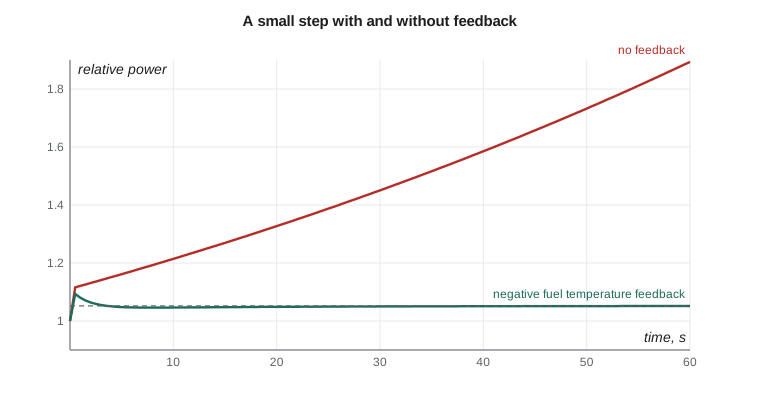
Adding feedback to point kinetics turns a linear problem into a nonlinear one. A simple lumped model links the fuel temperature rise \(\Delta T\) to the power through a heat balance with time constant \(\tau\), and the reactivity becomes \(\rho = \rho_{\text{ext}} + \alpha_F\,\Delta T\):
where \(G\) is the steady fuel temperature rise per unit increase of relative power. After an external step \(\rho_{\text{ext}} > 0\), power rises, the fuel heats, feedback removes reactivity and the power levels off where \(\alpha_F\,\Delta T = -\rho_{\text{ext}}\). The new steady power is \(1 + \Delta T/G\), higher than before, but no longer rising.
Worked problem
Where does power settle?
A core with \(\alpha_F = -2.5\) pcm/K and \(G = 500\) K per unit relative power receives a step of +0.1 dollars (\(\rho = 65\) pcm). Find the fuel temperature rise and new power.
Show solution
- Required \(\Delta T = 65/2.5 = 26\) K.
- New power \(= 1 + 26/500 = 1.052\) of the old.
Answer: The core settles about 5 percent higher in power with the fuel 26 K hotter. Without feedback the same step would raise power indefinitely with a period near 100 s.
# Power excursion with fuel-temperature (Doppler) feedback: lumped point-kinetics model.
beta, lam, Lam = 0.0065, 0.08, 2.0e-5
alpha_f = -2.5e-5        # reactivity per K of fuel temperature (illustrative LWR-like)
G = 500.0                # K of steady fuel temperature rise per unit of relative power (lumped)
tau = 5.0                # s, fuel heat removal time constant
def run(rho_ext, alpha, t_end=60.0, dt=1e-4):
    n, C, dT, t = 1.0, beta / (lam * Lam), 0.0, 0.0
    out, nxt = [], 0.0
    while t <= t_end:
        if t >= nxt: out.append((t, n, dT)); nxt += 10.0
        rho = rho_ext + alpha * dT
        n += ((rho - beta) / Lam * n + lam * C) * dt
        C += (beta / Lam * n - lam * C) * dt
        dT += ((G * (n - 1) - dT) / tau) * dt
        t += dt
    return out
rho_ext = 0.1 * beta
for a in (alpha_f, 0.0):
    res = run(rho_ext, a)
    lab = 'with negative feedback' if a else 'no feedback'
    print(lab + ': ' + '  '.join(f"t={t:4.0f}s P={n:6.2f} dT={dT:5.1f}K" for t, n, dT in res))
print(f"\nfuel temperature rise that cancels the step: {-rho_ext / alpha_f:.0f} K")
print(f"new steady power: {1 + (-rho_ext / alpha_f) / G:.3f} of the old power")with negative feedback: t= 0s P= 1.00 dT= 0.0K t= 10s P= 1.05 dT= 21.8K t= 20s P= 1.05 dT= 23.7K t= 30s P= 1.05 dT= 24.7K t= 40s P= 1.05 dT= 25.3K t= 50s P= 1.05 dT= 25.6K no feedback: t= 0s P= 1.00 dT= 0.0K t= 10s P= 1.21 dT= 77.0K t= 20s P= 1.33 dT=134.8K t= 30s P= 1.45 dT=194.3K t= 40s P= 1.59 dT=258.9K t= 50s P= 1.73 dT=329.4K fuel temperature rise that cancels the step: 26 K new steady power: 1.052 of the old power
The two runs start identically, because feedback needs the fuel to heat first. Within ten seconds they separate: with feedback, the power levels off near 1.05 and the fuel temperature approaches 26 K above its initial value; without feedback, the power keeps climbing on its period. Hana tries a positive coefficient by changing the sign of \(\alpha_F\) and watches the power accelerate, a vivid demonstration of why designs rely on negative prompt feedback and why any positive coefficient must be shown to be overwhelmed by other feedbacks and by protection systems.
Feedback and stability
Negative feedback is not automatically stable in every respect. A strong negative coefficient acting with a delay can cause oscillations, in the same way a thermostat with a slow sensor overshoots. Boiling water reactors must be designed and operated to avoid coupled neutronic and thermal-hydraulic oscillations in certain combinations of low flow and high power, and large light water cores can show slow axial xenon oscillations that operators damp with rods. Stability analysis, using the frequency response of the reactor with its feedbacks, is part of every design. Nuclear Reactor Control and Instrumentation, later in the program, covers it in detail.
Feedback in research reactors
the SLOWPOKE-2 research reactor at the Royal Military College in Kingston has a large negative temperature coefficient from its light water and a small excess reactivity. Even if all control were withdrawn, the water in and around the core would heat until the feedback cancelled the excess, and the power would settle at a safe level. That inherent safety is what allowed the design to be licensed for operation with minimal supervision at universities and hospitals.
Coefficients over the life of a core
Coefficients change with burnup. As plutonium builds up, the fuel's resonance and thermal properties change, and plutonium-239's resonance near 0.3 eV makes the moderator temperature coefficient more negative in light water reactors. Boron concentration falls through a PWR cycle, which also makes the moderator coefficient more negative. In CANDU fuel the void reactivity changes with burnup and with the moderator's poison concentration. Designers therefore calculate coefficients at many points in the cycle and in many states, and plant start-up tests measure the moderator temperature coefficient or the power coefficient to confirm the predictions.
Measuring a coefficient
At the start of each new light water reactor cycle, the moderator temperature coefficient is measured at hot zero power. The operators change the coolant temperature slowly by a few kelvin, keeping power near zero so that fuel temperature does not change, and a reactivity meter records the response. Dividing the reactivity change by the temperature change gives the isothermal temperature coefficient, from which the moderator part is found by subtracting the calculated fuel part. Agreement with the predicted value within a couple of pcm per kelvin confirms both the core loading and the design methods. CANDU stations make analogous measurements of moderator and coolant coefficients during commissioning and after major changes.
Hana's summary
At the end of the course Hana writes Teodora a one-page summary of what she has learned, framed around the same sheet of paper from the first morning. A thousand neutrons are born; the six-factor formula says where they go; diffusion theory says how many leak, and how a reflector helps; two-group theory and the spectrum say how fast and thermal neutrons share the work; reactivity measures how far the balance is from even; delayed neutrons make the balance adjustable by hand; and feedback makes it correct itself when power changes. Teodora reads it, adds a single line at the bottom about the next course, Reactor Physics II, where the fuel burns, xenon grows and the numbers start to move, and signs off on Hana's first rotation in the core physics group.
Common mistakes
MistakeAssuming every temperature coefficient is negative in every design.
InsteadSigns depend on design and state; CANDU coolant void reactivity is positive and PWR moderator coefficients can approach zero at high boron.
MistakeTreating all coefficients as equally useful for safety.
InsteadPrompt fuel temperature feedback limits fast transients; moderator effects are slower.
MistakeIgnoring the power defect when planning start-up reactivity.
InsteadRaising power removes reactivity, which must be covered by excess.
MistakeAssuming negative feedback guarantees stability.
InsteadDelayed strong feedback can drive oscillations; stability must be analysed.
Summary and key terms
- Reactivity coefficients describe how reactivity changes with fuel temperature, moderator temperature, coolant density, void and power.
- Doppler broadening of U-238 resonances gives a prompt negative fuel temperature coefficient in all low-enriched and natural uranium thermal reactors.
- Undermoderated light water lattices have negative moderator and void coefficients; soluble boron makes the PWR coefficient less negative.
- CANDU coolant void reactivity is positive and is managed with fast, diverse shutdown systems and safety analysis.
- Power and temperature defects are part of the reactivity budget.
- With negative feedback, a reactivity step leads to a new steady power instead of continued growth.
- Reactivity coefficient
- The change in reactivity per unit change in a core parameter such as temperature or void.
- Doppler broadening
- Widening of resonances with fuel temperature, increasing resonance capture in lumped fuel.
- Fuel temperature coefficient
- The change in reactivity per kelvin of fuel temperature, negative and prompt.
- Moderator temperature coefficient
- The change in reactivity per kelvin of moderator temperature.
- Void coefficient
- The change in reactivity per unit of coolant void fraction.
- Power coefficient
- The total change in reactivity per unit change in power.
- Power defect
- The total reactivity lost in raising a reactor from zero to full power.
Practice problems
Work each problem on paper first, then reveal the answer to check.
α_F = −3 pcm/K. Find the reactivity change for a 150 K fuel temperature rise.
Show answer
−450 pcm.
Using the lesson's lumped model, find the new power for a +100 pcm step with α_F = −2.5 pcm/K and G = 500 K.
Show answer
ΔT = 40 K; power = 1 + 40/500 = 1.08.
Using the program, what is the relative power 50 s after the step without feedback?
Show answer
About 1.73.
Why can a PWR's moderator temperature coefficient approach zero early in a cycle?
Show answer
High soluble boron is expelled as water expands, adding reactivity that offsets the density effect.
Why is the fuel temperature coefficient especially valuable for safety?
Show answer
It acts within milliseconds because fission heats the fuel directly.
Name the requirement in US regulations about prompt inherent nuclear feedback.
Show answer
General Design Criterion 11 in 10 CFR Part 50, Appendix A.
Lesson quiz · 5 questions
Score 60% or more to complete this lesson.
Create a free account to save your progress, take quizzes and earn a certificate.