
MSBA-351 · Lesson 10 of 12 · 20 min
Returns
▶ Video coming soon A video version of this lesson is on the way.
Returns at Corbel & Finch are not frequent, but they are messy. A grocer sends back a case whose bags arrived crushed. A café receives the wrong grind and wants an exchange. A packaging supplier ships labels with a misprint and agrees to take them back. In the old system each case ended in a credit note typed by hand, with no link to the original invoice, and the returned goods sat in a corner of the roastery until someone decided what to do with them. "A return has three questions," Noor said. "What money goes back, what goods come back, and what happens to those goods. Business Central keeps the answers together."
Credit memos and return orders
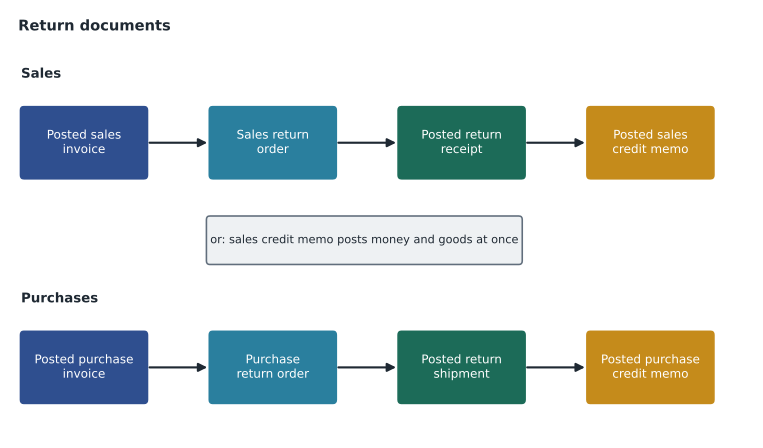
Business Central has two documents for reversing a sale. A sales credit memo posts the financial reversal: it reduces revenue and the receivable, and for items it can bring the quantity back into inventory in the same step. A sales return order separates the physical return from the financial one: it is received like a purchase, creating a posted return receipt, and invoiced later, creating a posted sales credit memo. Purchasing has the matching pair: a purchase credit memo and a purchase return order with a posted return shipment.
| Situation | Document | Why |
|---|---|---|
| Price correction, no goods return | Sales credit memo | Only money changes |
| Small return, goods back on the spot | Sales credit memo with item lines | Simple and quick |
| Goods must be received and inspected before credit | Sales return order | Receipt and credit are separate steps by different people |
| Wrong invoice that should be undone completely | Correct or Cancel on the posted invoice (finance course) | Business Central creates and posts the corrective credit memo |
| Returning goods to a vendor | Purchase return order or purchase credit memo | Mirror of the sales side |
Corbel & Finch chose return orders for wholesale returns, because Dovrin's team receives and inspects the goods before Callum approves the credit, and credit memos for price corrections and small café adjustments. The Correct and Cancel actions from the finance course remain the fastest way to reverse an invoice that was wrong in its entirety.
Getting the original lines
A return should reference what was sold, so that the return comes back at the right cost and price. On a return order or credit memo, Get Posted Document Lines to Reverse shows posted shipments, invoices, return receipts and credit memos for the customer; the user picks lines, and Business Central copies them with their quantities, prices, discounts, dimensions and item tracking, and records the link to the original entry in Appl.-from Item Entry. The alternative, Copy Document, copies a whole posted document onto the new one.
This link matters most for cost. If Exact Cost Reversing Mandatory is turned on in Sales & Receivables Setup (and Purchases & Payables Setup), every return line must be linked to the original entry, and the returned item comes back at exactly the cost it left with. Without the link, the return would be valued at the item's current unit cost, which for a FIFO or average item can differ from the original and distort margins. Noor turned on exact cost reversing for both sales and purchases.
Return reasons
Return reason codes explain why goods came back and can control what happens to them. A return reason can have a Default Location Code, so goods returned for damage go to a quarantine location rather than back into saleable stock, and an Inventory Value Zero setting, so goods that will be thrown away are received with no value. Return reasons are also a useful report dimension: a pattern of "crushed in transit" points to a carrier problem.
| Return reason | Default location | Inventory Value Zero | Use |
|---|---|---|---|
| DAMAGED | QUARANTINE | Yes | Crushed or torn bags, to be destroyed |
| WRONG-ITEM | ROASTERY | No | Wrong blend or grind, resaleable |
| QUALITY | QUARANTINE | No | Customer reports a taste problem; held for cupping |
| OVERSTOCK | ROASTERY | No | Goodwill return of unopened stock |
Callum added a fifth location, QUARANTINE, with its own inventory posting setup lines, for goods that may not be sold. Stock there is excluded from availability in practice because sales orders do not use that location, and the cafés' planning never transfers from it.
Worked problem
A crushed case
The grocery chain returns one CASE of Breakwater Blend that was crushed by the carrier. It was invoiced at 132.00 dollars on posted invoice S-INV-2147. The bags will be thrown away. What does Corbel & Finch post?
Show solution
- Create a sales return order for the customer and choose Get Posted Document Lines to Reverse; pick the Breakwater line from S-INV-2147 and set the quantity to 1 CASE.
- Set Return Reason Code to DAMAGED: the line moves to location QUARANTINE and Inventory Value Zero applies. The lot number is copied from the original shipment.
- Dovrin's team receives the case and posts Receive, creating a posted return receipt.
- Callum reviews the receipt, posts Invoice, and the posted sales credit memo credits 132.00 dollars plus tax to the customer.
- Post a negative adjustment from QUARANTINE with reason code DESTROYED when the bags are disposed of; because the value is zero, the write-off has no cost. The carrier claim is handled separately.
Answer: A return order linked to the original invoice, received into quarantine at zero value, then credited and written off.
Restocking fees and other charges
Some returns carry a fee, such as a restocking fee for a goodwill return of unopened stock. The fee can be a line on the credit memo with a G/L account or a negative item charge, so the customer is credited less than the full amount. Item charges on return documents also allow returned freight to be assigned back to the original entries. Corbel & Finch does not charge restocking fees to wholesale customers, but the web shop terms allow one for opened merchandise, which is entered as a G/L line on the credit memo.
Replacements and exchanges
An exchange is a return plus a new sale. When a café receives the wrong grind, the sales coordinator creates a return order for the wrong bags and a new sales order for the right ones. The Move Negative Lines function can also turn negative lines on a sales order into a return order. Business Central does not combine the two into one document, which keeps the financial and physical trail clear.
Purchase returns
Purchase returns mirror sales returns. When the label supplier's misprinted labels go back, Imogen creates a purchase return order, uses Get Posted Document Lines to Reverse to pick the original receipt, and posts Ship; when the supplier's credit note arrives, she fills Vendor Cr. Memo No. and posts Invoice, creating a posted purchase credit memo. A purchase credit memo alone is used for price corrections, such as a green coffee importer crediting a quality adjustment for a lot with a lower cupping score. Because Corbel & Finch uses exact cost reversing, the returned labels leave inventory at the cost they came in with.
Undoing return receipts and shipments
Like ordinary shipments and receipts, posted return receipts and return shipments can be undone with Undo Return Receipt or Undo Return Shipment before they are invoiced. This fixes the common mistake of receiving a return into the wrong location or with the wrong quantity.
Reports and controls
The posted return receipts and credit memos list, filtered by return reason, gives a monthly view of returns. Customer statistics show returns as a share of sales. Callum also added the credit memo approval workflow template so credit memos above 500 dollars need his approval, and above 5,000 Bettina's, matching the purchase approval limits from the foundations course.
Credit memos without goods
Many credits do not involve goods at all. A wholesale customer was charged the list price instead of their volume price, a delivery was late and Bettina agreed a goodwill credit, or an invoice discount was missed. For these, a sales credit memo with a G/L account line, or an item line with quantity but no inventory effect, is enough. When an item line is used only to correct the price, Callum uses Get Posted Document Lines to Reverse, changes the unit price on the credit memo to the difference, and turns the line into a price correction so no quantity comes back. For a pure goodwill credit he uses a G/L account line to a sales allowances account, which keeps margin reports honest.
| Credit reason | Line type | Account or effect |
|---|---|---|
| Wrong price charged | Item line reversing the original, price difference only | Revenue reduced; no inventory change |
| Goodwill after a late delivery | G/L account line | Sales allowances account |
| Missed invoice discount | G/L account line or corrective credit memo | Discount account |
| Goods returned | Item line from the original document | Revenue and inventory reversed |
Applying credits to invoices
Credit memos create customer ledger entries with negative amounts. When the credit relates to a specific invoice, the Applies-to Doc. No. on the credit memo applies it automatically on posting, so the invoice's remaining amount drops and the aged receivables report stays clean. When a credit is a general one, it remains open until it is applied to a future invoice or refunded. The finance course covered application and unapplication; returns use the same tools.
Worked problem
A wrong grind exchange
A café received 2 CASE of Breakwater in FILTER grind instead of ESPRESSO grind, invoiced at 138.00 dollars per case. The cases are unopened and can be resold. What is posted?
Show solution
- Create a sales return order, Get Posted Document Lines to Reverse for the 2 cases of the FILTER variant, and set return reason WRONG-ITEM; the location is ROASTERY.
- Create a new sales order for 2 cases of the ESPRESSO variant at the same price.
- Ship the new order and receive the return when the van brings the wrong cases back.
- Invoice both: the credit memo of 276.00 dollars applies to the original invoice, and the new invoice of 276.00 dollars replaces it.
Answer: A return order for the wrong variant back into saleable stock and a new order for the right one, with the credit applied to the original invoice.
Vendor quality credits
Green coffee quality claims are a regular part of Imogen's work. When a lot cups below the grade in the contract, the importer usually agrees a price reduction rather than taking the coffee back. Imogen records it as a purchase credit memo with an item charge assigned to the original receipt, so the reduction lowers the cost of that lot of coffee rather than going to an expense account. Cost adjustment (lesson 11) then carries the lower cost to roasted coffee made from it.
Returns from the web shop
Web shop returns arrive by post, usually one bag or one piece of merchandise at a time. Because the web shop posts to one WEB customer, Callum handles them with sales return orders for that customer, using the web shop order number in the external document number so the right buyer can be refunded through the web shop platform. Opened coffee cannot be resold and goes to QUARANTINE with reason DAMAGED; unopened merchandise goes back to ROASTERY with reason OVERSTOCK. The refund itself happens in the web shop's payment system, and the credit memo in Business Central records the revenue and tax reversal so the two systems agree at month end.
Common mistakes
MistakeTyping return lines by hand without reference to the original.
InsteadUse Get Posted Document Lines to Reverse so prices, costs and lots come from the original.
MistakeReturning damaged goods into saleable stock.
InsteadUse return reasons with a quarantine location and, if needed, zero inventory value.
MistakeUsing a credit memo when goods must be inspected first.
InsteadUse a return order so receipt and credit are separate steps.
MistakeLeaving Exact Cost Reversing Mandatory off.
InsteadTurn it on so returns come back at the original cost.
MistakeCorrecting a wrong whole invoice with a manual credit memo.
InsteadUse Correct or Cancel on the posted invoice.
Summary and key terms
- Credit memos reverse money and can return goods in one step; return orders separate receipt and credit.
- Get Posted Document Lines to Reverse copies original lines with prices, costs and tracking.
- Exact cost reversing returns items at their original cost.
- Return reason codes set default locations and zero inventory value and support reporting.
- Purchase return orders and purchase credit memos mirror the sales side.
- Return receipts and shipments can be undone before invoicing.
- Sales credit memo
- A document that reverses a sale financially and can return items.
- Sales return order
- A document that receives returned goods and later posts a credit memo.
- Posted return receipt
- The record of returned goods received from a customer.
- Exact cost reversing
- A setting that links returns to the original entry so cost is reversed exactly.
- Return reason code
- A code explaining a return, with an optional default location and zero value setting.
- Purchase return order
- A document that ships goods back to a vendor and later posts a purchase credit memo.
Practice problems
Work each problem on paper first, then reveal the answer to check.
Why use a sales return order instead of a credit memo for a wholesale return?
Show answer
So the goods are received and inspected before the credit is posted, as separate steps.
What does Inventory Value Zero on a return reason do?
Show answer
Receives the returned goods with no value, for goods that will be scrapped.
What does Exact Cost Reversing Mandatory require?
Show answer
That return lines are linked to the original item ledger entry so the original cost is reversed.
Lesson quiz · 5 questions
Score 60% or more to complete this lesson.
Create a free account to save your progress, take quizzes and earn a certificate.