
MSBA-350 · Lesson 7 of 12 · 20 min
Fixed assets
▶ Video coming soon A video version of this lesson is on the way.
The most expensive thing Corbel & Finch owns is its drum roaster, bought in 2021 for about 118,000 dollars. Around it sit two grinders, a bagging machine, a delivery van, six espresso machines in the cafés, the café fit-outs, office computers and a cold brew system bought in summer 2026. In the old system, depreciation was a spreadsheet that Callum updated once a year. Noor set up the Fixed Assets area in CONFIG in November 2026 so that each asset would have a card, a depreciation schedule and a full history, and so that depreciation would post every month without a spreadsheet. This lesson covers the setup, the transactions across an asset's life, and the depreciation methods the MB-800 exam expects candidates to tell apart.
The fixed asset setup
Fixed assets are another subledger. Each asset has a fixed asset card and FA ledger entries. The setup lists that support them are shown in the table.
| Setup | Purpose | Corbel & Finch example |
|---|---|---|
| FA Setup | Default depreciation book, number series, whether main assets and components are allowed | Default book COMPANY |
| Depreciation Books | A set of rules for depreciation, and whether each posting type integrates with the G/L | COMPANY (integrated), TAX (not integrated) |
| FA Classes and Subclasses | Grouping of assets | Tangible: Production Equipment, Vehicles, Café Equipment, Leaseholds, Computers |
| FA Posting Groups | The G/L accounts for each kind of asset | EQUIPMENT, VEHICLES, LEASEHOLD, COMPUTERS |
| FA Locations | Where assets are | ROASTERY, CAFE1, CAFE2, OFFICE |
| FA Journal Setup | Which journal templates and batches each book uses | FA G/L journal batch DEPREC |
The depreciation book is the central idea. A book is a set of depreciation rules and history. A company can keep several books for the same asset, for example a COMPANY book for the financial statements and a TAX book for tax depreciation, which in Canada follows the capital cost allowance rules and in the United States follows tax depreciation rules that differ from book depreciation. Only books marked as integrated with the general ledger post G/L entries. On the depreciation book card, the G/L Integration options can be set separately for acquisition cost, depreciation, write-down, appreciation, custom postings, disposal and maintenance. Corbel & Finch's COMPANY book integrates everything; the TAX book integrates nothing and is used only to track tax amounts for the accountant.
The FA posting group names the accounts for an asset type: acquisition cost, accumulated depreciation, depreciation expense, gains and losses on disposal, maintenance expense and others. The roaster, grinders and bagging machine share the EQUIPMENT group; the van uses VEHICLES; café fit-outs use LEASEHOLD; laptops use COMPUTERS. Posting groups can also carry an allocation, for example splitting depreciation expense across departments.
Fixed asset cards, main assets and components
Each fixed asset card has a number, description, class, subclass, location, responsible employee, serial number and one or more FA depreciation book lines. Each book line holds the depreciation method, the depreciation starting date, the number of years or ending date, the FA posting group and, for some methods, a declining-balance percentage. The card's statistics show acquisition cost, accumulated depreciation and book value per book.
Large assets made of parts can be set up as a main asset with components. The café fit-out at CAFE2, for example, was built as a main asset with components for the counter, the plumbing and the electrical work, because they have different useful lives. Each component is its own fixed asset that carries its own depreciation; the main asset gives a combined view. The Main Asset Components page links them, and the main asset's statistics roll up its components.
The life of an asset
Every fixed asset goes through the same stages, each recorded as an FA posting type.
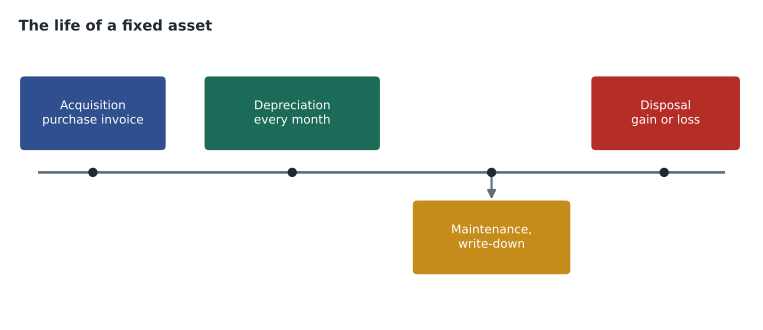
Acquisition. The usual way to acquire an asset is a purchase invoice with a line of type Fixed Asset, the asset number and FA Posting Type Acquisition Cost. When posted, the cost goes to the asset's acquisition cost account and an FA ledger entry is created in the default book. Assets can also be acquired through the FA G/L journal (for example, an asset built by the company's own staff), and an acquisition guide available from the asset card can walk a user through the steps. Opening balances for existing assets are entered through the FA journal or a configuration package, with acquisition cost and accumulated depreciation as separate lines dated before go-live.
Depreciation. The Calculate Depreciation process looks at every asset in a book and creates journal lines for the depreciation due up to a date. In an integrated book, it fills an FA G/L journal; the user reviews and posts it. Corbel & Finch runs it monthly as part of the close (lesson 12), with the posting date on the last day of the month.
Other changes. Write-down reduces value for impairment; appreciation increases it where accounting rules allow; maintenance records repair costs against the asset without changing its value, so total maintenance per asset can be reported; and custom posting types exist for special needs. Insurance can be tracked on separate insurance cards linked to assets, so the insured value can be compared with book value.
Disposal. When an asset is sold or scrapped, a disposal is posted, either from a sales invoice line of type Fixed Asset with the sale price, or from the FA G/L journal with FA Posting Type Disposal. Business Central calculates the gain or loss by comparing the proceeds with book value, posts it to the gain or loss account in the FA posting group, and removes the acquisition cost and accumulated depreciation from the books. Depreciation for the part of the year before disposal is calculated first.
Depreciation methods
The study guide asks candidates to tell apart the depreciation methods. Business Central offers these on each FA depreciation book line.
| Method | How it works | Suits |
|---|---|---|
| Straight-line | Equal amounts over the useful life, from the depreciable basis less salvage value | Most equipment, leaseholds |
| Declining-Balance 1 | A fixed percent of the declining book value; the annual amount is spread evenly over the year's periods | Assets that lose value fast |
| Declining-Balance 2 | A fixed percent of the declining book value, recalculated each period | The same, with period-based calculation |
| DB1/SL and DB2/SL | Declining balance, switching to straight-line when straight-line gives the larger amount | Tax-style schedules |
| User-Defined | A depreciation table of percentages by period | Special schedules required by rules or policy |
| Manual | No automatic calculation; amounts are entered by hand | Assets not depreciated, such as land, or one-off cases |
Worked problem
Depreciating the cold brew system
The cold brew system cost 36,000 dollars and was placed in service on July 1, 2026. Corbel & Finch expects to use it for 6 years with no salvage value. What does straight-line depreciation post each month, and what is the book value at December 31, 2026?
Show solution
- Depreciable amount: 36,000 less 0 salvage = 36,000.
- Annual depreciation: 36,000 divided by 6 years = 6,000.
- Monthly depreciation: 6,000 divided by 12 = 500.
- From July to December 2026 is 6 months: 6 times 500 = 3,000 of accumulated depreciation.
- Book value at December 31, 2026: 36,000 less 3,000 = 33,000.
Answer: 500 dollars a month; book value of 33,000 dollars at December 31, 2026.
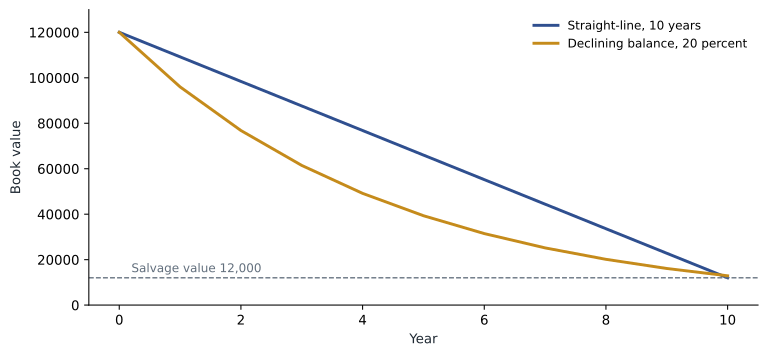
Under declining balance at 20 percent a year, the same asset would depreciate by 7,200 in its first full year (20 percent of 36,000), then 5,760 in the second (20 percent of 28,800), and so on. The method gives larger amounts early and smaller amounts later. Business Central also needs to know how to treat the first partial year; the depreciation book has settings for the fiscal year length, whether to use a 365-day year and how to handle the first period, and the asset's Depreciation Starting Date decides when the calculation begins.
Reports and reconciliation
The Fixed Asset - Book Value reports show acquisition cost, depreciation and book value by asset, class or posting group for a period. The Fixed Asset - Projected Value report forecasts depreciation for coming periods, which is useful for budgets (lesson 8). The Fixed Asset - Analysis report lists acquisitions and disposals. At month end, the balance of the acquisition cost and accumulated depreciation G/L accounts should equal the totals in the integrated book; if a user has posted directly to those accounts with a general journal, they will not. As with other control accounts, Direct Posting should be off on fixed asset accounts.
Callum loaded Corbel & Finch's 23 assets with a configuration package: cost, accumulated depreciation to December 31, 2026, method, starting date and remaining life. He then ran Calculate Depreciation for January 2027 in a sandbox copy and compared the result with his spreadsheet. Two assets differed by a few dollars because the spreadsheet rounded each year; he agreed to accept Business Central's figures going forward and noted the difference for the auditor.
Two journals for fixed assets
Fixed assets have two journals, and the difference confuses many new users. The FA G/L journal is used for books that are integrated with the general ledger: its lines post both an FA ledger entry and G/L entries. The FA journal is used for books that are not integrated, such as the TAX book: its lines post only FA ledger entries. If a user tries to post a depreciation line for an integrated book in the FA journal, Business Central refuses, because the G/L would miss the entry. The FA Journal Setup page names the template and batch each book uses, so Calculate Depreciation puts lines in the right journal automatically.
| Journal | Posts | Used for |
|---|---|---|
| FA G/L journal | FA ledger entries and G/L entries | Integrated books such as COMPANY |
| FA journal | FA ledger entries only | Non-integrated books such as TAX |
| FA reclassification journal | Moves cost and depreciation between assets | Splitting or combining assets |
| Insurance journal | Insurance coverage entries | Tracking insured amounts |
The FA reclassification journal moves acquisition cost and accumulated depreciation from one asset to another, for example when a grinder bought as part of a café fit-out is later moved to the roastery and needs its own card. It creates the lines needed in the FA G/L journal, so both assets keep a clean history.
Worked problem
Declining balance, year by year
A delivery van costs 48,000 dollars and is depreciated at 25 percent declining balance in the COMPANY book. What is the depreciation for each of the first three full years?
Show solution
- Year 1: 25 percent of 48,000 = 12,000; book value 36,000.
- Year 2: 25 percent of 36,000 = 9,000; book value 27,000.
- Year 3: 25 percent of 27,000 = 6,750; book value 20,250.
- With Declining-Balance 1, each year's amount is spread evenly over that year's months: 1,000 a month in year 1.
Answer: 12,000, then 9,000, then 6,750; the amount falls each year because it is a percent of a falling book value.
Maintenance and insurance
Repairs and servicing are recorded with maintenance postings, either on purchase invoices with FA Posting Type Maintenance or in the FA G/L journal, with a maintenance code such as SERVICE or PARTS. Maintenance does not change an asset's value; it posts to the maintenance expense account in the FA posting group, but it is stored against the asset, so the Maintenance - Details and analysis reports show what each asset has cost to keep running. For the roaster, that history helps Bettina decide when replacement is cheaper than repair. Insurance cards record each policy with its coverage, and linking assets to policies lets the Insurance - Uninsured FAs and coverage reports show assets that are under-insured or not insured at all. Callum linked the roaster, the van and the café equipment to the business's property and vehicle policies during setup.
Common mistakes
MistakePosting asset purchases to an expense or G/L account instead of a Fixed Asset line.
InsteadUse a purchase line of type Fixed Asset so the asset ledger and the G/L both record it.
MistakeIntegrating the tax book with the general ledger.
InsteadIntegrate only the book used for the financial statements.
MistakeDeleting a sold asset.
InsteadPost a disposal so the gain or loss and the removal of cost and depreciation are recorded.
MistakeDepreciating land.
InsteadUse the Manual method or no depreciation for land.
Summary and key terms
- Fixed assets are a subledger with cards, depreciation books and FA ledger entries.
- Depreciation books hold rules and history; only integrated books post to the G/L.
- FA posting groups name the accounts; classes, subclasses and locations organize assets.
- Main assets group components that depreciate separately.
- Assets are acquired, depreciated, maintained, written down and disposed of through purchase invoices, sales invoices and FA journals.
- Straight-line, declining-balance, combined, user-defined and manual methods suit different assets.
- Depreciation book
- A set of depreciation rules and history for assets, optionally integrated with the G/L.
- FA posting group
- The G/L accounts used for a kind of fixed asset.
- Main asset
- A fixed asset made up of component assets that depreciate separately.
- Calculate Depreciation
- The process that creates depreciation journal lines up to a date.
- Declining balance
- A method that depreciates a fixed percent of the remaining book value.
- Disposal
- The posting that removes a sold or scrapped asset and records the gain or loss.
Practice problems
Work each problem on paper first, then reveal the answer to check.
Which book should integrate with the general ledger at Corbel & Finch?
Show answer
The COMPANY book used for the financial statements.
How is a fixed asset normally acquired in Business Central?
Show answer
By posting a purchase invoice with a Fixed Asset line and posting type Acquisition Cost.
What does the Manual depreciation method do?
Show answer
It does not calculate depreciation automatically; amounts are entered by hand.
Lesson quiz · 5 questions
Score 60% or more to complete this lesson.
Create a free account to save your progress, take quizzes and earn a certificate.