
MSBA-331 · Lesson 5 of 12 · 19 min
Trade agreements and pricing
▶ Video coming soon A video version of this lesson is on the way.
Tadeusz Kowal-Mensah runs customer service for the distribution business in Calgary. He arrived at the pricing session with a binder. It held the old price lists: a list price sheet for each product family, discount letters for 140 distributors, a spreadsheet of special prices for the two largest utilities, and handwritten notes on which of those were still valid. "Somewhere in here," he said, "is the price of a DU-40 for Prairieline Pump Supply. I am about 70 percent sure which page." Annelise told him that by the end of the session the system would know the answer, and so would he.
Where prices come from
In Supply Chain Management, the price on a purchase or sales line can come from several sources. The simplest is the base price on the released product: a purchase price and a sales price, each with a unit and price quantity. On top of that, trade agreements hold prices and discounts for specific combinations of item, vendor or customer, quantity, date and dimension. Purchase agreements and sales agreements are commitments with agreed prices over a period. Some companies also use the pricing management features, including price trees and discount groups, especially with Dynamics 365 Commerce. This lesson focuses on trade agreements, which are what the MB-330 exam objective names: configure default item prices, purchase and sales prices, and discounts in trade agreements.
| Price source | Holds | Typical use |
|---|---|---|
| Base price on the released product | One purchase price and one sales price | Fallback and simple items |
| Trade agreement | Prices and discounts by item, party, quantity, date and dimensions | Price lists, customer-specific prices, vendor price lists |
| Purchase or sales agreement | Committed quantity or value at agreed prices over a period | Annual contracts, blanket orders |
| Manual price on the line | A price typed by the user | Exceptions, controlled by security and tolerance |
Trade agreement relations
A trade agreement line belongs to one of eight relations: purchase price, purchase line discount, purchase multiline discount, purchase total discount, sales price, sales line discount, sales multiline discount and sales total discount. Price relations set a unit price. Line discounts reduce the price of one line, as an amount, a percentage or both. Multiline discounts look at the total quantity of several lines that share a multiline discount group, so a customer who orders 20 different seal kits in one order can get a quantity discount across all of them. Total discounts apply to the order total.
| Relation | Based on | Example at Cobalt Ridge |
|---|---|---|
| Sales price | One item for a customer, customer price group or all customers | DU-40 list price and the utility contract price |
| Sales line discount | One item or item discount group for a customer or group | Distributor discount of 30 percent on spares |
| Sales multiline discount | Total quantity across items in a multiline discount group | 5 percent when 50 or more seal kits are on one order |
| Sales total discount | The order total for items that allow it | Not used |
| Purchase price | One item from a vendor or vendor group | Lakehead Forge price per kilogram of CS-3300 |
| Purchase line discount | One item or group from a vendor or group | Bearing distributor discount on catalog items |
Account codes and item codes
Each trade agreement line has an account code and an item code. The account code is Table (one specific customer or vendor), Group (a price or discount group of customers or vendors) or All. The item code is Table (one item), Group (an item discount group, for discounts) or All. Combined, they make nine possible levels of specificity, from one item for one customer down to every item for every customer. Customer price groups and discount groups are set on the customer account, and item discount groups on the released product.
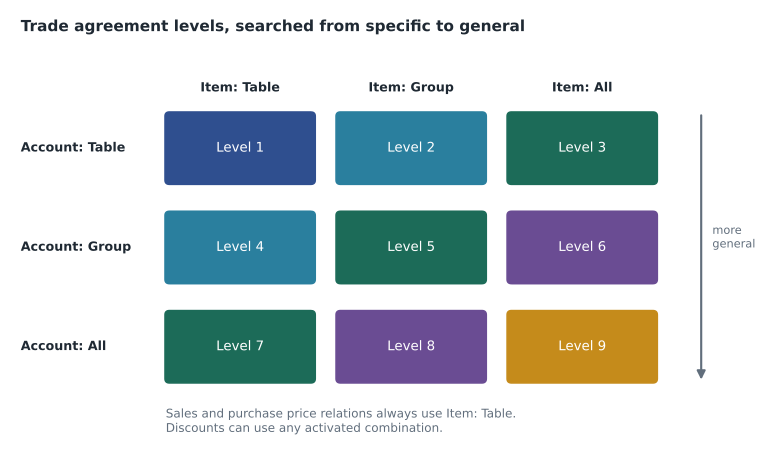
Not every combination applies to every relation. A price relation always names a specific item, so its item code is Table; the account code can be Table, Group or All. Discount relations can use any combination. Which combinations the system looks at is switched on in Activate price/discount in the Accounts receivable and Procurement and sourcing parameters. Switching on only what is used makes price searches faster and setups easier to understand; Cobalt Ridge enabled, for sales prices, Table and Group account codes; for line discounts, the account Group with item Table and Group; and for multiline discounts, the account Group with item Group.
The price search and Find next
When a line is entered, the system searches the active trade agreements for that relation from the most specific level to the most general. Within each level it looks for lines whose quantity range, date range, currency, unit and dimensions match the order line. Two settings on each trade agreement line control what happens when more than one line could apply. Find next tells the search to continue to more general levels after finding a match, so that, for discounts, a specific discount and a general one can both apply. If Find next is off, the search stops at the first match. For prices, when Find next is on and several lines match across the levels searched, the lowest price found is used; with Find next off, the first matching price is used.
| Setting | Effect |
|---|---|
| Find next | Continue searching more general levels after a match |
| From and To dates | The agreement line applies only between these dates |
| From and To quantity | The line applies only to order quantities in this range |
| Currency and unit | The line applies only to lines in this currency and unit |
| Include generic currency | Allows conversion from the company currency where enabled |
| Product and storage dimensions | The price can differ by variant, site or warehouse where enabled |
Annelise warned that Find next is the most common source of pricing surprises. If a distributor gets a 30 percent group discount on spares and a specific 5 percent extra discount on one part, the team must decide whether the extra discount replaces the group discount or adds to it. With Find next on for the specific line, the search continues and both discounts are found; how they combine is then decided by the discount setup for the customer, such as whether line discounts are summed or the best is taken. Cobalt Ridge documented each rule with an example price calculation and tested every one in the CONFIG sandbox.
Trade agreement journals
Trade agreements are not typed onto lines directly. They are created and changed through trade agreement journals. A journal has a name, which can carry default relation and approval settings, and lines that describe new or changed agreements. When the journal is posted, its lines become active trade agreements. Journals can be created manually, imported from Excel, or created with functions such as Adjust that change existing prices by a percentage or amount and Copy that copies agreements from one party or period to another. Posted agreements can be found with Price/discount agreement inquiries and opened back into a journal for change.
This journal design gives control. Price changes can be prepared in a journal, reviewed, and posted on the day they take effect, or posted in advance with a future From date. Cobalt Ridge created journal names for the main uses: SALESLIST for the annual list price update, CONTRACT for customer contract prices, VENDOR for vendor price lists, and PROMO for temporary promotions, each with its own number sequence. Only the pricing analyst and the sales director can post SALESLIST and CONTRACT journals.
Purchase prices follow the same pattern. When Lakehead Forge sends its new price list in November for the coming year, Marisol's team opens the existing purchase price agreements for Lakehead in a VENDOR journal, uses Excel to update the prices, sets the From date to January 1, and posts the journal after the procurement manager has reviewed it. The current prices keep a To date of December 31, so orders for December deliveries still get this year's price, and orders for January deliveries get next year's. Because the search uses the line's delivery date or the order date depending on the parameter setting, the team checked which date their parameters used before the first year-end. They also agreed that a purchase price trade agreement does not change the standard cost of an item; standard costs change only through costing versions, as the product course explained, and any difference between the purchase price and the standard cost is posted as a purchase price variance.
Prices by variant and dimension
Trade agreements can be specific to product dimensions, so each MC-150 variant can have its own price, and to storage dimensions such as site or warehouse when the item's dimension groups allow price search by those dimensions. The MC-150 price list uses Configuration and Size, because motor rating and impeller size change the price, but not Style: the coating is priced as a separate surcharge. For purchase prices, the castings from Lakehead Forge have one price for the Hamilton plant and another for the Akron plant, because freight terms differ, which uses the site dimension on purchase trade agreements.
Seeing why a line got its price
Users need to see where a price came from. On sales and purchase lines, the price details view shows the trade agreement lines and agreements that the search considered, which one was used, and the discounts applied, with their relation, account code and item code. Tadeusz's team uses it whenever a distributor questions an invoice. It also shows whether the price was overridden manually. Manual overrides can be restricted by security and, on sales orders, by a setting that records the reason for the override; Cobalt Ridge made the reason code mandatory and reviews overrides monthly, because frequent overrides on the same item usually mean the trade agreement is wrong.
Prices carry a price unit, or price quantity, as well as an amount. A price of 18.50 per 100 pieces for bolts is held as an amount of 18.50 with a price unit of 100, so a line for 400 pieces costs 74.00. Mixing price units is a classic data migration error: if the old system held bolt prices per 100 and the import treats them as per piece, every bolt order is a hundred times too expensive. Price charges and price-related rounding rules, set per currency, also affect the final unit price, and the team agreed to round distributor prices to two decimals with no further rounding.
Moving the binder into the system
Tadeusz's binder became a migration plan. List prices for every family were loaded through a SALESLIST journal with a From date of January 1, 2027 and an account code of All. The 140 distributor discount letters, which used only six distinct discount levels, became six customer discount groups with line discounts by item discount group, which reduced 140 separate agreements to 18 trade agreement lines. The two utility contracts became customer-specific prices for the items they cover, plus one sales agreement. Handwritten notes that nobody could confirm were left out, and Tadeusz wrote to the customers concerned. By the end of the session, the price of a DU-40 for Prairieline was a line on the screen with its source shown.
Purchase and sales agreements
Agreements sit next to trade agreements. A purchase agreement commits the company to buy a quantity or value of products from a vendor over a period, at agreed prices and discounts. Release orders, which are ordinary purchase orders linked to the agreement, draw down the commitment. A sales agreement does the same for a customer. Agreements can be by product quantity, by product value, by product category value or by total value. They are useful for annual contracts: Cobalt Ridge has a sales agreement with one utility for 60 MC-150 pumps over 2027, and each call-off is a release order at the agreed price. Agreement prices take precedence over trade agreements when a line is linked to the agreement.
Worked problem
Working out a distributor price
Prairieline Pump Supply, in the DIST-A customer price group and DIST discount group, orders 12 SK-90H seal kits. The list price for all customers is 250. The DIST-A group price is 230. The DIST group line discount for item group SEALS is 10 percent with Find next off. What is the net unit price?
Show solution
- The price search finds the DIST-A group price of 230, which is more specific than the all-customers price of 250.
- The line discount search finds the DIST group discount of 10 percent on item group SEALS.
- Find next is off, so no further discount levels are searched.
- Net unit price: 230 less 10 percent is 207.
- Line amount: 12 times 207 is 2,484.
Answer: The net unit price is 207 and the line amount is 2,484, in the customer's currency.
Common mistakes
MistakeTyping prices onto order lines instead of using trade agreements.
InsteadMaintain prices in trade agreement journals so the price search finds them.
MistakeTurning on every account and item code combination in Activate price/discount.
InsteadActivate only the combinations in use; the setup becomes clearer and faster.
MistakeLeaving Find next on or off without deciding how discounts should combine.
InsteadDecide the rule, document an example and test it.
MistakePosting price changes with today's date for a change that takes effect next month.
InsteadPost journals with the correct From date, in advance if needed.
Summary and key terms
- Prices come from base prices, trade agreements, purchase and sales agreements, or manual entry.
- Trade agreements have eight relations: prices, line, multiline and total discounts for sales and purchase.
- Account code and item code combinations set how specific a line is; Activate price/discount decides which combinations are searched.
- The price search runs from specific to general; Find next decides whether it continues after a match.
- Trade agreements are created and changed through journals; agreements commit quantities or values over a period.
- Trade agreement
- A price or discount line for a combination of item, party, quantity, date and dimensions.
- Relation
- The type of trade agreement, such as sales price or purchase line discount.
- Find next
- A setting that makes the price search continue to more general levels after a match.
- Trade agreement journal
- The journal through which trade agreements are created and changed.
- Purchase agreement
- A commitment to buy a quantity or value from a vendor over a period at agreed terms.
Practice problems
Work each problem on paper first, then reveal the answer to check.
Which item code must a sales price relation use?
Show answer
Table, a specific item.
Where do you switch on which account and item code combinations are searched?
Show answer
In Activate price/discount in the parameters.
A list price is 100 with a 20 percent line discount and Find next off. What is the net price?
Show answer
80.
Lesson quiz · 5 questions
Score 60% or more to complete this lesson.
Create a free account to save your progress, take quizzes and earn a certificate.