
MSBA-331 · Lesson 1 of 12 · 19 min
Procurement setup
▶ Video coming soon A video version of this lesson is on the way.
Annelise opened the procure-to-pay series in the Hamilton plant's training room with a printout from the old system: a purchase order for 400 kilograms of duplex steel castings that had been approved by nobody, sent to a supplier who had been blocked for quality problems a year earlier, and charged to the wrong cost centre. Marisol Teixeira-Bond, the senior buyer, laughed and said it was not even the worst one in the drawer. Piotr Vasquez-Lind, the supply chain manager, did not laugh. "That is why we are here," he said. "Before anyone types a purchase order in the new system, I want the system to know who can buy what, from whom, and who has to approve it."
This course follows the procurement and sales sessions at Cobalt Ridge Manufacturing. It builds on the product and inventory setup from the previous course: the MC-150 municipal pump master and its variants, the storage and tracking dimension groups, the costing methods and the quality associations are all in place in the CONFIG sandbox. Now the team configures how goods are bought and sold.
Procurement in the MB-330 exam
In the MB-330 skills measured as of October 21, 2026, procurement and sales sit in the domain Implement and manage supply chain processes, weighted at 15 to 20 percent. Its procurement objectives include creating and maintaining vendors; purchase requisitions, requests for quotation and purchase orders; purchase agreements and vendor rebates; consignment inventory; over and under deliveries and delivery schedules; procurement categories, charge codes and purchasing policies; vendor collaboration; vendor returns; registration and product receipt; and procurement workflows. Trade agreements appear under product information management, in the objective about purchase and sales prices and discounts. This course covers all of these, plus landed cost in outline.
| MB-330 objective area | Lesson in this course |
|---|---|
| Vendors, procurement categories, purchasing policies, charge codes, workflows | 1 and 10 |
| Purchase requisitions and requests for quotation | 2 |
| Purchase orders, delivery schedules, over and under delivery, registration and product receipt | 3 |
| Vendor collaboration | 4 |
| Trade agreements, purchase and sales agreements | 5 |
| Customers, sales quotations, sales orders, reservations, ATP and CTP | 6 and 7 |
| Vendor and sales returns | 8 |
| Intercompany orders | 9 |
| Vendor and customer rebates, charges | 10 |
| Agents and Copilot in procurement | 11 |
The procure-to-pay flow
Procurement in Dynamics 365 Supply Chain Management follows a familiar chain. A need is recorded, often as a purchase requisition. A buyer turns approved demand into a purchase order, possibly after a request for quotation. The vendor confirms the order. Goods arrive, are registered and received with a product receipt. The vendor invoice is matched against the order and the receipt in Finance's accounts payable, and the invoice is paid. Each step leaves documents and journal entries behind, and each can be controlled by policy and workflow.
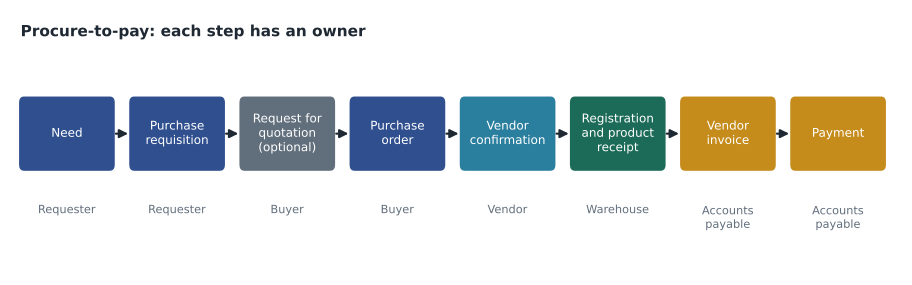
Not every purchase uses every step. Cobalt Ridge decided that direct materials for production, such as castings and motors, would usually come from planned purchase orders created by master planning, with no requisition. Indirect purchases, such as safety equipment, tools and office supplies, would start as requisitions. Services such as calibration would use purchase orders with procurement category lines rather than item lines. Piotr wanted the rules written down before the configuration started, so each choice had an owner.
Vendors and vendor groups
Vendors are the parties the company buys from. Each vendor account belongs to a vendor group, which supplies default posting profile, terms of payment and settle period and is used in many filters and reports. The party behind the vendor is shared across companies through the global address book, so Lakehead Forge appears once as a party and has vendor accounts in CRCA, CRUS and, from January 2027, CRMX. Vendor accounts carry the currency, tax group, delivery terms, mode of delivery, payment method and the financial dimensions that should default onto documents.
| Vendor group | Used for | Default terms |
|---|---|---|
| DIRECT | Production materials and components | Net 45 |
| INDIRECT | Tools, maintenance, office and safety supplies | Net 30 |
| SERVICE | Calibration, freight, contract labour | Net 30 |
| INTERCO | Other Cobalt Ridge companies | Net 30, settled monthly |
| ONETIME | One-time vendors | Due on receipt |
Vendors can be put on hold for different transaction types. A hold of All stops every new transaction. Invoice stops invoicing and payment. Payment stops only payments. Requisition stops the vendor from being used on purchase requisitions. Never is the normal state. Marisol pointed out that the vendor who had caused the quality problem in the old system would now carry a hold of Requisition and Invoice while the quality team decided its future, so no one could buy from it by accident while outstanding invoices could still be reviewed.
New vendors can be onboarded through the vendor collaboration request process, where a prospective vendor fills in a registration and an approval workflow creates the vendor account, or entered directly by the accounts payable team. Cobalt Ridge chose the workflow for new direct-material vendors, because quality had to approve them, and direct entry for one-time and indirect vendors under a size limit.
Vendors can also be evaluated. Vendor evaluation criteria are grouped and scored, for example on quality, delivery and service, and scores can be recorded per category, so a casting supplier can be rated highly for quality and poorly for on-time delivery. Teodora Brisebois, the quality manager, asked that every direct-material vendor be scored each quarter, because the scores would feed the decision about which vendors stay on the approved lists.
Procurement categories
A procurement category hierarchy groups what the company buys. It is a category hierarchy with the procurement role, like the hierarchies from the product course, and each node can be linked to products and used directly on purchase lines when no item exists. A requisition for calibration services, for example, can be a line with the category Services > Calibration, a description, a quantity of one and a price, with no item number. Categories also carry settings that matter for procurement: which vendors are approved for the category, the default financial dimensions, questionnaires, and policy rules.
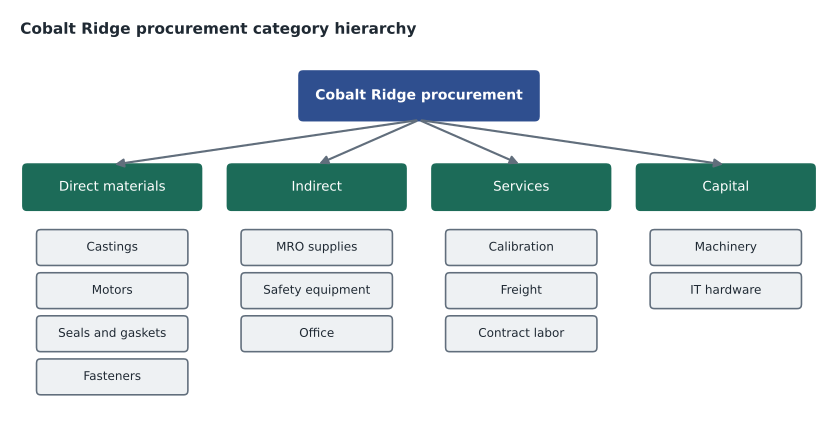
The team kept the hierarchy shallow: four branches and two levels below them. Annelise's rule was that each leaf should be something a buyer could recognize from a requester's description and that would be reported on separately. Fasteners, for instance, got their own node because the company spends heavily on them and wants to consolidate suppliers.
Purchasing policies
A purchasing policy is a set of rules that applies to an organization, either a legal entity or an operating unit such as a department. The policy rules decide how requisitions are processed and controlled. The main rule types are listed in the table. When a requester's organization is covered by more than one policy, the policy setup decides which applies; at Cobalt Ridge each legal entity has one main policy, and the Engineering department has an extra policy that allows engineers to request prototype parts from a wider set of vendors.
| Policy rule | What it controls |
|---|---|
| Category access | Which procurement categories requesters in the organization may use |
| Category policy | Per category: whether receiving is required, whether vendors outside the approved list are allowed, price tolerance and other controls |
| Requisition purpose | Whether requisitions are for consumption or for replenishment |
| Requisition control | Required fields and limits on requisitions |
| Purchase order creation and demand consolidation | Whether approved requisition lines become purchase orders automatically or go to the buyer for consolidation |
| Catalog policy | Which procurement catalogs requesters see |
| Re-approval | Which changes to a purchase order need approval again |
The purchase order creation and demand consolidation rule was the one that started an argument. Marisol wanted every approved requisition line to come to the buyers for consolidation so she could combine orders to the same vendor. The plant managers wanted small indirect requisitions to become purchase orders automatically. They agreed on a split: lines under 2,500 Canadian dollars with a known vendor and a catalog price become purchase orders automatically; everything else goes to the buyers' consolidation workspace.
Procurement catalogs
A procurement catalog is a curated list of products and categories that requesters see when they create requisitions. It is built from the procurement category hierarchy, can include internal products and links to external vendor catalogs through punchout, and is published to the organizations that should use it. Catalogs make requisitions faster and more accurate, because a requester picks a nitrile glove of a known size from an approved vendor instead of typing a free-text description that a buyer must interpret. Catalogs can also be restricted by the catalog policy rule, so the Hamilton maintenance team sees maintenance supplies while the office sees office supplies.
At Cobalt Ridge the first catalog, Plant MRO, holds about 600 maintenance, repair and operations items: bearings, belts, lubricants, filters and safety supplies. Each catalog item points to a released product with an approved vendor and a purchase trade agreement price, which is what allows the automatic purchase order creation described above. Office supplies come through a punchout to the office supply vendor's own website: the requester shops on the vendor's site, and the cart returns to the requisition as lines. The team left capital purchases out of catalogs entirely, because each machine is a negotiation.
Delivery terms, modes and addresses
Purchase orders and sales orders both carry terms of delivery, such as the Incoterms used in international trade, and a mode of delivery, such as truck, courier or customer pickup. Both are set up once and default from the vendor or customer account. Delivery addresses come from the global address book: a purchase order delivers by default to the receiving warehouse's address, but lines can deliver to other addresses, such as a customer for a drop shipment or a construction site. The team set up Incoterms for international vendors, because the casting supplier in Europe ships under different terms from the North American suppliers, and those terms decide who pays freight and when risk passes. Landed cost, which allocates freight and duty to received items on international voyages, is part of the MB-330 objectives as well; Cobalt Ridge will use it for the European castings in phase 2, and lesson 10 explains how charges handle freight in the meantime.
Procurement parameters and number sequences
The Procurement and sourcing parameters page holds company-wide defaults: whether purchase orders use change management, the default order type, whether product receipts are required before invoicing for stocked items, the default posting and delivery settings and many more. Number sequences for purchase orders, requisitions, requests for quotation, product receipts and vendor accounts follow the convention from the foundation course, so a Cobalt Ridge purchase order in CRCA looks like PO-CRCA-000123.
One parameter deserves early attention: Activate change management. When it is on, a purchase order goes through approval before it can be confirmed, and any later change sends it back to the Draft or In review approval state. Cobalt Ridge turned it on for all three companies, with the option to override per vendor off, because the old system's unapproved orders were the reason Piotr started the project.
Procurement workflows
Workflows route documents for review and approval. The main procurement workflow types are the purchase requisition review workflow, the requisition line review workflow, the purchase order workflow, the vendor invoice workflow in accounts payable, the vendor request workflows for onboarding, and the procurement catalog workflow. Each workflow uses conditions, such as total amount or category, to decide which approval steps run, and assigns steps to users, roles, managers in a hierarchy or participants.
| Workflow | Cobalt Ridge approval rule |
|---|---|
| Purchase requisition review | Requester's manager; then plant manager above 10,000 |
| Purchase order | Buyer's lead above 25,000; plant manager above 100,000; controller above 250,000 |
| Vendor request (add vendor) | Quality for DIRECT vendors, then accounts payable |
| Vendor invoice | As set in the foundation course: site manager, controller above 25,000 |
Annelise reminded the team to set workflows up after the policies and categories, because the conditions often refer to them, and to test each workflow with a user who is not an administrator. Workflow approval in finance and operations apps runs through the batch-driven workflow processor, so in the sandbox a submitted document might take a minute to move to its next step.
Worked problem
Holding a problem vendor without losing its history
Ferrolux Castings has failed two incoming inspections. Quality wants no new orders placed while it investigates, but three invoices for goods already received must still be processed.
Show solution
- Open the Ferrolux vendor account in CRCA.
- Set the vendor hold to Requisition so it cannot be chosen on requisitions, and remove Ferrolux from the approved vendor list for the Castings category.
- Leave invoice and payment allowed so accounts payable can process the three outstanding invoices.
- Add a note to the vendor explaining the hold and the quality case number.
- Review the hold with quality at the next weekly meeting.
Answer: Ferrolux can no longer be selected for new requisitions or chosen in the Castings category, but its open invoices can be posted and paid.
Common mistakes
MistakeStarting with workflows before policies and categories exist.
InsteadBuild vendors, categories and purchasing policies first; workflow conditions refer to them.
MistakeCreating a deep procurement hierarchy with dozens of levels.
InsteadKeep the hierarchy shallow and recognizable; add depth only where reporting needs it.
MistakeUsing a vendor hold of All for a vendor whose invoices are still open.
InsteadChoose the hold type that stops what needs stopping, such as Requisition.
MistakeTurning off change management to save approval time.
InsteadKeep change management on where control matters; use workflow conditions to keep small orders fast.
Summary and key terms
- Procurement and sales are in the MB-330 domain Implement and manage supply chain processes (15 to 20 percent).
- Vendors belong to vendor groups, share a party across companies and can be put on hold by transaction type.
- Procurement category hierarchies classify purchases and allow category lines without items.
- Purchasing policies control category access, receiving, vendor rules, purchase order creation and re-approval for an organization.
- Change management sends purchase orders through approval before confirmation; workflows define the approval steps.
- Vendor group
- A group of vendor accounts that supplies defaults such as posting profile and terms of payment.
- Procurement category
- A node in a procurement category hierarchy used to classify what is bought.
- Purchasing policy
- A set of rules that controls requisitions and purchasing for an organization.
- Change management
- A procurement setting that requires purchase orders to be approved before confirmation and again after changes.
- Vendor hold
- A setting that blocks a vendor for some or all transaction types.
Practice problems
Work each problem on paper first, then reveal the answer to check.
Which hold type stops a vendor from being used on requisitions but allows invoices?
Show answer
Requisition.
Where would you control whether approved requisition lines become purchase orders automatically?
Show answer
In the purchase order creation and demand consolidation policy rule.
In which MB-330 domain do purchase requisitions appear?
Show answer
Implement and manage supply chain processes.
Lesson quiz · 5 questions
Score 60% or more to complete this lesson.
Create a free account to save your progress, take quizzes and earn a certificate.