
MSBA-331 · Lesson 10 of 12 · 19 min
Rebates and charges
▶ Video coming soon A video version of this lesson is on the way.
Thandeka brought two complaints to the session, one about money going out and one about money coming in. Money going out: freight on castings had been posted to an expense account for years, so the inventory value of every casting was understated and the product margins were wrong. Money coming in: Lakehead Forge had paid Cobalt Ridge a volume rebate of about 38,000 every year, calculated from Lakehead's own records, and nobody at Cobalt Ridge could check it. Meanwhile, Cobalt Ridge paid its own distributors rebates that Tadeusz calculated in a spreadsheet each quarter. "Charges and rebates," Annelise said. "Two small features with a big effect on margin."
Charges
Charges are amounts added to purchase or sales documents for things other than the goods themselves: freight, handling, insurance, small order fees, restocking fees and similar. A charge has a charge code, which decides where the amount is posted. On the purchase side, a charge can be posted to a ledger account, to a vendor (when another vendor, such as a freight company, will invoice it), or to the item, which adds it to the inventory cost of the item. On the sales side, a charge can be posted to a ledger account or to the customer, so it appears on the invoice and is billed.
| Charge code | Side | Debit | Credit | Use |
|---|---|---|---|---|
| FRT-IN | Purchase | Item | Vendor or freight vendor | Inbound freight added to inventory cost |
| FRT-OUT | Sales | Customer | Ledger: freight revenue | Freight billed to customers |
| HANDLING | Sales | Customer | Ledger: handling revenue | Small order handling fee |
| RESTOCK | Sales (returns) | Customer | Ledger: restocking revenue | Restocking fee on returns |
| INSUR | Purchase | Ledger: insurance expense | Vendor | Insurance on imported castings |
Freight on castings became the charge code FRT-IN, with the debit posted to the item. When the receiving clerk posts the vendor invoice with the freight charge, the freight is added to the received castings' cost. For castings on standard cost, the product course explained that differences between actual and standard cost post as variances, so the freight appears in the purchase price variance until the next standard cost update includes it. Ifeoma Ladipo-Ward, the cost accountant, added freight to the 2027 standard cost roll-up for castings so the variance would shrink.
Auto charges
Charges can be added by hand, but most are added automatically by auto charges. An auto charge rule combines an account code (a specific vendor or customer, a charges group or All) and an item code (a specific item, an item charges group or All) with a charge code and a value. Header charges apply once per order; line charges apply to each line. Values can be fixed amounts, percentages, amounts per unit or, with transportation management, rated freight. When an order is created, the system searches for matching auto charges and adds them.
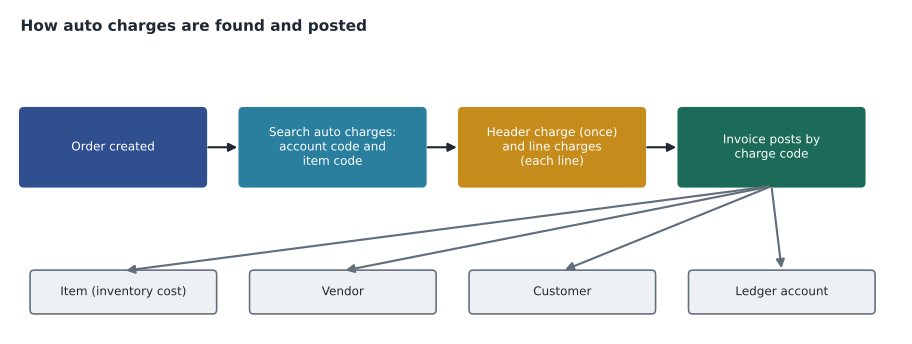
| Auto charge | Account code | Item code | Value |
|---|---|---|---|
| Freight from Lakehead Forge | Vendor Lakehead Forge | Item charges group CASTINGS | 0.12 per kilogram (line) |
| Small order fee | Customer charges group DIST | All | 45.00 per order when the order is under 500 (header) |
| Freight to distributors (plant shipments) | Customer charges group DIST | All | Entered by the clerk from the carrier quote (header, manual) |
Charges can also be allocated. A header charge, such as one freight bill for a delivery of several items, can be spread across lines by quantity, amount or weight, so each item's cost includes its share. For the casting deliveries, where one truck brings several casting types, the freight charge is entered on the header from the carrier's invoice and allocated across lines by net weight, which is what the foundry's freight is actually based on.
Charges and the vendor invoice
Charges often arrive with the vendor invoice rather than being known when the order is placed. Accounts payable can add charges to a pending vendor invoice, match them against expected charges from the purchase order, and allocate them. With the charges matching tolerance, a difference between the expected charge on the order and the charge on the invoice can be flagged for approval. When freight is invoiced by a separate freight company rather than the goods vendor, the charge on the goods' purchase order can be posted to the freight vendor's account, so the freight company's invoice can be matched against it.
Charges on sales orders
On the sales side, charges are how freight and fees reach the customer's invoice. For shipments from the distribution warehouse, transportation management rates the load, and the rated freight can be added to the sales order as an FRT-OUT charge. For shipments from the plant, the clerk enters the carrier's quote as a header charge. Distributors get free freight on orders over 5,000, which the team set up as an auto charge with a zero value above the threshold rather than a separate discount, so the freight the company absorbs is still visible in reports. Charges on sales orders are taxed according to the charge code's tax settings; in both countries freight billed with taxable goods is generally taxable, and Thandeka's team set the sales tax group on FRT-OUT accordingly after checking with the tax advisors.
Customer service can see and override charges on the order before it is invoiced, and every override is logged. Tadeusz's team found the small order fee was the charge most often waived, usually for good reasons, so they added a reason code requirement and a monthly review, the same approach used for price overrides in lesson 5.
Landed cost in outline
For international purchases, charges are often not enough. Landed cost adds voyages, containers and shipping legs, and estimates and then reconciles freight, duty, insurance and brokerage, allocating them to the items on each voyage. MB-330 has a separate objective area for it, covering landed cost parameters, voyage statuses, cost types and auto costs, tracking of inbound voyages and journey templates. Cobalt Ridge will use landed cost for castings imported from its European foundry, starting in phase 2, because those shipments come by sea with duty and brokerage fees that charges handle poorly. For now, the European castings use FRT-IN and INSUR charges entered from the broker's invoice.
Vendor rebates
A vendor rebate is money the vendor pays back, usually based on volume or value purchased in a period. In Supply Chain Management, vendor rebates are set up as rebate agreements, which hold the vendor or vendor group, the products or product groups, the period, the rebate program type and the tiers: for example, 1 percent of purchases up to 500,000 and 2 percent above it. As purchases are invoiced, the system records rebate transactions that accrue the expected rebate, and at the end of the period the rebates are processed into claims and settled against the vendor.
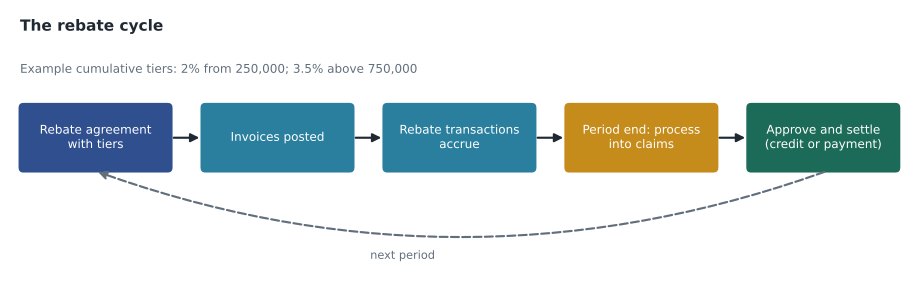
The Lakehead Forge rebate became a vendor rebate agreement with two tiers on CASTINGS for the calendar year. Because the accrual is calculated from Cobalt Ridge's own invoices, Thandeka can compare it with Lakehead's statement at year end and has an accrued receivable on the balance sheet throughout the year, which the old system never showed. Rebates can be based on cumulative or incremental tiers, on amount or quantity, and on invoice or delivery dates, and the agreement records which; the team chose cumulative tiers on invoiced amount, which is how Lakehead's contract is worded.
Customer rebates
Customer rebates work the same way in the other direction. A customer rebate agreement defines which customers or customer groups earn a rebate, on which products, over which period and at what rates. Sales invoices create rebate transactions that accrue the expected rebate as a liability, and at period end the rebates are processed, reviewed and paid, either as a credit note, a payment, or a deduction on the next invoice. MB-330 names both vendor and customer rebates among its objectives.
| Distributor rebate tier (annual purchases) | Rebate |
|---|---|
| Up to 250,000 | None |
| 250,000 to 750,000 | 2 percent |
| Above 750,000 | 3.5 percent |
Tadeusz's spreadsheet became one customer rebate agreement for the DIST customer group, with the three tiers above, on all distributor products except third-party items bought for direct delivery. Rebates accrue on every distributor invoice, and the quarterly process produces claims that Tadeusz reviews before the credit notes are posted. The difference between cumulative and incremental tiers matters for the numbers: with cumulative tiers, a distributor that reaches 800,000 earns 3.5 percent on the whole 800,000; with incremental tiers, it would earn 2 percent on the band from 250,000 to 750,000 and 3.5 percent only on the part above 750,000.
Rebate management features
Rebate functionality in Supply Chain Management has grown over time. The rebate management module provides deals with lines, guarantees, rebate program types, and the posting setup for accruals and settlements, and it covers both vendor and customer rebates as well as royalties. Older, simpler customer rebate features still exist in Accounts receivable and Sales and marketing in some versions. Annelise recommended rebate management for new implementations because it handles both directions and tiers in one place, and that is what the team configured. She told the team to check the current documentation for the exact program types before the final design, because the feature set changes with releases.
What rebates post
Finance cares most about the accruals. For a customer rebate, each sales invoice to a distributor creates a rebate transaction for the expected amount at the tier currently reached, and the periodic posting of accruals debits a rebate expense or a revenue reduction account and credits a rebate liability. At settlement, the liability is cleared against the credit note or payment to the customer. For a vendor rebate, the accrual debits a rebate receivable and credits a reduction of purchases or cost, and settlement clears the receivable against the vendor's credit. When a distributor crosses a tier during the year with cumulative tiers, the earlier accruals were too low; the processing step recalculates them, so the year-end figure is right even though the monthly accruals rose in a step.
Thandeka chose to post customer rebate accruals monthly, with the business unit and product line dimensions from the sales lines, so the monthly margin report shows rebates in the month the sales happened rather than in the quarter they are paid. Vendor rebate accruals for Lakehead Forge post monthly as a reduction of the castings' purchase cost account, with the Plant dimension, so the plant cost reports show the net cost of castings.
| Event | Customer rebate | Vendor rebate |
|---|---|---|
| Invoice posted | Rebate transaction created at the current tier | Rebate transaction created at the current tier |
| Monthly accrual posting | Debit rebate expense; credit rebate liability | Debit rebate receivable; credit purchase cost reduction |
| Tier crossed (cumulative) | Recalculated at processing | Recalculated at processing |
| Settlement | Credit note or payment clears the liability | Vendor credit clears the receivable |
Testing charges and rebates
Charges and rebates are easy to configure and easy to get wrong, because an error is often small and repeated on thousands of documents. The team tested them with worked examples whose expected results were calculated by hand first. A casting receipt with freight allocated by weight had to put the right freight amount on each line; a small distributor order had to get the 45.00 handling fee and a larger one had not; a distributor whose test sales crossed 750,000 had to see its accruals recalculated; and Lakehead's rebate had to accrue on castings and not on the steel bar it also supplies. Each test was signed off by the person who owns the money: Ifeoma for freight on cost, Tadeusz for distributor charges and rebates, and Thandeka for the Lakehead rebate.
Commissions, royalties and other deductions
Rebates sit next to other margin items. Commissions, from lesson 6, are paid to sales staff. Royalties, which rebate management can also calculate, are paid to the owners of designs or licenses. Customer deductions taken by a customer from a payment, such as a disputed price, are handled in accounts receivable. Keeping them separate makes margin reporting clearer. Thandeka asked for a margin report by distributor that shows the gross margin, then deducts commissions, rebates and freight absorbed, which needs each of these to post to its own account with the right dimensions.
Worked problem
Calculating a distributor rebate
Prairieline Pump Supply's invoiced distributor sales for 2027 total 800,000. The agreement uses cumulative tiers: 2 percent from 250,000, 3.5 percent above 750,000. What rebate does Prairieline earn? What would it be with incremental tiers?
Show solution
- Cumulative: 800,000 is above 750,000, so 3.5 percent applies to the whole amount: 800,000 times 3.5 percent is 28,000.
- Incremental: nothing on the first 250,000.
- Incremental: 2 percent on 500,000 (250,000 to 750,000) is 10,000.
- Incremental: 3.5 percent on 50,000 (above 750,000) is 1,750.
- Incremental total: 10,000 plus 1,750 is 11,750.
Answer: Cumulative tiers give 28,000; incremental tiers would give 11,750. The agreement must say which applies.
Common mistakes
MistakePosting inbound freight to an expense account.
InsteadPost freight on stocked purchases to the item so it is part of inventory cost.
MistakeAdding the same freight charge by hand on every order.
InsteadUse auto charges with account and item codes.
MistakeRelying on the vendor's statement to calculate rebates.
InsteadSet up rebate agreements so rebates accrue from your own invoices.
MistakeLeaving the tier basis (cumulative or incremental) undecided.
InsteadMatch the agreement's tier basis to the contract wording and test the calculation.
Summary and key terms
- Charges add freight, fees and similar amounts to orders; charge codes decide where they post.
- Purchase charges posted to the item become part of inventory cost; sales charges can be billed to customers.
- Auto charges add header or line charges from account code and item code rules; header charges can be allocated to lines.
- Landed cost handles voyages, duty and international freight beyond what charges can do.
- Vendor and customer rebates accrue from invoices under rebate agreements with tiers and are settled at period end.
- Charge code
- A code that defines where a charge amount is posted.
- Auto charge
- A rule that adds charges to orders automatically.
- Landed cost
- Functionality that estimates and allocates international freight, duty and other import costs to items.
- Rebate agreement
- An agreement that defines who earns a rebate, on what, over which period and at what rates.
- Cumulative tier
- A rebate tier whose rate applies to the whole amount once the threshold is reached.
Practice problems
Work each problem on paper first, then reveal the answer to check.
Where should a charge code post inbound freight on stocked items?
Show answer
To the item, so it becomes part of inventory cost.
What is the difference between a header charge and a line charge?
Show answer
A header charge applies once per order; a line charge applies to each line.
Sales of 600,000 with cumulative tiers of 2 percent from 250,000. What is the rebate?
Show answer
12,000.
Lesson quiz · 5 questions
Score 60% or more to complete this lesson.
Create a free account to save your progress, take quizzes and earn a certificate.