
MSBA-331 · Lesson 2 of 12 · 20 min
Purchase requisitions
▶ Video coming soon A video version of this lesson is on the way.
On a Tuesday in October, the Hamilton maintenance supervisor needed six replacement bearings for a lathe that had started to whine. In the old system he would have phoned Marisol, who would have written the details on a sticky note and created a purchase order later that day if she remembered. In the new system he opened Purchase requisitions, picked the bearings from the Plant MRO catalog, chose a reason, and submitted. Annelise used that requisition as the thread for the session, following it from the requester's screen to the purchase order.
What a requisition is
A purchase requisition is an internal document that requests the purchase of goods or services. It is not sent to a vendor. It records who needs what, why, by when and for which organization, and it goes through a review workflow before anything is ordered. Once approved, its lines are released to purchase orders, either automatically or by a buyer, depending on the purchasing policy. The requisition keeps the link to the purchase orders it produced, so the requester can see the status of his bearings without calling anyone.
Requisition purpose and the buying organization
Every requisition has a requisition purpose of consumption or replenishment. Consumption requisitions are for goods used by the requester's organization, such as the bearings or a new safety cabinet. Replenishment requisitions are for stock that will be put into inventory, and they can be created by planning, such as min-max replenishment of spare parts. The purpose matters because the purchasing policy can treat them differently and because replenishment lines use the inventory dimensions of the stocking warehouse.
The requisition also records the buying legal entity and the receiving operating unit. A requester in Engineering can create a requisition on behalf of the Calgary warehouse if the policy allows it, and the purchase order is then created in the buying legal entity with delivery to that warehouse. Annelise noted that the requester's own legal entity and department come from the worker record, so the employee data must be complete before go-live, or requisitions will be created with missing organizations and policies will not apply.
| Field | Where it comes from | Why it matters |
|---|---|---|
| Requester | The signed-in worker, or another worker if allowed | Decides which policy applies |
| Buying legal entity | The requester's company by default | The company where the purchase order is created |
| Receiving operating unit | The requester's department by default | Drives default financial dimensions and policy |
| Requisition purpose | Consumption or replenishment | Changes processing rules and inventory dimensions |
| Requested date and accounting date | Entered by the requester | Used for delivery and budget checks |
| Reason | A list maintained by procurement | Supports reporting and justification |
Lines: items, catalog products and categories
Requisition lines come in three shapes. A catalog line is picked from a procurement catalog and carries the item, vendor and price defined there. An item line names a released product directly, for requesters who know the item number. A non-catalog or category line has a procurement category, a description, a quantity and an estimated price, with no item; it is how services, one-off purchases and things not yet in the product list are requested. Category lines can include a product questionnaire, so a request for contract labour asks the right questions about dates, skills and site access.
Each line carries its own vendor, delivery date, delivery address and financial dimensions. Lines do not have to share a vendor; a single requisition can contain bearings from one supplier and a calibration service from another. The policy can require receiving for some categories and not others, and that setting flows to the purchase order line as whether a product receipt is required before the invoice can be matched.
Budget checks and pre-encumbrance
If budget control is configured in Finance, requisitions can be checked against available budget when they are submitted or approved. Pre-encumbrance reserves budget for an approved requisition; when the purchase order is confirmed, the reservation moves to an encumbrance on the order, and when the invoice is posted the actual expense replaces it. Cobalt Ridge decided not to use budget control at go-live, because the old system had no budgets at department level and the finance team did not want to enforce numbers no one had agreed. Requisitions therefore carry the accounting date for later reporting, and budget control is on the phase 2 list.
The review workflow
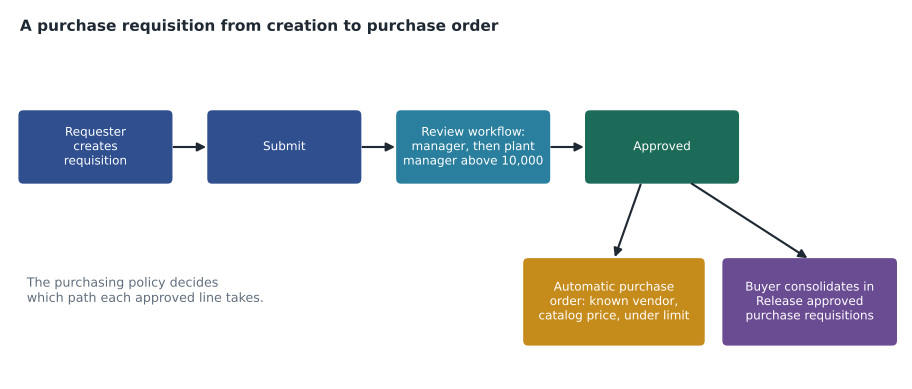
Submitting a requisition starts the purchase requisition review workflow. The workflow can approve the whole document or each line, through the related line review workflow. At Cobalt Ridge the requester's manager approves every requisition, and the plant manager also approves requisitions above 10,000 Canadian dollars. Category conditions add steps where they matter: anything in the Capital branch goes to the controller, and anything in Safety equipment goes to the health and safety coordinator for a quick check that the item is approved.
| Requisition status | Meaning |
|---|---|
| Draft | Being created; not yet submitted |
| In review | Submitted and moving through the review workflow |
| Rejected | Returned to the requester, who can change and resubmit it |
| Approved | All required steps are complete; lines can be released |
| Closed | All lines have been released to purchase orders or cancelled |
| Cancelled | Withdrawn and not processed |
Approvers see their work items in the action center and the workspace, can approve, reject, delegate or ask for changes, and can see the requisition's lines and comments. Marisol asked whether a buyer could change a price on an approved requisition. The answer is that buyers usually make such changes on the purchase order, which has its own approval rules, so the requisition remains a record of what was requested and approved.
From requisition to purchase order
When a requisition is approved, the purchasing policy's purchase order creation and demand consolidation rule decides what happens next. Lines that meet the automatic conditions become purchase orders straight away, grouped by vendor and other order header values. Lines that need a buyer appear in Release approved purchase requisitions, where buyers can review lines, assign or change vendors, combine lines from several requisitions into one purchase order, or turn lines into a request for quotation. Each purchase order line keeps a reference back to its requisition line.
Worked problem
Consolidating three requisitions
Three requisitions from Hamilton maintenance, the paint shop and quality each include safety glasses from the same vendor, totalling 140 pairs. None met the automatic creation rule because the paint shop line had no price.
Show solution
- Open Release approved purchase requisitions and filter by category Safety equipment.
- Check the vendor on each line and add the trade agreement price to the paint shop line.
- Select the three lines and create one purchase order for the vendor.
- Confirm that each purchase order line refers to its own requisition line and delivers to the right department.
- Submit the purchase order to its approval workflow.
Answer: One purchase order for 140 pairs, traceable back to three requisitions, priced from the trade agreement.
When a requisition is rejected or changed
Not every requisition sails through. In the first test round, the paint shop requested a new spray booth filter set as a category line with an estimated price of 900 dollars. The plant manager rejected it with a comment: the same filters were already in the MRO catalog at a lower price. The requisition returned to Draft, with the comment visible to the requester, who replaced the category line with the catalog item and resubmitted. The workflow restarted from the first step, and the history kept both rounds, so anyone reviewing the purchase later could see why the line changed.
Approvers can also request a change rather than reject, which keeps the requisition with the approver's comments attached until the requester responds, and they can delegate a work item when they are away. Delegation rules can be set ahead of time in the workflow settings, so a plant manager on holiday has his approvals routed to his deputy for those dates. Annelise recommended that every approver set a delegate before go-live; otherwise a single vacation can stall a week of maintenance purchases.
| Approver action | Effect on the requisition |
|---|---|
| Approve | Moves to the next step, or to Approved after the last step |
| Reject | Returns to Draft with comments; resubmission restarts the workflow |
| Request change | Asks the requester to change it before the approver decides |
| Delegate | Passes the work item to another user |
| Recall (by requester) | Withdraws a submitted requisition to edit it |
Requests for quotation
When the price or the vendor is not known, a buyer can send a request for quotation (RFQ) to several vendors. An RFQ case lists the items or categories, quantities and required dates; it is sent to selected vendors, who reply with prices, delivery dates and alternatives, either through the vendor collaboration interface or by email that the buyer enters. The buyer compares replies, can award the business to one vendor or split it, and the accepted reply becomes a purchase order or a purchase agreement. RFQs can include scoring criteria so the comparison is not only about price.
Cobalt Ridge uses RFQs for capital purchases and for new casting patterns. The first live one, planned for December 2026, is for a coordinate measuring machine for the Hamilton quality lab. Teodora Brisebois, the quality manager, set up the scoring: price 40 percent, accuracy and specification 35 percent, service and training 25 percent.
Requisitions from planning and from other modules
Not all requisitions come from people. Master planning can create planned purchase orders, which are firmed directly into purchase orders, or, when the policy requires it, into requisitions for review. Min-max replenishment for MRO stock can generate replenishment requisitions. Some organizations use requisitions as the single front door for all non-production buying, so that every purchase has an approval trail. Cobalt Ridge kept production material on planned purchase orders, because the requisition review would slow down buyers who already work from the planning results, and kept requisitions for everything else.
A practical tip from Annelise: requisitions only help if people use them. That means the catalog must hold what they actually buy, the review must be fast for small amounts, and the requester must be able to see where the order is. The pilot group of 25 requesters will use them from the first day of go-live, with a buyer on call for questions.
Tracking a requisition
Once submitted, a requisition is easy to follow. The requester sees the document status on the list page and the line status on each line: In review, Approved, Purchase order created, or Cancelled. From an approved line, the related purchase order can be opened, and from there its confirmation, receipt and invoice status. The workflow history shows who approved each step and when, with comments. For the maintenance supervisor this meant he could see on Wednesday morning that his bearings had been ordered from the bearing distributor with delivery promised for Friday, without phoning anyone.
Buyers and managers need the wider view. The Purchase requisition list pages can be filtered and saved as views, such as requisitions awaiting release older than two days, and the procurement workspaces show tiles for approved requisitions not yet released and for requisitions returned to requesters. Marisol set up a personal view of category lines with no vendor, because those are the lines that wait longest, and asked for a weekly report of requisitions by category so the team could find things worth adding to the catalog.
| Who | What they watch | Where |
|---|---|---|
| Requester | Status of my requisitions and their purchase orders | My purchase requisitions list |
| Approver | Work items waiting for me | Action center and workspace tiles |
| Buyer | Approved lines not yet released | Release approved purchase requisitions |
| Procurement manager | Volume and cycle time by category and department | Saved views and reports |
| Catalog owner | Frequent non-catalog lines | Requisition line reports by category |
Roles and security
Requisitions touch many people, so the security setup is part of the design. Requesters need a role that lets them create and submit requisitions for themselves and, where allowed, on behalf of others; this is usually the employee role with requisition duties. Approvers need only to act on workflow items and view the documents. Buyers need the purchasing agent role to release requisitions and create purchase orders. Procurement managers maintain categories, catalogs and policies. Segregation of duties rules can stop the same person from both approving a requisition and creating the purchase order from it, which Cobalt Ridge enabled for amounts above the automatic creation limit.
Annelise also showed how to let one worker request on behalf of another. The Request on behalf of setting on the worker allows, for example, the plant administrator to enter requisitions for shop floor staff who do not have computers. The requisition then records both the preparer and the requester, and the policy of the requester's organization applies.
A setup checklist for requisitions
Requisitions depend on several earlier pieces of setup, and a missing piece usually shows up as a requisition that cannot be submitted or a line that never becomes a purchase order. The team kept the checklist below on the project board and ticked it off in the CONFIG sandbox before the first test with requesters.
| Setup item | Owner |
|---|---|
| Workers with legal entity and department assignments | HR and IT |
| Procurement category hierarchy and category vendors | Procurement manager |
| Purchasing policies and their rules | Procurement manager |
| Procurement catalogs published to organizations | Catalog owner |
| Requisition reasons and number sequences | Functional consultant |
| Purchase requisition review workflow, activated | Functional consultant |
| Security roles for requesters, approvers and buyers | IT security |
| Test requisitions for each policy path | Project team |
Common mistakes
MistakeExpecting the vendor to receive the requisition.
InsteadA requisition is internal; vendors receive purchase orders or requests for quotation.
MistakeLetting requesters type free-text lines for items that exist in the catalog.
InsteadPublish catalogs with the common items and restrict category lines where it makes sense.
MistakeLeaving worker records without a department or legal entity.
InsteadComplete worker data so the right purchasing policy and dimensions apply.
MistakeChanging prices on approved requisitions.
InsteadChange commercial terms on the purchase order, which has its own approval.
Summary and key terms
- A purchase requisition is an internal request for goods or services that is reviewed before purchase orders are created.
- Requisition purpose is consumption or replenishment; the buying legal entity and receiving operating unit drive policy and dimensions.
- Lines can be catalog, item or category lines, each with its own vendor, date and dimensions.
- The review workflow approves documents or lines; approved lines become purchase orders automatically or through buyer consolidation.
- Requests for quotation collect vendor bids when price or vendor is unknown.
- Purchase requisition
- An internal document requesting goods or services, reviewed before ordering.
- Requisition purpose
- Whether a requisition is for consumption or for replenishment of inventory.
- Pre-encumbrance
- A budget reservation for an approved requisition.
- Request for quotation
- A request sent to vendors for prices and terms before ordering.
- Demand consolidation
- Combining approved requisition lines into purchase orders.
Practice problems
Work each problem on paper first, then reveal the answer to check.
Where does a buyer combine approved requisition lines into a purchase order?
Show answer
In Release approved purchase requisitions.
What is a category line on a requisition?
Show answer
A line with a procurement category, description, quantity and price but no item number.
What replaces a pre-encumbrance when the purchase order is confirmed?
Show answer
An encumbrance on the purchase order.
Lesson quiz · 5 questions
Score 60% or more to complete this lesson.
Create a free account to save your progress, take quizzes and earn a certificate.