
MSBA-280 · Lesson 9 of 12 · 18 min
Conversation intelligence
▶ Video coming soon A video version of this lesson is on the way.
Most of Kestrelbay's inside selling happens on the phone. A marina manager calls about a pump, the seller quotes, the manager says he will think about it, and the details live only in the seller's memory. Teams calling for inside sales had been on the phase two list since go-live. Ottilie now had a further wish: "I want to know what customers actually say on these calls. Which competitors come up, what objections we hear, and whether my sellers talk too much."
Dynamics 365 Sales answers that with conversation intelligence, which records, transcribes and analyzes sales calls and produces insights and summaries for sellers and managers. The AB-210 outline lists setting up conversational intelligence and setting up relationship intelligence among the AI-powered features of its second domain. This lesson covers both, starting with the calls.
What conversation intelligence provides
During a recorded call, a seller using the Teams dialer inside Dynamics 365 sees a live transcript and can note highlights. After the call, the call summary shows the recording, the transcript, an AI-generated summary, action items, questions asked, mentions of tracked keywords and competitors, sentiment over the course of the call and conversation style measures such as the talk-to-listen ratio and longest customer monologue. Microsoft's documentation states that conversation intelligence has processed call data with Azure OpenAI Service since June 2024, using the nearest region where it is available if the environment's region has none.
Managers get the same insights in aggregate: which keywords and competitors appear most, how sentiment trends, and how each seller's conversation style compares with the team. The point is coaching, not surveillance, and Mirela framed it that way from the first meeting.
Prerequisites
Conversation intelligence works with Microsoft Teams or with supported third-party dialers. For Teams, Microsoft lists these prerequisites: a Teams licence, a Teams Phone System licence with a Calling Plan or Direct Routing so the seller has a phone number, and the Teams dialer enabled and configured for the organization. Optionally, a company can supply its own Azure storage for recordings, transcripts and insights. Microsoft's documentation states that Sales Enterprise includes conversation intelligence with no hour limit.
| Prerequisite | Kestrelbay status |
|---|---|
| Teams licences for sellers | Already in Microsoft 365 plans |
| Teams Phone System with Calling Plan or Direct Routing | Added for 6 inside sellers |
| Phone numbers assigned | Assigned by the Microsoft 365 administrator |
| Teams dialer enabled in Dynamics 365 | Turned on in quick setup |
| Recording consent wording and policy | Approved by the owners |
The licensing and phone numbers belong to the Microsoft 365 side, not Dynamics 365. Mirela worked with the Microsoft 365 administrator, who assigned Teams Phone licences and numbers to the six inside sellers. Field reps kept their mobile phones; recording their calls was not in scope.
Turning on Teams calling and recording
The quickest path is the quick setup for conversation intelligence in Sales settings. Turning on Teams calls lets sellers make and receive Teams calls inside Dynamics 365. Defaults let sellers answer incoming calls in Dynamics 365, while internal calls ring only in Teams unless that option is cleared. An Enable for setting limits the dialer to all security roles or to specific ones. A second toggle turns on recording with real-time transcription and insights, with its own Enable for setting. Recording can be turned off while calling stays on, but turning calling off also turns recording off.
Mirela enabled Teams calls and recording for the inside seller role only, and left internal calls ringing in Teams. That way, a seller's colleagues calling from the warehouse would not interrupt the Dynamics 365 workspace.
Recording policies
More detailed settings live under Sales Insights settings, in the Conversation intelligence page under Productivity. Recording policies define the call provider, the security roles a policy applies to and how recording works. Microsoft lists four recording options.
| Recording option | Effect |
|---|---|
| Manually record all participants | The seller starts recording when needed |
| Manually record all participants, sellers are automatically recorded | Seller's side recorded automatically; customer recorded only when the seller starts it |
| Automatically record all participants | Every call recorded from the start |
| Automatically record all participants, sellers can stop recording | Recorded by default, seller can stop |
A company can create several policies for different roles, such as automatic recording for managers' coaching calls and manual recording for sellers. Roles assigned to a policy need read access on the Recording table. Kestrelbay chose automatically record all participants, sellers can stop recording, combined with a rule that every recorded call begins with the seller telling the customer that the call is recorded. Recording laws differ by jurisdiction, so the wording and policy were approved by the owners and recorded in the project log.
Storage and retention
Conversation intelligence offers three storage options. Microsoft Dataverse storage is managed at the organization level and needs no Azure details. Microsoft provided storage is the default, with retention of 30 or 90 days, after which recordings and transcripts are deleted. Your own Azure storage is required when data must be kept longer than 90 days; the administrator enters the storage account and container names created in the Azure portal.
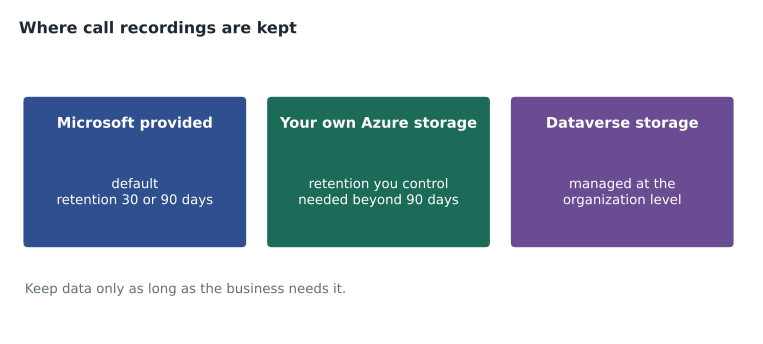
Ottilie wanted recordings kept for a year for coaching. Mirela pushed back gently: a year of recordings is a year of personal data to protect. They agreed on 90 days in Microsoft provided storage, with sellers able to save key highlights to the opportunity as notes, which are kept with the record. If a longer requirement arose later, Kestrelbay would create its own storage account with access controls agreed with the owners.
Business settings: keywords and competitors
Conversation intelligence requires at least one tracked keyword and one tracked competitor before it can be enabled; both are global settings that apply to all sales calls and can be changed later. Keywords are words or phrases the business wants to notice, and competitors are names that should be flagged. The call summary option should stay selected so that sellers get AI-generated notes after calls.
Ottilie's list of keywords was practical: warranty, delivery date, discount, refit, winter storage and a handful of product names. Competitors were the three other marine distributors on the coast and the big online retailer that undercut them on small parts. Optional settings included data consent (letting Microsoft read data to improve insights) and preview features such as hiding credit card numbers in transcripts. Mirela turned on the credit card masking preview in the sandbox first, tested it with a fake card number, and only then enabled it in production.
Worked problem
Reading the first month of insights
After a month, the manager view shows: the keyword "delivery date" appears in 38 percent of calls, the online retailer is mentioned in 22 percent, and two sellers have average talk-to-listen ratios of 70 to 30. What should Ottilie do with this?
Show solution
- Delivery date is the top concern: ask the warehouse for a reliable delivery promise and add it to the quote template.
- The online retailer comes up on one call in five: prepare a short answer about service and same-day counter pickup.
- The two sellers talk much more than they listen: coach them using their own recordings, privately.
Answer: Treat the insights as questions for the business and coaching material for sellers, not as scores. Changes to delivery promises and a competitor answer came from the first month.
Relationship intelligence
The exam treats relationship intelligence alongside conversation intelligence. It has two parts. Relationship analytics combines email and activity data to calculate a relationship health score for contacts, leads, opportunities and accounts, reflecting how often and how recently the company interacts with them and whether the engagement goes both ways. Who knows whom suggests colleagues with connections to a lead or contact, ranked by connection strength, and lets a seller send an introduction request.
Microsoft describes a basic level built from Dynamics 365 data, included with Sales Enterprise, and an enhanced or advanced level that also uses Exchange data, needs server-side synchronization and requires a qualifying Sales Premium licence. Both are configured in Sales Insights settings under Relationship insights. Kestrelbay used the basic level. Its main value was the health indicator on Ottilie's key accounts: when a large marina's relationship health dropped because nobody had spoken to its manager in six weeks, the account appeared on her review list.
Designing a coaching routine
Insights help only if someone acts on them. Ottilie and Mirela designed a monthly coaching routine. Each inside seller chose two of their own recorded calls, one good and one difficult, and reviewed them privately with their manager using the call summary, highlights and conversation style measures. The team meeting each month looked only at aggregate trends: top keywords, competitor mentions and sentiment, never individual sellers' numbers. Sellers were told this before recording started, which mattered for trust.
| Routine | Who | Data used |
|---|---|---|
| Private call review | Seller and manager | Two calls chosen by the seller |
| Monthly team trends | Whole inside team | Aggregate keywords, competitors, sentiment |
| Quarterly settings review | Ottilie and Mirela | Keyword and competitor lists, retention |
Privacy obligations
Recordings and transcripts are personal data about customers and sellers. Kestrelbay's privacy notice was updated to mention call recording for quality and training. A customer who asks not to be recorded is not recorded; the seller stops recording, which the chosen policy allows. If a customer asks for their data, recordings and transcripts within the retention period are part of what must be found, so Mirela documented where they are stored and how long they are kept. The short retention period chosen earlier made those obligations easier to meet.
Third-party dialers
Conversation intelligence also works with some third-party dialers through connectors, so companies that use another telephony system are not excluded. Kestrelbay used Teams, so Mirela did not pursue this, but she noted it for the Customer Service project in case Ravi's team moved to a contact centre system.
Using call summaries every day
For sellers, the call summary became part of finishing a call. After each recorded call, the seller opened the summary, checked the AI notes against what they remembered, turned action items into tasks on the opportunity, and saved any important quote or promise as a note. That routine took about a minute and made the opportunity record complete without retyping the conversation. It also fed Copilot: the next time anyone summarized the opportunity, the call notes and tasks were part of the history.
| After the call | Action |
|---|---|
| Check the AI summary | Correct anything wrong in a note |
| Action items | Create tasks on the opportunity |
| Key promises or prices | Save as a note on the record |
| Competitor mentioned | Link the competitor to the opportunity |
A pilot before everyone
Recording started with two volunteers for two weeks rather than all six inside sellers. The pilot checked the disclosure script in real conversations, the quality of transcripts for marine terms and part numbers, and whether the call summary saved time. Transcripts struggled with some product codes, so Mirela added the most common codes as tracked keywords, which made them easier to find in transcripts even when spelled oddly. After the pilot, both volunteers presented what they had learned to the rest of the team, which did more for adoption than any instruction from management.
Conversation intelligence also changed how new sellers learned. Instead of shadowing an experienced colleague for a week, a new inside seller listened to a handful of good recorded calls chosen by Ottilie, with the colleague's permission, and read the call summaries alongside. They heard how the best sellers handled questions about delivery dates and the online retailer, and then practised. Mirela made sure the shared calls were stored as highlights saved to records, not downloaded copies, so that retention and access rules still applied to them.
Common mistakes
MistakeTurning on recording without a disclosure policy.
InsteadAgree recording wording and policy with the owners before the first recorded call.
MistakeKeeping recordings as long as possible by default.
InsteadChoose the shortest retention that meets the business need, and save key highlights to the record.
MistakeUsing talk-to-listen ratios as performance scores.
InsteadUse conversation insights for coaching, privately and with context.
MistakeExpecting enhanced who knows whom on Sales Enterprise.
InsteadKnow that the enhanced level with Exchange data needs Sales Premium and server-side synchronization.
Summary and key terms
- Conversation intelligence records, transcribes and analyzes calls, producing summaries, action items, tracked mentions, sentiment and style measures.
- For Teams it needs Teams and Teams Phone licences with a Calling Plan or Direct Routing, and the Teams dialer enabled.
- Recording policies set how recording works for each security role.
- Microsoft provided storage keeps data for 30 or 90 days; longer retention needs your own Azure storage.
- At least one keyword and one competitor must be set; relationship intelligence adds health scores and who knows whom.
- Conversation intelligence
- The Sales feature that records, transcribes and analyzes sales calls.
- Teams dialer
- The Teams calling experience embedded in Dynamics 365 Sales.
- Recording policy
- A setting that defines how calls are recorded for specified security roles.
- Tracked keyword
- A word or phrase flagged in call transcripts and insights.
- Relationship health
- A score reflecting how often, how recently and how two-way the engagement with a customer is.
- Who knows whom
- A feature that suggests colleagues with connections to a lead or contact.
Practice problems
Work each problem on paper first, then reveal the answer to check.
What must be defined before conversation intelligence can be enabled?
Show answer
At least one tracked keyword and one tracked competitor.
Ottilie wants recordings kept for a year. What storage is required?
Show answer
The company's own Azure storage, because Microsoft provided storage keeps data for at most 90 days.
What happens to recording if Teams calls are turned off?
Show answer
Recording is turned off too.
Lesson quiz · 5 questions
Score 60% or more to complete this lesson.
Create a free account to save your progress, take quizzes and earn a certificate.