
MSBA-280 · Lesson 12 of 12 · 18 min
Case study: configuring Sales for a distributor
▶ Video coming soon A video version of this lesson is on the way.
This last lesson puts the whole course together in one problem. Mirela uses it to train junior consultants at her firm, and it is written so that you can work through it yourself before reading her answers. The company is fictional and separate from Kestrelbay. Work through each part with a notebook, then compare your design with the worked solution.
The brief
Fathomline Industrial Supply is a family-owned distributor of hydraulic hoses, fittings and pumps based in Thunder Bay, with a second branch in Sudbury. It has 14 sellers: 8 inside sellers who take phone and web enquiries, and 6 field reps who visit mines, sawmills and municipal works yards across northern Ontario. About a quarter of sales are to mining companies in Minnesota, invoiced in United States dollars. Fathomline has used a contact manager and spreadsheets for ten years and has just bought Dynamics 365 Sales Enterprise for all 14 sellers.
The owner, a former field rep, has five requests. One: "Every seller should know each morning who to call first." Two: "I want one forecast for both branches and both currencies, and targets for every seller." Three: "Our field reps must log visits from the truck." Four: "Quotes must use the right price list, and discounts above 8 percent need my approval." Five: "I want to hear what customers say about our competitors."
Fathomline's data: about 3,000 customer accounts after cleanup, 900 leads in the last two years (310 qualified, 260 disqualified), 420 opportunities (150 won, 130 lost), 2,500 products in 40 families, and three pricing tiers: list, contractor (90 percent of list) and municipal tender (fixed prices for one year).
Part 1: prerequisites and plan
List what must be true before any AI feature is switched on, and check whether Sales Enterprise covers the requests.
| Item | Decision |
|---|---|
| Environment region and Copilot | Confirm Copilot availability in the region; record a decision on cross-region data movement with the owner |
| Mailboxes | Approve, test and enable all 14 mailboxes; track email from known leads, contacts and accounts |
| Auditing | On for lead, opportunity and account |
| Licence fit | Enterprise covers forecasting, goals, the sales accelerator (up to 1,500 sequence records a month), scoring (up to 1,500 records a month) and conversation intelligence |
| Teams Phone | Teams Phone with a Calling Plan or Direct Routing for 8 inside sellers |
| Mobile | Dynamics 365 for mobile privilege in the field rep role; Intune deployment |
| Sandbox | All configuration built and tested in a sandbox first |
Volumes: 900 leads in two years is under 40 a month, far inside the 1,500-record limits. Enterprise is enough. The worked solution recommends measuring usage for a quarter before considering Premium.
Part 2: data model and process
Fathomline's deals come in three kinds: new accounts, municipal tenders with formal deadlines, and replacement projects at mines. Repeat orders should not be opportunities. The owner also wants to know each mine's number of active haul trucks, because it predicts hose demand.
Opportunity: fl_dealtype  Choice: New account | Municipal tender | Mine replacement project
Opportunity: fl_tenderdeadline  Date only (required in Propose when deal type is Municipal tender)
Account: fl_activehaultrucks  Whole number
Business process flow: Fathomline Sales Process
  Qualify (lead) -> Develop -> [branch on deal type]
     Municipal tender -> Tender documents -> Propose
     Mine replacement project -> Site visit -> Propose
     New account -> Propose
  -> Close
Repeat orders go straight to orders with a separate short flow. Close reasons become required, because the scoring models will learn from them. Migrated records are reassigned from the import account to the right sellers by territory before any work list or scoring is turned on.
Part 3: catalogue, currencies and discounts
Design the catalogue and pricing for three tiers and two currencies, with the discount rule.
| Component | Worked solution |
|---|---|
| Unit groups | Each; Hose lengths (primary unit one metre, plus a reel unit) |
| Families | 40 families under Hoses, Fittings, Pumps and Services; family properties for pressure rating and fitting size |
| Price lists in the base currency | List (markup over cost), Contractor (90 percent of List), Municipal tender (fixed amounts, one-year end date) |
| Price lists in the transaction currency | List (cross-border) and Contractor (cross-border) |
| Defaults | Default price list and currency on each account |
| Exchange rate | Weekly update by a scheduled cloud flow from a published rate |
| Discounts | Discount list for volume hose orders; approval flow for header discounts above 8 percent |
A common error is to create one price list containing both currencies. A price list has exactly one currency, so cross-border customers need their own lists, and every product used on a cross-border deal needs an item in the cross-border list.
Part 4: goals and forecast
Set fiscal year settings first (Fathomline uses a calendar year in quarters). Create a goal metric Won revenue with actual and in-progress rollup fields, and a rollup query excluding service-only deals. Give each seller a quarterly goal with the branch manager's goal as parent. Configure one forecast: quarterly, users by manager, opportunity as the rollup table, columns Quota (from goals), Won, Committed, Best case and Pipeline, with snapshots on. Because every amount also has a base amount, both currencies roll up into one forecast in the base currency.
Part 5: who to call first
Turn on the sales accelerator for the inside seller and sales manager roles. Create segments and sequences: web leads with a fast New lead sequence, tender opportunities with a deadline-driven Tender chase sequence, and quotes with a Quote chase sequence. Create assignment rules: web leads to inside sellers by load balancing with availability respected; mine replacement leads to the field rep whose territory matches, using a territory seller attribute. Run predictive scoring quick setup: Fathomline's 310 qualified and 260 disqualified leads and 150 won and 130 lost opportunities exceed the 40-and-40 minimums. Exclude the Created by column if migration used one account, add Deal type and active haul trucks, and plan quarterly retraining.
Worked problem
Checking the scoring prerequisites
The owner asks whether Fathomline can score both leads and opportunities from day one, and whether open records count towards training.
Show solution
- Lead model: 310 qualified and 260 disqualified within two years, both above 40.
- Opportunity model: 150 won and 130 lost, both above 40.
- Open records have no outcome, so they are scored but not used to train.
- Monthly scored records stay well under the Enterprise limit of 1,500.
Answer: Yes to both models. Quality matters more than count: required close reasons and clean migrated data will improve the second model.
Part 6: competitors, Copilot and the field
For request five, configure conversation intelligence for the inside sellers: Teams calls and recording for their role, a recording policy that records automatically with the seller able to stop, a disclosure script approved by the owner, Microsoft provided storage with 90-day retention, and tracked keywords (lead time, pressure rating, warranty, tender) and competitors (the two regional rivals and a national chain). Review the manager insights monthly for competitor mentions and objections.
Turn on Copilot for Sales Hub only, choose summary fields for leads, opportunities and accounts (including Deal type, tender deadline and active haul trucks), keep the related sections on, add the opportunity summary widget to the custom form, and grant the audit privileges to seller roles. For the field, deploy the Sales mobile app through Intune, add the mobile privilege, limit quick create to notes, phone calls and opportunities, and agree a routine of dictating visit notes before leaving each site.
Part 7: extending Sales
The fifth exam domain includes extending Sales with Power Platform. Fathomline's worked solution uses three small extensions: a Power Automate flow for the discount approval and another for the weekly exchange rate; an embedded Power BI report on the owner's dashboard comparing forecast with invoiced revenue from the accounting system; and a small embedded Power Apps canvas component on the opportunity form that calculates hose lengths and fitting counts from a site sketch, so field reps stop doing it on paper. Each is built in the Fathomline solution and moved to production like any other change.
Part 8: risks and measures
| Risk | Mitigation | Measure after one quarter |
|---|---|---|
| Sellers ignore forecast categories | Friday review uses categories; past-close-date view | Committed vs actual at quarter end |
| Scoring trusted blindly | Training on factors; judgement rule | Conversion by grade |
| Recording without consent | Disclosure script, policy approved by owner | Spot checks of recordings |
| Automated emails sound robotic | Owner reads every template | Reply rates per sequence step |
| Thin Copilot summaries | Regarding set on emails and notes | Seller survey on briefing time |
Debrief
When Mirela's junior consultants work through this case, the most common gaps are the same each time: forgetting that the base currency is fixed and must be chosen first; designing a business process flow with too many required steps; turning on scoring before reassigning migrated records; and enabling recording before agreeing a disclosure policy. The strongest answers treat each AI feature as the last layer on a stack of ordinary configuration, and build the stack in order.
That is also the lesson of Kestrelbay's second stage. By the end of it, Ottilie had her price lists, her forecast, a list each morning for every inside seller, scores she could question, call insights about competitors, and Copilot briefings for Joaquim in the car park. None of it would have worked without approved mailboxes, honest close reasons and a catalogue that matched what the counter charged. The next course adds the Sales agents on top.
Presenting the design
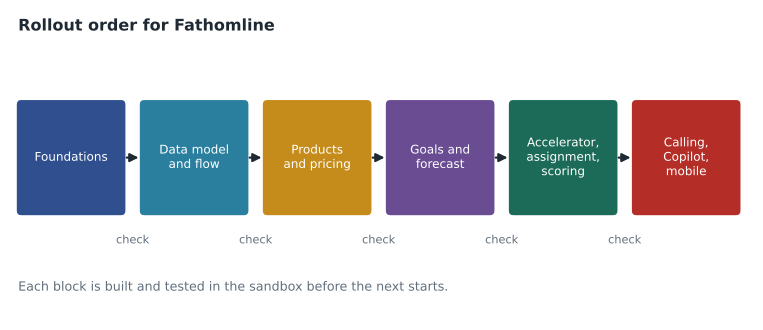
Mirela's juniors finish the case by presenting their design to a colleague playing the owner. The best presentations follow the owner's five requests rather than the order of configuration: for each request, what will change, what the seller will see, what it depends on and how success will be measured. They then show the rollout order as a separate slide, explaining why foundations come first even though the owner did not ask for them.
Owners ask predictable questions. "Will the AI decide which customers we serve?" No: scores rank and Copilot summarizes; sellers decide. "Can I keep recordings forever?" Only with your own storage and a reason, and shorter is safer. "Do I need the most expensive plan?" Not yet; measure usage against the Enterprise limits first. Having crisp answers to those three questions is often what wins the owner's trust.
Keeping a configuration log
The worked solution ends with a configuration log, because the person who maintains the system next year may not be the person who built it. Each entry records the date, the setting changed, where it lives, the reason, who approved it and how it was tested. Mirela's juniors often find this the least exciting part of the case and the most useful when something changes after go-live.
| Date | Setting | Where | Reason | Approved by |
|---|---|---|---|---|
| Week 1 | Cross-region data movement on | Power Platform admin center | Copilot availability | Owner |
| Week 2 | Deal type column and process branch | Fathomline solution | Tender and mine paths | Owner |
| Week 3 | Contractor price list at 90 percent | App Settings, price lists | Contractor tier | Finance |
| Week 5 | Recording policy, 90-day retention | Sales Insights settings | Competitor insights | Owner |
A realistic timeline for the whole case, with one consultant and a part-time internal lead, is about eight to ten weeks, with each rollout block taking one to two weeks including testing and training. The worked solution warns against compressing it: the sandbox tests and seller sessions are what make the AI features trustworthy on day one.
A final check before the junior consultants present: every request maps to at least one configuration item, every configuration item has an owner and a test, and every AI feature has a stated human decision it supports. If any feature cannot name the decision it helps with, the worked solution suggests leaving it off until it can. That rule kept Fathomline's first phase small enough to deliver well, which in Mirela's experience is the best predictor of whether a second phase ever happens.
Common mistakes
MistakeDesigning features in the order the owner listed requests.
InsteadBuild in dependency order: foundations, data, process, pricing, planning, then AI features.
MistakePutting both currencies in one price list.
InsteadCreate one price list per currency and set defaults on accounts.
MistakeSkipping a measurement plan.
InsteadAgree measures for each change before go-live and review them after a quarter.
MistakeBuilding extensions directly in production.
InsteadBuild flows, embedded reports and components in the solution in a sandbox.
Summary and key terms
- A full Sales configuration starts with prerequisites: region, mailboxes, auditing, licences and a sandbox.
- The data model and business process flow are designed around the kinds of deals the company actually sells.
- The catalogue, price lists, currencies and discounts must match how the company prices, one currency per price list.
- Goals, forecasts, the sales accelerator, assignment rules and scoring turn data into daily priorities and plans.
- Conversation intelligence, Copilot summaries, the mobile app and Power Platform extensions complete the design, each with governance.
- Dependency order
- Building configuration so that each feature is added after the features it relies on.
- Check gate
- A test and sign-off before moving to the next block of a rollout.
- Disclosure script
- The words a seller uses to tell a customer that a call is recorded.
- Measurement plan
- The agreed measures used to judge whether a change worked.
- Embedded Power BI report
- A Power BI report shown inside a Dynamics 365 dashboard or form.
- Canvas component
- A Power Apps component embedded on a model-driven form to add custom behaviour.
Practice problems
Work each problem on paper first, then reveal the answer to check.
Why must Fathomline's base currency be chosen before anything else involving money?
Show answer
It is set when the environment is created and cannot be changed, and every amount is also stored in it.
Which three required steps did the worked solution keep in the business process flow, apart from the tender deadline?
Show answer
Decision maker in Develop, proposal sent in Propose and final decision date in Close.
Name one Power Platform extension in the worked solution and its purpose.
Show answer
For example, an embedded Power BI report comparing forecast with invoiced revenue.
Lesson quiz · 5 questions
Score 60% or more to complete this lesson.
Create a free account to save your progress, take quizzes and earn a certificate.