
MSBA-111 · Lesson 4 of 12 · 23 min
Multi-turn conversations
▶ Video coming soon A video version of this lesson is on the way.
Within a few weeks some of Quillfield's heaviest Copilot users had a new problem: too many chats. Gus had more than ninety conversations in his history, most of them called something like "Summarize claims for...", and he could never find the one with the good table in it. Solveig had the opposite habit, one enormous conversation she had been using for two weeks for every client, which had started to mix them up. The fourth clinic was about multi-turn conversations: how Copilot uses conversation history, how to keep a conversation on track, and how to manage the chats you accumulate.
What a conversation remembers
A conversation, or chat, is a sequence of turns: your prompts and Copilot's responses. When you send a new prompt, Copilot includes the earlier turns of that conversation as context, which is why short follow-ups work. The model itself does not learn from your chat; it is given the conversation again with each turn. That has two consequences. First, everything earlier in the chat can influence later answers, including mistakes and topics you have moved away from. Second, there is a practical limit to how much history fits in the model's working context. In a very long conversation, older turns may be summarized or given less weight, and details from the beginning can fade.
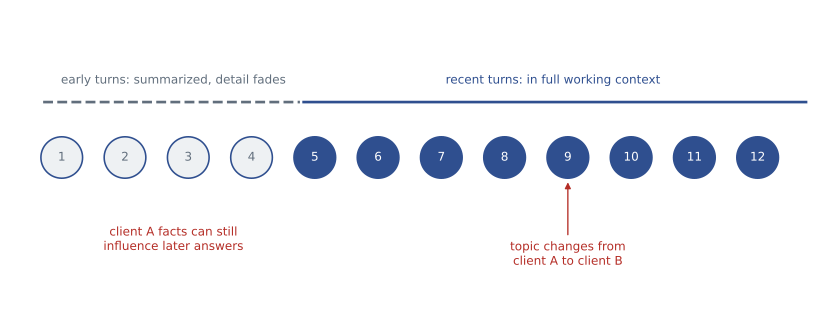
This is why Solveig's single long chat started confusing clients. Facts about Ridgeline from the first day were still in the conversation when she asked about a different trucking client a week later, and the model had every reason to think they were related. The fix was the rule Hamish had mentioned in lesson 2: one conversation per task, or at least one per client or project.
Building on earlier turns
Used well, multi-turn conversations are how complex work gets done. A typical sequence starts broad and narrows: gather and summarize the facts, then analyze them, then draft something from the analysis, then refine the draft. Each step builds on the last, and Copilot can refer back to earlier results without your restating them. You can say "using the three risks you listed earlier, draft the recommendation paragraph" and Copilot knows which list you mean.
Worked problem
A four-turn renewal preparation
Plan a conversation that takes Solveig from raw materials to a draft agenda for the Ridgeline renewal meeting.
Show solution
- Turn 1: "Summarize the changes between [last year's policy summary] and [this year's renewal quote] as a table."
- Turn 2: "Which of these changes is the client most likely to question, based on [the email thread with their office manager]?"
- Turn 3: "Draft a 30-minute meeting agenda that covers those questions first, then the rest of the changes."
- Turn 4: "Shorten each agenda item to one line and add a time estimate."
Answer: Each turn uses the previous result: the table becomes the basis for the likely questions, which shape the agenda, which is then refined. Four short prompts in one focused conversation do what a single long prompt could not.
Two techniques keep longer conversations on track. The first is to restate key facts when they matter: "Remember that the renewal date is March 1 and the client wants to keep the same deductible." A short restatement brings the fact back into focus. The second is to ask for a summary of the conversation before a new phase: "Summarize what we have decided so far in five bullet points." You can check the summary, correct anything wrong, and carry it into the next step or into a new chat if needed.
Recognizing drift
Drift is what happens when a conversation slowly moves away from its purpose or starts mixing contexts. Warning signs include answers that mention people or facts from an earlier topic, a correction that reappears a few turns later, or responses that get longer and vaguer as the conversation goes on. When you see drift, you have three options: restate the facts and goal, ask for a summary and correct it, or start a new conversation with a clean, complete prompt. For anything client-facing, Hamish recommended the third option as soon as two different clients had been mentioned in the same chat.
| Situation | Keep going in this chat | Start a new chat |
|---|---|---|
| Refining the same draft | Yes | No |
| Next step of the same task | Yes | Optional |
| A different client or project | No | Yes |
| The same correction needed a second time | Maybe, with a restatement | Usually |
| A brand-new, unrelated question | No | Yes |
Managing your chats
The Microsoft 365 Copilot app keeps a history of your conversations so you can return to them. Exam AB-730 expects candidates to know the basic management actions: opening an earlier conversation and continuing it, renaming a conversation so it is easy to find, deleting conversations you no longer need, and keeping the ones you want for later. Copilot usually gives a new chat an automatic title based on the first prompt, which is why Gus had ninety chats with nearly identical names. Renaming a conversation to something like "Ridgeline renewal 2027 – agenda" takes a few seconds and makes history useful. The exact location of the controls changes as Microsoft updates the app, and Microsoft's own support pages note that a new Home experience was still rolling out in late 2026, so look for the options menu next to a conversation in the chat history list.
Deleting a conversation removes it from your history. It is good practice for chats that contained sensitive content you no longer need, and it keeps the history short. Deleting a chat does not delete the files, emails or meetings that Copilot referenced; those stay wherever they are stored, under their own retention rules. Your organization may also keep records of Copilot interactions for compliance purposes, which the governance courses explain, so deleting a chat is a matter of tidiness, not a way to erase a record.
Memory and personalization
Beyond the current conversation, Microsoft 365 Copilot can personalize responses using Copilot Memory. According to Microsoft's support guidance, updated in November 2026, Copilot can infer memories from your chats, such as your job role, the tasks you do often or skills you want to improve, and use them as context in future responses. You can also ask it directly: "Remember that I work in commercial lines and prefer tables to long paragraphs." Copilot confirms with a notice that memory was updated.
Memories are under the user's control. In Copilot Chat you can open the settings menu, go to the personalization settings and manage saved memories, deleting individual memories or all of them. You can also turn saved memories off; Microsoft notes that turning the setting off does not delete existing memories, so delete them as well if you want them gone. Your organization's administrators can also control whether these features are available. Hamish showed the clinic his own saved memories and deleted one that had picked up a client's name from an early chat, a small example of why it is worth looking.
Worked problem
Deciding what belongs in memory
Which of these should Hamish ask Copilot to remember, and which should stay in individual prompts? (a) He prefers answers with headings and short paragraphs. (b) The renewal date for Ridgeline is March 1. (c) He is studying for AB-730. (d) A client's claim amount.
Show solution
- Lasting preferences and facts about him suit memory: (a) and (c).
- Facts about a specific client or case change and are sensitive: (b) and (d) belong in the prompt or referenced files.
- Client details in memory could appear in unrelated conversations later.
Answer: Remember (a) and (c). Keep (b) and (d) in the conversation about that client, where they are relevant and can be checked against the source.
Conversations and agents
Conversations work the same way when you chat with an agent, such as Researcher or an agent a colleague built. The agent keeps the conversation history and can answer follow-ups, but each agent conversation is separate from your general Copilot Chat history. If you start a task in Copilot Chat and then switch to Researcher, it will not automatically know what you discussed; give it a complete prompt or paste the summary you asked for earlier. Lessons 6 to 8 cover agents in more detail.
Conversation habits for a team
By the end of the session the clinic had agreed four habits. One conversation per client or task. Rename any conversation you expect to return to. Ask for a summary before switching phases. Delete chats with sensitive content once the work is done. Gus went back to his desk and deleted sixty conversations. Solveig split her long chat into five, starting each with a summary of what she already knew about that client.
Conversation patterns that work
Over the weeks the clinic noticed a few conversation patterns that worked reliably for common tasks. The first was draft, critique, revise: ask for a draft, then ask Copilot to critique its own draft against your criteria ("Review this email as the client would read it and list three ways it could be misunderstood"), then ask it to revise using the critique. The critique step often catches problems neither you nor the first draft noticed. The second was facts, then judgment: first ask for the facts from the sources with citations, check them, and only then ask for analysis or recommendations based on the agreed facts. The third was one variable at a time: when comparing options, change one thing per turn ("now assume the client keeps the old deductible") so you can see what drives each difference.
| Pattern | Turns | Good for |
|---|---|---|
| Draft, critique, revise | Draft; critique against criteria; revise | Client letters, proposals, anything persuasive |
| Facts, then judgment | Extract cited facts; check; analyze | Summaries that lead to decisions |
| One variable at a time | Baseline; change one assumption per turn | Comparing options and scenarios |
| Interview me | Copilot asks questions; you answer; it drafts | Complex documents where you hold the knowledge |
The fourth pattern, interview me, reverses the usual direction. You ask Copilot to ask you questions one at a time until it has enough to write a document, and then to draft it. Celestine used it to draft a job description for a new data analyst role: Copilot asked about responsibilities, tools, reporting lines and the team's goals, and the draft that followed reflected her answers rather than a generic template. The pattern works because the knowledge is in your head, and the conversation is a structured way of getting it out.
Conversations with sensitive content
Some conversations involve content that should not linger: a discussion of an employee issue, a complaint involving health information, or a draft of a confidential proposal. Good practice is to keep such conversations focused, avoid copying sensitive details into them that are not needed, and delete them when the work is done. Wendell also pointed out that conversations can be retained by the organization for compliance and legal reasons, and may be discoverable in the same way as email, so the usual standard applies: do not write anything in a prompt that you would not write in a work email.
Worked problem
Choosing a conversation pattern
Gus must decide whether to recommend that a client increase their liability limit. He has the policy, the client's revenue figures and the carrier's pricing for three limits. Which conversation pattern fits, and how would the turns go?
Show solution
- Facts first: "List the current limit, the three quoted limits and their premiums from [the carrier quote], with citations."
- Check the figures against the quote.
- One variable at a time: "Assuming the client chooses the middle limit, how does the premium change compared with today?" then repeat for the highest limit.
- Judgment last: "Based on these figures and [the client's revenue summary], draft the considerations I should discuss with the client, without making a recommendation for them."
Answer: Facts, then one variable at a time, then judgment. The final turn keeps the decision with Gus and the client, which is appropriate for advice in a regulated industry.
Conversation history and the exam
Expect AB-730 questions that test the practical side of conversations rather than how models work. A scenario might describe a user who cannot find an earlier answer, and the right option renames conversations as they are created. Another might describe a user whose answers keep mentioning an old project, and the right option starts a new conversation. A third might ask how to stop Copilot remembering a personal preference, and the right option deletes the saved memory as well as turning the setting off. In each case the knowledge being tested is simple; the skill is recognizing which simple action solves the problem described.
Common mistakes
MistakeUsing one long conversation for many clients or tasks.
InsteadUse one conversation per task or client so old facts do not leak into new answers.
MistakeLeaving every chat with its automatic title.
InsteadRename conversations you plan to return to.
MistakeAssuming an agent knows what you discussed in Copilot Chat.
InsteadGive the agent a complete prompt or paste a summary.
MistakeTurning memory off and assuming saved memories are gone.
InsteadDelete saved memories separately; turning the setting off does not remove them.
Summary and key terms
- Each turn is answered with the conversation so far as context, so earlier content shapes later answers.
- Long or mixed conversations drift; restate facts, ask for summaries or start a new chat.
- Manage chat history by continuing, renaming and deleting conversations.
- Copilot Memory can remember lasting preferences; users can view, delete and turn off saved memories.
- Agent conversations are separate from general Copilot Chat conversations.
- Conversation
- A sequence of prompts and responses that Copilot treats as shared context.
- Turn
- One prompt and its response within a conversation.
- Working context
- The amount of conversation and content the model can consider at once.
- Drift
- A conversation moving away from its purpose or mixing unrelated contexts.
- Copilot Memory
- A personalization feature that saves facts and preferences for use in future responses.
- Chat history
- The list of earlier conversations that a user can reopen, rename or delete.
Practice problems
Work each problem on paper first, then reveal the answer to check.
Why did Solveig's long conversation start mixing up clients?
Show answer
Earlier turns about one client stayed in the context and influenced answers about another.
Name three chat management actions expected for AB-730.
Show answer
Any three of: continuing an earlier chat, renaming, deleting and keeping conversations for later.
Does turning off saved memories delete them?
Show answer
No. Existing memories must be deleted separately.
Lesson quiz · 5 questions
Score 60% or more to complete this lesson.
Create a free account to save your progress, take quizzes and earn a certificate.