
MSBA-111 · Lesson 12 of 12 · 23 min
Case study: preparing for a client meeting
▶ Video coming soon A video version of this lesson is on the way.
The twelfth and final clinic was a live exercise. Solveig's renewal meeting with Ridgeline Cartage was at 10 a.m. on Thursday, November 19, 2026, and at the final clinic on Tuesday, November 17, she agreed to prepare for it in front of the group using everything the clinic had covered. Hamish ran the projector and kept time. Wendell sat in to review anything that would go to the client. This lesson follows the session step by step, and then asks you to plan your own version.
The situation
Ridgeline Cartage was a regional trucking company with 18 vehicles, a new depot opened in the summer, and a commercial fleet policy renewing on December 1. The carrier's renewal quote had arrived the week before with a higher premium and a change to the deductible. The client's office manager had sent several emails asking about the new depot's coverage and about a claim from August. Solveig's goals for the meeting were to explain the renewal clearly, answer the depot and claim questions, and agree on next steps. Her materials were scattered across a client folder, her inbox, two meeting recaps and a Teams chat with Gus.
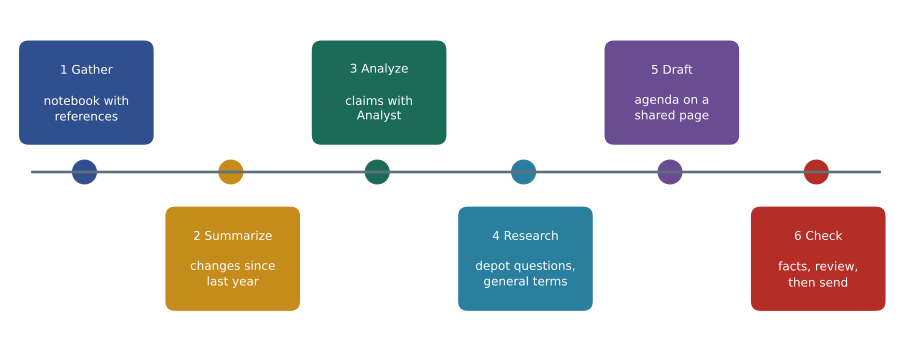
Step 1: Gather the materials
Solveig started by creating a Copilot Notebook called "Ridgeline Cartage – renewal December 2026" and adding references: last year's policy summary, this year's renewal quote, the carrier's renewal letter, the underwriter's email explaining the rate change, the email thread with the office manager, the recap of last month's site visit, and the claims export for the account. She left out the Teams chat with Gus, because it contained internal opinions about the carrier that she did not want shaping client-facing drafts. That was a deliberate choice about sources, the kind lesson 3 described, and Wendell noted it approvingly.
Step 2: Summarize what changed
Her first prompt in the notebook was: "Compare last year's policy summary with this year's renewal quote and list every change in coverage, limits, deductibles and premium as a table with columns for item, last year, this year and source. Use the renewal letter if the quote and letter disagree. Mark anything you could not find." Copilot returned a table of nine rows with citations. Two rows were marked as not found in last year's summary, which turned out to be new optional coverages. One figure, the deductible, appeared in both the quote and the letter with the same value, which gave Solveig confidence in it.
She followed up: "Which of these changes is the client most likely to ask about, based on the office manager's emails?" Copilot picked out the premium increase, the deductible change and coverage at the new depot, each with a citation to a specific email. That matched Solveig's instinct, and it gave her the order for the agenda.
Step 3: Analyze the claims
The office manager had asked whether the August claim was the reason for the premium increase. Solveig opened Analyst, attached the claims export, and asked: "For Ridgeline Cartage, list claims in the last three policy years with date of loss, type and amount paid, and show the total paid per policy year as a table and a simple chart. The columns are claim number, date of loss, claim type, amount paid and status." Analyst worked through the file in visible steps and returned the table and chart. Solveig checked the total for the most recent year against the claims system, a 30-second check that matched.
Worked problem
Reading the claims result
Analyst reports paid claims of 18,400, 9,200 and 41,600 dollars over the last three policy years. What was the average per year, and how much higher was the latest year than the average of the two earlier years?
Show solution
- Total: 18,400 + 9,200 + 41,600 = 69,200; average per year: 69,200 / 3 is about 23,067.
- Average of the two earlier years: (18,400 + 9,200) / 2 = 13,800.
- Difference: 41,600 - 13,800 = 27,800.
Answer: About 23,067 dollars a year on average; the latest year was 27,800 dollars above the earlier two-year average. The underwriter's email cited the claims experience as one of two reasons for the rate change, which Solveig could now explain with numbers.
Step 4: A short piece of research
The new depot raised a question Solveig wanted to be ready for: what coverage considerations typically apply when a trucking firm adds a depot where vehicles are parked and maintained? She used Researcher, keeping the prompt general so that no client details went into web searches: "Summarize the main insurance coverage considerations for a small trucking company that opens a new depot for parking and light vehicle maintenance, in Saskatchewan. Cover property, liability, garage-related exposures and any common gaps. Use public industry and regulator sources and our internal guidance documents on commercial property. Give a one-page summary with citations." Researcher asked whether to include fuel storage, and she said yes. The report took a few minutes.
Reading it critically, she found it useful as a checklist but too general to quote to the client. Two of its points were already covered by the renewal quote, one pointed to a gap worth raising, and one cited an article from a different province or state's rules, which she set aside. The result was a short list of questions for the client, not a statement of their coverage, which was exactly the right use.
Step 5: Draft the agenda and talking points
Solveig asked the notebook to draft a 30-minute agenda that dealt with the client's three questions first, then moved the result to a Copilot Page and asked Copilot to add short talking points under each item, drawing on the comparison table, the claims analysis and the research checklist. She edited the page herself, cutting one talking point that sounded defensive, and shared the page with Gus so he could add notes on the August claim. Gus added two lines from his own knowledge of the claim and corrected a date. The page became the working document for the meeting.
| Agenda item | Time | Prepared material |
|---|---|---|
| Premium change and the reasons for it | 8 min | Comparison table; underwriter's two reasons; claims chart |
| Deductible change and options | 6 min | Quote and letter figures; option to buy back a lower deductible |
| Coverage at the new depot | 8 min | Research checklist turned into five questions |
| The August claim | 4 min | Gus's notes; claim status |
| Next steps and decisions | 4 min | List of items needing the client's answer before December 1 |
Step 6: Check and send
Before anything went to the client, Wendell reviewed the confirmation email Solveig drafted from the page: "Draft a short email to Ridgeline's office manager confirming Thursday's 10 a.m. meeting, listing the five agenda items, and asking them to bring their updated driver list and the depot lease. Under 150 words, friendly and professional. Do not include premium figures." Wendell checked each statement against the sources and the page. The meeting time matched the invitation, the agenda matched the page, and the email contained no figures. He made one change: the draft promised to "confirm coverage for the depot", which sounded like a guarantee, so he changed it to "review coverage for the depot".
Solveig saved the comparison prompt from step 2 as a template, "Renewal changes table", with placeholders for the client and the two documents, and added it to the team's prompt library with herself as owner. She renamed the notebook chats she wanted to keep and deleted a test chat. The whole preparation had taken about 50 minutes, including the group's discussion; she estimated it would normally have taken her most of a morning.
What the case shows
Every lesson in the course appeared in the exercise. The prompts had goals, context, sources and expectations. Solveig iterated in short steps. She chose her references deliberately and left internal opinions out. She used a notebook to keep the project together, Analyst for the numbers, Researcher for general background with no client details, and a page to collaborate. She checked facts in proportion to their consequences, and a second person reviewed the client-facing text. And she turned a good prompt into a reusable template. The meeting went well; the client renewed and asked for a quote to lower the deductible.
Worked problem
Planning your own version
Choose a real or realistic meeting from your own work and plan its preparation using the six steps. For each step, write the tool you would use and one prompt.
Show solution
- Gather: which references go into a notebook, and which do you leave out?
- Summarize: what comparison or summary do you need first?
- Analyze: is there data that needs Analyst or Excel?
- Research: is there a general question for Researcher, phrased without confidential details?
- Draft: what goes on a shared page, and who edits it?
- Check: what must be verified, and who reviews it?
Answer: A good plan names a tool and a complete prompt for each step, keeps sensitive details out of web research, and includes a check by someone other than the author for anything client-facing. Compare your plan with Solveig's and look for steps you could save as templates.
The prompts in full
For reference, here are the core prompts from the session as Solveig ran them, so you can see the four parts at work in each.
| Step | Tool | Prompt (shortened) |
|---|---|---|
| Summarize | Notebook chat | Compare last year's policy summary with this year's quote; table of item, last year, this year, source; letter wins if they disagree; mark anything not found. |
| Likely questions | Notebook chat | Which of these changes is the client most likely to ask about, based on the office manager's emails? |
| Claims | Analyst | List claims for the last three policy years with date, type and amount paid; totals per year as a table and chart; columns explained. |
| Background | Researcher | Coverage considerations for a small trucking company opening a depot for parking and light maintenance; public and internal sources; one page with citations. |
| Agenda | Notebook chat, then a page | Draft a 30-minute agenda that deals with the client's three questions first; add talking points from the table, claims analysis and checklist. |
| Copilot Chat | Confirm Thursday's meeting, list the agenda, ask for the driver list and depot lease; under 150 words; no premium figures. |
What went less well
Not everything in the session worked the first time, and the group found the misses as instructive as the successes. The first Analyst prompt forgot to say which policy years to include, and the result covered five years instead of three; a follow-up fixed it in one turn. The first agenda draft put the August claim first because the office manager's most recent email was about it, which would have started the meeting on a negative note; Solveig moved it to fourth place by hand. And the Researcher report included a paragraph about cargo coverage that was irrelevant to a depot, which she simply ignored. None of these misses mattered, because each was caught by a person reading the output with the purpose of the meeting in mind.
After the meeting
Copilot's role did not end when the meeting started. With the client's consent, the meeting was transcribed, and afterward Solveig asked Copilot in the notebook to draft a recap with decisions and action items. Applying lesson 10, she checked the recap against her own notes before sending it, correcting one action item that had been assigned to the wrong person. The recap went onto the agenda page, so the page now held the plan, the discussion and the outcome. The decisions themselves were recorded in Quillfield's client management system, which remained the official record. A week later, when the client accepted the quote to lower the deductible, Solveig asked the notebook for a short summary of the renewal history to include in the file note, and checked it against the documents in a few minutes.
Worked problem
Estimating the time saved
Solveig estimates her usual preparation for a renewal of this size at 3.5 hours. With Copilot it took about 50 minutes plus 20 minutes of checking. How much time did she save, and what share of her usual time is that?
Show solution
- Time with Copilot: 50 + 20 = 70 minutes.
- Usual time: 3.5 hours = 210 minutes.
- Saved: 210 - 70 = 140 minutes, which is 140 / 210, or two thirds of her usual time.
Answer: About 140 minutes, roughly two thirds of the usual preparation time, with checking included. The saving comes from gathering and drafting; the checking time is the part not to cut.
Looking ahead
The clinic series ended with the case study, and Hamish booked his AB-730 exam for January 2027. The next course in the program, MSBA-112, applies the same prompting skills inside Word, Excel, PowerPoint, Outlook and Teams, where much of Quillfield's daily work happens. MSBA-119 then reviews all three skill areas for the exam. The habits from this course carry into both: complete prompts, short iterations, deliberate sources, the right tool for the task, and checking in proportion to the consequences.
Common mistakes
MistakeAdding every available source to a notebook, including internal opinions.
InsteadChoose references deliberately, and leave out material that should not shape client drafts.
MistakePutting client details into a Researcher prompt that searches the web.
InsteadKeep research general and apply it to the client yourself.
MistakeQuoting a general research report to a client as if it described their coverage.
InsteadTurn research into questions and check against the client's actual documents.
MistakeSending a client email without a final check.
InsteadCheck every fact against the sources, and get a second review where required.
Summary and key terms
- A realistic preparation combines several Copilot features, each used for what it does best.
- A notebook keeps the project's references together; choosing references is a deliberate decision.
- Analyst handles the numbers, Researcher the general background, and a page the shared draft.
- Client-facing content gets full checking and, where required, a second reviewer.
- Good prompts from the work become templates for the team.
- Preparation workflow
- A planned sequence of steps and tools for getting ready for a task such as a meeting.
- Talking points
- Short notes under each agenda item that the presenter can speak from.
- Second review
- A check by someone other than the author before content goes outside the organization.
- Template prompt
- A saved prompt with placeholders, created from a prompt that worked well.
Practice problems
Work each problem on paper first, then reveal the answer to check.
Why did Solveig leave the Teams chat with Gus out of the notebook?
Show answer
It contained internal opinions she did not want shaping client-facing drafts.
How did she keep client details out of web research?
Show answer
She phrased the Researcher prompt in general terms about small trucking companies with a new depot.
What did Wendell change in the confirmation email, and why?
Show answer
He changed "confirm coverage" to "review coverage", because the original sounded like a guarantee.
Lesson quiz · 5 questions
Score 60% or more to complete this lesson.
Create a free account to save your progress, take quizzes and earn a certificate.