
MSBA-103 · Lesson 12 of 12 · 21 min
Case study: a 90-day Copilot and agents pilot
▶ Video coming soon A video version of this lesson is on the way.
The last working session, in the third week of November 2026, had one item on the agenda: turn eleven sessions of decisions into a pilot plan the board could approve. Ines wanted it on four pages. Lorna wanted the costs on one of them. Dr. Ostrander-Bey wanted the stop conditions on the first. Teodor had the decision log, the settings records and the measurement plan, and two hours to make them into a plan that someone who had attended none of the sessions could follow. This lesson walks through that plan as a worked case study, drawing together every part of the course.
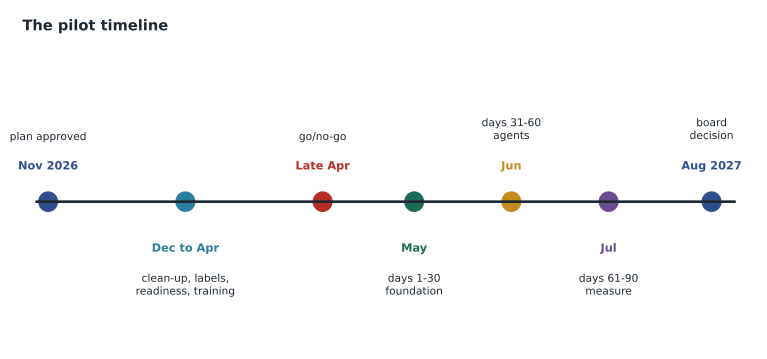
The pilot was set to run for 90 days from the first Monday in May 2027, after the oversharing clean-up and the go/no-go review in April that the governance plan required. Everything in this lesson is therefore a plan written in November 2026: what Corvallin intended to do, how it would know whether the pilot worked, and what would make it stop.
Goals and scope
A pilot without goals measures enthusiasm. Corvallin's plan stated three goals, each tied to a measure from lesson 10, and kept the scope deliberately narrow.
| Goal | Measure | Target by day 90 |
|---|---|---|
| Save office staff time on writing and summarizing | Monthly survey; Copilot Dashboard where available | Median saving of at least one hour a week |
| Make reliable answers easier to find | Use and ratings of the procedures and intake agents; help desk tickets about procedures | Agents used weekly; more positive than negative ratings; fewer repeat questions to coordinators |
| Prove that Copilot can be run safely | DLP alerts, incidents, help desk AI tickets | No privacy incident caused by Copilot or an agent |
In scope: 40 office staff with Microsoft 365 Copilot licences; the four IT staff; about 30 schedulers using the procedures agent through pay-as-you-go; four organization-built agents (Intake Questions, Procedures Helper, New Hire Guide and Help Desk Triage); and the Microsoft-built agents the group had allowed. Out of scope: home-care staff on F3 licences, any agent that reads client records, any third-party agent, and any change to clinical workflows. Dr. Ostrander-Bey insisted on the last line: "Copilot can help write the letter about the care plan. It does not touch the care plan."
Readiness gates before day 1
Lesson 4's checklist became a set of gates, each with an owner and a date, all of which had to pass before licences were assigned.
| Gate | Owner | Due |
|---|---|---|
| Oversharing clean-up and access review for every site pilot users can reach | Teodor | April 2027 |
| Sensitivity labels and DLP for Copilot in enforcement, per the governance plan | Teodor and the privacy officer | April 2027 |
| Readiness report clean for all 40: eligible base licence, supported update channel, no blockers | Ama | Two weeks before start |
| Agent knowledge sources cleaned: no superseded or draft documents | Ansel Marrowby | Two weeks before start |
| Copilot use guide signed by every pilot user after one-hour training | Ines | Before licence assignment |
| Settings, billing policy and spending limits configured and recorded | Teodor | One week before start |
| Go/no-go meeting | Ines, Dr. Ostrander-Bey, Lorna | Last week of April 2027 |
Licensing and billing
The licensing plan from lesson 3 stood, with the details from lesson 4.
| Item | Plan |
|---|---|
| Pilot licences | 40 Microsoft 365 Copilot licences on an annual commitment, assigned through group-based licensing to Copilot-Pilot |
| IT licences | 4, already assigned directly; to be moved into a Copilot-IT group for consistency |
| Waiting list | Two branch managers; licences reassigned from users inactive for four weeks after coaching |
| Schedulers | Pay-as-you-go billing policy for SharePoint agents covering the Schedulers group, in its own resource group |
| Budget alerts | 50, 75 and 100 percent of the monthly planned amount, to IT and finance |
| Hard stop | Spending limit in Cost management; help desk runbook to remove users from the billing policy |
| Copilot Studio | Capacity for Help Desk Triage based on Ama's estimate of about 3,200 billable messages a month |
Worked problem
Lorna's cost page
For the board summary, Lorna uses illustrative planning figures: 40 pilot licences at 30 dollars per user per month; schedulers' pay-as-you-go budgeted at 400 dollars a month; and Help Desk Triage capacity budgeted at 150 dollars a month. The four IT licences are already paid for. What is the planned cost for the three months of the pilot, excluding the IT licences?
Show solution
- Pilot licences per month: 40 times 30 dollars is 1,200 dollars.
- Pay-as-you-go per month: 400 dollars.
- Copilot Studio per month: 150 dollars.
- Total per month: 1,200 plus 400 plus 150 is 1,750 dollars.
- Three months: 1,750 times 3 is 5,250 dollars.
Answer: About 5,250 dollars for the 90 days on these planning figures, with the annual commitment for the 40 licences noted separately because it runs for a year. Actual prices come from the current quote.
Lorna added one line under the total that summarized the course's lesson on billing: the licence figure is fixed, the pay-as-you-go figure is a budget that warns rather than stops, and the spending limit is the real ceiling.
Settings and agents
The settings records from lessons 7 and 11 were attached to the plan as appendices. The plan itself listed the decisions that mattered for the board.
| Area | Decision |
|---|---|
| Copilot settings | Web search on, with guidance; independent-processor AI providers off pending privacy review; image generation on with labelling; self-service purchases off |
| Teams meetings | Clinical-Meetings policy keeps Copilot to during the meeting only |
| Agent access | User access limited to Copilot-Pilot, IT-Team and Schedulers; external-publisher agents off; Microsoft-built agents allowed as reviewed |
| Agent building | Agent Builder for pilot users; broad sharing only through Agent-Sharers; Copilot Studio authoring for Teodor and Ama in managed environments |
| Publishing | Organization agents published to pilot groups only, with the default policy template, after review |
| Prompts | Twelve organizational prompts, four pinned, with versions in a second language for the eastern branch |
| Scheduling | Training covers native scheduling under Tasks > Scheduled only |
| Agent | Tool | Owner | Audience | Review before day 1 |
|---|---|---|---|---|
| Intake Questions | Agent Builder | Nadia Prevost (added as owner) | Intake coordinators | Refusal tests for medication and named clients |
| Procedures Helper | SharePoint agent | Ansel Marrowby | Pilot users and schedulers | Library contains approved current versions only |
| New Hire Guide | Agent Builder | HR and training lead | New office staff in the pilot | Onboarding pages current |
| Help Desk Triage | Copilot Studio | Ama Owusu-Pratt | Pilot users and IT | Ticket action limited to creating tickets; data policy allows only required connectors |
The 90 days
The plan divided the pilot into three 30-day phases, each with a focus and a review.
| Phase | Focus | Activities | Review at end |
|---|---|---|---|
| Days 1 to 30: foundation | Everyday Copilot in Outlook, Teams and Word | Training follow-up; champions in each department; weekly tips; help desk AI ticket category | Usage report: active rate; first survey; any incidents |
| Days 31 to 60: agents | Agents and prompts | Intake Questions and Procedures Helper promoted; Researcher and Analyst sessions for leaders and finance; prompt-sharing in teams | Agent usage and ratings; second survey; cost against budget |
| Days 61 to 90: measure and decide | Evidence for the board | Interviews with six users; registry and settings review; expansion options costed | All targets; recommendation to the board |
Every week of the pilot, Ama would run the fifteen-minute agent review from lesson 7, and Teodor would read the Copilot usage report and the Cost management overview. Every month, the working group would meet for an hour with the latest numbers, the survey results and the help desk report.
Stop conditions and risks
Dr. Ostrander-Bey's first page listed the conditions under which the pilot would pause, and the plan said who could pause it.
| Condition | Action | Who decides |
|---|---|---|
| A privacy incident caused by Copilot or an agent | Pause the affected feature or agent at once; report to the clinical director within a day | Ines or Dr. Ostrander-Bey |
| An agent gives harmful or materially wrong answers | Block the agent; investigate; fix content; update through approval | Teodor |
| Pay-as-you-go spending reaches the spending limit | Usage stops at the limit; review before raising it | Lorna and Ines |
| A Microsoft change affects pilot features | Review the message center item; adjust training or settings | Teodor |
| Risk | Likelihood | Impact | Mitigation |
|---|---|---|---|
| Users send AI-drafted text without checking it | Medium | High | Use guide, training, "Ask for sources" prompt, champions |
| Agents cite superseded documents | Medium | Medium | Records manager owns agent knowledge; quarterly content review |
| Oversharing missed in the clean-up | Low | High | Access review gate; DLP for Copilot; restricted content discovery on sensitive sites |
| Low adoption by some users | Medium | Medium | Coaching before reassigning licences |
| Microsoft changes names, features or prices | High | Low to medium | Monday message center triage; decision log; SKU IDs in scripts |
The last risk made the room laugh, but it was the most certain one. During the eleven sessions alone, Microsoft had renamed products, moved scheduled prompts to a new experience and changed how agent billing was described. Teodor's mitigation was the habit he had built since the Thursday tenant reviews: read the message center every Monday, record what changes and why in the decision log, and never let a script depend on a product's display name.
The decision at day 90
The plan ended with the three options the board would choose between in August 2027, and the evidence each would need.
| Option | When it fits | Evidence needed |
|---|---|---|
| Expand to all office staff (about 120) | All targets met; no incidents; costs as planned | Survey results, usage, agent ratings, cost per user |
| Extend the pilot with changes | Mixed results; specific problems fixable | What did not work and what would change |
| Stop | A stop condition triggered and unresolved, or targets missed widely | Incident reports and lessons learned |
Worked problem
Testing the plan against AB-900
Before sending the plan to the board, Teodor checks it against the AB-900 objectives for administering Copilot and agents. Which parts of the plan cover each objective?
Show solution
- Compare built-in capabilities and agents: scope section and allowed agents (lessons 1 and 2).
- Compare the licence and pay-as-you-go: licensing and billing section, including SharePoint agents (lesson 3).
- Features that can be enabled or disabled: settings decisions (lesson 11).
- Use cases for Researcher, Analyst and custom agents: phase 2 activities and the agent table (lessons 2 and 5).
- Assign licences; manage billing policies: group-based licensing, billing policy and spending limits (lessons 3 and 4).
- Monitor usage and adoption; manage prompts: measurement plan and organizational prompts (lessons 9 and 10).
- Configure user access to agents; create an agent; approval; monitoring in both admin centers: agent access, the four agents, publishing and the weekly review (lessons 5 to 8).
Answer: Every objective in the domain appears in the plan. Teodor took the mapping to his AB-900 exam preparation as a revision sheet.
Communicating the pilot
A pilot affects more people than its users. Staff outside the pilot would hear that colleagues had Copilot and wonder why they did not; managers would wonder whether their teams would be next; the help desk would field questions from everyone. The plan included a short communication schedule: an all-staff note from Ines a month before the start explaining what the pilot was, who was in it and why, and that nobody's job was changing; a note to managers of pilot users asking them to protect an hour in the first week for practice; a monthly update on the intranet with one result and one lesson; and a closing note after the board decision.
The champions network carried most of the day-to-day communication. Each department in the pilot had one champion, trained an extra hour, who held a fifteen-minute "Copilot corner" every Friday in the first month to share a useful prompt and collect problems. Champions were chosen, like the pilot users, for their work and their willingness to help, and Teodor met them every second week to hear what the reports could not tell him.
After the pilot
Whatever the board decided, the plan said what would happen to the work. If the pilot expanded, the configuration, prompts, agents and guidance would become the standard for all office staff, and the decision log would be the handover. If it was extended, the working group would rewrite the goals for the extension based on what had been learned. If it stopped, licences on the annual commitment would be reassigned for the rest of the term to the users who had found most value, agents would be retired through the normal lifecycle, and the lessons would be written up for the next attempt. Ines insisted on this section because, as she put it, a plan that only describes success is not a plan.
Teodor sent the four pages to Ines on the Friday of the third week of November. She returned them with one change, a line at the top of the first page naming the clinical director as the person who could stop the pilot at any time, and forwarded them to the board.
Common mistakes
MistakeStarting a pilot without written goals and targets.
InsteadSet goals, measures and targets before day 1 so the result can be judged.
MistakeAssigning licences before readiness gates pass.
InsteadGate licences on data clean-up, app readiness, guidance and configuration.
MistakeLeaving stop conditions vague.
InsteadName the conditions, the action and who decides.
MistakeTreating the pilot plan as finished once approved.
InsteadReview it weekly and monthly; Microsoft's changes alone will require updates.
Summary and key terms
- A pilot plan states goals, measures and targets, and keeps scope narrow and explicit.
- Readiness gates, each with an owner and date, must pass before licences are assigned.
- Licensing combines group-based Copilot licences, pay-as-you-go for light users, Copilot Studio capacity, budgets that warn and spending limits that stop.
- Settings, agent access, building, publishing, prompts and scheduling decisions are recorded and attached to the plan.
- Three 30-day phases, weekly and monthly reviews, stop conditions and a risk register lead to a clear decision at day 90.
- Pilot
- A limited, time-boxed rollout to test value and risks before a wider deployment.
- Readiness gate
- A condition that must be met before the next step of a rollout.
- Stop condition
- A predefined event that pauses or ends a pilot.
- Risk register
- A list of risks with likelihood, impact and mitigation.
- Champion
- A trained user who helps colleagues adopt a new tool.
- Decision log
- A running record of configuration decisions and the reasons for them.
Practice problems
Work each problem on paper first, then reveal the answer to check.
Name three readiness gates in Corvallin's plan.
Show answer
Any three: oversharing clean-up and access review; labels and DLP for Copilot; readiness report clean; agent knowledge cleaned; use guide signed after training; settings and billing configured; go/no-go meeting.
What is the difference between the pay-as-you-go budget and the spending limit in the plan?
Show answer
The budget sends alerts but does not stop usage; the spending limit is the actual ceiling.
What are the three options at day 90?
Show answer
Expand, extend the pilot with changes, or stop.
Lesson quiz · 5 questions
Score 60% or more to complete this lesson.
Create a free account to save your progress, take quizzes and earn a certificate.