
MSBA-102 · Lesson 11 of 12 · 18 min
Privacy, residency and the Microsoft trust commitments
▶ Video coming soon A video version of this lesson is on the way.
Corvallin's board approved the Copilot pilot only after its lawyer read Microsoft's terms. Her questions were the ones every privacy-conscious organization asks: Will Microsoft use our client information to train its AI? Where is the data stored and processed? Who at Microsoft can see it? And how do we prove to a regulator that we have done our part? This lesson covers Microsoft's commitments and the Purview tool, Compliance Manager, that helps organizations track their own obligations.
Enterprise data protection
When people sign in to Microsoft 365 Copilot or Copilot Chat with a work account, Microsoft describes their prompts and responses as covered by enterprise data protection. In practice this means Copilot interactions are treated under the same contractual terms as other Microsoft 365 customer data: the Microsoft Product Terms and the Data Protection Addendum (DPA). Under those terms Microsoft acts as a data processor, using customer data only to provide the service the customer has paid for.
| Commitment | What it means for Corvallin |
|---|---|
| Not used to train foundation models | Prompts, responses and data accessed through Microsoft Graph are not used to train the large language models behind Copilot |
| Data processor terms | Microsoft processes client information only to provide the service, under the DPA |
| Encryption | Data is encrypted at rest and in transit by default |
| Permissions respected | Copilot only uses content each user can access |
| Residency | Stored Copilot interaction content falls under Microsoft 365 data residency commitments for the tenant's location |
| Web queries limited | When web grounding is used, generated search queries, not files, are sent to Bing |
These commitments are a floor, not the whole picture. They describe what Microsoft does with data. They say nothing about whether Corvallin's own permissions, labels and policies are right, which is why the first ten lessons exist.
Where data lives and where it is processed
Data residency is about where customer data is stored. Microsoft 365 offers several layers. Core data residency commitments in the Product Terms cover customer data at rest for tenants in certain countries and regions. The Advanced Data Residency add-on extends commitments to more workloads. Multi-Geo lets large organizations store some users' data in different geographies. Copilot interaction content stored in a tenant is covered by Microsoft's data residency commitments for Microsoft 365 Copilot. For organizations in the European Union, the EU Data Boundary commits to storing and processing customer data within the EU and EFTA for in-scope services.
Processing is a separate question. Large language models run in Microsoft data centres, and for most of Copilot's history a prompt could be processed outside the tenant's country. In November 2025 Microsoft announced in-country processing of Copilot interactions for a list of countries. An April 2026 update to that announcement changed the timeline: the United States, United Kingdom, Australia, India and the United Arab Emirates by the end of 2026, Canada in 2027, and Japan in 2028, with EU and EFTA countries handled regionally under the EU Data Boundary. Microsoft now describes this step as local data inferencing.
For Corvallin, a Nova Scotia custodian of personal health information, the timeline mattered. Teodor confirmed that Corvallin's tenant stored data in Canada and that stored Copilot interactions were covered by residency commitments, and he noted in the privacy impact assessment that Copilot's processing would move to in-country inferencing when Microsoft delivers it for Canada, expected in 2027 according to Microsoft's April 2026 update. The lawyer accepted this with a requirement to revisit the assessment when the change arrived.
Worked problem
Answering the lawyer's questions
The lawyer asks four questions: (1) Will our client data train Microsoft's models? (2) In what role does Microsoft handle it? (3) Where are Copilot conversations stored? (4) What do we still have to do ourselves? Give short answers.
Show solution
- (1) No. Prompts, responses and Graph data are not used to train the foundation models.
- (2) As a data processor under the Product Terms and Data Protection Addendum.
- (3) In each user's mailbox in the tenant, covered by Microsoft 365 data residency commitments.
- (4) Govern access, label and protect sensitive content, set DLP and retention, monitor, and complete our own privacy assessments.
Answer: No training; processor terms; stored in the tenant under residency commitments; and the customer still owns access, protection, policies and assessments.
Responsible AI
Microsoft publishes six responsible AI principles that guide how it designs AI products, and the AB-900 outline asks candidates to understand them. They are also a useful frame for an organization's own policies.
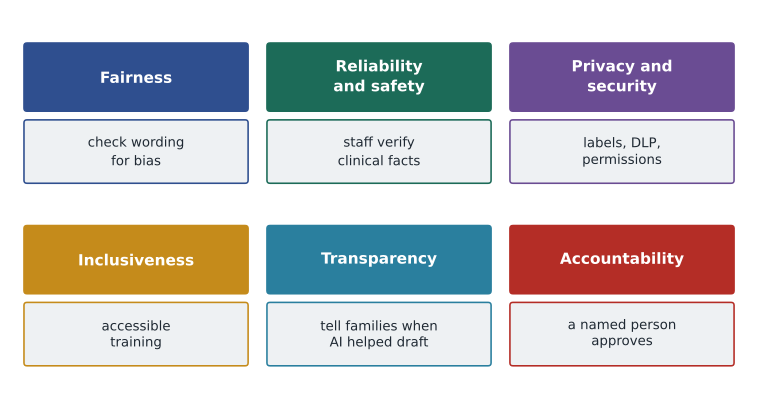
| Principle | Meaning | Corvallin practice |
|---|---|---|
| Fairness | AI should treat people fairly and avoid bias | Review Copilot-drafted assessments for biased wording about clients |
| Reliability and safety | AI should perform reliably and safely | Staff check every clinical fact Copilot summarizes against the source |
| Privacy and security | AI should protect privacy and be secure | Labels, DLP and permissions from this course |
| Inclusiveness | AI should empower everyone | Training that works for staff with different languages and abilities |
| Transparency | People should understand how AI is used | Tell families when AI helped draft a letter |
| Accountability | People remain accountable for AI systems | A named person approves anything sent to a client |
Microsoft builds some protections into Copilot itself. During processing, Copilot applies harmful content filtering, protected material detection, which checks responses for known copyrighted text and code, and defences against prompt injection, where hidden instructions in a document or email try to make the AI ignore its rules. Microsoft also offers a Customer Copyright Commitment for commercial customers who use its Copilot services and follow the required guardrails. None of these replace human judgement; they reduce the chance of the worst outcomes.
The Service Trust Portal
Organizations that need evidence of Microsoft's own controls can use the Service Trust Portal, which publishes independent audit reports, certifications such as ISO/IEC 27001 and SOC reports, and documents about data handling. Corvallin's lawyer downloaded the relevant reports for her file. Auditors increasingly ask for this kind of evidence before they accept that a cloud service meets an organization's obligations.
Compliance Manager
Microsoft Purview Compliance Manager helps an organization manage its own side of compliance. It provides assessments built from regulatory templates, a compliance score that measures progress, and improvement actions that describe what to do. Some actions are completed by Microsoft and counted automatically; others belong to the customer and can be tested automatically when Compliance Manager can detect a setting, or updated manually with evidence.
A Data Protection Baseline assessment is provided by default. Organizations can add templates for laws and standards that apply to them, including privacy regulations and AI-related frameworks; Microsoft's documentation describes regulatory templates that help assess compliance for generative AI apps, such as monitoring AI interactions and preventing data loss in AI apps. Each improvement action shows its points, which reflect how much it reduces risk, an owner and a status. The exam asks candidates to identify compliance risks and recommendations with Compliance Manager, which in practice means reading assessments and improvement actions and deciding what to do next.
| Compliance Manager term | Meaning |
|---|---|
| Assessment | A grouping of controls from a regulation or standard, built from a template |
| Template | The framework an assessment is based on, such as a privacy law or an AI framework |
| Improvement action | A recommended step, with guidance, points, owner and status |
| Compliance score | Points achieved as a share of points possible across assessments |
| Microsoft actions | Controls Microsoft implements in the service, counted automatically |
Teodor assigned Corvallin's open improvement actions to owners: label actions to himself, retention actions to the records manager, insider risk actions to the privacy officer. The score rose as the work in this course was completed. Ines warned the board not to treat the score as a certificate. It measured progress against recommendations, not legal compliance, which only the organization's own review and its regulators could judge.
A privacy impact assessment for Copilot
Many privacy laws and policies expect an organization to assess the privacy impact of a new system before it goes live. Corvallin's assessment for Copilot followed a simple structure: what personal information Copilot could process, for which purposes, who could access the results, where data would be stored and processed, which safeguards applied, and which risks remained. The safeguards section was largely this course: permissions cleanup, labels, DLP for prompts and labelled content, retention for interactions, audit and eDiscovery, and Microsoft's contractual commitments. The remaining risks section listed things that controls could not eliminate, such as a staff member trusting an inaccurate summary, and the mitigations: training and the rule that a person checks every clinical fact.
An acceptable use policy for AI
Policies tell people what is expected; tools enforce some of it. Corvallin's acceptable use policy for Copilot was one page long and covered: which AI tools are approved (Copilot with work accounts) and which are not (consumer AI sites for any client information); that users remain responsible for anything they send or save; that clinical facts must be checked against the source; that Copilot interactions are recorded, kept for two years and searchable by named roles for legitimate reasons; and how to report a problem. Every pilot user signed it before receiving a licence.
Microsoft access to customer data
Customers sometimes ask whether Microsoft engineers can read their content. Microsoft describes its operations as designed so that engineers do not have standing access to customer content, and that access for support is granted only when needed and for a limited time. Customer Lockbox adds a step for organizations that want it: when a Microsoft engineer needs access to customer content to resolve a support case, the customer receives a request and must approve it before access is granted. Corvallin turned Customer Lockbox on, and the lawyer noted it in the assessment as an additional control.
Copilot, copyright and accuracy
Two more trust questions came up at the board meeting. One member asked who owned the content Copilot produced. Microsoft's terms treat output as the customer's, and the Customer Copyright Commitment addresses claims that output infringes someone else's copyright, provided the customer uses the required content filters and does not deliberately try to produce infringing material. The other asked whether Copilot could be wrong. Ines answered plainly: yes. Copilot can misunderstand a question, miss a document or state something with confidence that the sources do not support. That is why Corvallin's policy required a person to check clinical facts, and why Copilot's citations, which link each answer to its sources, mattered so much in training.
Keeping up with change
Microsoft changes Copilot and Purview frequently, and features move from preview to general availability, change names or gain new settings. Teodor subscribed to the Microsoft 365 message center posts for Copilot, Purview and SharePoint, added a monthly item to the governance review for "what changed", and checked the Microsoft Learn pages for any control the organization relied on before each quarterly report. The commitments in this lesson are stable; the details of how they are delivered are not.
Explaining the commitments to staff
Staff had questions of their own, and they were less about contracts than about trust. Will my manager read my prompts? Does Microsoft keep what I type? Is it safe to ask Copilot about a client? Teodor wrote short answers for the intranet. Prompts are stored in your mailbox like your chats, are kept for two years, and can only be searched by named roles for complaints, investigations or legal reasons. Microsoft does not use them to train its models. It is safe to ask Copilot about a client you are working with, because Copilot only uses files you can already open, but never paste client information into other AI sites. Plain answers like these did more for adoption than any feature list, because they let staff use Copilot without worrying that they were doing something wrong.
Common mistakes
MistakeTelling staff that Copilot conversations train Microsoft's AI.
InsteadMicrosoft commits that prompts, responses and Graph data are not used to train foundation models.
MistakeTreating data residency and processing location as the same thing.
InsteadResidency covers where data is stored; in-country processing is a separate commitment with its own timeline.
MistakeReading the Compliance Manager score as proof of legal compliance.
InsteadThe score measures progress on improvement actions; legal compliance needs the organization's own assessment.
MistakeAssuming Microsoft's commitments cover the customer's permissions and policies.
InsteadUnder shared responsibility, access, labels, DLP and retention remain the customer's job.
Summary and key terms
- Copilot for work accounts is covered by enterprise data protection under the Product Terms and Data Protection Addendum.
- Prompts, responses and Graph data are not used to train foundation models, and Microsoft acts as a data processor.
- Data residency covers stored data; Microsoft's in-country processing for Copilot is rolling out by country, with Canada expected in 2027.
- Microsoft's six responsible AI principles are fairness, reliability and safety, privacy and security, inclusiveness, transparency and accountability.
- Compliance Manager uses assessments, templates, improvement actions and a compliance score to track the customer's obligations.
- Enterprise data protection
- Microsoft's term for the contractual and technical protections that apply to Copilot interactions with work accounts.
- Data Protection Addendum (DPA)
- Microsoft's contract terms for processing and protecting customer personal data.
- Data residency
- Commitments about the geographic location where customer data is stored.
- EU Data Boundary
- Microsoft's commitment to store and process in-scope customer data within the EU and EFTA.
- Protected material detection
- A Copilot safety check that looks for known copyrighted text and code in responses.
- Compliance Manager
- A Purview solution that tracks compliance assessments, improvement actions and a compliance score.
- Improvement action
- A recommended compliance step in Compliance Manager with points, owner and status.
Practice problems
Work each problem on paper first, then reveal the answer to check.
Name three of Microsoft's six responsible AI principles.
Show answer
Any three of: fairness, reliability and safety, privacy and security, inclusiveness, transparency, accountability.
In which year did Microsoft's April 2026 update expect in-country Copilot processing for Canada?
Show answer
2027.
Which Compliance Manager assessment is provided by default?
Show answer
The Data Protection Baseline.
Lesson quiz · 5 questions
Score 60% or more to complete this lesson.
Create a free account to save your progress, take quizzes and earn a certificate.