
MSAZ-120 · Lesson 4 of 12 · 20 min
Data roles: administrator, engineer and analyst
▶ Video coming soon A video version of this lesson is on the way.
The third data hour begins with a question from Keiko that has clearly been bothering her. "When we move to Azure, who does what? Walt looks after StockLine, Ines builds pipelines, I write reports. But the job titles at other companies are all over the place, and I'm not sure where one job stops and the next begins." Elena says that is exactly the right question, and that the DP-900 exam asks it too. The exam names three core roles in data work: the database administrator, the data engineer and the data analyst. Real organizations add others and blend them in different ways, but these three describe the main responsibilities clearly.
The database administrator
A database administrator, or DBA, is responsible for keeping databases available, secure and performing well. Walt is Harrow & Finch's DBA, and his responsibilities are typical of the role.
- Installing, configuring and upgrading database software, and planning capacity so the database has enough memory, processing power and storage.
- Backing up databases and, just as important, regularly proving that the backups can be restored. Walt restores a copy of StockLine to a test server every month and times how long it takes.
- Designing and running high availability and disaster recovery, so the database survives the failure of a server, a disk or a whole site.
- Managing security: creating logins and users, granting only the permissions each person or program needs, and making sure sensitive data is encrypted.
- Monitoring performance, finding slow queries, adding indexes and tuning settings.
- Applying patches and updates without disrupting the business.
Much of a DBA's work is invisible when it is done well. Nobody thanks Walt when StockLine is simply up all through Black Friday, but everyone would notice if it were not. The role rewards patience, careful habits and a healthy suspicion of untested changes. Walt's binder of runbooks, step-by-step procedures for every task from restoring a database to failing over to the second site, is the physical form of that care.
Moving to Azure changes the DBA role rather than removing it. With platform services such as Azure SQL Database, Microsoft takes over much of the routine work: installing and patching the database engine, taking backups automatically, and keeping a standby copy ready. Walt will spend less time on that and more on design, security, performance tuning and cost. With SQL Server on a virtual machine, by contrast, he keeps nearly all his current tasks. Lesson 8 returns to this trade-off.
The data engineer
A data engineer builds and maintains the systems that move data from where it is created to where it is used, and that store it in a form suitable for analysis. Ines is Harrow & Finch's first data engineer. Her responsibilities include the following.
- Building pipelines that extract data from source systems such as StockLine, the website and the warehouse, and load it into the data platform, on a schedule or continuously.
- Transforming data: cleaning it, removing duplicates, converting types, fixing dates, joining sources together and reshaping it into tables that are easy to analyse.
- Designing storage for analytical data: choosing file formats, folder structures, tables and partitions, often in a data lake or lakehouse.
- Making sure data is trustworthy, with checks that catch problems such as a store that sent no sales, a price of zero or a sudden doubling of rows.
- Working with data governance: recording where data came from, who may use it and how long it is kept.
A data engineer works with many technologies: SQL, a programming language such as Python, pipeline tools, and analytics platforms such as Microsoft Fabric or Azure Databricks. Where a DBA is usually concerned with a few critical databases, a data engineer is concerned with the flow between many systems. Ines describes her job as plumbing: "Nobody wants to see the pipes, but everybody notices when the water stops."
# A simple data-quality check of the kind a data engineer runs after each load.
rows = [
    {"store": "12", "date": "2026-11-03", "sales": 4055.00},
    {"store": "15", "date": "2026-11-03", "sales": 0.0},
    {"store": "18", "date": "2026-11-03", "sales": 3720.50},
]
expected_stores = {"12", "15", "18", "21"}
problems = []
seen = {r["store"] for r in rows}
for missing in sorted(expected_stores - seen):
    problems.append("no rows for store " + missing)
for r in rows:
    if r["sales"] <= 0:
        problems.append("store " + r["store"] + " has sales of " + str(r["sales"]))
print("Rows loaded:", len(rows))
print("\n".join(problems) if problems else "All checks passed")Rows loaded: 3 no rows for store 21 store 15 has sales of 0.0
What this code does
Checks a night's data load against the list of stores expected to report. It flags a store with no rows at all and a store reporting zero sales, both of which should be investigated before reports run. Data engineers run checks like this after every load.
Try it yourself
Find duplicate rows
Pipelines sometimes load the same row twice. Write a function duplicates(rows) that takes a list of (store, date) tuples and returns a sorted list of the tuples that appear more than once (each listed once).
def duplicates(rows):
    # count each tuple, then return the ones with a count above 1
    return []

rows = [("12", "2026-11-03"), ("15", "2026-11-03"), ("12", "2026-11-03")]
print(duplicates(rows))
The data analyst
A data analyst explores data to answer business questions and presents the answers so people can act on them. Keiko is a data analyst. Her responsibilities include the following.
- Understanding what the business needs to know, often by turning a vague request such as "why are sales down in the west?" into specific questions the data can answer.
- Finding, exploring and cleaning the data needed, using SQL queries and tools such as Excel or Power BI.
- Building data models that define how tables relate and how measures such as total sales or year-over-year growth are calculated.
- Creating reports, dashboards and visualizations that make the answers clear.
- Explaining the findings to managers, including what the data cannot show.
An analyst's value lies as much in judgment and communication as in technical skill. Keiko knows that a dip in store 15's sales in October was caused by road construction outside the entrance, not by a failing product line, because she called the store manager before drawing a conclusion. Power BI, Microsoft's main business intelligence tool, is covered in MSAZ-121, and much of an analyst's day is spent there.
How the roles work together
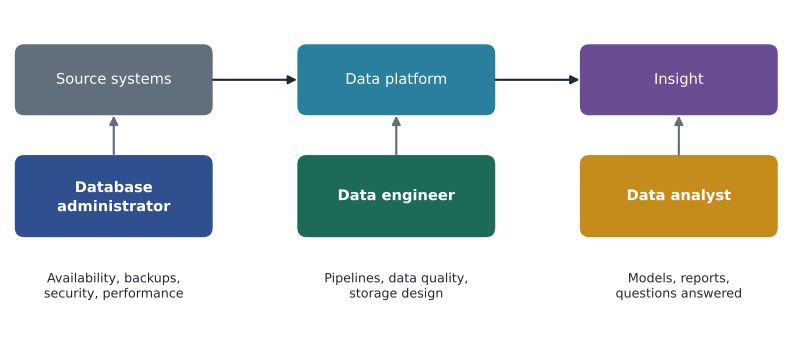
The three roles hand work to each other along the path that data travels. The DBA keeps the source systems healthy and makes data available safely. The data engineer moves that data into the analytical platform and makes it clean and well organized. The analyst turns it into answers. When something goes wrong, the roles cooperate: if a report shows strange numbers, Keiko asks Ines whether last night's load ran correctly, and Ines may ask Walt whether StockLine had an outage.
| Role | Main focus | Typical tools | At Harrow & Finch |
|---|---|---|---|
| Database administrator | Availability, backup and restore, security, performance of databases | SQL, management tools, monitoring, scripts | Walt Hadley, StockLine |
| Data engineer | Pipelines, transformation, storage design and data quality for analytics | SQL, Python, pipeline and analytics platforms | Ines Duarte, the new data platform |
| Data analyst | Answering business questions with models, reports and visualizations | SQL, Excel, Power BI | Keiko Tanabe, sales reporting |
The boundaries blur in practice. In a small company one person may do all three jobs. Some DBAs write pipelines and some analysts build their own data transformations. The exam expects you to know the core responsibilities of each role and to match a described task to the role that would normally do it. A useful test is to ask what the task protects or produces: the health of a database points to the DBA, the movement and preparation of data points to the engineer, and answers and visuals point to the analyst.
Related roles
Several other roles appear around these three, and Harrow & Finch will meet most of them as Project Skylight grows.
- Data scientists use statistics and machine learning to build predictive models, such as forecasting how much paint each store will sell next spring.
- Data architects design the overall data landscape: which stores exist, how they connect and which standards apply.
- AI engineers build applications that use AI models, such as the Ask Finch customer assistant described in the Azure AI courses.
- Data stewards and governance teams decide who may use which data and make sure privacy rules are followed. Harrow & Finch's privacy officer, Carmen Ortiz, plays part of this role.
- Database developers write the stored procedures, views and queries that applications use, and design table structures.
Elena's own title, data platform lead, is a mix of architect, engineer and manager. She jokes that her main job is making sure Walt, Ines and Keiko talk to each other.
Matching tasks to roles
To prepare for the exam, Keiko practises sorting tasks. Elena reads them out and Keiko answers.
Worked problem
Who does it?
Assign each task to the database administrator, data engineer or data analyst: (a) restore last Tuesday's backup of StockLine to investigate a deleted record; (b) build a nightly pipeline that loads website orders into the data lake; (c) create a dashboard that compares store sales with last year; (d) grant the new pricing app read access to the Products table; (e) remove duplicate customer records before they reach the analytics tables.
Show solution
- Restoring a backup protects and manages the database itself, so (a) belongs to the DBA.
- Moving data from a source into the analytical platform is a pipeline task, so (b) belongs to the data engineer.
- Turning data into a visual answer for managers is analysis, so (c) belongs to the data analyst.
- Granting database permissions is database security, so (d) belongs to the DBA.
- Cleaning data on its way into the analytical store is data preparation, so (e) belongs to the data engineer.
Answer: (a) DBA, (b) data engineer, (c) data analyst, (d) DBA, (e) data engineer.
Keiko gets all five right and then asks one Elena did not expect: who decides whether a report is allowed to show individual customers' names? Elena answers that the decision belongs to governance, the privacy officer and the business owner of the data, while the DBA and engineer enforce it technically and the analyst respects it in every report. Privacy rules differ by place: in Canada, private-sector personal information is governed mainly by PIPEDA and, in some provinces, provincial laws such as Quebec's Law 25. Lesson 12 covers how databases help enforce such rules.
What changes in the cloud
Cloud services shift the balance of work among the roles. Routine infrastructure tasks such as installing software, patching operating systems and replacing failed disks move to the cloud provider for platform services. New responsibilities appear in their place: managing costs, because every resource now has a visible monthly bill; configuring identity and network access in Azure; choosing service tiers; and automating deployments. All three roles benefit from understanding the basics of Azure, which is one reason Elena wants Walt and Ines to study for DP-900 alongside Keiko, even though they already know their own specialities well.
Certifications reflect the same roles. Microsoft offers role-based certifications for database administrators, data engineers and data analysts, and DP-900 is the shared foundation beneath all of them. Elena suggests a path for each person: Walt toward Azure database administration, Ines toward data engineering with Microsoft Fabric, and Keiko toward Power BI and analytics. Each path starts with the vocabulary of this course, which is why she wants all three to sit DP-900 first, even though Walt grumbles that he has been a DBA longer than some of the exam writers have been alive.
Walt admits he is a little nervous. Seventeen years of runbooks are built around a server he can walk up to and touch. Elena reassures him that his knowledge of how StockLine behaves under load, which queries are critical, and what a healthy Monday looks like is exactly what the migration needs. The tools change; the judgment does not.
Common mistakes
MistakeBuilding a Power BI dashboard is a database administrator's task.
InsteadDashboards and reports are normally built by data analysts.
MistakeData engineers are mainly responsible for backups and patching of production databases.
InsteadThat is the DBA's responsibility; data engineers build pipelines and prepare data for analysis.
MistakeMoving to platform services removes the need for DBAs.
InsteadPlatform services take over routine tasks, but someone still owns design, security, performance and cost.
Summary and key terms
- The database administrator keeps databases available, secure, backed up and performing well.
- The data engineer builds pipelines that move and transform data and designs storage for analytics.
- The data analyst explores data, builds models and creates reports and visualizations to answer business questions.
- The roles hand work along the path from source systems to insight and overlap in practice.
- Related roles include data scientists, data architects, AI engineers, database developers and data stewards.
- Cloud platform services shift routine work to the provider and add new tasks such as cost and access management.
- Database administrator (DBA)
- The person responsible for the availability, security, backup and performance of databases.
- Data engineer
- The person who builds pipelines and storage that move and prepare data for analysis.
- Data analyst
- The person who explores data and creates models, reports and visualizations to answer business questions.
- Pipeline
- An automated process that moves data from sources to a destination, often transforming it on the way.
- Runbook
- A documented, step-by-step procedure for an operational task.
- Data governance
- The policies and processes that decide how data is owned, used, protected and retained.
Practice problems
Work each problem on paper first, then reveal the answer to check.
Which role would normally tune a slow query in a production database?
Show answer
The database administrator.
Which role would normally build a pipeline that loads sales into a data lake every night?
Show answer
The data engineer.
Which role would normally build a Power BI report for store managers?
Show answer
The data analyst.
Name one responsibility that shifts to Microsoft when a database moves to a platform service.
Show answer
For example: patching the database engine, taking automatic backups or maintaining the underlying hardware.
Lesson quiz · 5 questions
Score 60% or more to complete this lesson.
Create a free account to save your progress, take quizzes and earn a certificate.