
MCAT-150 · Lesson 8 of 12 · 21 min
Anxiety, performance and the final two weeks
▶ Video coming soon A video version of this lesson is on the way.
The session on anxiety started with a confession from Devika. 'I am fine at the start of practice tests. Then I see a passage I do not understand and my brain says, "You are going to fail, you will never get into medicine, everyone will know." And then I read the same sentence four times.' Elliot admitted he felt almost nothing before practice tests, which worried him in a different way, because he expected to be nervous on the real day. Ezequiel, who had worked accident scenes for five years, said the physical side of fear was familiar to him. 'Heart rate up, hands cold. On a call you use it. On the MCAT in 2025 it used me.'
This lesson covers the psychology of test performance: why some anxiety helps, why too much hurts, and practical methods for keeping it in a useful range. It then lays out a plan for the last two weeks before the test, when the main goals change from learning to consolidating and arriving rested. Psych/Soc students will recognize several of the ideas from MCAT-130 Psychological and Social Foundations, which is a nice bonus: you can use them on the test and on yourself.
Arousal and performance
Psychologists describe the relation between arousal and performance with the Yerkes-Dodson law: performance rises with arousal up to a point, then falls as arousal becomes too high. The best level of arousal depends on the task. For simple, well-practised tasks, fairly high arousal is fine. For complex tasks that need careful thinking, such as reading a dense passage, the best level is moderate. The MCAT is a long series of complex tasks, so the goal is not to feel calm and sleepy but alert and steady.
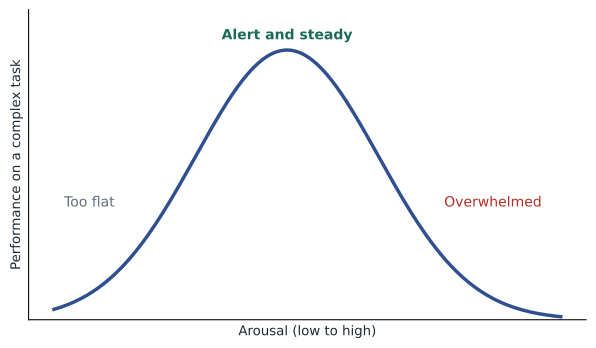
This explains why some anxiety is useful. A little nervousness sharpens attention and makes you check your work. Elliot's lack of nerves in practice was not a problem in itself; but it did mean his practice tests might not feel like the real one, and he would need methods ready in case test day felt very different. Devika's spiral, on the other hand, took her past the peak: her attention narrowed onto the threat ("I will fail") and away from the task (the passage).
What anxiety does to thinking
Anxiety affects performance mainly through attention and working memory. Worrying thoughts take up working memory, which is the same limited system you need to hold a passage's argument in mind or track the steps of a calculation. That is why anxious students reread sentences, lose their place in multi-step problems and miss words like "not" in stems. The content is still there; the space to use it is not.
Anxiety also changes behaviour in ways that hurt scores. Some students rush to get away from a hard passage; others freeze and cannot leave it. Some check the clock every minute. Some change right answers to wrong ones because they no longer trust themselves. Knowing the patterns helps you notice them as they start.
Methods that help
Several methods have good research support, and all of them can be practised during full-length tests so that they are automatic on test day.
Slow breathing. A few slow breaths with a longer exhale than inhale, for example in for four counts and out for six, can lower heart rate and the feeling of panic within a minute or two. It is invisible to everyone around you and takes no equipment. Thandiwe's three-step section-start routine from MCAT-101 begins with one slow breath for exactly this reason.
Reappraisal. The physical signs of anxiety and of excitement are almost the same: a fast heart, alert senses, energy. Studies have found that telling yourself the arousal is a sign that your body is getting ready to perform, rather than a sign of danger, can improve performance on tests compared with trying to calm down. Ezequiel used this on ambulance calls without a name for it. 'My heart is fast because this matters. Good. Now do the next thing.'
Expressive writing. Some experiments have found that spending ten minutes writing about your worries just before a high-stakes test can improve performance for anxious students, possibly by clearing those worries out of working memory. You cannot do this in the testing room, but you can do it at home on the morning of the test, or in the car before you go in.
Grounding in the task. When you notice a spiral, bring your attention back to something concrete and small: the next sentence, the next question stem, the axis labels on the figure. Writing a few words on the noteboard is a good anchor, because it requires attention to the passage.
Rehearsal. The more test day feels like the practice tests you have already taken, the less threat it carries. This is the strongest argument for taking full-length tests under real conditions, at the real time, with the real break plan.
| Sign of a spiral | What to do in the moment |
|---|---|
| Rereading the same sentence several times | Stop, take one slow breath, write three words about the sentence on your noteboard |
| Catastrophic thoughts about the future | Name it ("a worry, not a fact"), then return to the next question stem |
| Checking the clock after every question | Use only your planned checkpoints; cover the clock with a note if needed |
| Unable to leave a hard passage | Apply the two-minute rule: eliminate, guess, flag, move on |
| Changing answers repeatedly without reason | Change only for a concrete reason you can name |
Rewriting thoughts
The thoughts that come with anxiety are often extreme and absolute: "I will fail", "I always choke", "everyone else is better at this". A method from cognitive behavioural therapy is to notice such a thought, check it against the evidence and rewrite it in a form that is accurate and useful. This is not positive thinking. It is accurate thinking, and accurate thinking is usually less frightening.
Worked problem
Rewriting a catastrophic thought
In the middle of a practice Chem/Phys section, Devika meets a passage on an unfamiliar optical device and thinks: "I don't understand any of this. I'm going to fail the MCAT and never get into medicine." How can she rewrite the thought?
Show solution
- Name it as it happens: "This is a catastrophic thought."
- Check the evidence: she has understood most passages in this section; her error log shows most misses are fixable; one passage is about 5 questions of 59.
- Check the conclusion: one hard passage does not decide a section, a section does not decide the test, and the test does not alone decide admission.
- Rewrite: "This passage is hard. Most passages have been fine. I will map it, answer what I can, use the two-minute rule on the rest and move on."
- Return to the task: write the passage's research question on the noteboard.
Answer: An accurate, useful thought: "This passage is hard, but it is one of ten. Map it, answer what I can, move on." Then a concrete action that brings attention back to the passage.
Devika wrote her rewritten thought on an index card and read it before every practice test for two weeks. She found that the spiral still started sometimes, but stopped sooner. 'It is like a fire drill,' she said. 'The alarm still goes off, but I know where the door is.'
When anxiety is more than nerves
For some students, anxiety is severe enough to affect sleep, appetite or daily life for weeks, or it shows up as panic attacks. That is a health matter, and it deserves care in its own right, not just test strategies. Campus counselling services, a family doctor or a mental health professional can help, and effective treatments exist. Students with a diagnosed condition that affects testing can apply to the AAMC for accommodations; MCAT-101 explained the process and timelines, which require applying well in advance.
The final two weeks: goals
In the last two weeks, the goals change. You are no longer trying to learn large new areas; there is not enough time for new learning to settle, and trying usually adds stress. The goals are to consolidate what you know, keep your skills sharp, fix the last few patterns your error log shows, and arrive rested and confident in your routine.
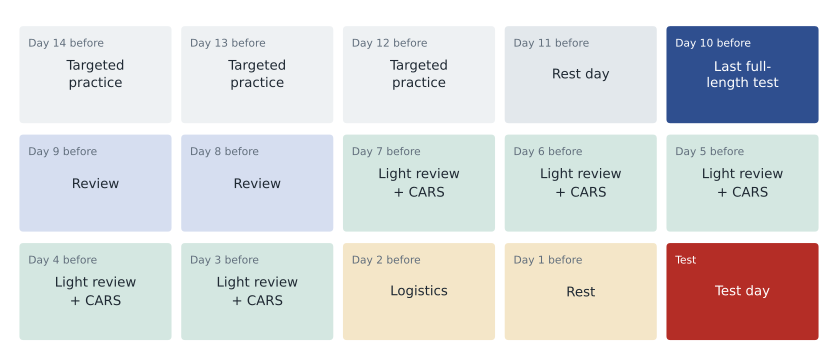
A typical structure looks like this. About 8 to 10 days before the test, take your last full-length test, an official one, under exact test-day conditions. Spend the next two days reviewing it carefully. In the final week, do light, focused review: your error log (especially open entries), a short sheet of equations and facts you tend to forget, a couple of timed CARS passages each day to keep your reading sharp, and a few short timed science passage sets. Taper off in the last two or three days, with the day before the test almost entirely free.
What to do in the final week
Daily CARS. Two timed passages a day keep your CARS reading in rhythm. CARS skills fade more quickly with a break than content knowledge does, and Elliot, whose weakest section was CARS, planned to keep his two-a-day habit right up to two days before his test.
The error log. Go through open entries and re-test them. Read through closed entries quickly, as reminders. Pay special attention to recurring patterns: if you often confuse two terms or misread a type of figure, remind yourself of the fix.
A short review sheet. Many students make a one- or two-page sheet of the facts they most often forget: a few equations, amino acid properties, a handful of Psych/Soc term pairs. Reading it each morning in the last week is a light, useful review. You cannot bring it into the test, of course; it is for the days before.
Short timed sets. A few timed passage sets from each science section keep your pacing fresh. Keep them short; this is maintenance, not training.
Sleep and schedule. Keep going to bed and waking at your test-day times. If you have not already shifted your schedule, start at least a week before, moving your wake time earlier in small steps.
What not to do. Do not take a full-length test in the last five or six days; it costs energy and rest for little information. Do not start new resources or new content areas. Do not compare notes with friends about how ready they feel. Do not cram the night before.
The last two days
Two days before the test, check your logistics: confirmation, ID, route, the packing list from lesson 2. Do a very light review, an hour or two at most. The day before, do as little MCAT work as you can stand; a short look at your review sheet and your test-day plan is plenty. Do something pleasant and low-key: a walk, a film, a meal with people you like. Pack your bag in the evening, set two alarms and go to bed at your usual time.
If you cannot sleep, do not panic. One poor night before a test has less effect than most people expect, especially if the previous week's sleep was good. Lying in the dark resting is better than lying there worrying about not sleeping, and reminding yourself of that fact often helps sleep arrive.
The group's final-two-weeks plans
Each member of the group wrote a final-two-weeks plan, counted back from their test date. Elliot's last full-length test was set for January 10 or 11, ten or eleven days before his January 21 test, with review on the following two days, light review and daily CARS from January 13 to 18, logistics on the 19th, rest on the 20th. Ezequiel's last full-length test was set for April 11, six days before his April 17 test, which Thandiwe asked him to move a day or two earlier if possible, to leave more time for review and rest. Devika's plan, counted back from May 13, put her last full-length test on May 3.
Thandiwe added one last thing to everyone's plan: a line at the bottom saying what they would do the day after the test. 'Something that has nothing to do with medicine. You will have earned it.' Ezequiel wrote: take his niece to the zoo.
Common mistakes
MistakeThe best mental state for the MCAT is complete calm.
InsteadModerate arousal, alert and steady, supports the best performance on complex tasks.
MistakeAnxiety means you are not prepared.
InsteadAnxiety is common among well-prepared students; it affects performance mainly through attention and working memory, which practised methods can protect.
MistakeUse the final week to learn the topics you have not covered yet.
InsteadThe final weeks are for consolidation, error-log review, light timed practice and rest, not new content.
MistakeTake a full-length test two or three days before the real one to stay sharp.
InsteadTake the last full-length test about 8 to 10 days before, then taper.
MistakeA bad night's sleep before the test will ruin your score.
InsteadOne poor night has less effect than people fear, especially after a week of good sleep.
Summary and key terms
- By the Yerkes-Dodson law, performance on complex tasks is best at moderate arousal; aim to be alert and steady, not flat or overwhelmed.
- Anxiety hurts performance mainly by using up working memory and attention; it shows up as rereading, rushing, freezing and second-guessing.
- Slow breathing, reappraising arousal as readiness, expressive writing before the test, grounding in the task and rehearsal all help; practise them in full-length tests.
- Rewrite catastrophic thoughts into accurate, useful ones, and follow with a concrete action.
- Severe or persistent anxiety is a health matter that deserves care; accommodations require advance application.
- Take the last full-length test 8 to 10 days out, review it, do light focused review with daily CARS, and keep the last day or two for logistics and rest.
- Yerkes-Dodson law
- The finding that performance rises with arousal up to an optimum and then falls, with a lower optimum for complex tasks.
- Working memory
- The limited system that holds and manipulates information during thinking.
- Reappraisal
- Reinterpreting a situation or a feeling, such as viewing arousal as readiness rather than danger.
- Expressive writing
- Writing about one's thoughts and worries, sometimes used before tests to reduce the effect of anxiety.
- Catastrophic thinking
- Treating a setback as a sign of disaster, out of proportion to the evidence.
- Taper
- Reducing study load in the final days so as to arrive rested.
Practice problems
Work each problem on paper first, then reveal the answer to check.
Using the Yerkes-Dodson law, explain why trying to feel completely calm before the MCAT may not be the best goal.
Show answer
Complex tasks are best performed at moderate arousal; too little arousal can lower attention and effort, so the goal is alert and steady.
Why might anxiety make a student miss the word "not" in a question stem?
Show answer
Worry uses working memory and narrows attention, leaving less capacity for careful reading.
Rewrite this thought: "I got the first passage wrong, so the whole section is ruined."
Show answer
For example: "The first passage was hard; it is one of ten. The section scores all 59 questions. Next passage."
Ezequiel planned his last full-length test six days before his test date. Why did Thandiwe suggest moving it earlier?
Show answer
Eight to ten days gives time to review the test and still taper and rest before test day.
Lesson quiz · 5 questions
Score 60% or more to complete this lesson.
Create a free account to save your progress, take quizzes and earn a certificate.