
MCAT-150 · Lesson 3 of 12 · 21 min
Passage strategy for the science sections: Chem/Phys and Bio/Biochem
▶ Video coming soon A video version of this lesson is on the way.
Thandiwe opened with a slide that showed one sentence from an invented passage: "Absorbance at 340 nm was monitored for 5 minutes after the addition of substrate." She asked what it told them. Elliot said it was a kinetics experiment. Devika said NADH absorbs at 340 nanometres, so the researchers were probably following NADH. Ezequiel said the dependent variable was absorbance and time was the independent variable, so a graph of absorbance against time was coming. 'All three right,' Thandiwe said. 'And that is the point. A science passage gives you a few sentences of setup, and you have to turn each one into a fact you can use. We are going to practise reading for the experiment, not for the words.'
This lesson covers the science sections of the MCAT: Chem/Phys, Bio/Biochem and, in its science-style passages, Psych/Soc, which lesson 4 also covers. It explains the kinds of passages you will see, a reading method that works for both science sections, how to use figures and tables quickly, how to work through the questions, and how to handle the fifteen independent questions in each section. The content behind these questions is in MCAT-110 Biochemistry Review, MCAT-111 Cell and Molecular Biology Review, MCAT-112 Organ Systems Review, MCAT-120 General Chemistry Review, MCAT-121 Physics and Math Review and MCAT-122 Organic Chemistry Review. Here the subject is method.
What the science sections look like
Each science section has 59 questions in 95 minutes. Forty-four of them come in ten passage sets of four to six questions each; the other fifteen are independent questions that stand alone. Questions are distributed across the section, so independent questions appear in small groups between passages, not all at the end. That works out to a little over a minute and a half per question, or about eight minutes for a five-question passage set, including reading time.
The AAMC tests four scientific inquiry and reasoning skills across the science sections, and knowing them helps you see what a question is asking. Skill 1 is knowledge of scientific concepts and principles: recognizing and applying content. Skill 2 is scientific reasoning and problem solving: using theories and models to explain and predict. Skill 3 is reasoning about the design and execution of research: hypotheses, variables, controls and flaws in methods. Skill 4 is data-based and statistical reasoning: reading figures, tables and graphs and drawing conclusions from them. The AAMC content outline puts about 35 percent of science questions in skill 1, 45 percent in skill 2 and 10 percent each in skills 3 and 4, but skills 3 and 4 often decide the hardest questions in a passage.
| Skill | What it asks | Typical question cue |
|---|---|---|
| 1: Knowledge of concepts | Recall and apply content | "Which of the following best describes..." "What is the function of..." |
| 2: Reasoning and problem solving | Explain or predict using a model or equation | "If the temperature were doubled, the rate would..." "Which mechanism best explains..." |
| 3: Research design | Hypotheses, variables, controls, flaws | "What was the purpose of..." "Which change would strengthen the conclusion..." |
| 4: Data and statistics | Read and interpret data | "According to Figure 2..." "Which conclusion do the data support..." |
Two kinds of passages
Science passages come in two broad kinds, and they read differently. An information passage reads like a textbook section or a short review article: it explains a system, a phenomenon or a technique, often with a diagram or equation, and the questions test whether you can apply what it says. An experiment passage reads like a shortened research report: a question, a method, results in a table or figure, and sometimes a conclusion. Most Bio/Biochem passages and many Chem/Phys passages are experiment passages. A few passages combine both.
The difference matters because each kind needs a different focus. For an information passage, the key is to know where things are, so you can find a detail when a question asks for it. You do not need to understand every sentence on the first read. For an experiment passage, the key is to understand the logic of the study: what was varied, what was measured, what each control rules out and what the results show. Questions on experiment passages often ask about design and data, and the answers turn on details of the method you might skim if you were reading for content.
A reading method for science passages
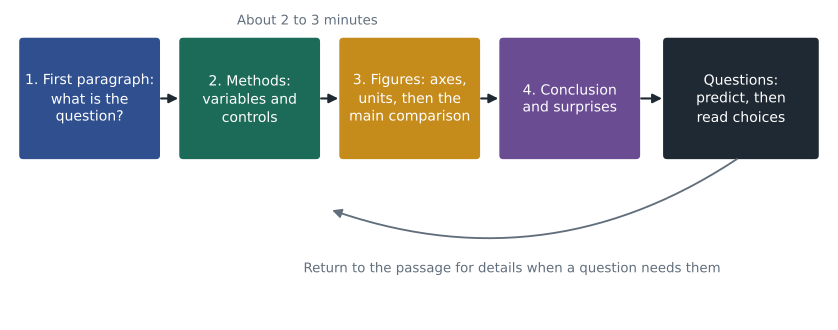
Thandiwe's method has four steps, and it takes about two to three minutes for a typical passage.
1. Read the first paragraph for the question. What is the passage about, and, if it is an experiment, what were the researchers trying to find out? Write a few words on your noteboard: "Does drug Y slow enzyme Z?" or "Projectile range vs launch angle."
2. Read the methods for variables and controls. What was changed (independent variable), what was measured (dependent variable), and what conditions were held constant or included as controls? Label each experiment with its purpose in a few words.
3. Read figures and tables by their headings, axes and units first. Then find the main comparison: which bar is tallest, which line rises, which condition differs from the control. Do not try to absorb every number.
4. Note the conclusion, if the passage gives one, and anything surprising. Surprises are where questions tend to come from.
Some students prefer to glance at the questions before reading the passage. It can help with very long or dense passages, but most students who try it find that it costs time without improving accuracy, because they read the passage looking for answers to questions they only half remember. The test is empirical: try both methods on several timed passage sets and compare your accuracy and time. Elliot tried questions-first on whole passages for two weeks and went back to passage-first, keeping only one habit from the experiment: a quick look at the question stems before working through a large table. Ezequiel kept a hybrid: he read the question stems, not the answer choices, for passages longer than about five paragraphs.
Reading figures and tables quickly
Many points in the science sections are lost not to missing content but to misread data. Ezequiel found that about a third of his science misses on his diagnostic involved reading tables and graphs. He built a habit: within 60 seconds of seeing a figure, say out loud (or write) the main comparison it shows. "Mutant enzyme has a higher Km than wild type." "Current rises linearly with voltage, then levels off." That habit forces you to read the axes, the units and the legend before the data.
A few checks help with almost every figure. What are the axes and their units, and is either axis logarithmic? Is the y-axis truncated, so that small differences look large? What are the error bars, and do the bars for two conditions overlap? (Overlapping error bars suggest, but do not prove, that a difference may not be significant.) Is there a control, and what is it compared with? When a question asks "according to the data", the answer must be in the figure, even if your outside knowledge suggests something else.
Working the questions
With the passage read and mapped, the questions should go quickly. For each question, read the stem carefully and decide what kind of question it is. If it is a skill 1 question, you may be able to answer it without the passage. If it is a skill 3 or 4 question, go back to the relevant part of the passage; do not answer from memory of the passage, because the details matter.
Predict the answer before reading the choices when you can. For a calculation, estimate first: if the answer must be about 10 to the minus 3, eliminate choices that are orders of magnitude off. For a conceptual question, say what you expect ("the rate should go up"), then look for the choice that matches. Use the strikethrough tool to eliminate choices you are sure are wrong, so you can see what is left.
Watch for three common traps. The first is a choice that is true but does not answer the question: a correct fact about the enzyme when the question asks about the effect of the mutation. The second is a choice that goes beyond the data: "the drug cures the disease" when the data show only that it lowers a marker. The third is a choice drawn from outside knowledge that conflicts with the passage. When the passage describes an invented system, its rules govern, even if they differ from a textbook case.
Calculations without a calculator
Chem/Phys has more calculations than the other sections, but none needs a calculator. The numbers are chosen so that you can estimate. Round early (9.8 to 10, 0.693 to 0.7), work in scientific notation, and cancel units as you go, which catches errors in setup. Use the answer choices: if they differ by factors of ten, you need only the order of magnitude; if they are close together, you need more care, and the choices often show you which simplification is safe.
Devika, whose diagnostic showed nine content misses and three careless misses in Chem/Phys, adopted a rule: write the equation and the units before putting in any numbers. It added about ten seconds per calculation and removed most of her careless errors. In MCAT-121 Physics and Math Review she drills logarithms and powers of ten; here the point is that a clean setup beats speed.
Worked problem
Estimating under time pressure
A passage states that a solution of a weak acid has a concentration of 0.010 molar and a Ka of 1.0 times 10 to the minus 6. A question asks for the approximate pH. The choices are 2.0, 4.0, 6.0 and 8.0.
Show solution
- Recognize the type: a weak acid, where the hydrogen ion concentration is approximately the square root of Ka times the concentration.
- Set up in scientific notation: Ka times concentration is 1.0 times 10 to the minus 6, times 1.0 times 10 to the minus 2, which is 1.0 times 10 to the minus 8.
- Take the square root: 1.0 times 10 to the minus 4 molar.
- pH is the negative log of the hydrogen ion concentration: 4.0.
- Sanity check: a weak acid at 0.01 molar should be less acidic than a strong acid at the same concentration (pH 2), so a value above 2 makes sense. pH 8 would be basic and can be eliminated at once.
Answer: pH 4.0. The choices differ by two units each, so a clean setup and the square root of a power of ten are enough; no calculator is needed.
Independent questions
The fifteen independent questions in each science section test content directly, usually skill 1 or skill 2, without a passage. They are your best chance to bank time. Most should take under a minute. If you know the content, answer and move on. If you do not, eliminate what you can, guess, flag it and move on; do not spend three minutes on an independent question you cannot answer, because the time is worth more on a passage. A question you are unsure of is worth exactly as much as one you know.
Elliot's weakness was the opposite: he answered independent questions so fast that he misread some. His fix was to read the last sentence of every stem twice, because that is where the actual question is, and where words like "not", "except" and "least" appear.
Differences between Chem/Phys and Bio/Biochem
The method is the same, but the sections differ in emphasis. Chem/Phys has more equations, more units and more calculations; many passages describe a physical system (a circuit, a fluid, an optical device, a reaction) and ask you to predict how it behaves. Biochemistry also appears in Chem/Phys, about a quarter of the section, often in passages about enzymes, buffers or molecular structure. Bio/Biochem has more experiment passages, more biology and biochemistry, and more questions on research design and data. It also tends to have more text per passage and more complex figures.
In both, the passage is the authority. Thandiwe's favourite line applies to both: 'A passage is a lab report somebody else wrote. Read it like a scientist.' Ask what the authors did, what they found and whether their conclusion follows.
Practising the method
A method helps only if you practise it until it is automatic. In the weeks between full-length tests, do timed passage sets from the AAMC section banks and question packs, and after each set check not only which answers you got wrong but whether you followed the method. Did you write the research question? Did you read the axes before the data? Did you predict before reading the choices? Lesson 6 shows how to add those process checks to your error log, so you can see whether a miss came from content or from method.
Common mistakes
MistakeRead every sentence of a science passage until you understand it fully before going to the questions.
InsteadMap the passage for the question, variables, controls and main result; return for details when a question needs them.
MistakeIf a choice is a true scientific statement, it is probably the answer.
InsteadThe right answer must answer the question asked; true but irrelevant statements are common distractors.
MistakeOutside knowledge should override what the passage says.
InsteadFor invented systems and data, the passage governs; use outside knowledge to understand it, not to contradict it.
MistakeCalculations should be worked out exactly.
InsteadRound early, use scientific notation and let the answer choices tell you how precise you need to be.
MistakeSpend whatever time it takes on a hard independent question.
InsteadEliminate, guess, flag and move on; time is worth more on passages.
Summary and key terms
- Each science section has 59 questions in 95 minutes: ten passage sets and fifteen independent questions, about eight minutes per five-question set.
- The four reasoning skills are concepts (1), reasoning (2), research design (3) and data (4); skills 3 and 4 often decide the hardest questions.
- Information passages need a map of where things are; experiment passages need the logic of the study: variables, controls and results.
- Read figures by headings, axes and units first, then state the main comparison in a sentence.
- Predict before reading choices, estimate calculations, and watch for true-but-irrelevant, beyond-the-data and outside-knowledge traps.
- Bank time on independent questions; flag and move on from any you cannot answer.
- Experiment passage
- A passage that describes a study: its question, methods, results and sometimes a conclusion.
- Information passage
- A passage that explains a system or phenomenon, like a textbook section.
- Independent variable
- The factor a researcher changes in an experiment.
- Dependent variable
- The quantity a researcher measures as the outcome.
- Independent question
- A question with no passage, usually testing content directly.
- Main comparison
- The single most important contrast a figure or table shows.
Practice problems
Work each problem on paper first, then reveal the answer to check.
A passage describes three experiments testing whether a compound inhibits an enzyme. What should you write on your noteboard for each experiment?
Show answer
A few words on its purpose: what was varied, what was measured and what the experiment rules out.
A graph shows two bars with overlapping error bars. A choice says the difference "is statistically significant". What should you think?
Show answer
Overlapping error bars suggest the difference may not be significant; the choice goes beyond what the figure supports unless the passage reports a test.
A question asks for a value, and the choices are 3 times 10 to the 2, 3 times 10 to the 4, 3 times 10 to the 6 and 3 times 10 to the 8. How precise must your calculation be?
Show answer
Only the order of magnitude matters, so round aggressively.
What is the purpose of reading the last sentence of a question stem twice?
Show answer
That is where the actual question is, and where words like "not", "except" and "least" appear.
Lesson quiz · 5 questions
Score 60% or more to complete this lesson.
Create a free account to save your progress, take quizzes and earn a certificate.