
MCAT-150 · Lesson 4 of 12 · 21 min
Passage strategy for CARS and Psych/Soc
▶ Video coming soon A video version of this lesson is on the way.
Elliot's CARS score had moved from 122 on his September diagnostic to the low 124s on timed section practice, and he wanted more. In the session on CARS and Psych/Soc strategy he described what still went wrong. 'I read it, I understand it, and then the question asks what the author would think about something, and I pick what I would think.' Thandiwe nodded. 'That is the most common CARS mistake there is. You are not being asked what is true. You are being asked what this author argued, on this page.' Ezequiel, whose best section was Psych/Soc, had the reverse problem in that section: he knew the material from years on an ambulance, but he sometimes answered from experience rather than from the terms the test uses.
This lesson covers strategy for the two sections that are most about reading: Critical Analysis and Reasoning Skills (CARS) and Psychological, Social, and Biological Foundations of Behavior (Psych/Soc). CARS requires no outside knowledge at all; Psych/Soc requires a large vocabulary of terms and theories plus the science-passage skills of lesson 3. MCAT-140 Critical Analysis and Reasoning Skills (CARS) and MCAT-130 Psychological and Social Foundations teach each section in depth. This lesson is about how to take them under test conditions, inside a full-length test.
The shape of CARS
CARS has 53 questions in 90 minutes, over nine passages of roughly 500 to 600 words each, with five to seven questions per passage. About half the passages come from the humanities (art, music, literature, philosophy, ethics, religion, architecture, cultural studies) and about half from the social sciences (history, economics, political science, sociology, anthropology, psychology as a discipline, archaeology). Passages are often written in a style that is denser and more abstract than everyday reading, and some take a position that is subtle or ironic.
The AAMC divides CARS questions into three skills. Foundations of Comprehension, about 30 percent, asks about main ideas, the meaning of terms in context and the purpose of particular sentences or paragraphs. Reasoning Within the Text, about 30 percent, asks how parts of the argument fit together: what evidence supports a claim, what is assumed, what the author would agree with. Reasoning Beyond the Text, about 40 percent, asks you to apply the passage's ideas to new situations or to consider how new information would affect the argument. The largest share of questions, in other words, asks you to carry the author's reasoning somewhere new, which is exactly where Elliot's habit of answering from his own view did the most damage.
Pacing CARS
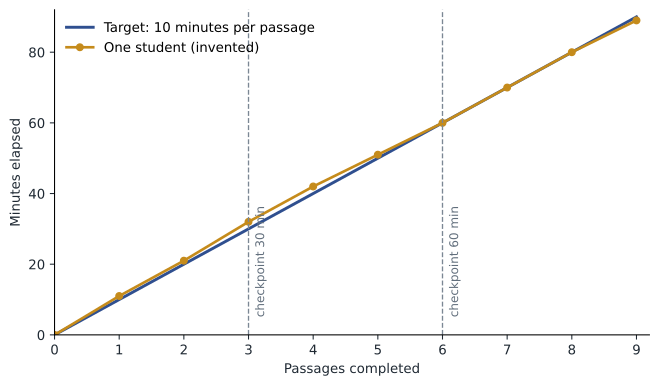
Ninety minutes for nine passages is ten minutes per passage. A common plan is about three to four minutes to read the passage and six to seven to answer the questions, with a minute or two of slack overall. Set checkpoints: after three passages you should be at about 30 minutes elapsed, after six at about 60. If you are well behind at a checkpoint, speed up by spending less time on the hardest question in each set, not by reading faster, since rushed reading causes most CARS misses.
Passages are not ordered by difficulty, and the hardest passage is not always last. Some students skip a passage that looks very hard and come back to it; the interface allows it. That can help, but only if you are disciplined about coming back and about not losing track of time. Try it on several timed sections before deciding. Devika, who reads quickly and widely, never skipped. Elliot found that skipping one very dense philosophy passage per section, then returning to it last, raised his score slightly, because he no longer burned twelve minutes on it early and rushed everything after.
Reading CARS for the argument
The core CARS skill is following an author's argument: what the author claims, why, what they are arguing against and how strongly they hold the view. Facts in the passage matter only as evidence for or against claims. Read actively. After each paragraph, give it a few words on your noteboard: "older view: art as imitation", "author: rejects, cites Goya", "concedes some imitation". At the end, write the main idea in one line and the author's tone in one word: approving, critical, ambivalent, neutral.
Watch the signal words that mark the structure of an argument. "However", "but" and "yet" mark a turn, often toward the author's own view. "Indeed", "moreover" and "furthermore" mark support. "Admittedly", "to be sure" and "it is true that" mark a concession, which the author will usually limit or answer. Words such as "perhaps", "may" and "arguably" soften a claim; "clearly" and "undoubtedly" strengthen it. Many wrong answers are wrong only because they state a claim more strongly or more weakly than the author did.
Working CARS questions
For every CARS question, the answer is in the passage or follows from it. Even for Reasoning Beyond the Text questions, which bring in a new situation, the right answer is the one most consistent with the author's reasoning, not with your own. Go back to the passage for every question about a specific part of it. For broad questions, rely on your one-line main idea and tone.
Eliminate rather than confirm. Most CARS questions have one answer that is clearly best and three that are wrong for identifiable reasons: too extreme, outside the scope of the passage, true of a different part of the passage, opposite to the author's view, or a distortion of what the author said. If two choices remain, compare them directly against the relevant lines of the passage. Ask which one the author would be more willing to sign.
Worked problem
A short CARS-style passage and question
"Historians of the nineteenth-century novel have often treated serial publication as a commercial necessity that writers endured. The evidence suggests otherwise. Authors revised later instalments in response to readers' letters, planned cliffhangers with evident pleasure and, in their correspondence, described the monthly deadline as a discipline that sharpened rather than dulled their invention. To be sure, some complained of the pressure. But complaint is not the same as constraint, and a writer may grumble about the very form that suits her best." Which statement would the author most likely agree with? (A) Serial publication damaged the quality of most nineteenth-century novels. (B) Authors' complaints about deadlines show that serial publication constrained them. (C) Some novelists may have benefited creatively from serial publication. (D) Historians have correctly treated serial publication as a commercial necessity. (Passage written for this course.)
Show solution
- Map the argument: older view (serial publication was a commercial burden), author's view (evidence suggests otherwise; deadlines could sharpen invention), concession (some complained), answer to the concession (complaint is not constraint).
- Tone: critical of the older view, cautious in its own claims ("suggests", "may").
- Eliminate A: the opposite of the author's view.
- Eliminate B: the author explicitly rejects this inference in the last sentence.
- Eliminate D: the author argues against the historians' treatment.
- Choice C matches the author's view and its cautious strength ("some", "may").
Answer: C. It matches both the content and the strength of the author's claim. See how the concession ("to be sure") and its answer ("but") set up choice B as a trap.
Elliot practised one habit for this: before choosing an answer to any "the author would agree" question, he pointed to the line in the passage that supported it. If he could not find one, he did not pick it. His accuracy on those questions rose within two weeks, though his speed dropped at first. Thandiwe told him the speed would come back, and it did.
The shape of Psych/Soc
Psych/Soc has the same structure as the other science sections: 59 questions in 95 minutes, in ten passage sets and fifteen independent questions. Its content is introductory psychology (about 65 percent), introductory sociology (about 30 percent) and a little introductory biology (about 5 percent), organized under five foundational concepts: how people sense, perceive and respond to the world (concept 6), behaviour and behaviour change (concept 7), how people think about themselves and others (concept 8), social structures (concept 9) and social inequality (concept 10). The same four reasoning skills apply, with many questions on research design and statistics.
Psych/Soc is the last section of a long day, which makes it the section most affected by fatigue. Many students who score well on Psych/Soc in isolation lose a point or two when it comes last in a full-length test. The fix is partly endurance (lesson 1) and partly method: because Psych/Soc questions often turn on the exact meaning of a term, a tired reader who skims stems makes avoidable errors.
Psych/Soc passages
Psych/Soc passages usually describe a study: a survey, an experiment, an observational study or a review of research. Read them with the same method as other science passages: the research question, the variables and how they were measured, the design, the results and the conclusion. Pay special attention to the design, because many questions ask what kind of study it was, what it can and cannot show, and how it could be improved. A correlational study cannot show cause. A cross-sectional study compares groups at one time and cannot show change within people. A study without random assignment cannot rule out confounding variables.
Precision with terms
The largest single source of Psych/Soc misses is confusing related terms. The test likes pairs and trios that sound alike: the fundamental attribution error and the actor-observer bias; confirmation bias and belief perseverance; the availability heuristic and the representativeness heuristic; social facilitation and social loafing; role conflict and role strain; prejudice, stereotype and discrimination; validity and reliability. A question often describes a scenario and asks which term best fits it. You need not only the definition of each term but the feature that separates it from its neighbours.
| Easily confused pair | The distinguishing feature |
|---|---|
| Fundamental attribution error vs actor-observer bias | The first is about explaining others' behaviour by disposition; the second contrasts how we explain our own behaviour (situation) with others' (disposition) |
| Confirmation bias vs belief perseverance | The first is seeking evidence that supports a belief; the second is holding a belief after the evidence for it is discredited |
| Availability vs representativeness heuristic | The first judges likelihood by how easily examples come to mind; the second by how closely something matches a prototype |
| Role conflict vs role strain | The first is tension between two different roles; the second is tension within one role |
| Reliability vs validity | Reliability is consistency of a measure; validity is whether it measures what it claims to measure |
| Prejudice vs discrimination | Prejudice is an attitude; discrimination is behaviour |
Ezequiel built a list of these pairs as he met them in practice, with one line on the distinguishing feature and one example from his own experience. His example for role strain was a paramedic who must be both fast and thorough on the same call; for role conflict, a paramedic who is also a parent, called in on a child's birthday. 'If I can see it on a call, I remember it,' he said. Thandiwe warned him to check each example against the textbook definition, because a memorable example that is slightly wrong does more harm than none.
Working Psych/Soc questions
Many Psych/Soc questions describe a scenario in the stem and ask for the term, theory or finding that best explains it. Before reading the choices, say in your own words what is happening in the scenario: "she keeps her view even after learning the study was retracted." Then match that description to a term. Reading the choices first invites you to pick the first familiar term.
For questions on passages, return to the passage for details of the study. Questions on research design often hinge on one word in the methods: "randomly assigned", "self-reported", "followed for five years", "matched for age and income". Questions on statistics usually need only concepts: what a correlation coefficient of minus 0.6 means, what statistical significance does and does not show, why a larger sample narrows a confidence interval.
Holding focus at the end of the day
Psych/Soc comes after more than five hours of testing. Use the third break well: water, a snack, a minute of slow breathing, and a reminder that this is the last section. Inside the section, use the same pacing checkpoints as in the other science sections, and watch for the signs of fatigue: rereading the same sentence, losing track of a stem halfway through, choosing an answer without reading all four. When you notice them, take three slow breaths and reread the stem. Ten seconds spent resetting costs much less than a wrong answer.
Common mistakes
MistakeIn CARS, the best answer is the one that is most true about the world.
InsteadThe best answer is the one most consistent with the author's argument in the passage.
MistakeStrongly worded answer choices show confidence and are usually right.
InsteadAnswers often fail by being more extreme than the author; match the strength of the author's claim.
MistakePsych/Soc can be answered from common sense and experience.
InsteadQuestions test precise terms and research concepts; experience helps only when it matches the definitions.
MistakeA correlational study can show that one variable causes another if the correlation is strong.
InsteadCorrelation alone cannot establish cause, however strong; confounding variables remain possible.
MistakeReading faster is the way to catch up in CARS.
InsteadRushed reading causes most CARS misses; recover time by limiting the hardest question in each set.
Summary and key terms
- CARS has 53 questions in 90 minutes over nine passages, about ten minutes per passage, with checkpoints at 30 and 60 minutes.
- CARS skills are Foundations of Comprehension (about 30 percent), Reasoning Within the Text (about 30 percent) and Reasoning Beyond the Text (about 40 percent).
- Read CARS for the argument: paragraph labels, a one-line main idea and a one-word tone; answer from the passage, matching the author's strength of claim.
- Psych/Soc has 59 questions in 95 minutes, mostly psychology and sociology, organized under foundational concepts 6 to 10.
- Psych/Soc passages usually describe studies; read for design, because many questions turn on what a design can show.
- Most Psych/Soc misses come from confusing related terms; learn the feature that separates each term from its neighbours.
- Foundations of Comprehension
- The CARS skill of understanding main ideas, terms in context and the purpose of parts of a passage.
- Reasoning Within the Text
- The CARS skill of seeing how claims, evidence and assumptions in a passage fit together.
- Reasoning Beyond the Text
- The CARS skill of applying a passage's ideas to new situations or new information.
- Concession
- A point an author grants to an opposing view, usually followed by a limit or reply.
- Confounding variable
- A variable related to both the presumed cause and the effect, which can create a misleading association.
- Cross-sectional study
- A study that compares different groups at a single point in time.
Practice problems
Work each problem on paper first, then reveal the answer to check.
You are at passage 3 in CARS with 36 minutes elapsed. What should you do?
Show answer
You are about six minutes behind; recover gradually over the next passages by limiting time on the hardest question in each set, not by reading faster.
A CARS choice says the author "proves" a claim the author only "suggests". What kind of wrong answer is this?
Show answer
Too extreme: it states the author's claim more strongly than the passage does.
A nurse keeps believing a patient is drug-seeking even after tests confirm a real injury. Which term fits best: confirmation bias or belief perseverance?
Show answer
Belief perseverance, because the belief persists after the evidence against it is clear.
A survey finds that people who sleep less report more stress. Why can the study not show that short sleep causes stress?
Show answer
It is correlational: stress might cause short sleep, or a third variable might cause both.
Lesson quiz · 5 questions
Score 60% or more to complete this lesson.
Create a free account to save your progress, take quizzes and earn a certificate.