
MCAT-150 · Lesson 2 of 12 · 22 min
Test-day plan: logistics, rules and the day itself
▶ Video coming soon A video version of this lesson is on the way.
Ezequiel told the story without being asked. In June 2025 he had registered late, and the only seat left was at a test centre two hours from home. Road construction held him up, and he walked in twelve minutes before his start time. The staff admitted him, but his hands were still shaking when the Chem/Phys timer started. 'I lost the first passage to adrenaline,' he said. 'It took me a whole section to calm down.' Thandiwe used his story to open the session on test day. 'Content you can review. Strategy you can practise. Logistics you just have to get right, and they are completely in your control.'
This lesson covers what happens on test day from the moment you wake up to the moment you leave the centre: what to bring, how check-in works, the rules in the testing room, how to use the breaks, the decision to void, and what happens after. It also covers the weeks before test day: confirming your appointment, the deadlines for changes and rehearsing the trip. The AAMC publishes the official rules each testing year in a guide called the MCAT Essentials; read the current version before your test, because details change.
Weeks before: confirm, check and rehearse
Four things should be done well before test day. First, confirm your appointment, test centre and start time in your AAMC account. The standard start time is 8:00 a.m. local time; a few centres and dates differ, and your confirmation is the authority. Second, check your identification. The AAMC requires a government-issued photo ID with a printed expiration date that is unexpired and undamaged, in English, and the first and last names on it must match your MCAT registration exactly; a middle name is optional. If your registration says "Ezequiel Barragan" and your licence says "Ezequiel A. Barragan-Ortiz", fix it before test day, not at the check-in desk.
Third, know the deadlines for changes. For the 2027 testing year, rescheduling costs 55 US dollars at 60 or more days before the test, 110 dollars at 30 to 59 days and 210 dollars at 10 to 29 days, with lower fees for students in the Fee Assistance Program. A cancellation brings a partial refund only at 30 or more days. No changes at all are possible fewer than 10 days before the test. Deadlines fall at 11:59 p.m. in the test centre's time zone. That 10-day line matters for the decision in lesson 7 about whether to postpone: once you are inside it, your options are to test or not show up, and a no-show counts as an attempt.
| Days before the test | Reschedule fee (standard) | Reschedule fee (Fee Assistance) | Cancellation refund |
|---|---|---|---|
| 60 or more | 55 US dollars | 25 US dollars | 180 US dollars (75 with Fee Assistance), if 30 or more days |
| 30 to 59 | 110 US dollars | 45 US dollars | 180 US dollars (75 with Fee Assistance) |
| 10 to 29 | 210 US dollars | 85 US dollars | No refund |
| Fewer than 10 | No changes possible | No changes possible | No refund |
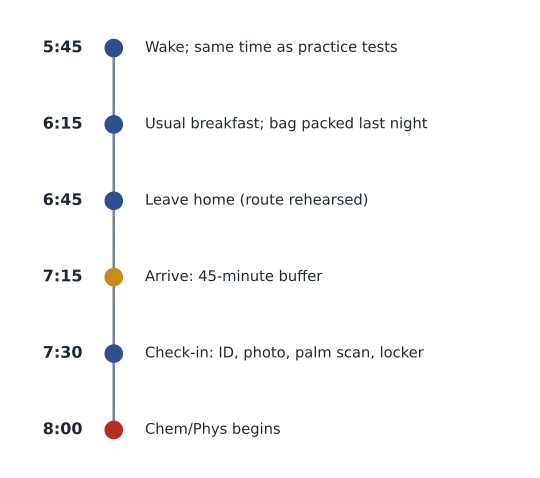
Fourth, rehearse the trip. Drive, ride or walk to the test centre at the same time of day and on the same day of the week as your appointment, at least once and ideally twice. Find the entrance, the parking and the floor. Ezequiel planned his rehearsal for March 2027: two weekday mornings, leaving his apartment at 6:45 a.m. to see the traffic. Devika, who had not yet booked, decided to choose a Toronto centre she could reach by transit with one transfer, and to test the route on a weekday at rush hour.
The night before
Pack the night before. Lay out your ID, your appointment confirmation, your snacks and drinks for the breaks, a sweater or layers (test rooms are often cold, and you cannot control the temperature), earplugs if you want them and they are allowed (the centre provides noise-reducing headphones or earplugs in many locations; check what is permitted), and anything else you will need, such as glasses. Do no studying beyond a quick, calm look at a short list of reminders you have written for yourself. Go to bed at your usual time. Many people sleep badly the night before, and one poor night is less harmful than people fear; what matters more is the sleep of the preceding week.
| Bring and keep in your locker | Allowed in the testing room | Not allowed in the testing room |
|---|---|---|
| Photo ID (shown at each entry) | Your ID, checked on each entry | Phones, watches, smart devices |
| Snacks and drinks for breaks | The noteboard booklet and marker provided | Notes, books, your own paper or pens |
| Layers of clothing | Clothing you are wearing (pockets may be checked) | Food and drink |
| Any medication you need | Items approved as accommodations | Bags, wallets, keys |
| Appointment confirmation | Earplugs or headphones provided by the centre | Hats and bulky jackets (rules vary; check) |
Arrival and check-in
Plan to arrive at least 30 minutes before your appointment. The AAMC is clear that if you arrive late, the centre may refuse to admit you, and that counts as a no-show, with no refund. Allow for traffic, parking, a slow elevator and a line at the desk. Ezequiel's new rule: aim to arrive 45 minutes early and sit in the car or a nearby café for fifteen minutes if he is too early.
Check-in at a Pearson VUE test centre follows a security routine. Staff check your ID, take a photograph and scan your palm. You store everything except your ID in a small locker. Before you enter the testing room, staff may ask you to turn out your pockets, roll up your sleeves and lift your trouser legs, and they may check you with a metal-detector wand. The same checks happen each time you re-enter after a break, so build them into your break timing. At your workstation you receive the noteboard booklet, a laminated set of pages with a fine-point marker, and you can ask for a replacement booklet if it fills up.
Inside the testing room
The test begins with an agreement to the examinee rules, a short tutorial on the test interface that you can skip or use to settle in, and then Chem/Phys. The interface lets you highlight text, strike through answer choices, flag questions for review and move back and forth within a section. At the end of each section a review screen shows which questions you have flagged or left incomplete. Once you leave a section, you cannot return to it. Chem/Phys includes a periodic table you can open on screen. There is no calculator, which is why the content courses insisted on estimation and scientific notation.
Practise with the interface before test day. The official AAMC practice tests use an interface very close to the real one, and taking your full-length tests on it means test day holds no surprises. Learn whether you prefer to highlight a lot or a little; heavy highlighting can turn a passage into a wall of yellow that helps nobody.
If something goes wrong during the test, raise your hand. That includes noise from a neighbour, a screen problem, a broken marker, or feeling unwell. Staff cannot help with content, but they can deal with the room, and any irregularity should be reported to them during the test, not afterward. Do not leave your seat without permission.
Using the breaks
The three breaks are optional, but almost every coach recommends taking all of them. The first, up to 10 minutes, comes after Chem/Phys. The second, the long one, comes after CARS and lasts up to 30 minutes. The third, up to 10 minutes, comes after Bio/Biochem. The break clock runs whether or not you are back at your seat, and the check-in routine on re-entry takes a few minutes, so a 10-minute break gives you about 6 or 7 minutes of real rest. If you are late back, the next section starts without you and the time is lost.
Thandiwe asked each student to write down their break plan and practise it in every full-length test. Elliot's plan for the 10-minute breaks: washroom, a granola bar and water, a minute of slow breathing, back early. For the long break: a proper snack, a short walk in the corridor, no thinking about CARS answers. Devika added one rule. 'I am not allowed to replay the last section. If a passage was horrible, it is gone. The next section scores separately.'
| Break | Length | A practical plan |
|---|---|---|
| After Chem/Phys | Up to 10 minutes | Washroom, water, small snack, a minute of slow breathing; back with 2 to 3 minutes to spare |
| After CARS | Up to 30 minutes | Real snack, walk and stretch, washroom; set a mental checkpoint at 20 minutes to start heading back |
| After Bio/Biochem | Up to 10 minutes | Water, quick snack, breathing; remind yourself Psych/Soc is the last push |
The void question
At the end of the test you are asked once whether you want your exam scored or voided. If you void, your test will not be scored, you will not see a score, and medical schools will not see that you took the test. The decision is final; you cannot change your mind, and you cannot void later. If you do not answer, the exam is scored. A voided test still counts toward your attempt limits: three in a testing year, four over two consecutive years and seven in a lifetime. Lesson 7 discusses when voiding makes sense; the short version is that it is for a test day that went seriously wrong, not for a test that merely felt hard, because almost every MCAT feels hard.
Ezequiel had thought about voiding in 2025 and decided against it. His 499, though below his goal, was a scored result he could build from, and his new plan rested partly on knowing exactly where those points had come from. Thandiwe agreed with his choice. 'Feelings at the end of the day are terrible predictors of scores. Almost everybody walks out thinking it went worse than it did.'
A worked example: a test-day problem
Worked problem
A late start and a long break
A student's appointment is at 8:00 a.m. She leaves home with a planned 30-minute buffer, but a transit delay means she arrives at 7:52. She is admitted and starts on time. During the long break she loses track of time and returns 4 minutes late. What has she lost, and what should she change?
Show solution
- Arriving at 7:52 broke the AAMC's 30-minute guidance. She was lucky to be admitted; the centre could have refused entry and counted a no-show.
- Returning 4 minutes late from the long break means the Bio/Biochem clock ran without her. She starts the section with about 91 minutes instead of 95, and she may feel rushed from the first passage.
- Four minutes is close to one passage set's worth of time. If she does not adjust her pacing checkpoints, she may run out of time at the end of the section.
- Her fixes: a larger travel buffer (45 to 60 minutes when relying on transit), a route rehearsal at the same time of day, and a break routine with a fixed point at which she starts heading back.
Answer: She risked a no-show at check-in and lost about four minutes of Bio/Biochem time. She should leave earlier, rehearse the route and practise a break routine with a set turnaround time.
After the test
Scores are released 30 to 35 days after the test, by 5 p.m. Eastern time, in your AAMC account. For the 2027 testing year the AAMC publishes the release date for each test date; Elliot's January 21 test, for example, has scores due February 23. Medical schools that use AMCAS receive your scores automatically on the release date, and Ontario schools through OMSAS follow their own score-release rules, covered in MCAT-101. You cannot get a score early, and calling or emailing the AAMC will not change the date.
The day after the test, do nothing related to the MCAT. Many students feel flat or anxious in the weeks of waiting. It helps to have something planned: work, a trip, a hobby you put aside. If you are applying in the current cycle, use the time to work on your application, not to rehearse the exam in your head.
Building your own test-day plan
Thandiwe asked each member of the group to write a one-page test-day plan and test it during every full-length test. The plan has six parts: the night before (what to pack, when to sleep), the morning (wake time, breakfast, departure time, route), check-in (ID, locker), the three breaks (what to eat, when to head back), what to do if something goes wrong (raise your hand; keep going), and the void question (a rule decided in advance, such as "I score the test unless I was ill or missed a whole section").
Elliot's plan was the shortest, five lines on an index card. Devika's filled a page and included the transit route with a backup. Ezequiel's had a line at the top in capital letters: LEAVE AT 6:45. 'Last time, the test got me before the test started,' he said. 'Not this time.'
Common mistakes
MistakeArriving just before the appointment time is enough.
InsteadArrive at least 30 minutes early; late arrivals may be refused and counted as no-shows.
MistakeAny photo ID will do as long as the face matches.
InsteadThe ID must be government-issued, unexpired, with a printed expiration date, and the first and last names must match the registration exactly.
MistakeA 10-minute break means 10 minutes of rest.
InsteadRe-entry checks use part of the break, and the next section starts on time whether or not you are back.
MistakeYou can void the test later if the score is disappointing.
InsteadThe void decision is made once, at the end of the test, and it is final; a voided test still counts as an attempt.
MistakeYou can reschedule up to the day before the test.
InsteadNo changes are possible fewer than 10 days before the test.
Summary and key terms
- Confirm your appointment, check your ID against your registration and know the change deadlines; nothing can be changed within 10 days of the test.
- Rehearse the route at the same time of day, pack the night before and arrive at least 30 minutes early.
- Check-in includes ID, photograph, palm scan and locker storage, repeated on each re-entry after a break.
- The interface allows highlighting, strikethrough, flagging and review within a section; Chem/Phys includes a periodic table; there is no calculator.
- Take all three breaks (10, 30 and 10 minutes) and return early; lost break time comes out of the next section.
- The void decision is made once at the end, is final and still counts as an attempt; scores are released 30 to 35 days later.
- MCAT Essentials
- The AAMC's official guide to registration, test-day rules and policies for each testing year.
- No-show
- Missing an appointment or being refused entry; it counts as an attempt and is not refunded.
- Void
- Choosing at the end of the test not to have it scored; final and counted as an attempt.
- Re-entry check
- The ID and security routine repeated each time you return to the testing room.
- Flag for review
- An interface tool that marks a question so it appears on the section review screen.
- Score release date
- The published date, 30 to 35 days after the test, when scores appear in your AAMC account.
Practice problems
Work each problem on paper first, then reveal the answer to check.
A student's licence shows her full middle name, which her MCAT registration omits. Is this a problem?
Show answer
No, provided the first and last names match exactly; the middle name is optional under the AAMC ID rules.
Twelve days before his test, a student decides to postpone. What are his options?
Show answer
He can still reschedule, at the 10-to-29-day fee (210 US dollars standard), but he must act before the 10-day line; a cancellation at this point brings no refund.
Why might a student plan to be back from a 10-minute break after about 7 minutes?
Show answer
The re-entry check takes time, and the next section starts on time even if the student is not seated.
Write a one-line void rule that follows the lesson's advice.
Show answer
For example: "I score the test unless I was ill, had to leave or could not finish a whole section."
Lesson quiz · 5 questions
Score 60% or more to complete this lesson.
Create a free account to save your progress, take quizzes and earn a certificate.