
MCAT-150 · Lesson 12 of 12 · 26 min
Capstone: a timed mixed set, full debrief and a next-steps plan
▶ Video coming soon A video version of this lesson is on the way.
The last session of the course was the closest thing to a test day that the Sunday Session could make on a screen. Thandiwe wrote twenty questions across all four sections in the real order: a Chem/Phys passage, a CARS passage, a Bio/Biochem passage and a Psych/Soc passage of four questions each, and four independent questions placed where they would fall on test day, two after the Chem/Phys passage and two after the Bio/Biochem passage. Time allowed: 32 minutes, close to the real pace. Rules: no going back to an earlier passage, the section-start routine before each passage, three to six flags at most. 'Then we review it the way you will review every full-length test from now on,' she said, 'and you each leave with a plan.'
Take the set under these conditions before reading the explanations. Then do a blind review of the questions you marked, check the key, classify every miss with the categories from lesson 6, and write the next-steps plan described at the end of the lesson. Every passage and question is original, and all data are invented for this course.
Passage 1 (Chem/Phys): measuring a dye by absorbance
A student measured the concentration of a blue food dye in a sports drink by spectrophotometry. The Beer-Lambert law states that absorbance equals the molar absorptivity of the substance times the path length of the light through the sample times the concentration. The dye absorbs most strongly at 630 nanometres. The student prepared standard solutions of the dye, measured their absorbance at 630 nanometres in a cuvette with a path length of 1.0 centimetre, and then measured the drink, diluted tenfold with water.
| Dye concentration (micromolar) | Absorbance at 630 nm |
|---|---|
| 0 (water blank) | 0.00 |
| 2.0 | 0.20 |
| 4.0 | 0.40 |
| 6.0 | 0.60 |
| Drink, diluted tenfold | 0.30 |
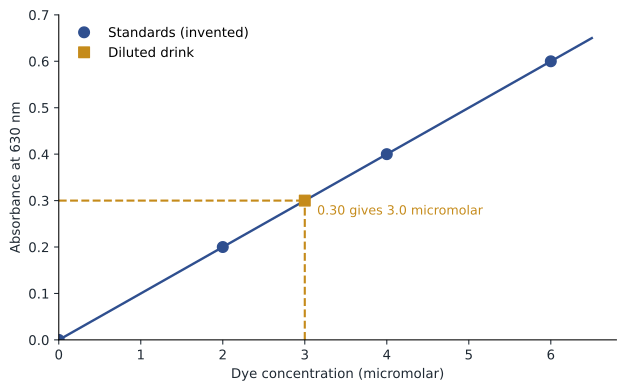
1. What is the dye concentration in the undiluted drink? (A) 0.30 micromolar. (B) 3.0 micromolar. (C) 30 micromolar. (D) 300 micromolar.
2. If the student had used a cuvette with a path length of 2.0 centimetres for the diluted drink, its absorbance would have been about: (A) 0.15. (B) 0.30. (C) 0.60. (D) 1.20.
3. The dye absorbs light at 630 nanometres. Compared with a photon of 450-nanometre light, a photon of 630-nanometre light has: (A) more energy, because its wavelength is longer. (B) less energy, because energy is inversely proportional to wavelength. (C) the same energy, because both are visible light. (D) less energy, because it travels more slowly.
4. What is the main purpose of measuring the water blank? (A) To set the absorbance due to the cuvette and solvent to zero. (B) To find the dye's wavelength of maximum absorbance. (C) To check the drink's sugar content. (D) To measure the path length.
Independent questions
5. How much work is done against gravity in lifting a 2.0-kilogram textbook 1.5 metres at constant speed (g = 10 metres per second squared)? (A) 3.0 joules. (B) 15 joules. (C) 30 joules. (D) 300 joules.
6. What is the hybridization of the carbon atom in methane? (A) sp. (B) sp2. (C) sp3. (D) sp3d.
Passage 2 (CARS): on what maps are for
It is often said that the map is not the territory. The saying contains a truth and a mistake. The truth is that no map can show everything about a place; a map that did would be as large and as useless as the place itself. The mistake is the assumption that a map exists to copy its territory, and fails to the degree that it leaves things out.
A better picture treats the mapmaker as someone who argues. Every map makes choices: which features to show, which to omit, where to put the centre of the page, how to flatten a round earth onto a flat sheet. A transit map straightens rivers and shrinks suburbs because riders need connections, not distances. A soil map ignores roads because farmers need drainage, not directions. The result is not a copy but a claim about what matters for a purpose, a claim that can be good or bad, honest or misleading.
Seen this way, the existence of many maps of one place is not a sign that no one has yet drawn it correctly, but a sign of how much the place contains. Each map shows something the others miss. A traveller is better served by a road map, a terrain map and a transit map than by one "complete" map that tries to do everything and does nothing well.
This view has its dangers. It can excuse the mapmaker who bends the land to suit a purpose so completely that the territory disappears behind the argument, as in maps drawn to inflate a claim or hide a hazard. A map must still be a map of somewhere, answerable to the ground it describes. But the opposite danger, a literalism so anxious about omission that it buries every useful feature under detail, is at least as common, and less often named. (Passage written for this course.)
7. The author's central claim is that: (A) maps are useless because they leave things out. (B) a map is best understood as a selective claim made for a purpose, which must remain answerable to the territory. (C) the most detailed map is always the most accurate. (D) travellers should rely on a single complete map.
8. According to the passage, the existence of many different maps of one place is: (A) evidence that mapmakers have failed. (B) a sign of how much the place contains. (C) confusing for travellers. (D) a reason to choose one complete map.
9. In the last paragraph, the author's attitude toward maps that bend the land to suit a purpose is best described as: (A) enthusiastic. (B) cautious, insisting that a map stay answerable to the ground it describes. (C) completely hostile to any map made for a purpose. (D) indifferent.
10. Suppose an atlas advertises one of its world maps as "the true shape of the world". Based on the passage, the author would most likely object that: (A) the map is too detailed. (B) every flat map of the world reflects choices made for a purpose, so no single map can claim to be the true shape. (C) atlases should not include world maps. (D) the shape of the world is unimportant.
Passage 3 (Bio/Biochem): a booster dose
Researchers studied antibody responses to a new protein vaccine in 40 adult volunteers who had never been exposed to the antigen. Each volunteer received a first dose on day 0 and a booster dose on day 60. Blood samples were taken at intervals, and levels of antigen-specific IgM and IgG antibodies were measured as relative units. A control group of 10 volunteers received a saline injection on both days.
| Day | IgM (vaccine group) | IgG (vaccine group) | IgG (control group) |
|---|---|---|---|
| 0 | 1 | 1 | 1 |
| 10 | 30 | 12 | 1 |
| 30 | 8 | 20 | 1 |
| 60 | 3 | 10 | 1 |
| 70 (10 days after booster) | 10 | 160 | 1 |
11. Which observation best shows a secondary (memory) response? (A) IgM peaks on day 10. (B) IgG rises to 160 units within 10 days of the booster, much higher than after the first dose. (C) IgG in the control group stays at 1 unit. (D) IgM falls between day 10 and day 60.
12. Which cells are most directly responsible for the rapid, large IgG response after the booster? (A) Memory B cells formed after the first dose. (B) Natural killer cells. (C) Neutrophils. (D) Red blood cells.
13. Why did IgM rise early after the first dose while IgG rose later? (A) IgM is the first antibody class produced in a primary response; class switching to IgG takes time. (B) IgG is produced only after a booster. (C) IgM is made by T cells and IgG by B cells. (D) The vaccine contained IgM.
14. What is the main purpose of the control group? (A) To show that the rise in antibodies was caused by the vaccine, not by the injection procedure or the passage of time. (B) To increase the sample size. (C) To measure the vaccine's side effects only. (D) To test a second vaccine.
Independent questions
15. During the rising phase of a neuronal action potential, the membrane potential becomes more positive mainly because: (A) sodium ions flow into the cell through voltage-gated channels. (B) potassium ions flow into the cell. (C) chloride ions flow out of the cell. (D) the sodium-potassium pump speeds up.
16. A student takes a pain reliever to stop a headache, and becomes more likely to take it again when headaches occur. In operant conditioning terms, this is: (A) positive reinforcement. (B) negative reinforcement. (C) positive punishment. (D) extinction.
Passage 4 (Psych/Soc): night shifts and health
Researchers surveyed 1,200 hospital employees about their work schedules, sleep and health. Employees who had worked rotating night shifts for at least three years reported shorter sleep and more digestive complaints than employees who worked only day shifts. The night-shift group also had, on average, lower household income and fewer years of formal education, and was more likely to include employees in support roles than in physician roles. The researchers noted that circadian rhythms are regulated by the suprachiasmatic nucleus of the hypothalamus, which responds to light and controls the timing of melatonin release.
17. Which conclusion does the study design best support? (A) Night shifts cause digestive complaints. (B) Night-shift work is associated with shorter sleep and more digestive complaints. (C) Day-shift work prevents all digestive illness. (D) Melatonin causes digestive complaints.
18. Which feature of the study makes it hardest to attribute the health differences to the shift schedule itself? (A) The large sample size. (B) The two groups differed in income, education and job role, which may also affect health. (C) The study was done in a hospital. (D) The survey asked about sleep.
19. Exposure to bright light at night most directly affects circadian timing by: (A) signalling the suprachiasmatic nucleus, which suppresses melatonin release. (B) increasing melatonin release from the adrenal glands. (C) stimulating the cerebellum. (D) lowering body temperature directly.
20. A sociologist argues that the pattern partly reflects who is likely to be assigned night shifts in hospitals. This argument focuses on: (A) social stratification and its link to health. (B) the bystander effect. (C) cognitive dissonance. (D) the fundamental attribution error.
Answers and explanations: passage 1 and independent questions 5 and 6
1. C (skill 4). An absorbance of 0.30 on the calibration line corresponds to 3.0 micromolar in the diluted sample. The drink was diluted tenfold, so the original concentration is 30 micromolar. Choice B forgets the dilution.
2. C (skill 2). Absorbance is proportional to path length, so doubling it doubles the absorbance from 0.30 to 0.60.
3. B (skill 1). Photon energy equals Planck's constant times the speed of light divided by wavelength, so longer wavelength means lower energy. All light travels at the same speed in a vacuum (D).
4. A (skill 3). The blank sets the baseline, so any absorbance by the cuvette and the water is not counted as dye. The blank's absorbance of zero confirms the calibration line passes through the origin.
5. C (skill 2). Work against gravity equals mass times g times height: 2.0 times 10 times 1.5 is 30 joules.
6. C (skill 1). Methane's carbon forms four single bonds in a tetrahedral arrangement, sp3 hybridization.
Answers and explanations: passage 2
7. B. The second paragraph states the central picture, the mapmaker as "someone who argues" and the map as "a claim about what matters for a purpose", and the last paragraph adds that a map must stay "answerable to the ground it describes". Choice A is the mistaken assumption the author rejects; C is the danger of literalism the last paragraph names.
8. B. The third paragraph says many maps are not a sign that no one has drawn the place correctly but "a sign of how much the place contains".
9. B. The author names the danger and insists that a map be "answerable", while saying the opposite danger is "at least as common". The attitude is cautious, not hostile to purposeful maps (C), which the author defends throughout, or enthusiastic (A).
10. B (Reasoning Beyond the Text). The author treats every map as a set of choices, including how to flatten a round earth, and prefers several maps to one "complete" map. A claim to "the true shape" contradicts that view.
Answers and explanations: passage 3 and independent questions 15 and 16
11. B (skill 4). After the booster, IgG rose to 160 units in 10 days, far above the primary peak of 20, the faster and larger response typical of immunological memory.
12. A (skill 1). Memory B cells formed during the primary response divide quickly on re-exposure and differentiate into plasma cells that secrete IgG.
13. A (skill 2). The primary response begins with IgM; class switching to IgG, driven by helper T cells, takes days. Choice B is contradicted by the IgG rise after the first dose.
14. A (skill 3). The saline group received injections and was sampled on the same schedule, ruling out effects of the procedure and of time. Its flat IgG at 1 unit shows that the rise in the vaccine group came from the vaccine.
15. A (skill 1). Opening of voltage-gated sodium channels lets sodium flow in, depolarizing the membrane. Potassium flows out during repolarization (B is wrong in direction and phase).
16. B (skill 1). Removing an unpleasant stimulus (the headache) increases the behaviour, which is negative reinforcement. Punishment would decrease the behaviour.
Answers and explanations: passage 4
17. B (skill 3). A survey comparing existing groups shows association, not cause. Choice A claims causation the design cannot support.
18. B (skill 3). Income, education and job role differ between groups and could each affect health; they are possible confounding variables.
19. A (skill 1). Light reaching the retina signals the suprachiasmatic nucleus, which suppresses melatonin release from the pineal gland. Melatonin comes from the pineal gland, not the adrenal glands (B).
20. A (skill 2). The argument concerns how jobs, and so health risks, are distributed across social strata, a question of social stratification and health disparities.
The debrief
Thandiwe put the three results on the shared screen. Elliot: 18 of 20 timed, 19 after blind review. Devika: 17 timed, 19 after blind review. Ezequiel: 16 timed, 18 after blind review. Then she asked each student to read out their misses and the category they had assigned, before she said anything.
Elliot's two timed misses were question 1, where he forgot the tenfold dilution and chose B, and question 9, where he chose "completely hostile". He fixed question 1 on blind review; question 9 stayed wrong. He logged both as reading: in question 1 he had not reread the method, and in question 9 he had reacted to the word "dangers" without reading the sentences that follow it. He noticed a pattern across all three mixed sets: his CARS misses came from the last paragraph of a passage, the one his diagnostic in September had shown him skimming. 'It is the same habit, just smaller,' he said.
Devika's three timed misses were question 1, the same dilution slip, question 13 and question 18, both "why" questions in which she picked a plausible cause too fast. On blind review she fixed questions 13 and 18 but not question 1, because she again forgot the dilution, and wrote in large letters in her log: "Read the method sentence again before any calculation." She was pleased with one thing: she had no timing misses at all, the first set in the course where that was true. The triage habits from lesson 5 had held.
Ezequiel missed four timed: questions 2, 6, 10 and 17. He fixed questions 6 and 17 on blind review; question 6 had been a careless click, sp2 for sp3, and question 17 a causal claim he had not checked against the design. Question 2 was a content gap on the Beer-Lambert relation, and question 10 a CARS question where he chose D, which he said he picked because it was the only one he understood. He ran out of time on the last Psych/Soc passage, answering questions 19 and 20 in the final minute, and got both right anyway. 'My Psych/Soc is the last thing to go,' he said. 'That is good news and bad news.'
| Student | Timed | After blind review | Misses by category | Biggest single fix |
|---|---|---|---|---|
| Elliot | 18 of 20 | 19 of 20 | Reading 2 | Read the last paragraph of every CARS passage at full attention |
| Devika | 17 of 20 | 19 of 20 | Reading 1, reasoning 2 | Reread the method sentence before any calculation |
| Ezequiel | 16 of 20 | 18 of 20 | Content 1, reading 1, reasoning 1, careless 1 | Keep pace on Chem/Phys passages so the last section is not rushed |
Thandiwe pointed out three patterns across the group. First, every student recovered points on blind review, so time pressure and habits still cost more than content. Second, the dilution slip in question 1 caught two of them, a reminder that most Chem/Phys points in a calculation are lost in the setup, not the arithmetic. Third, the hardest CARS question for two of them was the attitude question, which depended on reading a concession and its reply in the same paragraph. All three patterns had appeared in earlier sets. 'That is what an error log is for,' she said. 'It turns "I keep making mistakes" into "I make three kinds of mistakes, and here is the fix for each."'
Writing a next-steps plan
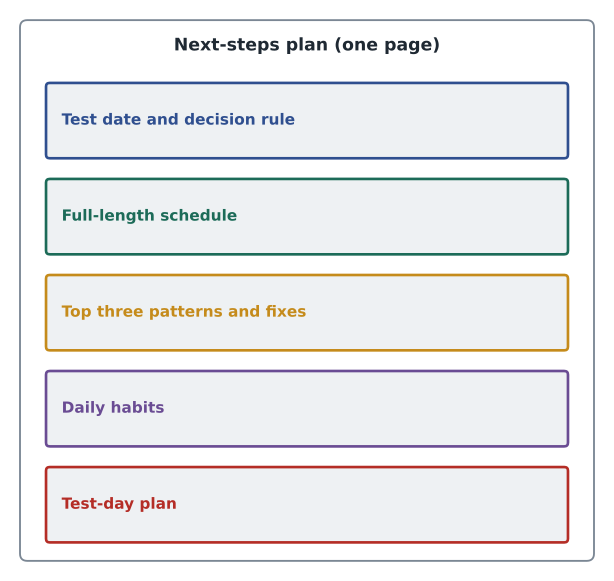
Every review should end with a plan for the next week or two. Thandiwe asked each student to write one, using the same five headings, and to keep it to a page.
- Test date and decision date: the test date, the date of the postponement decision (lesson 7) and the rule.
- Full-length schedule: the dates of the remaining full-length tests and which are official (lesson 1).
- Top three patterns: the three most common miss types in the error log, each with a specific fix (lesson 6).
- Daily habits: a small number of short, daily practices, such as two timed CARS passages or a five-minute calculation drill.
- Test-day plan: a link to the one-page plan from lesson 2, with the break plan and the void rule.
The three plans
Elliot's plan. Test date: January 21, 2027. Decision date: January 3, with the rule from lesson 7 (average of his last three full-length tests, at least two official; move the test if below 508 or if CARS averages below 124). Full-length tests: weekly from mid-December, last on January 10 or 11. Top three patterns: CARS last-paragraph skimming (fix: read the last paragraph at full attention and write its point); careless setup in calculations (fix: write equation and units first); strengthen-or-weaken misreads (fix: mark each choice plus, minus or neutral). Daily habits: two timed CARS passages and one mixed passage. Test-day plan: the index card, now with a line added for the long break.
Devika's plan. Test date target: May 13, 2027, to be booked once her Fee Assistance decision arrives. Decision date: about April 13, before the 30-day fee band ends. Full-length tests: three on alternate weekends in March and April during term, then three in the weeks after finals, the last on May 3. Top three patterns: calculation setup, especially dilutions and proportional reasoning (fix: reread the method, write the equation and factors first); "why" questions answered too fast (fix: name two possible causes before choosing); statistics concepts (fix: review the research methods lessons of MCAT-130). Daily habits: a fifteen-minute calculation drill and one timed science passage. Test-day plan: the full page, with the transit route and a backup.
Ezequiel's plan. Test date: April 17, 2027. Decision date: about March 18, with a conservative rule because his 2025 score is on record: test in April only if his official average is at least 506 and rising. Full-length tests: seven from February 22, the last moved to April 9 to leave more taper time. Top three patterns: reading tables and figures (fix: state the main comparison within 60 seconds); bringing in ideas the passage does not support (fix: check any answer that uses a word the passage never used); pace on Chem/Phys (fix: checkpoints written on the noteboard at the start). Daily habits: one figure-reading drill and one timed CARS passage; two sections back to back every Saturday until full-length tests begin. Test-day plan: LEAVE AT 6:45, and the route rehearsal in March.
Closing the course
Thandiwe ended the session the way she had started the group in September, with the error-log template on the screen. 'You came in with diagnostic scores and no idea where the points were,' she said. 'Now you each have a log of a few hundred questions, a list of your own patterns and a plan. The content courses gave you the material. This one gave you a way to use it under pressure and a way to keep getting better. From here, every practice test is a lesson, if you review it.' Ezequiel, who had studied alone in 2025, asked if the group could keep meeting through April. Thandiwe said yes.
Common mistakes
MistakeA calculation from a calibration line is finished once you read off the concentration.
InsteadCheck the method for dilutions or other steps that change the sample before the measurement.
MistakeA large secondary antibody response means the booster contained more antigen.
InsteadA faster, larger response after re-exposure reflects memory B cells formed in the primary response.
MistakeA survey showing that night-shift workers are less healthy proves night shifts cause illness.
InsteadExisting groups can differ in many ways; such a survey shows association, with possible confounders.
MistakeTaking a pain reliever that removes a headache is positive reinforcement.
InsteadRemoving an unpleasant stimulus to increase a behaviour is negative reinforcement.
MistakeA review is finished when every miss has an explanation.
InsteadA review is finished when it ends in a plan: patterns, fixes, daily habits and the next tests.
Summary and key terms
- The capstone set used all four sections in order: Beer-Lambert spectrophotometry, a CARS passage on what maps are for, an immunology passage on a booster dose and a Psych/Soc passage on night shifts and health.
- Absorbance is proportional to concentration and path length; remember dilution factors; photon energy is inversely proportional to wavelength.
- Secondary responses are faster and larger because of memory B cells; IgM comes first in a primary response, IgG after class switching.
- Surveys of existing groups show association, not cause, and differences in income, education and role can confound health comparisons.
- Across the group, blind review recovered points every time; the remaining misses fell into a few repeated patterns, each with a specific fix.
- End every review with a one-page plan: test and decision dates, full-length schedule, top three patterns with fixes, daily habits and the test-day plan.
- Beer-Lambert law
- Absorbance equals molar absorptivity times path length times concentration.
- Calibration line
- A plot of a measured signal against known concentrations, used to find unknown concentrations.
- Secondary immune response
- The faster, larger antibody response on re-exposure to an antigen, due to memory cells.
- Negative reinforcement
- Increasing a behaviour by removing an unpleasant stimulus.
- Social stratification
- The ranking of groups in a society by wealth, power and prestige.
- Next-steps plan
- A one-page plan written after review, listing dates, patterns, fixes and daily habits.
Practice problems
Work each problem on paper first, then reveal the answer to check.
A diluted sample (diluted fivefold) has an absorbance of 0.50 on the calibration line in Table 1. What is the concentration of the original sample?
Show answer
The diluted sample is 5.0 micromolar, so the original is 25 micromolar.
In passage 3, what would you expect IgG levels to look like if a volunteer had already been exposed to the antigen before day 0?
Show answer
A faster and larger rise after the first dose, resembling a secondary response.
Suggest one way to strengthen the night-shift study's ability to attribute health differences to shift work.
Show answer
Compare night and day workers matched for income, education and job role, or follow the same workers before and after a change in schedule.
Write the "top three patterns" section of your own next-steps plan from your error log.
Show answer
For each pattern, name the miss type, give an example and write a specific fix, for example: "Dilution slips in calculations; reread the method and write the dilution factor before calculating."
Lesson quiz · 5 questions
Score 60% or more to complete this lesson.
Create a free account to save your progress, take quizzes and earn a certificate.