
MCAT-150 · Lesson 6 of 12 · 20 min
Reviewing mistakes: blind review and the error log
▶ Video coming soon A video version of this lesson is on the way.
Thandiwe began the review session by asking how long each of them had spent reviewing their last timed section. Elliot said forty minutes. Devika said about two hours. Ezequiel said he had not finished. 'Ezequiel wins,' Thandiwe said, to some laughter. 'I mean it. A section you take in 95 minutes deserves at least that long in review, and a full-length test deserves most of a day. The test told you what you got wrong. Review tells you why, and the why is the only part you can fix.'
This lesson explains how to review a practice section or full-length test so that each one makes the next one better. It covers blind review, the error log the group has kept since September, how to classify misses, how to choose a fix for each kind, and how to read patterns in the log over several weeks. Review is the part of preparation students most often cut short, and the part that most separates students who improve from those who plateau.
Why review matters more than volume
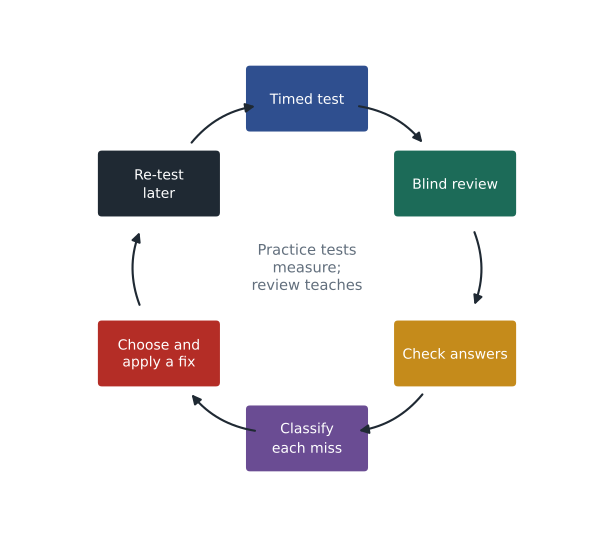
A practice test gives you a score and a list of wrong answers. By itself, that changes nothing: if you take another test without understanding why you missed what you missed, you will miss the same kinds of questions again. Students who take many tests and review them lightly often see their scores flatten after the first few weeks. Students who take fewer tests and review each one thoroughly tend to keep improving, because each review turns a miss into a lesson. That is the meaning of the line on the group's whiteboard: 'Practice tests measure; review teaches.'
Good review also catches problems that a score hides. A question you got right by guessing is a miss waiting to happen. A question you got right after five minutes of struggle is a pacing problem. A question you got right for the wrong reason is a misunderstanding. None of these show up as wrong answers, but all of them cost points on test day.
Blind review
Blind review is reconsidering questions before you see the answers. The idea is simple. During a timed section, mark every question you are not sure of, using the flag tool or a note on your noteboard. When the section is over, before you check any answers, go back to the marked questions and work them again with no time limit. Decide on a final answer for each, and write a sentence explaining why. Only then check the key.
Blind review separates two kinds of misses that look identical on a score report. If you got a question wrong under time but right on blind review, the problem was time pressure, reading speed or nerves: you knew how to do it. If you got it wrong both times, the problem is understanding: content, reasoning or a habit of reading. The two need different fixes. Most students find that a large share of their misses, often a third or more, are fixed on blind review, which is both encouraging and useful, because those points are the easiest to recover.
Keep two scores for every section: your timed score and your blind review score. The gap between them is a measure of how much you lose to time pressure. Elliot's capstone set in MCAT-111 went from 19 of 20 timed to 20 of 20 on blind review; Ezequiel's went from 15 to 17. Ezequiel's gap of two questions on a 20-question set, if it held across a full section, would be worth several scaled points.
Reviewing every question that matters
After blind review and checking the key, review three groups of questions. First, every question you got wrong. Second, every question you got right but had marked as uncertain, since those were partly luck. Third, every question that took much longer than it should have, even if you got it right; your noteboard timings or the interface review can help you find them. For each one, work out exactly why it went wrong or slow.
For wrong answers, the important question is not "what is the right answer" but "why did I choose the wrong one, and what would have led me to the right one?" Read the explanation, but then explain it again in your own words. Look at the wrong choice you picked and identify the feature that made it attractive. Look at the passage and find the line or data point that decided the question. If you cannot find it, that is itself information: perhaps you need to read figures differently.
The error log
The group's error log is a shared spreadsheet template Thandiwe introduced in September. Each row is one question. The columns are: the question (with a short description), the section, the topic, why it was missed, the fix, and a re-test date. Some students add columns for the reasoning skill (1 to 4) and for whether blind review fixed it.
| Category | What it means | Typical fix |
|---|---|---|
| Content | You did not know or misremembered a fact, term or equation | Review the topic; make flashcards; do 10 to 20 recall questions on it |
| Reading | You misread the stem, the passage or a figure | Read the last sentence of the stem twice; read axes and units first |
| Reasoning | You knew the content but applied it wrongly or followed a faulty logic | Work similar problems slowly; write out each step; compare with the explanation |
| Timing | You ran short of time and guessed or rushed | Practise checkpoints and the two-minute rule; timed sets |
| Careless | An arithmetic slip, a mis-click or a misread number | Write the setup and units first; check the chosen letter before moving on |
Choosing a category is the most important step, and it requires honesty. It is tempting to call every miss "careless", because that suggests you knew it all along. But if you made the same "careless" error three times, it is a habit, and habits need practice to change. Thandiwe's rule: a miss can be called careless only once. If it happens again, it moves to reading or reasoning.
Writing a useful entry
An error-log entry is useful only if it tells your future self what to do differently. "Got it wrong" or "should have known" is useless. A good entry names the specific error and a specific change.
Worked problem
Turning a miss into a useful log entry
Devika missed a Chem/Phys question asking how the resistance of a wire changes if its length doubles and its radius halves. She chose "doubles". The correct answer is "increases eightfold". How should she log it?
Show solution
- Find the error: resistance is proportional to length divided by cross-sectional area. Area depends on radius squared. Halving the radius cuts the area to one quarter.
- So resistance changes by a factor of 2 (length) divided by one quarter (area), which is 8.
- She chose "doubles" because she accounted for length but treated the radius change as if it did not matter, or forgot to square it.
- Category: reasoning (she knew the equation but applied it incompletely), not content.
- Fix: for every proportional-reasoning question, write the full equation, then mark each variable with its factor (length times 2, radius times one half, area times one quarter) before combining.
- Re-test: three proportional-reasoning questions in one week, from a question bank.
Answer: Entry: "Chem/Phys, resistance of a wire; chose doubles, answer eightfold. Forgot area goes with radius squared. Reasoning. Fix: write the equation and mark each factor before combining. Re-test in one week."
Compare that entry with "resistance question, careless". The first one tells Devika exactly what to practise. The second tells her nothing, and calling it careless hides the fact that the same mistake can happen with any equation that has a squared term.
Reading the log for patterns
One error-log entry is a lesson; fifty are data. After every two or three full-length tests, sort or filter the log by category, by section and by topic, and count. The patterns you see should drive your study plan for the next weeks.
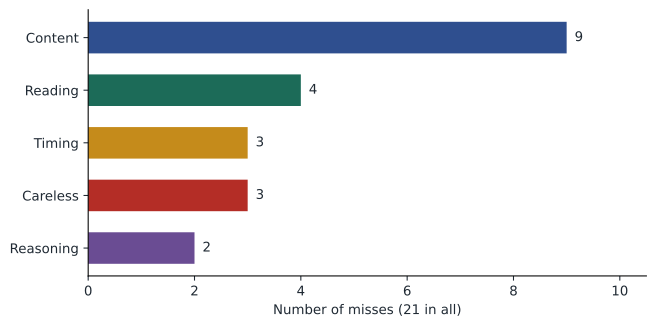
Devika's diagnostic in September gave her 21 Chem/Phys misses: 9 content, 4 reading, 2 reasoning, 3 timing and 3 careless. The largest group, content, pointed to physics and general chemistry review, which she began. By late November her timed Chem/Phys sets showed fewer content misses, and timing had become the largest category, which led to the triage work in lesson 5. Ezequiel's log showed a different pattern: about a third of his science misses involved reading tables and graphs, a skill 4 problem. That led to his 60-second rule for stating the main comparison in any figure.
Also look for topics that recur. If five misses across three tests involve buffers, that is a content gap that needs a focused review, no matter which category each one was logged under. If misses cluster in the last two passages of each section, that is stamina. If most of your misses are questions where you narrowed to two choices and picked the wrong one, look at what distinguished the right answer: was it usually the more cautious choice? The one tied most directly to the data?
Re-testing
A fix is finished only when you can do the kind of question correctly later, without the explanation fresh in mind. That is the reason for the re-test date column. A week or so after logging a miss, do a few new questions of the same kind, or rework the original question cold. If you get them right, mark the entry as closed. If not, the fix did not work, and you need a different one.
Spacing matters here. Reworking a question an hour after reading the explanation tells you very little, because you remember the explanation. Reworking it a week later tells you whether the understanding has stuck. Research on learning consistently finds that spaced retrieval, recalling something after a delay, builds more durable memory than rereading. The re-test column turns that finding into a habit.
How long review takes, and how to split it
A full-length test has 230 questions. If you got 75 percent right, that is about 57 wrong, plus perhaps 20 to 30 right answers that were uncertain or slow. At five to ten minutes each, that is six to twelve hours of review. Most students split it over two days. A practical split is to blind-review and check all four sections on the evening of the test or the next morning, then do the detailed review of two sections per day over the next two days.
Some students review the CARS section differently. Because CARS needs no content, the review focuses on reasoning: for each miss, find the line in the passage that supports the right answer and identify why the wrong choice was attractive. Some students also reread the whole passage and rewrite their paragraph labels, then compare them with what the passage actually argued.
Review and morale
Reviewing mistakes is uncomfortable. It is easier to take another test than to look at fifty wrong answers. But review is also where the encouraging news is: most misses turn out to be fixable, and many are fixed by a habit rather than by months of content review. Ezequiel, who had studied alone and without review in 2025, put it this way at the end of the session: 'Last time I took tests and felt bad. This time I take tests and make a list. The list is better.'
Common mistakes
MistakeReview only the questions you got wrong.
InsteadAlso review questions you got right by guessing and questions that took far too long.
MistakeRead the explanation and move on.
InsteadExplain the answer in your own words and identify why the wrong choice attracted you.
MistakeMost misses are careless.
InsteadA miss can be called careless only once; repeated "careless" errors are habits of reading or reasoning.
MistakeReworking a question right after reading the explanation shows you have learned it.
InsteadRe-test after a delay, about a week, to see whether the understanding has stuck.
MistakeTaking another practice test is a better use of time than a long review.
InsteadA thorough review of one test usually teaches more than a second test reviewed lightly.
Summary and key terms
- Practice tests measure; review teaches. A full-length test deserves six to twelve hours of review, usually over two days.
- Blind review means reworking uncertain questions without a time limit before checking answers; it separates time-pressure misses from understanding misses.
- Review wrong answers, uncertain right answers and slow questions, and explain each in your own words.
- The error log records the question, section, topic, why it was missed (content, reading, reasoning, timing or careless), the fix and a re-test date.
- A good entry names the specific error and a specific change; repeated "careless" errors are habits.
- Read the log for patterns every few tests, and re-test each fix after about a week.
- Blind review
- Reworking marked questions without a time limit before checking the answer key.
- Error log
- A record of missed and uncertain questions with the cause of each miss, a fix and a re-test date.
- Timed score
- The score on a section as taken under time limits.
- Blind review score
- The score after reconsidering uncertain questions without time pressure.
- Spaced retrieval
- Recalling information after a delay, which strengthens memory more than rereading.
Practice problems
Work each problem on paper first, then reveal the answer to check.
A student's timed CARS score is 38 of 53 and her blind review score is 46 of 53. What does the gap suggest?
Show answer
About eight questions are lost to time pressure or rushed reading rather than lack of understanding; pacing and reading habits are the priority.
A student logs the same misread of "not" in question stems three times as careless. How should the log change?
Show answer
After the first time it should be logged as a reading error, with a fix such as reading the last sentence of every stem twice.
Why include questions you got right in your review?
Show answer
Right answers that were guesses or took too long hide weaknesses that will cost points on test day.
Ezequiel finds that 6 of his last 20 science misses involved enzyme inhibition, logged under different categories. What should he do?
Show answer
Treat it as a content gap: review enzyme inhibition and do focused practice, regardless of the categories logged.
Lesson quiz · 5 questions
Score 60% or more to complete this lesson.
Create a free account to save your progress, take quizzes and earn a certificate.