
MCAT-150 · Lesson 5 of 12 · 20 min
Stamina and pacing: timing, triage and checkpoints
▶ Video coming soon A video version of this lesson is on the way.
Devika's first timed Chem/Phys section of the full-length block ended badly in an ordinary way. She was on pace for six passages, then met a dense passage on a thin-film interference experiment, spent eleven minutes on it, and finished the section with four questions answered by guesses in the last ninety seconds. 'I knew I was slow on that passage,' she said. 'I just could not make myself leave it.' Thandiwe put up a chart of Devika's minutes per passage. Six bars were close to eight minutes; one was eleven; the last passage got three. 'This is not a knowledge problem. This is a triage problem. You paid for one hard passage with the easy points at the end.'
This lesson covers pacing and triage: how to know where you should be at each point in a section, what to do when you fall behind, how to decide which questions and passages deserve extra time, and how to measure and build stamina across the whole test. These skills matter on every section, and they matter more as fatigue builds in the second half of the day.
The arithmetic of time
Every question on the MCAT is worth the same. A hard question on a dense passage counts no more than an easy independent question, and there is no penalty for a wrong answer. Two rules follow. First, never leave a question blank. Second, time spent on a question is worth spending only if it raises your chance of getting that question right more than the same time would raise your chances on other questions.
In the science sections, 95 minutes for 59 questions is about 1.6 minutes per question. A five-question passage set gets about eight minutes, including two to three minutes of reading; a four-question set gets about six and a half; a six-question set about nine and a half. Independent questions should average under a minute, which leaves a little time in hand for passages. In CARS, 90 minutes for nine passages is ten minutes per passage, as lesson 4 explained.
Checkpoints
You cannot check your pace after every question without wasting time, but you can check it a few times per section. Pick checkpoints by question number and write them on your noteboard at the start of the section, before the first passage. For the science sections, a simple set is: question 15 at about 24 minutes elapsed, question 30 at about 48 minutes, question 45 at about 72 minutes, and question 59 at about 92 minutes, leaving three minutes for flagged questions. The on-screen clock counts down, so convert the checkpoints to time remaining: 71, 47 and 23 minutes left at questions 15, 30 and 45.
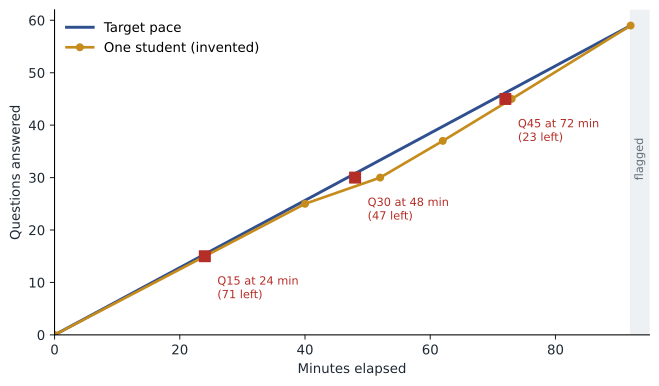
| Question number | Minutes elapsed (target) | Clock shows about |
|---|---|---|
| 15 | 24 | 71 minutes remaining |
| 30 | 48 | 47 minutes remaining |
| 45 | 72 | 23 minutes remaining |
| 59 | 92 | 3 minutes remaining (for flagged questions) |
Checkpoints are guides, not rules. Questions are not spread perfectly evenly, and a passage-heavy stretch will put you a minute or two behind before an independent-question stretch brings you back. React only when you are more than about three minutes off pace. Being a little ahead is fine, but if you are far ahead, slow down: rushing produces careless errors.
When you fall behind
Falling behind is normal; what matters is how you recover. The worst recovery is to read faster. Rushed reading leads to misread stems and misread figures, which cost more than the time saved. The better recovery is to spend less time on the questions that are least likely to repay it.
Here is the sequence Thandiwe teaches. First, finish the passage you are on, but cap the hardest remaining question in that set: make your best guess, flag it and move on. Second, on the next one or two passages, read efficiently but completely, and answer the straightforward questions; flag and guess on anything that would take more than about two minutes. Third, move briskly through independent questions you can answer from knowledge. Within two or three passages you will usually be back on pace. Then use any time at the end for flagged questions.
Triage: what deserves extra time
Triage means sorting questions by how much time they deserve. Some questions are quick and certain: answer them. Some are slow but answerable: answer them if you have the time, and give them the time if you are on pace. Some are slow and uncertain: these are the ones to limit. A good rule is the two-minute rule: if a question has taken two minutes and you are not close to an answer, eliminate what you can, choose the best remaining answer, flag it and move on. You may come back to it, and you will often see it more clearly then.
| Type of question | What to do | Example |
|---|---|---|
| Quick and certain | Answer and move on; do not second-guess | An independent question on a definition you know well |
| Slow but answerable | Answer if on pace; give it the time it needs | A two-step calculation with a clear setup |
| Slow and uncertain | Two-minute rule: eliminate, guess, flag, move on | A question that needs data from three figures and an unfamiliar model |
| Impossible for you now | Guess at once and flag; spend the time elsewhere | A topic you have never studied |
Triage applies to passages as well as questions. Some students skip a passage that looks very hard on first glance, answer everything else and come back to it. In the science sections this can work, because passages vary a great deal in difficulty. But it has costs: you may lose track of which passages you skipped, and coming back to a passage means rereading it. If you skip, skip at most one or two passages per section, flag every question in them, and check the review screen before time runs out. Test the strategy in practice first. Devika tried it in two practice sections and found it helped in Chem/Phys, where she could see at a glance which passages were heavy on calculations, but not in Bio/Biochem, where every passage looked equally long.
Flagging and the review screen
The flag tool marks a question so it appears on the section review screen at the end. Flag sparingly. If you flag fifteen questions, you will not have time to revisit them, and you will spend time deciding which to look at. A good target is three to six flags per section: questions where you had narrowed the choice to two and a second look might help. Do not flag questions you guessed on with no idea; a second look is unlikely to change them.
When you return to a flagged question, change your answer only for a reason: you misread the stem, you found a detail in the passage you missed, or you realize your reasoning had an error. Research on answer changing in multiple-choice tests finds that changes made after reconsideration more often go from wrong to right than the reverse, so the belief that your first instinct is always best is a myth. But the gain comes from reconsidering with a reason, not from switching on a vague feeling.
The last five minutes
Plan the end of each section in advance. At five minutes remaining, stop working on anything slow. Make sure every question has an answer, using the review screen to find any left blank. Then use the remaining time on flagged questions, starting with the ones where you were down to two choices. At one minute remaining, check once more that nothing is blank. Ezequiel added an extra step to his plan: in the last minute, he takes one slow breath before the section ends, so he starts the break calmly instead of in a rush.
A worked example: rescuing a section
Worked problem
Two passages behind at the halfway point
In Bio/Biochem, a student reaches question 30 with 41 minutes remaining. The target is 47 minutes remaining, so she is about six minutes behind. The next passage looks long, with two figures and six questions. What should she do?
Show solution
- Recognize the gap: six minutes is more than the three-minute threshold, so she needs to recover, but gradually.
- Read the next passage completely but efficiently, using the four-step method from lesson 3, and answer the questions that are straightforward.
- Apply the two-minute rule strictly to any question that needs data from both figures or an unfamiliar model: eliminate, guess, flag.
- Move briskly through the next group of independent questions, aiming for under a minute each.
- Check again at question 45. A realistic goal is to be within two or three minutes of the target (about 20 minutes remaining).
- In the last five minutes, answer anything blank first, then return to flagged questions.
Answer: Recover in steps: complete but efficient reading, strict two-minute triage, quick independent questions, and a check at question 45. Never speed up by skimming passages.
Measuring stamina
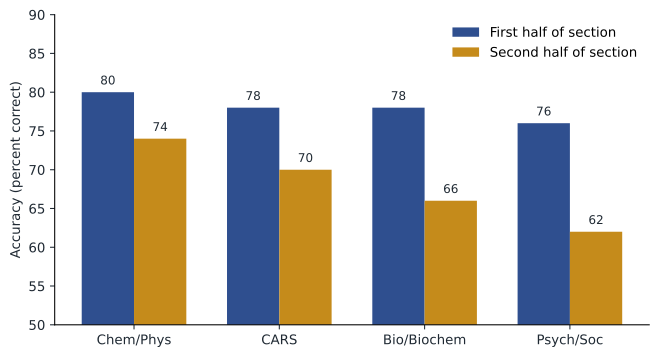
You can measure stamina from your full-length tests. Two numbers tell you most of what you need. The first is your accuracy in the first half of each section compared with the second half. If accuracy falls by more than about 10 percentage points in the second half of most sections, you are tiring within sections. The second is your accuracy in each section across the day: if Psych/Soc is consistently weaker in full-length tests than in section practice, you are tiring across the day.
Ezequiel tracked both after taking the AAMC Unscored Sample Test as a full-length stamina check during his foundation phase. His Bio/Biochem accuracy was 78 percent on the first 30 questions and 66 percent on the last 29. His Psych/Soc accuracy was 70 percent in the full-length test, compared with about 80 percent in section practice. Both numbers pointed to stamina. Thandiwe's advice: keep doing two sections back to back each Saturday, add a third section every other week, and practise the break routine every time.
Building stamina inside sections
Stamina is partly physical and partly a matter of habit. Within a section, three habits help. First, reset between passages: after the last question of each passage, take one slow breath before reading the next. It costs three seconds and keeps fatigue from stacking up. Second, keep your posture and your eyes moving: sit up, look away from the screen for a moment between passages. Third, use the noteboard as an anchor: writing a few words for each paragraph keeps your attention on the passage when it would otherwise drift.
Across the day, stamina comes from training (lesson 1), sleep, food and the breaks (lesson 2). It also comes from not spending energy on things that do not help: replaying the last section, checking your feelings about how it is going, wondering what score you will get. Thandiwe's rule for the group: 'Every section is a new test. The only question that matters is the one on the screen.'
Pacing in practice
Pacing becomes automatic only through practice. Use the checkpoints in every timed section and every full-length test, not just on test day. After each section, write down where you were at each checkpoint and whether you used the two-minute rule. Over several weeks you will see your own pattern: some students always fall behind in the first third and catch up later, others start fast and slow down. Knowing your pattern lets you plan for it.
Elliot discovered he was consistently ahead at question 15 and behind at question 45 in Bio/Biochem, because he raced through the first passages and then hit his reading fatigue. His fix was counterintuitive: slow down at the start. Reading the first three passages a little more carefully cut his careless errors there and left him fresher for the second half.
Common mistakes
MistakeIf you are behind, read the passages faster.
InsteadRecover time by limiting the hardest questions, not by skimming; rushed reading causes more errors.
MistakeLeave hard questions blank and return to them if there is time.
InsteadAlways choose an answer before moving on; there is no penalty for wrong answers.
MistakeFlag every question you are unsure about.
InsteadFlag three to six questions per section where a second look could help, usually ones narrowed to two choices.
MistakeNever change your first answer; first instincts are best.
InsteadReconsidered changes more often help than hurt; change when you have a concrete reason, such as a misread stem or a missed detail.
MistakeBeing far ahead of pace is always good.
InsteadBeing far ahead often means rushing; slow down and read carefully.
Summary and key terms
- Every question is worth the same and wrong answers are not penalized, so never leave a blank and limit time on slow, uncertain questions.
- Science sections allow about 1.6 minutes per question; checkpoints at questions 15, 30 and 45 (about 71, 47 and 23 minutes remaining) keep you on pace.
- When behind, cap the hardest questions with the two-minute rule and move briskly through independent questions; do not skim passages.
- Flag sparingly and change answers only for a concrete reason.
- In the last five minutes, fill any blanks first, then revisit flagged questions.
- Measure stamina by comparing first-half and second-half accuracy within sections and section accuracy across the day.
- Checkpoint
- A planned point in a section, by question number, at which you compare your elapsed time with a target.
- Triage
- Sorting questions by how much time they deserve, and limiting time on slow, uncertain ones.
- Two-minute rule
- If a question has taken two minutes without an answer in sight, eliminate, guess, flag and move on.
- Review screen
- The screen at the end of each section that lists flagged and incomplete questions.
- Stamina
- The ability to keep accuracy steady late in a section and late in the day.
Practice problems
Work each problem on paper first, then reveal the answer to check.
The clock shows 52 minutes remaining when you finish question 30 of Chem/Phys. Are you on pace?
Show answer
Yes, about five minutes ahead (target 47 remaining). Keep the pace but do not rush; read carefully.
A student's accuracy is 82 percent on the first half of each science section and 68 percent on the second half. What does this suggest, and what is one fix?
Show answer
Fatigue within sections. Practise full sections back to back, and reset with one slow breath between passages.
Why should you not flag a question you guessed on with no idea of the answer?
Show answer
A second look is unlikely to help, and the time is better spent on questions narrowed to two choices.
What should you do first when five minutes remain in a section?
Show answer
Stop slow work and make sure every question has an answer, using the review screen to find blanks.
Lesson quiz · 5 questions
Score 60% or more to complete this lesson.
Create a free account to save your progress, take quizzes and earn a certificate.