
MCAT-140 · Lesson 9 of 12 · 22 min
Reasoning beyond the text: the effect of new information
▶ Video coming soon A video version of this lesson is on the way.
Elliot was in his element. “This is just experimental design,” he said, after the first new-information question. “They give you a hypothesis and a new result, and you ask whether the result supports it.” Thandiwe agreed, mostly. “The logic is the same,” she said. “The trap is different. In a lab you know which result would surprise you. Here you have to work out the author’s hypothesis first, from prose, and then notice that two of the choices are surprising for a different hypothesis than the one in the question.”
This lesson covers the second half of Reasoning Beyond the Text: questions that introduce new information and ask how it would affect a claim in the passage. They are among the most common questions on CARS. They reward a precise grasp of what the author claims and why, and the scientific habit of asking what a finding would mean for a specific hypothesis.
The forms of the question
New-information questions come in a few standard forms. Strengthen and weaken questions ask which finding, if true, would most support or most undermine a claim. Challenge questions ask which finding would most call the author’s argument into question. Consistency questions ask which finding is most compatible with the passage. Some questions reverse the direction: given a finding, how would the author most likely respond, or what effect would it have on the claim in paragraph 3?
In every form, the first job is to identify the target claim precisely. A question may target the main thesis, a claim in a single paragraph, or a view the author rejects. Strengthening the rejected view weakens the author, and the choices will exploit any confusion about which claim is in play.
The method
- Name the target claim in a few words, with its scope and strength.
- Recall why the author believes it: the premises and evidence from your map.
- For each choice, ask what the finding would make more or less likely about the target claim, specifically.
- Prefer findings that bear directly on the claim’s central mechanism over findings that touch only its edges.
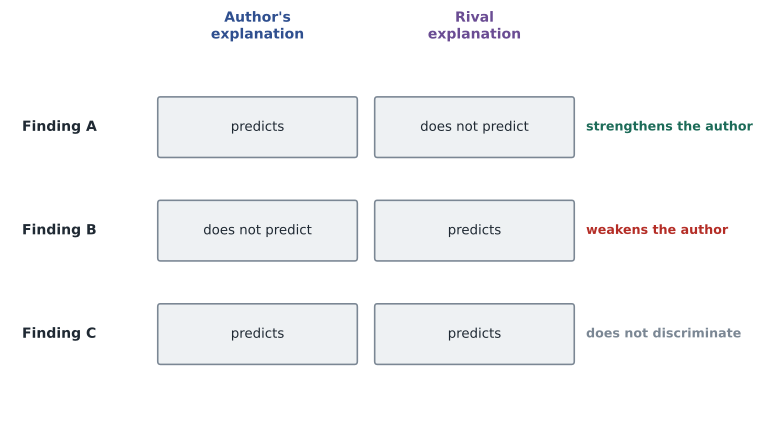
- Check that the choice actually differs between rival explanations; a finding both explanations predict decides nothing.
The discrimination principle
The most useful idea in this lesson comes from science: a finding helps decide between explanations only if they predict different things. If an author argues that a city declined because of drought, and a rival explanation says it declined because trade moved elsewhere, then evidence that the population fell does nothing to separate them; both explanations predict a falling population. Evidence that the decline began before any sign of drought, or that nearby cities on the same trade route declined at the same time while cities with similar rainfall did not, would discriminate.
Wrong answers on strengthen and weaken questions are often findings that sound relevant but that every explanation in the passage predicts equally. They are the CARS equivalent of a result that confirms what nobody doubted.
Practice passage: why the delta city emptied
The passage below was written for this course. Site K and its neighbours are invented, although the pattern it describes, a trading city weakened by a shifting river, is a familiar one in archaeology.
Passage
Around the beginning of the second millennium BCE, the people of a large city on a river delta, whose ruins archaeologists now call Site K, began to leave. Within about two centuries, the city that had held tens of thousands was reduced to a few scattered households. The usual explanation is environmental. Sediment cores from the region show that rainfall declined over the same period, and a long drought, the argument runs, would have ruined the farms on which the city depended.
The drought explanation has much to recommend it. The timing fits, and the city’s agriculture, irrigated by seasonal floods, was vulnerable to any change in the river. But it leaves an awkward fact unexplained. Several smaller towns upriver, which depended on the same floods and suffered the same decline in rainfall, did not shrink. Some of them grew. If drought emptied Site K, why did it spare its neighbours?
A better account begins with the city’s role in trade. Site K stood at the mouth of the river, where goods from the interior were loaded onto seagoing vessels. Its wealth, and much of its population, depended on that position. Excavations show that the city’s workshops for beads and metal goods, made largely for export, declined decades before its houses were abandoned. At about the same time, the main course of the river began to shift east, silting up the old harbour, and a new port grew on the eastern channel. The people of Site K, on this account, did not flee a failing harvest so much as follow their livelihoods to where trade had moved.
This does not mean the drought was irrelevant. A city already losing its trade would have been less able to buy grain from elsewhere when its own harvests faltered, and the two pressures probably compounded each other. But the order of events matters. Trade declined first, and the drought struck a city that had already lost the means to weather it. The upriver towns, which had never depended on the harbour, absorbed the same drought without collapsing.
The case is a reminder that environmental change rarely acts on societies directly. It acts through the arrangements people have made, and the same shock can be survivable or ruinous depending on what else is happening.
The target claims
Author’s thesis: Site K emptied mainly because its trade moved (river shift, new port), with drought compounding a decline already under way. Rival: drought was the main cause. Key evidence: upriver towns with the same drought did not shrink; export workshops declined before houses were abandoned; the harbour silted as the river shifted.
Questions
Question 1. Which finding, if true, would most strengthen the author’s explanation?
- A. Rainfall in the region declined by a substantial amount during the period.
- B. The new eastern port grew rapidly during the same decades in which Site K’s export workshops declined.
- C. Site K’s population fell over two centuries.
- D. The upriver towns grew wheat rather than barley.
Answer: B. A port growing as Site K’s trade fell is predicted by the trade explanation but not by the drought explanation. A is predicted by both and is already in the passage. C is the fact both explanations try to explain. D is irrelevant to either.
Question 2. Which finding would most weaken the author’s argument?
- A. Analysis shows that the export workshops kept operating at full capacity until the last decades of the city’s occupation.
- B. The upriver towns traded with the new eastern port.
- C. Some households remained at Site K for several generations.
- D. The river shifted gradually rather than suddenly.
Answer: A. The author’s order of events, trade first, drought second, rests on workshops declining before abandonment. If they did not, the key evidence for the trade explanation disappears. B and C are consistent with the author. D does not affect the argument, which never claims the shift was sudden.
Question 3. Suppose archaeologists discover that the upriver towns stored grain in large public granaries, while Site K did not. How would this most likely affect the author’s argument?
- A. It would strongly support it, because it shows Site K depended on trade.
- B. It would weaken it somewhat, by offering another reason the upriver towns survived the drought.
- C. It would have no bearing on it.
- D. It would show that the drought never occurred.
Answer: B. The author uses the upriver towns’ survival as evidence that drought alone does not explain Site K’s decline. Granaries offer an alternative reason for their survival, so the contrast becomes weaker evidence for the trade explanation. It does not refute the argument, which also rests on the workshop and harbour evidence, so “somewhat” is the right strength.
Question 4. Which finding would be most consistent with the passage’s final paragraph?
- A. A coastal town that depended entirely on fishing survived a severe storm season that destroyed an inland town dependent on a single crop.
- B. A drought caused every town in a region to be abandoned at once.
- C. A society’s arrangements had no effect on its response to environmental change.
- D. A city declined for reasons that had nothing to do with the environment.
Answer: A. The final paragraph says the same shock can be survivable or ruinous depending on people’s arrangements; A shows a shock affecting differently arranged towns differently. B and C contradict the principle; D is beside the point.
| Wrong-answer type | What it does | Example from the Site K questions |
|---|---|---|
| Non-discriminating | Is predicted by both the author and the rival | “Rainfall declined during the period.” |
| Restates the passage | Repeats evidence already given, so adds nothing new | “Site K’s population fell over two centuries.” |
| Wrong target | Bears on the rival view or a minor claim instead of the target | “The drought was especially severe in the upriver towns.” (would bear on the drought view) |
| Wrong strength | Says a finding destroys or proves a claim when it only shifts its likelihood | “It would show that the drought never occurred.” |
| Irrelevant | Concerns neither explanation | “The upriver towns grew wheat rather than barley.” |
Worked problem
Judging the strength of an effect
A choice says: “Pottery found at the new eastern port includes vessels in Site K’s style, dated to the decades of its decline.” How strongly does this support the author?
Show solution
- Target: people left Site K to follow trade to the new port.
- The finding suggests people from Site K, or its trade networks, moved to the new port during the decline.
- The drought explanation does not predict this movement toward the new port specifically, so the finding discriminates.
- It does not prove the trade explanation; styles can spread by trade alone. But it is strong support.
Answer: It strengthens the author’s explanation substantially, though it does not settle the matter.
Findings that cut both ways
Occasionally a new finding supports one part of an author’s argument while weakening another. Suppose archaeologists found that Site K’s harbour silted up rapidly, but only after most of the houses had already been abandoned. That would support the claim that the river shifted, while undermining the claim that the shift drove people away, because the timing would be wrong. Questions built on such findings usually ask about one specific claim, so the effect on that claim is what counts. Read the stem twice: “the author’s claim that the river shift caused the decline” and “the author’s claim that the river shifted” are different targets.
Another family of questions combines a finding with a request for the author’s best explanation of it: “Which of the following, if true, would best explain why the upriver towns grew during the drought?” Here the right answer is a finding that fits the author’s framework and fills a gap the author left open. For example, evidence that upriver towns took in people who had left Site K would explain their growth in a way consistent with the passage’s account of migration. Answers that explain the growth by a factor the author never considered may be true, but they do less to connect the facts to the author’s argument.
Answering in the author’s voice
Some questions ask how the author would respond to new information rather than how it would affect the argument. The method is the same with one more step: after judging the effect, ask what the author, given their reasoning, would say. Authors in CARS passages rarely abandon their views at the first contrary finding. They usually absorb it, as the Site K author absorbs the drought by making it a compounding factor. A choice in which the author says “this shows I was wrong” is less likely than one in which the author qualifies or explains.
Elliot’s lab notebook
Elliot started drawing a tiny two-column table for these questions: author’s explanation, rival explanation, and a check mark under each for whether it predicted the finding. It took him ten seconds and made the discriminating choice jump out. He got all four Site K questions right. Devika, who preferred to keep things in her head, admitted the table was faster on the question about granaries, where she had been tempted by “no bearing.” Ezequiel said it reminded him of differential diagnosis: “Every symptom you check should rule something in or out. If it doesn’t, it was a waste of a question.”
Common mistakes
MistakeAny finding that is relevant to the topic strengthens or weakens the argument.
InsteadOnly findings that the author’s and the rival’s explanations predict differently discriminate between them.
MistakeStrengthening the view the author rejects strengthens the author.
InsteadIdentify the target claim first; support for a rival is a weakener.
MistakeA finding that complicates the argument destroys it.
InsteadMatch the strength: most findings shift likelihood rather than prove or disprove.
MistakeEvidence already in the passage is a good strengthener.
InsteadStrengtheners add new support; restating the passage adds nothing.
MistakeAuthors respond to contrary evidence by abandoning their views.
InsteadCARS authors usually qualify or absorb new findings.
Summary and key terms
- New-information questions ask how a finding would affect a claim: strengthen, weaken, challenge or be consistent with it.
- Name the target claim precisely, with its scope and the reasons behind it.
- A finding discriminates only if the author’s and rival explanations predict it differently.
- Wrong answers are often non-discriminating, restated, aimed at the wrong target, wrong in strength or irrelevant.
- Judge degree: most findings make a claim more or less likely without settling it.
- When asked how the author would respond, expect qualification rather than surrender.
- Strengthen
- Make a claim more likely to be true.
- Weaken
- Make a claim less likely to be true.
- Target claim
- The specific claim a new-information question asks about.
- Discriminating evidence
- A finding that one explanation predicts and a rival does not.
- Rival explanation
- An alternative account of the same facts, often one the author rejects.
- Compounding factor
- A cause that worsens the effect of another cause.
Practice problems
Work each problem on paper first, then reveal the answer to check.
Why does “rainfall declined” not strengthen the author’s trade explanation?
Show answer
Both explanations accept that rainfall declined; it does not discriminate between them.
Which piece of the author’s evidence would be most damaged by finding that workshops kept operating until the end?
Show answer
The order of events: trade declining before abandonment.
How does the author handle the drought, which might seem to support the rival view?
Show answer
By treating it as a compounding factor that struck a city already weakened by lost trade.
What effect would evidence that upriver towns also lost population have?
Show answer
It would weaken the author, whose key contrast is that the upriver towns survived the drought.
Give a finding consistent with the passage’s final paragraph from a different field.
Show answer
For example, two firms facing the same price shock, where the one with savings survives and the indebted one fails.
Lesson quiz · 5 questions
Score 60% or more to complete this lesson.
Create a free account to save your progress, take quizzes and earn a certificate.