
MCAT-140 · Lesson 3 of 12 · 22 min
Foundations of comprehension: main idea and purpose
▶ Video coming soon A video version of this lesson is on the way.
Ezequiel came to the session annoyed with himself. He had missed a main-idea question on a practice passage about Renaissance gardens, choosing an answer that was, he insisted, in the passage word for word. “That’s exactly why it was wrong,” said Thandiwe. “It was in the passage. It was in paragraph four. The main idea is in the whole passage.” She asked the group to try a different test for main-idea answers: could the author have written that sentence as the passage’s title, and would the whole passage stand behind it?
Main-idea and purpose questions are the core of the Foundations of Comprehension skill area. They ask what a passage is about in the fullest sense: not just its topic, but its point, and why the author wrote it. This lesson separates topic, scope and main idea, shows where theses tend to hide, gives a vocabulary for describing an author’s purpose, and works through the traps that make these questions harder than they look.
Topic, scope and main idea
Three layers sit inside every passage. The topic is the general subject: “the restoration of old paintings.” The scope is the particular part of that subject the author addresses: “whether restorers should remove later additions to a painting.” The main idea is the author’s claim about that scope: “restorers should usually preserve later additions, because they are part of the painting’s history.” A main-idea answer must match all three.
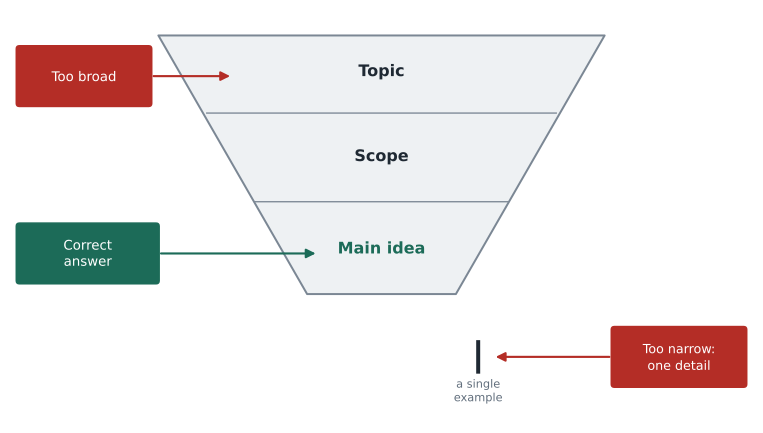
Most wrong answers to main-idea questions fail on scope. A too-broad answer describes the topic, or claims more than the author argued: “Old paintings should never be altered.” A too-narrow answer describes one paragraph or one example: “A seventeenth-century portrait was overpainted in the eighteenth century.” A third kind of wrong answer has the right scope but the wrong claim: it reverses the author’s view, or states a view the author reported but rejected.
Where the thesis lives
Students are often taught that the thesis comes at the end of the first paragraph. In CARS, that is true only some of the time. Authors adapted for the test frequently open with someone else’s view, a story or a puzzle, and reveal their own position in the second or third paragraph, after a turn. Some never state the thesis in one sentence at all, and you must assemble it from the turn and the conclusion.
Four common structures cover most passages.
| Structure | How it unfolds | Where the main idea usually is |
|---|---|---|
| Old view, new view | A conventional view is set out, then challenged or qualified | After the turn, often paragraph 2 or 3, and again in the conclusion |
| Puzzle and explanation | A surprising fact or question, followed by an explanation | In the explanation the author favours, often after rival explanations are rejected |
| Problem and proposal | A problem is described, then a solution is offered | In the proposal and the reasons for it |
| Comparison | Two cases, works or ideas are set side by side | In what the comparison reveals, usually stated near the end |
Your passage map from lesson 2 is the main tool here. If your main-point line has two halves, what the author grants and what the author claims, the right answer will usually have both halves too.
Purpose: why the author wrote it
Purpose questions ask what the author is doing, rather than what the author is saying. They often begin “The primary purpose of the passage is to…” and the choices start with verbs. The verb is half the answer, so it pays to have a precise vocabulary.
| Verb | Means the author mainly… | Usually wrong if the passage… |
|---|---|---|
| Argue, contend, defend | Takes a position and supports it | Mostly describes without taking sides |
| Describe, explain | Sets out how something is or works, with little evaluation | Takes a clear stand for or against |
| Criticize, challenge, refute | Attacks a view; refute implies showing it is false | Only qualifies a view or grants much of it |
| Qualify, refine, complicate | Accepts a view in part but limits or adds to it | Rejects the view entirely |
| Propose, recommend | Suggests a course of action or a new approach | Offers no solution or action |
| Compare, contrast | Weighs two things against each other | Discusses one thing at length |
| Trace, survey | Follows a development over time or across a field | Focuses on a single moment or argument |
Strength matters as much as direction. The standard time passage in lesson 2 qualifies the usual account; it does not refute it. A choice saying the author’s purpose is “to refute the claim that railways caused standard time” would be too strong, even though it points in roughly the right direction.
Practice passage: the restorer’s dilemma
Read the passage, written for this course, and build a map. Pay particular attention to where the author’s own view appears.
Passage
When a painting is restored, the public tends to imagine a simple process: grime is removed, colours brighten, and the work returns to the state in which its maker left it. Restorers know the matter is less tidy. Paintings do not merely get dirty. Over centuries they are cut down to fit new frames, partly painted over to suit new tastes, repaired with materials that later discolour, and varnished again and again. A painting that reaches us after four hundred years is a record not only of one artist’s intentions but of everything that later owners, dealers and restorers chose to do to it.
For much of the twentieth century, the dominant view in restoration held that later additions were corruptions to be stripped away. The goal was to recover the original as nearly as possible. This view had obvious appeal. It honoured the artist, it gave restorers a clear standard, and its results could be spectacular: faces emerged from brown varnish, landscapes regained their skies, and hidden figures reappeared under later paint.
Yet the pursuit of the original rests on an assumption that does not survive scrutiny: that there is a single original state, recoverable with enough skill. Many painters revised their own work over years. Some expected later varnish to tone down colours they had deliberately made bright. And removing a later layer is irreversible. A restorer who strips an eighteenth-century overpainting to reveal a seventeenth-century face has destroyed one historical object to recover another, and has done so on a judgment about which of the two matters more.
None of this means that nothing should be removed. Discoloured varnish that hides the whole surface, or a crude repair that obscures a figure, can reasonably be taken off. But the burden of proof should shift. Rather than treating every later addition as an error unless shown otherwise, restorers should treat each layer as part of the painting’s history unless there is a strong reason, documented and open to review, to remove it. The question to ask is not “What did the artist intend?” but “What will we lose, and is the gain worth it?”
Such a standard will produce fewer dramatic unveilings. Paintings will sometimes look older and darker than the public expects. That is a price worth paying. A painting is not a photograph of a moment in a workshop. It is an object that has lived a long life, and restoration should respect that life rather than pretend it never happened.
A map: P1, sets up the complexity: paintings carry later layers. P2, the old view (not the author’s): remove additions to recover the original; its appeal. P3, turn: the old view’s assumption fails (no single original; removal irreversible). P4, author’s proposal with concession: some removal is fine, but shift the burden of proof toward keeping layers. P5, conclusion: accept fewer dramatic results; respect the painting’s history. Main point: restorers should generally preserve later layers as part of a painting’s history and remove them only with strong, documented reasons. Tone: thoughtful, firm, conceding some ground.
Questions
Question 1. The author’s central thesis is that:
- A. restoration has made old paintings look brighter than their makers intended.
- B. restorers should regard a painting’s later layers as part of its history and remove them only for strong, documented reasons.
- C. no later addition to a painting should ever be removed.
- D. twentieth-century restorers lacked the technical skill to recover original paintings.
Answer: B. It matches the proposal in paragraph 4 and the conclusion in paragraph 5. A is a narrow point suggested in paragraph 3, not the thesis. C is too extreme; the author explicitly allows some removal. D misreads the passage: the author faults the old view’s assumption, not restorers’ skill.
Question 2. The primary purpose of the passage is to:
- A. describe the techniques used to remove varnish and overpainting.
- B. challenge a prevailing approach to restoration and propose an alternative standard.
- C. defend the twentieth-century goal of recovering the original painting.
- D. compare the restoration practices of several countries.
Answer: B. The author challenges the old view (paragraph 3) and proposes a new burden of proof (paragraph 4). A describes content the passage does not cover. C reverses the author’s position. D introduces a comparison that does not exist.
Question 3. Paragraph 2 functions primarily to:
- A. present the author’s own view of restoration.
- B. set out a view, and its attractions, that the author goes on to question.
- C. provide evidence that later layers should be preserved.
- D. describe the history of varnish.
Answer: B. “The dominant view” and the absence of the author’s endorsement mark it as a reported view; paragraph 3 opens with “Yet.” Observe, too, that the author is fair to the old view, listing its appeal. Fairness to an opposing view is common in CARS and does not mean the author agrees with it.
Worked problem
Testing a main-idea answer
A student is torn between two answers for the restorer passage: (1) “Removing later layers from paintings is irreversible.” (2) “Restorers should shift the burden of proof toward preserving a painting’s later layers.” How should she decide?
Show solution
- Ask whether the whole passage stands behind each choice. Choice 1 is a reason given in paragraph 3; paragraphs 1, 4 and 5 do not exist to establish it.
- Choice 2 is the proposal that paragraph 3 builds toward and paragraph 5 defends; every paragraph contributes to it.
- Apply the title test: “Shifting the burden of proof in restoration” could title the passage; “Removal is irreversible” could title only one paragraph.
Answer: Choice 2. Choice 1 is true and supported, but it is a supporting detail, not the main idea.
The explanation to question 3 is a reminder that many CARS answers turn on small things, such as the absence of an endorsement. It is worth training your eye for what an author does not say as well as what they do.
Traps in main-idea and purpose questions
- The true detail: a choice that is accurate and taken from the passage but covers only part of it.
- The topic restatement: a choice that names the subject but makes no claim about it.
- The reported view: a choice that states a view the author describes but does not hold.
- The exaggeration: a choice that turns “usually” into “always” or “qualify” into “refute.”
- The outside truth: a choice that is a reasonable thing to believe about the topic but is not what this passage argues.
When two choices both look good, compare them on scope and strength. The right one usually covers more of the passage and claims exactly as much as the author does. If one choice is a sentence you could underline in a single paragraph and the other summarizes several, the summary is usually the main idea.
Elliot’s rule
By the end of the session Elliot had written a rule on a sticky note: “Main idea = my map’s last line, both halves.” On his next practice set he answered all three main-idea questions correctly for the first time. He still missed a purpose question, choosing “criticize” for a passage that only qualified a view. Thandiwe pointed out that the passage spent two paragraphs praising the view before limiting it. “Count the paragraphs,” she said. “An author who spends forty percent of a passage on what is right about a view is not attacking it.” Elliot crossed out “forty percent” in his notes and wrote “two paragraphs out of five,” because he had decided he hated percentages.
Common mistakes
MistakeThe main idea is the first sentence of the passage.
InsteadMany CARS passages open with someone else’s view or a story; the thesis often follows a turn.
MistakeAn answer taken word for word from the passage must be right.
InsteadA true detail from one paragraph is usually too narrow to be the main idea.
MistakeIf the author criticizes a view at all, the purpose is to refute it.
InsteadCheck the strength: authors often qualify or refine a view while granting much of it.
MistakeFairness to an opposing view means the author agrees with it.
InsteadAuthors often set out the appeal of a view before challenging it.
MistakeA choice naming the topic is a safe main-idea answer.
InsteadThe main idea is a claim about the topic at the right scope, not the topic itself.
Summary and key terms
- Distinguish topic (subject), scope (the part addressed) and main idea (the author’s claim about that part).
- Wrong main-idea answers are usually too broad, too narrow, reversed or someone else’s view.
- The thesis often appears after a turn rather than in the first sentence; your map’s main-point line is the tool for finding it.
- Purpose questions hinge on the verb: argue, describe, criticize, qualify, propose, compare, trace.
- Match both direction and strength: qualify is not refute, usually is not always.
- The title test: would the whole passage stand behind this choice as its title?
- Topic
- The general subject of a passage.
- Scope
- The particular aspect of the topic that the passage addresses.
- Main idea
- The author’s central claim about the scope of the passage.
- Primary purpose
- What the author is mainly trying to do in the passage, expressed as a verb.
- Burden of proof
- Which side must give reasons before a choice is made; in the restorer passage, whoever wants to remove a layer.
- Too-narrow choice
- An answer that is accurate for one part of the passage but not for the whole.
Practice problems
Work each problem on paper first, then reveal the answer to check.
State the topic, scope and main idea of the restorer passage.
Show answer
Topic: painting restoration. Scope: whether later additions to paintings should be removed. Main idea: later layers should generally be preserved as part of a painting’s history and removed only for strong, documented reasons.
Why is “no later addition should ever be removed” wrong as a main idea?
Show answer
It is too extreme; paragraph 4 explicitly allows removing discoloured varnish or crude repairs.
Which purpose verb best fits the standard time passage in lesson 2: refute, qualify or describe?
Show answer
Qualify; the author calls the usual account “not wrong” but says it leaves out the social side.
What does the final sentence of paragraph 4 in the restorer passage contribute?
Show answer
It restates the author’s proposed standard as a question restorers should ask, sharpening the thesis.
Give one sign in the restorer passage that paragraph 2 is not the author’s view.
Show answer
It is introduced as “the dominant view” of the past century, and paragraph 3 opens with “Yet” to challenge it.
Lesson quiz · 5 questions
Score 60% or more to complete this lesson.
Create a free account to save your progress, take quizzes and earn a certificate.