
MCAT-140 · Lesson 5 of 12 · 21 min
Foundations of comprehension: meaning in context and rhetorical function
▶ Video coming soon A video version of this lesson is on the way.
Ezequiel had been an EMT for five years, and he brought the habits of that work to CARS. “On a call, words mean one thing,” he said. “‘Stable’ means stable. If somebody uses it loosely, people get hurt.” Thandiwe agreed that this was a fine habit for an ambulance and a dangerous one for CARS. “In these passages, authors use ordinary words in particular senses, and the test asks which sense,” she said. “The answer that gives the dictionary meaning is usually the trap.”
This lesson covers two closely related kinds of comprehension question. Meaning-in-context questions ask what a word, phrase or sentence means as the author uses it. Rhetorical-function questions ask what a sentence, example, quotation or paragraph is doing in the argument. Both reward the same habit: reading a piece of text in light of its surroundings, rather than on its own.
Words in context
A typical stem reads: “As it is used in paragraph 3, the word ‘economy’ most nearly means…” The choices will include the most common meaning of the word (“the system of production and trade”), a less common meaning that fits the passage (“careful, sparing use”), and one or two others. If the most common meaning were right, the question would not be worth asking. That is not a rule, but it is a strong tendency, and it should make you suspicious of the dictionary-first answer.
The reliable method has three steps. First, go back and read the sentence containing the word, plus the sentence before and after. Second, cover the choices (mentally or with your hand) and say what word you would put in its place. Third, find the choice closest to your substitute, and test it by reading the sentence with that choice in place. If the sentence still makes sense and says what the author meant, you have the answer.
Worked problem
Predicting before choosing
An author writes about a poet: “Her late poems are marked by a severe economy; she cut every adjective she could live without, and some she could not.” What does “economy” most nearly mean? A. a system of trade. B. thrift with money. C. sparing use of words. D. financial hardship.
Show solution
- Read around the word: the next clause explains it, “she cut every adjective she could live without.”
- Predict a substitute: “restraint” or “sparseness” in the use of words.
- Match: C fits. B is close in spirit but about money, which the passage never mentions. A and D are financial senses.
Answer: C. The surrounding clause defines the word for you.
Three kinds of wording need extra care. Words in quotation marks are often used ironically or in a sense the author disputes; the author may be quoting someone else’s term (“so-called ‘progress’”) to distance themselves from it. Metaphors must be read as metaphors: when an author calls a policy “a bridge to nowhere,” the meaning is about purpose and outcome, not engineering. And technical terms that a passage defines must be read with the passage’s definition, even if you know a different one from another field.
Rhetorical function
Function questions ask why something is there. “The author mentions the 1910 survey primarily in order to…”; “The quotation in paragraph 2 serves to…”; “Which statement best describes the role of the final paragraph?” The answer is always about the argument: the item supports a claim, illustrates it, introduces a view, concedes a point, raises an objection, or concludes.
| Role | What it does | Signals |
|---|---|---|
| Thesis or claim | States a position the passage supports | I would argue, the point is, in fact |
| Support or evidence | Gives a reason or data for a claim | because, for instance, the records show |
| Illustration | Makes a general point concrete | consider, take the case of, imagine |
| Counterexample | Shows a general claim has exceptions | yet in, but consider, not always |
| Concession | Grants a point to the other side | admittedly, to be sure, granted |
| Objection | Raises a problem for a view (often the opponent’s) | but this ignores, the difficulty is |
| Background | Supplies context needed to follow the argument | historically, until recently, in the past |
| Analogy | Explains one thing by comparison with another | just as, much like, in the same way |
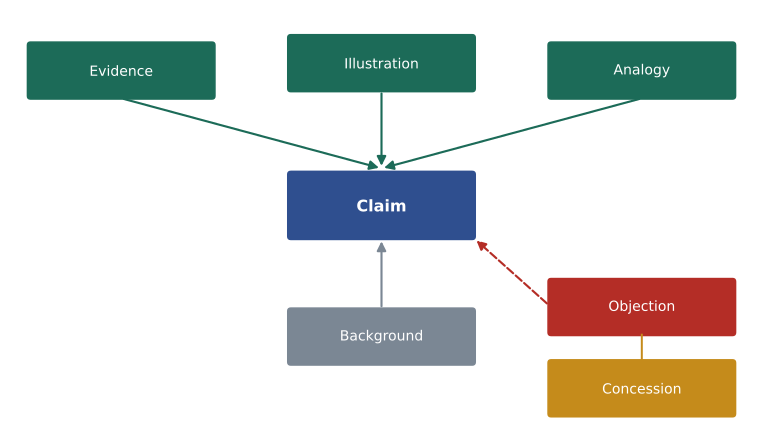
The most common error in function questions is answering with the content of the item rather than its role. If an author mentions an early survey of a forest, a choice that says the survey “recorded the number of trees” describes what the survey did, not why the author mentions it. The correct choice will say something like “to show that early observers already noticed the change the author describes.” Ask “why did the author put this here?” rather than “what does this say?”
A second error is to treat an illustration as more important than it is. Examples in CARS passages support general claims, and questions about them almost always point back to the general claim. If you are asked why the author describes a particular village, the answer is rarely about the village.
Practice passage: the meanings of wilderness
Passage
Few words in environmental debate carry as much weight as “wilderness,” and few have changed meaning so thoroughly. For the early European settlers of North America, as for many of their ancestors, wilderness was a place of danger and moral peril: the forest beyond the clearing, where crops failed, travellers were lost and temptation flourished. To call land wilderness was to say that it had not yet been improved. The word was an invitation to work.
By the end of the nineteenth century, the same word had begun to mean almost the opposite. For a growing number of writers and naturalists, wilderness was a refuge from the noise and corruption of cities, a place where one could meet nature unaltered and recover something lost. Land that had once needed taming now needed protecting. Societies were formed, parks established, and “wilderness” became a term of praise.
This reversal is often told as a story of moral progress, in which an exploitative attitude gave way to a reverent one. The story is not false, but it carries a hidden cost. The newer meaning kept something essential from the older one: the idea that wilderness was land without people. In the earlier sense, the absence of people meant the land was waiting to be used; in the later sense, it meant the land was pure. In both, the people who already lived there, and whose fires, paths and harvests had shaped the landscape for generations, were made to disappear.
The consequences were not merely verbal. In several places, the creation of protected areas involved the removal of resident communities, whose presence was seen as spoiling the very wildness that made the land worth protecting. A landscape that had been tended was declared untouched, and those who had tended it were treated as intruders. The word did work in the world.
None of this is an argument against protecting land. It is an argument for a more honest vocabulary. Many ecologists now speak of landscapes as shaped by long histories of human and nonhuman activity together, and of protection as a matter of caring for those relationships rather than freezing an imagined pristine state. That language is less romantic than “wilderness.” It is also closer to the truth.
Questions
Question 1. As used in paragraph 1, the phrase “an invitation to work” most nearly means that calling land wilderness:
- A. suggested it was a pleasant place to spend one’s working hours.
- B. implied that the land ought to be cleared and cultivated.
- C. was a way of advertising jobs in the forest.
- D. encouraged visitors to study the land scientifically.
Answer: B. The preceding sentence says wilderness meant land that “had not yet been improved.” The phrase is figurative; C reads it literally.
Question 2. The author’s use of “wilderness” in quotation marks in paragraph 5 most likely indicates that the author:
- A. is quoting a specific nineteenth-century writer.
- B. regards the term as carrying assumptions worth questioning.
- C. believes the word is no longer used.
- D. wishes to define the word technically.
Answer: B. The whole passage examines what the word assumes; the quotation marks hold it at a distance.
Question 3. The author mentions the removal of resident communities in paragraph 4 primarily in order to:
- A. show that the shared assumption in both meanings of wilderness had real consequences.
- B. argue that protected areas should be abolished.
- C. describe the history of a particular national park.
- D. explain why naturalists preferred protected land to cities.
Answer: A. The paragraph’s final sentence, “The word did work in the world,” states its function. B contradicts paragraph 5. C confuses a general point with a particular case. D belongs to paragraph 2.
Question 4. Paragraph 3 functions primarily to:
- A. present the author’s argument that the two meanings share a hidden assumption.
- B. provide evidence that the reversal of meaning was moral progress.
- C. introduce a new definition of wilderness.
- D. summarize the views of nineteenth-century naturalists.
Answer: A. After granting the progress story (“not false”), the author identifies what both meanings kept: land without people. B is the story the author qualifies.
Question 5. The word “tended” in paragraph 4 is closest in meaning to:
- A. inclined toward.
- B. cared for and managed.
- C. guarded by soldiers.
- D. occasionally visited.
Answer: B. Paragraph 3 describes “fires, paths and harvests” that shaped the land, so “tended” means cared for through use. A is a different sense of “tend.”
Function at the paragraph level
Questions about whole paragraphs are function questions on a larger scale, and your passage map answers them directly. In the wilderness passage, a map might read: P1 old meaning (danger, to be improved); P2 new meaning (refuge, to be protected); P3 author’s claim: both meanings erase people; P4 consequences of that erasure; P5 proposal for more honest language. If a question asks about paragraph 4, you already know: it shows consequences. The answer choice will use different words, but the idea will match.
Paragraph-function questions often ask about the first or last paragraph. First paragraphs commonly set out background or the view to be challenged; last paragraphs commonly conclude, qualify, or propose. In the wilderness passage, the last paragraph does all three: it limits the argument (“None of this is an argument against protecting land”), concludes (“an argument for a more honest vocabulary”) and points toward an alternative.
When the passage redefines a word
Authors sometimes announce that they will use a word in a special sense: “By ‘tradition’ I mean not a fixed body of customs but a continuing argument about which customs matter.” When that happens, the author’s definition governs every later use of the word in the passage, and questions about it will test whether you kept hold of the new sense. A passage may also contrast two senses of one word and argue for one of them, as the wilderness passage does over five paragraphs. In that case, a question about the word in a particular paragraph wants the sense active in that paragraph, which may be the one the author rejects.
Function questions can also target a single word or phrase rather than a sentence. “The author uses the word ‘merely’ in paragraph 4 to…” asks what the word contributes, which is often a judgment: “merely” belittles, “even” emphasizes, “only” limits. Small words of this kind can change the force of a whole sentence, and authors choose them deliberately. Reading them as signals rather than filler is part of what Thandiwe calls reading like the author rather than like a stranger to the text.
Devika’s sense-check
Devika rarely missed meaning-in-context questions, and Thandiwe asked her to explain why. She said she always read the answer back into the sentence aloud, quietly, as if she were the author. “If it sounds like something a person would actually write, it’s probably right. If it sounds like a dictionary entry dropped into the paragraph, it’s probably wrong.” Elliot tried it on a practice question about the word “currency” in a passage about ideas, and chose “acceptance” over “money” for the first time. Ezequiel, who had chosen “money” too, wrote a new line in his error log: “Read the word back in. Would the author say that?”
Common mistakes
MistakeThe most familiar meaning of a word is the safest answer.
InsteadMeaning-in-context questions usually test a less common sense; predict from the surrounding sentences first.
MistakeQuotation marks always mean the author is citing someone.
InsteadThey often signal distance or irony: the author is questioning the term.
MistakeA function question asks what an example says.
InsteadIt asks why the author included it; answer with its role in the argument.
MistakeAn example is important for its own sake.
InsteadExamples support general claims; the answer usually points back to the claim.
MistakeMetaphors can be read literally.
InsteadRead figurative language for its point about purpose, quality or outcome.
Summary and key terms
- Meaning-in-context questions ask how the author uses a word; predict a substitute from the surrounding sentences before reading the choices.
- Be wary of the most common dictionary meaning, of terms in quotation marks and of metaphors read literally.
- Function questions ask why a sentence, example, quotation or paragraph is in the passage.
- Common roles include claim, evidence, illustration, counterexample, concession, objection, background and analogy.
- Answer function questions with the item’s role in the argument, not its content.
- Your passage map answers paragraph-function questions directly.
- Meaning in context
- The sense a word or phrase carries in a specific passage, as opposed to its general dictionary meaning.
- Rhetorical function
- The role a part of a passage plays in the argument.
- Scare quotes
- Quotation marks used to signal that the author doubts or distances themselves from a term.
- Illustration
- An example that makes a general claim concrete.
- Counterexample
- A case that shows a general claim does not always hold.
- Analogy
- An explanation of one thing by comparison with another.
Practice problems
Work each problem on paper first, then reveal the answer to check.
In the wilderness passage, what shared assumption does the author find in both meanings of the word?
Show answer
That wilderness was land without people.
What is the function of the sentence “The word did work in the world”?
Show answer
It states the point of paragraph 4: the meaning of the word had real consequences for people.
A choice says the author mentions protected areas “to describe how parks are managed today.” Why is it wrong?
Show answer
It gives content rather than role, and the paragraph is about past removals as a consequence of the word’s assumption.
In “Her prose has a certain currency among younger writers,” what does “currency” most nearly mean?
Show answer
Acceptance or popularity, not money.
What three things does the final paragraph of the wilderness passage do?
Show answer
It limits the argument, states the author’s conclusion and points to an alternative vocabulary.
Lesson quiz · 5 questions
Score 60% or more to complete this lesson.
Create a free account to save your progress, take quizzes and earn a certificate.