
MCAT-140 · Lesson 8 of 12 · 22 min
Reasoning beyond the text: applying ideas to new contexts
▶ Video coming soon A video version of this lesson is on the way.
Elliot liked application questions at first. “Finally, something that isn’t in the passage,” he said. Then he got four of them wrong on a practice set. Each time he had chosen the scenario that looked most like the passage: same field, same kind of people, same vocabulary. Thandiwe showed him one of his misses. The passage was about how small towns police their own members through gossip; the correct answer was a scenario about an online forum for amateur astronomers, which shared nothing with a small town except the mechanism. “You matched the costume,” she said. “Match the skeleton.”
Reasoning Beyond the Text is the largest skill area on CARS, at about 40 percent of questions. This lesson covers the first of its two halves: applying the passage’s ideas to situations the passage does not mention. Lesson 9 covers the second: judging how new information would affect the passage’s claims. Both depend on understanding the author’s principles well enough to use them, which is a deeper kind of comprehension than recall.
What application questions ask
Application questions place a new case in front of you and ask how it relates to the passage. Common stems include: “Which of the following situations is most analogous to the one described in paragraph 3?”; “The author would most likely regard which of the following as an example of X?”; “Based on the passage, how would the author respond to a critic who claimed Y?”; “If the principle described in the passage were applied to Z, which outcome would be expected?”
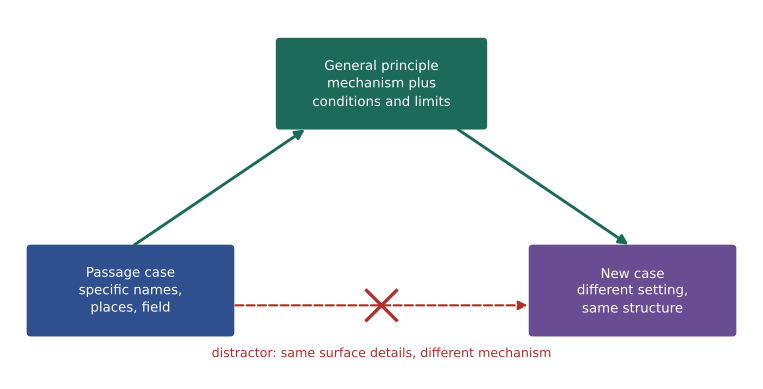
All of these require the same two steps. First, extract the principle: state, in general terms, the rule, mechanism or distinction the author describes. Second, test each choice against that principle, not against the surface details of the passage.
Extracting the principle
A principle is a statement that could apply to cases the author never mentions. To extract one, strip out the particulars: names, places, dates, the specific field. What remains should be a relationship between abstract things. “Savings clubs work because missing a payment means letting down neighbours” becomes “a commitment enforced by social reputation helps people stick to a plan they might otherwise abandon.” That principle applies to exercise partners, writing groups and public pledges as well as to savings clubs.
Good principles include the author’s conditions and limits. If the author says the mechanism works only among people who expect to keep seeing each other, that condition belongs in the principle, and it may be exactly what separates the right answer from a tempting wrong one.
Surface and structure
Wrong answers on application questions very often share the passage’s surface but not its structure. They use the same field, the same kind of people or the same vocabulary, while the mechanism differs. Right answers often look unrelated at first and share only the structure. Psychologists who study analogy have long noted that people are drawn to surface similarity even when they know structure is what matters; CARS writers rely on that pull.
| Feature of a choice | Surface match | Structural match |
|---|---|---|
| Same topic or field as the passage | Yes | Not necessarily |
| Same kind of people or setting | Yes | Not necessarily |
| Same causal relationship or mechanism | Not necessarily | Yes |
| Satisfies the author’s conditions and limits | Not necessarily | Yes |
| Likely to be correct on CARS | Only if it also matches structurally | Yes |
Practice passage: the obligation of gifts
Passage
Anthropologists have long observed that in many societies a gift is never simply a gift. To receive something is to accept an obligation: to acknowledge the giver, to return a gift of suitable value at a suitable time, and, by doing so, to keep a relationship alive. The return must not come too quickly, for a gift returned at once looks like a payment, a way of closing an account rather than continuing a bond. Nor can it come too late, or the relationship withers. The art lies in the interval.
This observation is sometimes taken to mean that gift exchange is a disguised form of trade, with the warmth of giving serving only to hide a calculation of debts. That reading misses what the interval accomplishes. In a market exchange, the transaction is complete when the goods and money change hands; the parties owe each other nothing further and may never meet again. In a gift exchange, the debt is deliberately left open. The open debt is the relationship. Each party has a reason to remain in contact, to think of the other, and to be thought of in turn.
From this perspective, an exact return is something of an insult. A guest who repays a dinner by handing over its cost in cash has not discharged an obligation but refused one. He has converted a relationship into a transaction and announced that nothing further is owed. Similarly, a gift so large that it can never be matched can become a weapon, binding the receiver in a debt that cannot be repaid and placing the giver permanently above them. Some of the most elaborate gift ceremonies recorded by ethnographers turn on precisely this use of generosity as a form of rivalry.
The modern world has not abandoned these patterns so much as confined them. Market exchange governs most of economic life, but gift exchange persists wherever people wish to build or maintain ties that markets cannot: among families and friends, in the exchange of favours among colleagues, and in the hospitality of neighbours. Its rules remain recognizable. The coworker who insists on repaying a small favour immediately, to the cent, is understood to be keeping a distance; the one who lets the favour stand until a chance comes to return it in kind is understood to be building a friendship.
What gift exchange shows, then, is not that generosity is secretly selfish, but that obligation can be a form of connection. To be in someone’s debt, in the right way, is to be in relationship with them.
The principle
Stripped of particulars: an exchange that leaves an obligation open, returned after a suitable interval and in suitable measure, sustains a relationship; an exchange closed at once or with an exact equivalent ends it; an unreturnable gift can create dominance.
Questions
Question 1. Which situation is most analogous to the dinner guest described in paragraph 3?
- A. A neighbour who brings back a borrowed ladder a week later with a jar of homemade jam.
- B. A new resident who, after a neighbour shovels her driveway, immediately offers twenty dollars for the work.
- C. A friend who forgets to return a birthday gift.
- D. A company that pays its suppliers on time.
Answer: B. Immediate, exact payment for a favour converts a relationship into a transaction, which is the guest’s error. A is the opposite: a delayed return in kind that continues the bond. D shares the vocabulary of payment but involves a market relationship where closure is expected. C involves a failed return, not an exact one.
Question 2. The author would most likely regard which of the following as an example of generosity used as a form of rivalry?
- A. A family that hosts a large wedding banquet to which all neighbours are invited.
- B. A wealthy donor who funds a village’s new well on condition that the village name it after him and consult him on local decisions.
- C. Two friends who take turns paying for lunch.
- D. A volunteer who teaches reading to adults for free.
Answer: B. A gift so large it cannot be matched, used to place the giver above the receivers, fits paragraph 3. C is balanced reciprocity, the healthy form. A and D are generous but involve no unreturnable debt used to dominate.
Question 3. Based on the passage, how would the author most likely respond to someone who argued that gift exchange is simply trade with extra steps?
- A. By agreeing, since both involve the transfer of goods.
- B. By arguing that the deliberate open debt in gift exchange sustains a relationship that trade, by closing the account, does not.
- C. By arguing that gifts have no economic value.
- D. By pointing out that markets are more efficient than gift systems.
Answer: B, which restates paragraph 2’s reply to exactly this view. C overreaches; D is outside the passage.
Question 4. A software company encourages employees to help colleagues and discourages them from tracking who owes whom. According to the principles in the passage, this policy would most likely:
- A. weaken relationships, because favours would go unpaid.
- B. support the formation of relationships by leaving obligations open.
- C. turn the workplace into a market.
- D. have no effect, since the passage is about non-industrial societies.
Answer: B. Not keeping exact accounts lets obligations stand, which the passage says builds ties. D ignores paragraph 4, which applies the principle to modern workplaces.
Worked problem
Testing choices against the principle
A choice reads: “A tourist who buys a souvenir from a market stall and pays the asking price.” Is this analogous to anything in the passage?
Show solution
- State the principle: open debts sustain relationships; closed, exact exchanges end them.
- The souvenir purchase is a closed exchange with no relationship expected.
- The passage treats market exchange as normal where no relationship is sought; it is not an insult or an error.
Answer: It illustrates ordinary market exchange, which the passage describes in paragraph 2 as complete and owing nothing further. It would be right for a question asking about market exchange, and wrong for one asking about the dinner guest’s error.
Conditions and limits
The hardest application questions turn on a condition the author attached to the principle. In the gift passage, timing matters: a return that comes too quickly looks like payment, and one that comes too late lets the relationship wither. A choice describing a friend who returns a favour after twenty years, long after contact was lost, fails the timing condition even though it involves a delayed return in kind. Reading your principle with its conditions guards against these near misses.
Limits also matter. The author says gift exchange persists where people want ties that markets cannot provide. A choice that applies gift logic to a situation where no relationship is sought, an anonymous online purchase, for instance, goes beyond the author’s scope.
Application in the other direction
Some application questions run backwards. Instead of giving you a new case and asking how the author would see it, they give you a principle from outside the passage and ask which part of the passage it fits. “Which of the following principles is best illustrated by the coworker described in paragraph 4?” The method is the same, reversed: state what the coworker in the passage actually does and why it matters to the author, then find the principle whose structure matches. A choice such as “settling a debt immediately signals a wish to limit a relationship” fits; a choice such as “people should always repay their debts promptly” states a moral rule the author does not endorse and reverses the passage’s point.
Other questions ask what the author would count as a counterexample to a principle, or which new case would fall outside it. These test the conditions directly. In the gift passage, a case in which an exact, immediate return strengthened a friendship would be a counterexample. A case in which a market purchase built no relationship would not be, because the passage expects exactly that. Asking “would the author be surprised by this?” is a quick way to tell a counterexample from a confirming case.
Elliot’s skeleton
Elliot took the advice literally. Before reading the choices on any application question, he wrote the principle in one line with no proper nouns, then wrote the word “condition” and whatever limits the author had stated. On his next set he got five of six application questions right. The one he missed involved a condition he had left out. He was, by his own account, getting better at recognizing the moment when he was about to choose the costume.
Ezequiel found application questions easier than most. He thought it came from years of protocols. “You learn the rule, then every call is a new case,” he said. “Nobody’s chest pain looks exactly like the textbook.” Thandiwe said that was the best description of the skill she had heard all year.
Common mistakes
MistakeThe most analogous choice is the one from the same field as the passage.
InsteadAnalogies are about structure; the right answer often comes from a completely different field.
MistakeApplication questions invite speculation.
InsteadThey test whether you can use the author’s principle; every correct answer follows from the passage.
MistakeA principle is a summary of the passage’s example.
InsteadA principle is stated generally, without names or places, and includes the author’s conditions.
MistakeIf a choice fits the main mechanism, conditions do not matter.
InsteadHard questions often hinge on a timing, scope or size condition the author stated.
MistakePassages about the past do not apply to modern cases.
InsteadCheck whether the author extends the principle, as the gift passage does in paragraph 4.
Summary and key terms
- Reasoning Beyond the Text is about 40 percent of CARS; application questions are one of its two halves.
- Extract the principle by removing particulars and keeping the author’s mechanism, conditions and limits.
- Match structure, not surface: wrong answers often share the field or vocabulary but not the mechanism.
- Test each choice against the principle, including its conditions.
- Questions asking how the author would respond to a critic are usually answered by a reply the passage already makes.
- Stay within the author’s scope; do not apply a principle where the author says it does not hold.
- Application question
- A question asking how the passage’s ideas apply to a situation the passage does not mention.
- Principle
- A general statement of the mechanism or rule the author describes, free of the passage’s particulars.
- Structural similarity
- Similarity in causal relationships or mechanisms, as opposed to surface features.
- Surface similarity
- Similarity in topic, setting or vocabulary.
- Reciprocity
- The exchange of gifts or favours in return, sustaining a relationship over time.
- Analogous
- Sharing the same structure or relationship as another case.
Practice problems
Work each problem on paper first, then reveal the answer to check.
State the gift passage’s principle about timing.
Show answer
A return should come after a suitable interval: too soon looks like payment and closes the relationship; too late lets it wither.
Why is an exact cash repayment an “insult” in the author’s view?
Show answer
It closes the obligation and so declares that the relationship is over.
Which is more analogous to the gift principle: a library loan returned on time, or a friend who helps you move and is later helped in return?
Show answer
The friend; the library loan is a rule-governed transaction with no relationship sustained by an open debt.
Give an example from outside the passage of generosity as rivalry.
Show answer
For example, a relative who gives a gift so lavish that the family can never reciprocate and then expects deference.
What condition would a choice fail if it described a return made decades after contact was lost?
Show answer
The timing condition: a return that comes too late does not sustain the relationship.
Lesson quiz · 5 questions
Score 60% or more to complete this lesson.
Create a free account to save your progress, take quizzes and earn a certificate.