
MCAT-140 · Lesson 12 of 12 · 29 min
Capstone: a timed CARS set
▶ Video coming soon A video version of this lesson is on the way.
For the last session of the CARS block, Thandiwe sent the group three passages she had written and eighteen questions, with an instruction: thirty minutes, one sitting, no pausing, and no looking anything up. Then a blind review: before checking the answer key, go back through every question and mark each answer as certain or uncertain, changing any you now think are wrong. “The first score tells you how you perform under time,” she said. “The second tells you how much of the gap is timing and how much is understanding. Those need different fixes.”
This lesson is that set, followed by the answer key with explanations tagged by skill area, the group’s results and debrief, and a plan for CARS on test day. Take the set yourself before reading the key. Set a timer for 30 minutes, about ten minutes per passage, and work in order. The passages and questions were written for this course; they imitate the style of CARS but are not real test items.
Passage 1
Every translator of poetry eventually confronts the same complaint: that the translation is not faithful. The complaint assumes that fidelity is a simple matter of fit, that a good translation reproduces the original’s meaning in another language as a good copy reproduces a painting. On this view, the translator’s ideal is invisibility. The reader should feel that nothing has been added and nothing lost.
The trouble is that a poem’s meaning does not live only in what its words refer to. It lives in their sound, their rhythm, the associations they carry for readers of the original language, and the way they rhyme or refuse to. A translator who preserves the literal sense of each line may lose all of these, producing a version that is accurate in every particular and dead as a whole. A translator who preserves the music may have to change what the lines say. No translation can be faithful to everything at once, and so the question is never whether to betray the original, but which betrayals to choose.
This is why the most admired translations are often the least literal. They are faithful, but to something other than the dictionary: to the poem’s tone, to its effect on a reader, to the sense of surprise its images create. Their translators make choices that a word-for-word comparison would condemn, substituting an image that carries the same charge in the new language for one that would fall flat. Readers who know both languages sometimes find these choices outrageous. Readers who know only the translation often find in it a poem, which a literal version rarely gives them.
None of this licenses a translator to do anything at all. A version that keeps nothing of the original but its title is not a translation but a new poem with a borrowed name, and should be presented as such. The translator’s freedom is bounded by an obligation to the source, but the obligation is to the poem as a living thing, not to its words as a list. Fidelity, properly understood, is not invisibility. It is a kind of responsible visibility: the translator’s choices are present in the work, and the best translators make them in the poem’s service rather than their own.
Questions 1 to 6
1. The author’s main point is that:
- A. poetry cannot be translated.
- B. fidelity in poetic translation means serving the poem’s overall life and effect, which requires choosing among unavoidable losses.
- C. literal translations are always superior to free ones.
- D. translators should feel free to change anything in the original.
2. The comparison in paragraph 1 between a translation and “a good copy” of a painting serves to:
- A. support the author’s claim that translations should be invisible.
- B. show that painting and poetry are similar arts.
- C. explain why translators admire painters.
- D. illustrate the view of fidelity the author goes on to challenge.
3. As used in paragraph 2, “betray” most nearly means:
- A. reveal a secret.
- B. deceive a reader deliberately.
- C. depart from some aspect of the original.
- D. abandon translation altogether.
4. The author’s attitude toward readers who find free translations “outrageous” is best described as:
- A. understanding but unpersuaded.
- B. contemptuous.
- C. fully in agreement.
- D. indifferent.
5. Which of the following would the author most likely consider a responsible translation choice?
- A. Replacing a sad poem with a cheerful one because readers prefer cheerful poems.
- B. Translating each word with its first dictionary entry regardless of the result.
- C. Rendering a pun that has no equivalent with a different pun in the new language that creates a similar effect.
- D. Publishing an original poem under the name of a foreign poet.
6. The author’s argument assumes that:
- A. all readers know both languages.
- B. literal translations are easy to produce.
- C. poets dislike their translators.
- D. a poem’s effect on readers is part of what a translation can be faithful to.
Passage 2
Waiting in line is among the most ordinary experiences of modern life, and among the least examined. Sociologists who have studied queues argue that they are not merely a way of distributing a scarce service but a small social order with its own rules, enforced not by any authority but by the people standing in them. The central rule, first come first served, is so widely accepted that it rarely needs to be stated. What needs explaining is how strongly people defend it.
Field studies in which researchers deliberately cut into lines find that objections come most often from the people immediately behind the intruder, who lose the most, but also, at lower rates, from people further back and even from those ahead, who lose nothing at all. This last finding is the interesting one. People ahead of an intruder are not harmed by the intrusion; they object anyway. Their behaviour is hard to explain as self-interest and easier to explain as the defence of a norm. The queue, on this account, is a shared agreement, and an intrusion is an offence against everyone party to it.
Queues also tolerate exceptions, and the exceptions reveal the norm’s logic. People commonly allow a stranger with one item to go ahead of a full shopping cart, or let a person who has briefly stepped away reclaim their place. These exceptions are not violations but refinements: they preserve the underlying idea that the order should be fair, adjusting it when strict sequence would produce an obviously unfair result. What people resist is not departure from sequence as such, but departure that one person imposes for their own benefit.
Institutions that replace physical lines with numbered tickets, appointment systems or paid priority change this order in revealing ways. Tickets preserve sequence while removing the need for bodies to enforce it, and they are generally accepted. Paid priority is more contested. It is efficient, its defenders say, because those who value time most can buy it. Critics reply that it converts a shared agreement into a market and changes what the queue means: no longer a place where everyone is equal before the order of arrival, but one where the order can be bought. The disagreement is not about efficiency at all. It is about whether some things should be distributed by a rule everyone accepts rather than by willingness to pay.
Questions 7 to 12
7. The primary purpose of the passage is to:
- A. argue that queues should be replaced by appointment systems.
- B. explain queues as a self-enforced social norm and examine how changes to them reveal that norm.
- C. criticize sociologists for neglecting queues.
- D. describe the history of numbered tickets.
8. According to the passage, the finding that people ahead of an intruder object is significant because:
- A. it is hard to explain by self-interest and suggests defence of a shared norm.
- B. it shows that those people are harmed by intrusions.
- C. it proves that queues are enforced by authorities.
- D. it shows that most objections come from the front of the line.
9. Which situation would the author most likely describe as a refinement rather than a violation of the queue norm?
- A. A man pushes ahead because he is late for a meeting.
- B. A customer pays a clerk to be served before others.
- C. A woman saves places for six friends who arrive later.
- D. A group in a line lets a person holding a crying infant go first.
10. The claim that objections come “at lower rates” from people further back is used mainly to:
- A. prove that people further back are harmed more.
- B. argue that queues are inefficient.
- C. show that objection is not limited to those who lose the most.
- D. explain why tickets are accepted.
11. Which finding would most weaken the author’s interpretation of why people ahead of an intruder object?
- A. People ahead object only when they expect the intruder to slow service down for everyone.
- B. People behind an intruder object more often than people ahead.
- C. Numbered ticket systems are common in government offices.
- D. Some people never object to intruders.
12. The author suggests that the dispute over paid priority is fundamentally about:
- A. whether paid priority saves time.
- B. whether some goods should be allocated by an accepted rule rather than by payment.
- C. the cost of printing tickets.
- D. which customers value time most.
Passage 3
When a musician records a song written and first made famous by someone else, the result is usually called a cover. The word suggests something secondary, a sheet laid over the original, and for much of the history of recorded popular music, covers were treated that way: as tributes at best and imitations at worst, measured by how closely they approached the source.
This view sits oddly with the actual history of the form. Before recording, almost all popular music was what we would now call covers. Songs circulated as sheet music and were performed by whoever could play them, and a song belonged as much to its many performers as to its writer. The idea that a song has a single authoritative version, the recording by its first famous performer, is a product of the recording industry, which made one performance permanent and sold it. Covers, in this light, are not a departure from the normal life of songs but a return to it.
Some of the most celebrated recordings of the past century are covers that so transformed their source that the later version displaced the earlier one in public memory. In such cases, listeners often do not know that the version they love is not the first. The transformation usually involves more than a change of style. A cover that slows a cheerful song can reveal a sadness its first performers hurried past; one sung from a different point of view can change who the song is about. The best covers are arguments about what a song means.
This does not mean every cover is a work of interpretation. Many are faithful reproductions made for commercial reasons, and there is nothing wrong with them. But the habit of judging covers by fidelity misses what the strongest of them do. They treat the original not as a finished object to be copied but as material to be reinterpreted, as performers did with songs for centuries before the first record was pressed.
Questions 13 to 18
13. The author would most likely agree that:
- A. covers are always inferior to original recordings.
- B. sheet music was more accurate than recordings.
- C. commercial covers should be banned.
- D. the idea of a single authoritative version of a song is largely a product of recording.
14. The word “cover” is discussed in paragraph 1 primarily to:
- A. define a technical term from music theory.
- B. show that the author dislikes covers.
- C. introduce the view, implied by the term, that covers are secondary.
- D. explain how bed linens are named.
15. The author mentions listeners who “do not know that the version they love is not the first” in order to:
- A. criticize listeners for their ignorance.
- B. illustrate how fully a transforming cover can displace its source.
- C. argue that originals should be better advertised.
- D. show that covers are usually faithful.
16. Which new recording would best fit the author’s description of the strongest covers?
- A. A version of a love song sung from the point of view of the person being left, recasting its meaning.
- B. A note-for-note recreation of a famous single for a film soundtrack.
- C. A karaoke track of a popular song.
- D. A remastered reissue of the original recording.
17. The author’s attitude toward faithful commercial covers is best described as:
- A. contemptuous.
- B. enthusiastic.
- C. resentful.
- D. accepting, though they are not the author’s focus.
18. Which finding, if true, would most challenge the author’s claim in paragraph 2?
- A. Many popular songs were sold as sheet music before recording.
- B. Some covers are commercially successful.
- C. Before recording, audiences and publishers commonly treated one performer’s rendition of a song as its correct version.
- D. Recording technology improved during the twentieth century.
Answer key and explanations
| Question | Answer | Skill area | Why |
|---|---|---|---|
| 1 | B | Comprehension (main idea) | Paragraphs 2 to 4: choose which betrayals; fidelity to the poem as a living thing. A and D are extremes; C reverses the author. |
| 2 | D | Within the text (function) | The copy analogy expresses the view the author challenges in paragraph 2. |
| 3 | C | Comprehension (meaning in context) | Every translation must depart from something; no secret or deception is involved. |
| 4 | A | Comprehension (attitude) | The author explains why such readers object but argues the free versions give readers “a poem.” |
| 5 | C | Beyond the text (application) | Substituting an equivalent effect is the kind of choice paragraph 3 praises; A serves the market, not the poem; D is “a new poem with a borrowed name.” |
| 6 | D | Within the text (assumption) | The argument depends on effect and tone being things a translation can be faithful to; negate it and the case for free translation collapses. |
| 7 | B | Comprehension (purpose) | The passage explains the norm and uses exceptions and institutions to reveal it; it does not recommend replacements. |
| 8 | A | Within the text (evidence) | Paragraph 2: hard to explain as self-interest, easier as defence of a norm. B contradicts “not harmed.” |
| 9 | D | Beyond the text (application) | An exception that corrects an obviously unfair result, granted by those in line, matches paragraph 3; A, B and C are imposed for one person’s benefit. |
| 10 | C | Within the text (function) | It extends objection beyond those who lose most, building toward the norm explanation. |
| 11 | A | Beyond the text (new information) | If people ahead object only because they expect to be slowed, self-interest explains their behaviour after all. |
| 12 | B | Comprehension (inference) | Final sentences: “The disagreement is not about efficiency at all.” A and D are exactly what the author says it is not about. |
| 13 | D | Within the text (inference) | Paragraph 2 says the idea of one authoritative version “is a product of the recording industry.” |
| 14 | C | Within the text (function) | The word’s suggestion of something secondary introduces the view the author challenges. D takes the metaphor literally. |
| 15 | B | Within the text (function) | It shows the extent of displacement, not a criticism of listeners. |
| 16 | A | Beyond the text (application) | Changing the point of view to change what the song means is named in paragraph 3; B, C and D are reproductions. |
| 17 | D | Comprehension (attitude) | “There is nothing wrong with them”: accepting, but the strongest covers are the focus. |
| 18 | C | Beyond the text (new information) | If one performance was treated as correct before recording, the claim that the authoritative version is a product of recording is weakened. |
The group’s results
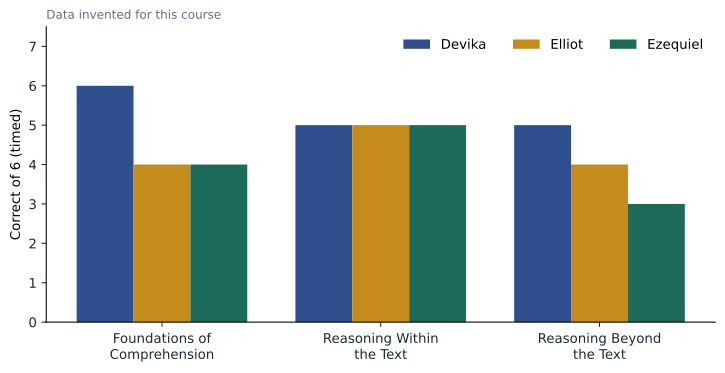
Thandiwe collected the scores from the timed attempt and the blind review.
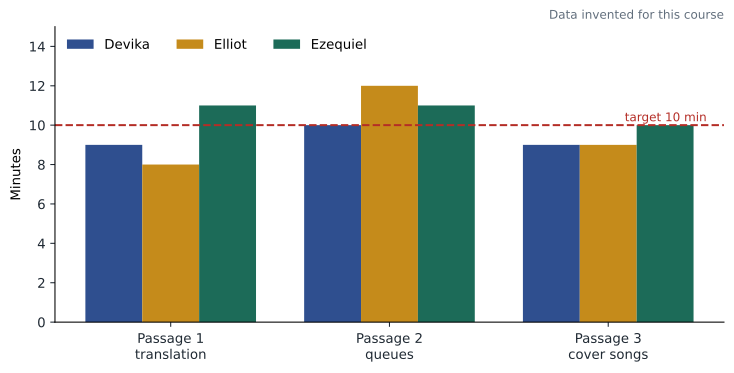
| Student | Timed score (of 18) | After blind review | Minutes per passage (1 / 2 / 3) | Main lesson |
|---|---|---|---|---|
| Devika | 16 | 17 | 9 / 10 / 9 | Missed question 6 on assumptions in both attempts; changed question 11 correctly in review |
| Elliot | 13 | 15 | 8 / 12 / 9 | Ran long on the queue passage; fixed questions 7 and 12 in review after rereading its final paragraph |
| Ezequiel | 12 | 15 | 11 / 11 / 10 | Two misses from rushing the last passage; questions 9 and 11 drew on his own experience of waiting rooms |
The debrief
Elliot had improved the most since September, and his misses had changed character. On the diagnostic, he had chosen answers he agreed with. In the capstone, the two misses he fixed in review, questions 7 and 12, came from not finishing his reread of the queue passage’s final paragraph, where the author says the dispute over paid priority “is not about efficiency at all.” His new rule: “Last paragraph twice, always.” Two of his three remaining misses were on application questions and came from matching surface details: he chose “saves places for six friends” on question 9 because it involved generosity toward others. Thandiwe asked him who decided the exception. “She did,” he said. “For her friends. Not the line.” He wrote it down.
Ezequiel’s gap between timed and blind-review scores was the largest, three questions, which pointed at timing. He spent eleven minutes on each of the first two passages and rushed the third. His plan for the next month was to use the checkpoint after passage 3 strictly in every timed set, and to practise one-sentence passage maps to cut his reading time. His two outside-knowledge misses were on the queue passage: he had spent years in emergency waiting rooms, where order is set by triage, not arrival, and he had read the passage through that lens. “Different social order,” Thandiwe said. “Good observation for an essay. Wrong for this passage.”
Devika’s only consistent miss was question 6, the assumption question. She had chosen A, “all readers know both languages,” reasoning that the author discussed bilingual readers. The negation test exposed it: if not all readers know both languages, the argument is unharmed, indeed strengthened. She added a line to her log: “Negate every assumption choice, even when one looks obvious.”
CARS on test day
Thandiwe ended the block with a short plan for test day, which the group agreed to rehearse on every full-length practice test from now on.
- Before the section: use the short break after Chem/Phys to reset. Do not review science answers in your head.
- First minute: take one breath, note the checkpoint targets (60 minutes remaining after passage 3, 30 after passage 6), and start passage 1.
- Each passage: read at a steady pace, map in fragments, state the main point before the first question.
- Each question: predict before reading choices when you can, eliminate with reasons, and point to the line for every answer.
- When stuck: eliminate what you can, choose, flag, and move on. Never leave a question blank.
- At each checkpoint: if behind, plan to save a minute on each remaining passage rather than rushing one.
- Last two minutes: answer every unanswered question, then revisit flagged ones if time remains.
- After the section: let it go. The 30-minute break is for eating, moving and resetting for Bio/Biochem, not for replaying CARS.
Worked problem
Putting the plan to work under pressure
On a full-length practice test, Elliot reaches the passage 6 checkpoint with 24 minutes remaining and three passages left. What should he do?
Show solution
- He is about 6 minutes behind the 30-minute target.
- Three passages in 24 minutes is 8 minutes each, two minutes less than usual.
- He should shorten his map to one line for the main point plus brief paragraph labels, and limit himself to about one rereading per passage.
- If one passage is much harder, he can answer its most direct questions, guess and flag the hardest one, and protect the other two.
Answer: Aim for about 8 minutes per passage with a lighter map, guess strategically on the hardest questions, and answer everything before time ends.
Where to go from here
The remaining weeks of preparation for each student look different, but the CARS part is the same for all three: two timed passages a day with full review, a weekly longer set, and the AAMC’s official CARS practice materials as the main source of real passages. MCAT-150, the final course in this program, covers full-length practice tests, review methods and the test-day plan across all four sections.
Common mistakes
MistakeA practice set is mainly a measure of your score.
InsteadBlind review separates timing problems from understanding problems, and review is where improvement happens.
MistakeSpending extra time on one passage is harmless if you get its questions right.
InsteadExtra time on one passage is taken from the last ones; use checkpoints.
MistakeAn answer that fits your own experience is likely right.
InsteadThe passage’s social order or argument governs, however familiar the topic.
MistakeThe final paragraph can be skimmed once you know the main point.
InsteadConclusions often contain the author’s sharpest claims and qualifications.
MistakeIf one assumption choice looks obvious, there is no need to negate the others.
InsteadNegate every candidate; obvious-looking choices are often irrelevant.
Summary and key terms
- Take a timed set of three passages in 30 minutes, then do a blind review before checking answers.
- The gap between timed and blind-review scores shows how much of the problem is timing.
- Tag every miss by skill area and error type to choose the right fix.
- Apply the course’s tools: the passage map, the title test, voice tracking, the negation test, the principle with conditions and the discrimination check.
- On test day, use checkpoints after passages 3 and 6, answer every question and leave CARS behind at the break.
- Keep practising daily with full review and official AAMC CARS materials.
- Blind review
- Reviewing your answers before seeing the key, marking certainty and changing answers you now think are wrong.
- Timed score
- The score on a set taken under test timing.
- Debrief
- A structured review of a practice set to find patterns in misses.
- Fidelity
- In the translation passage, faithfulness to the original, which the author redefines as service to the poem’s life.
- Norm
- A shared rule of behaviour enforced by the people who accept it.
- Cover
- A recording of a song first made famous by another performer.
Practice problems
Work each problem on paper first, then reveal the answer to check.
Why is A wrong for question 1?
Show answer
It is too extreme: the author argues that translation involves chosen losses, not that it is impossible.
Why is C wrong for question 9?
Show answer
Saving places is an exception one person imposes for her own group’s benefit, which the passage says people resist.
What does a large gap between timed and blind-review scores suggest?
Show answer
Many misses come from timing pressure rather than misunderstanding; pacing is the main fix.
Which capstone question tests the discrimination principle from lesson 9, and how?
Show answer
Question 11: the finding makes self-interest explain the objections, so it favours a rival explanation over the author’s norm account.
What should you do with 2 minutes left and three questions unanswered?
Show answer
Answer all three immediately, eliminating quickly where possible, and then revisit flagged questions if any time remains.
Lesson quiz · 5 questions
Score 60% or more to complete this lesson.
Create a free account to save your progress, take quizzes and earn a certificate.