
MCAT-140 · Lesson 4 of 12 · 22 min
Foundations of comprehension: tone, attitude and point of view
▶ Video coming soon A video version of this lesson is on the way.
Thandiwe began with a game. She read a sentence aloud three times, changing one word each time. “The new library is a bold building.” “The new library is a reckless building.” “The new library is, admittedly, a bold building.” Then she asked the group what the speaker thought of the library each time. Ezequiel answered fastest. “First one likes it. Second one hates it. Third one is about to tell you why they don’t like it.” Thandiwe laughed. “Twenty years as a coach and nobody has ever put it better. Tone lives in single words.”
Tone and attitude questions ask how the author feels about the subject, or about a particular view, person or work discussed in the passage. They belong to Foundations of Comprehension because they test whether you understood what the passage communicates beyond its literal claims. This lesson explains the difference between tone and attitude, shows how to gather evidence for both, introduces a tone scale for judging degree, and covers the special problem of passages that report several points of view.
Tone and attitude
Tone is the overall manner of the writing: measured, impassioned, ironic, playful, scholarly, urgent. Attitude is the author’s stance toward something specific: approval of one critic, scepticism about a theory, admiration for a work with reservations. A passage can have a calm, measured tone while expressing a sharply negative attitude toward its target. Questions may ask about either, so read the stem carefully. “The author’s tone throughout the passage can best be described as…” asks about manner. “The author’s attitude toward the critics mentioned in paragraph 2 is best described as…” asks about stance toward a specific target.
CARS authors, being mostly scholars writing for educated readers, rarely rage or gush. Their tones cluster in a moderate band: analytical, cautiously approving, mildly sceptical, respectfully critical. Their attitudes are often mixed: they admire a work but find one part weak, accept a theory but doubt one claim. Answer choices that describe extreme feelings, contempt, euphoria, outrage, are almost always wrong unless the passage’s language is unmistakably extreme.
Gathering evidence
Tone and attitude are carried by particular kinds of words, and you can collect them as you read. Evaluative adjectives and adverbs (“brilliant,” “careless,” “unfortunately,” “admirably”) are the strongest signals. Verbs of judgment (“exaggerates,” “illuminates,” “overlooks”) are close behind. Concessions (“to be sure,” “admittedly”) mark mixed attitudes: the author grants something before criticizing. Hedges (“perhaps,” “it may be that”) mark caution or tentativeness. Rhetorical questions and irony can mark impatience or scepticism.
| Kind of signal | Examples | What it suggests |
|---|---|---|
| Evaluative adjective or adverb | brilliant, careless, admirably, regrettably | Direction and strength of approval or disapproval |
| Verb of judgment | exaggerates, overlooks, illuminates, distorts | The author’s assessment of someone’s claim or work |
| Concession | to be sure, admittedly, granted | A mixed attitude; criticism usually follows |
| Hedge | perhaps, may, it seems, in some respects | Caution, tentativeness or modesty |
| Intensifier | deeply, entirely, profoundly, utterly | A stronger feeling than usual; check whether it is the author’s or a reported view |
| Irony or rhetorical question | “Who could object to progress?” | Scepticism or impatience with a view |
Once you have the evidence, judge two things separately: direction (positive, negative or mixed) and strength (mild, moderate or strong). Then look for the choice that matches both.
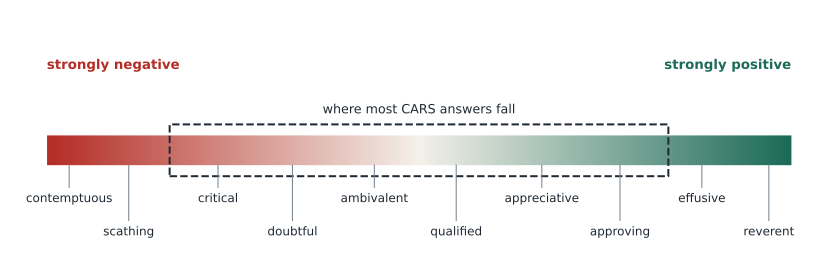
Two words to handle with care
Ambivalent means having mixed feelings: genuinely holding both positive and negative attitudes. It is often the right answer for a passage that praises a work and criticizes it. Indifferent means not caring at all. It is almost never right, because CARS authors care enough about their subject to write five paragraphs on it. Likewise, “neutral” fits a purely descriptive passage but not one that takes a side, even mildly.
Words such as “qualified” and “reserved” are useful for mixed attitudes that lean one way. “Qualified admiration” means admiration with reservations. “Reserved approval” means cautious approval. These combinations are common correct answers precisely because CARS authors so often grant and criticize in the same breath.
Points of view other than the author’s
Many passages present several viewpoints: critics, defenders, scholars of an earlier generation, the subjects of a study. Questions may ask about any of them. “According to the passage, the early critics regarded the work as…” asks for the critics’ attitude, which may differ completely from the author’s. Your map’s voice labels from lesson 2 are essential here. Before answering, locate the part of the passage that discusses the person or group named in the stem, and read only the signals attached to them.
A frequent trap pairs an attitude with the wrong owner. If the critics were dismissive and the author is admiring, the choices will include “dismissive” for a question about the author, hoping you remember the word without remembering whose it was.
Practice passage: the late dances of Margit Elund
Passage
Margit Elund’s late works have always divided her admirers. For three decades she was celebrated for dances of almost reckless energy: bodies flung across the stage, falls caught at the last instant, a vocabulary of risk that critics compared to athletics as often as to ballet. Then, in her sixties, she began to make pieces in which almost nothing happens. A dancer walks the width of the stage for six minutes. Two dancers stand facing each other and shift their weight, barely visibly, as the light changes.
The first reviews of these works were, to put it gently, bewildered. One critic called them “a retirement disguised as a style.” Another suggested that Elund, no longer able to demand from her dancers what she once had, had made a virtue of necessity. These judgments now seem unfair, and not only because time has been kind to the late pieces. They mistake a change of subject for a loss of nerve.
What the late works are about, I would suggest, is attention itself. The early dances held the eye by never letting it rest. The late ones ask the audience to do the work: to notice the slight lean of a shoulder, the moment a walk becomes a different walk. This is a riskier proposition than any fall. An audience that has come for spectacle may simply stop looking, and some, on those first nights, did. Elund was betting that the viewers who stayed would discover a kind of seeing they did not know they had.
To be sure, not every late piece wins the bet. Some of the longest works do outlast the attention they ask for, and a few seem less like dances than like demonstrations of an idea about dance. The twelve-minute duet that closed her final season is, frankly, a trial. But even the failures are failures of ambition rather than of energy, and the best of the late works, the walking solo above all, achieve something the early pieces never attempted.
It would be too much to say that the late Elund is greater than the early one. The early dances remain thrilling, and they changed what audiences expected a body to do on stage. But it is time to stop treating the late works as an epilogue. They are a second argument, and in some ways a harder one, made by an artist who could have kept winning the first.
Evidence and map
Signals about the early critics: “bewildered,” “a retirement disguised as a style,” “made a virtue of necessity.” Their attitude was dismissive and puzzled. Signals about the author’s view: “These judgments now seem unfair,” “I would suggest,” “riskier,” “the best of the late works… achieve something.” Concession: “To be sure, not every late piece wins the bet,” “frankly, a trial.” Limit: “It would be too much to say that the late Elund is greater.” The author’s attitude toward the late works is strong but qualified admiration. The tone is measured, appreciative and candid.
Questions
Question 1. The author’s attitude toward Elund’s late works is best described as:
- A. unreserved enthusiasm.
- B. admiration tempered by acknowledgment of some failures.
- C. polite indifference.
- D. disappointment mixed with nostalgia for the early works.
Answer: B. The author defends the late works and praises the best of them, but concedes that some fail (paragraph 4). A ignores the concession. C is never right for an author who argues this hard. D reverses the main attitude.
Question 2. The early critics quoted in paragraph 2 regarded the late works as:
- A. a deliberate exploration of attention.
- B. evidence of declining ability or ambition.
- C. superior to the early dances.
- D. too physically dangerous for older dancers.
Answer: B. “A retirement disguised as a style” and “made a virtue of necessity” both suggest decline. A is the author’s view, not the critics’; this is the wrong-owner trap.
Question 3. The phrase “frankly, a trial” in paragraph 4 conveys:
- A. the author’s candid criticism of one particular work.
- B. the early critics’ verdict on all the late works.
- C. the author’s view that the duet was physically demanding.
- D. the author’s regret that Elund retired.
Answer: A. “Frankly” signals the author speaking candidly; the target is “the twelve-minute duet.” Choice C takes “trial” in the wrong sense; lesson 5 deals with meaning in context.
Question 4. The author’s tone in the final paragraph is best described as:
- A. measured and corrective.
- B. scathing and dismissive.
- C. hesitant and apologetic.
- D. detached and neutral.
Answer: A. The author limits the claim (“It would be too much to say”) while correcting the habit of treating the late works as an epilogue. Neither strong negativity nor neutrality fits, and the author is not apologizing for anything.
Worked problem
Separating direction from strength
A passage on a historian’s book calls it “an important and often illuminating study,” then says its final chapter “overreaches, drawing conclusions the evidence cannot bear.” The choices for the author’s attitude are: scornful, generally favourable with specific reservations, uncritically admiring, ambivalent and uninterested. Which fits?
Show solution
- Direction: mostly positive (“important,” “illuminating”) with one negative (“overreaches”).
- Strength: moderate on both sides; no extreme words.
- “Scornful” is strongly negative; “uncritically admiring” ignores the criticism; “ambivalent and uninterested” pairs a possible word with an impossible one.
Answer: “Generally favourable with specific reservations.” It matches both the direction and the strength of the evidence.
When tone shifts within a passage
Some passages change tone partway through. An author may open with gentle irony about a popular belief, settle into careful analysis in the middle, and close with a note of urgency. A question about the tone of the passage as a whole wants the dominant manner, usually the one in which the author makes the main argument. A question that names a paragraph wants the tone of that paragraph only. When you map, it is worth adding a one-word tone note beside any paragraph where the voice changes noticeably, so that you are not forced to reconstruct it under time pressure.
Shifts in tone often coincide with shifts in voice. A passage that quotes a critic’s angry review will contain angry language, but the anger belongs to the critic; the author’s own tone may be cool and analytical. When the language suddenly heats up or cools down, ask first whether the speaker has changed. If the speaker is still the author, the shift usually marks the point the author cares about most. In the Elund passage, the only moment the author speaks bluntly, “frankly, a trial,” is a concession, which is itself a sign of an author trying to be fair: an advocate who admits a weakness openly is more persuasive than one who never does.
Elliot and the extreme words
Elliot noticed that his wrong tone answers on practice sets had a pattern: he liked strong words. “Scathing” felt decisive; “mildly sceptical” felt like a shrug. Thandiwe suggested he treat every extreme word in an answer choice as a claim that needed evidence of equal strength in the passage. If an author called a theory “problematic,” that did not support “contemptuous.” Over the next two sets he started striking out extreme choices first and checking whether any survived. On most questions, none did.
Devika had the opposite problem. She sometimes chose “neutral” or “objective” for passages that described a debate carefully, missing a single evaluative sentence near the end. Thandiwe’s advice to her was to read the last paragraph twice as slowly as the rest. Authors who hold back their judgment through most of a passage often reveal it in the conclusion.
Common mistakes
MistakeA calm, scholarly tone means the author has no strong view.
InsteadTone is manner; attitude is stance. A measured tone can carry a firm attitude.
MistakeStrong words such as scathing or reverent are safe when the author clearly takes a side.
InsteadCARS authors are usually moderate; extreme words need equally extreme evidence.
MistakeIndifferent is a reasonable answer for a balanced passage.
InsteadIndifferent is almost never right; balanced passages are usually ambivalent, qualified or neutral.
MistakeAny attitude word in the passage belongs to the author.
InsteadCheck the owner: critics, scholars and subjects often have attitudes the author rejects.
MistakeA concession means the author agrees with the other side.
InsteadA concession usually marks a mixed attitude, with the author’s main criticism or claim to follow.
Summary and key terms
- Tone is the manner of writing; attitude is the author’s stance toward a specific subject, view or person.
- Collect evidence from evaluative words, verbs of judgment, concessions, hedges and irony.
- Judge direction and strength separately, then match both.
- Most correct answers fall in a moderate band; extreme words and indifferent are rarely right.
- Ambivalent, qualified and reserved often describe the mixed attitudes CARS authors favour.
- For other viewpoints, find the part of the passage that discusses that person or group and read only its signals.
- Tone
- The overall manner of the writing, such as measured, ironic or urgent.
- Attitude
- The author’s stance toward a particular subject, view, work or person.
- Ambivalent
- Holding genuinely mixed positive and negative feelings.
- Indifferent
- Not caring either way; rarely a correct CARS answer.
- Qualified
- Limited by reservations, as in qualified praise.
- Hedge
- A word that softens a claim, such as perhaps or may.
- Wrong-owner trap
- An answer that gives one party’s attitude in response to a question about another.
Practice problems
Work each problem on paper first, then reveal the answer to check.
In the Elund passage, what is the author’s attitude toward the early critics’ judgments?
Show answer
Disapproving but restrained: the author calls them “unfair” and says they “mistake a change of subject for a loss of nerve.”
Which sentence in the Elund passage limits the strength of the author’s praise?
Show answer
“It would be too much to say that the late Elund is greater than the early one.”
A passage describes two schools of thought evenly and never evaluates either. Which tone word fits best: ambivalent, neutral or indifferent?
Show answer
Neutral; there is no evaluation, so there are no mixed feelings to be ambivalent about, and indifferent implies not caring.
What does “to be sure” at the start of paragraph 4 signal?
Show answer
A concession: the author grants that some late works fail before reaffirming their value.
Why is “uncritically admiring” wrong for the Elund passage?
Show answer
The author explicitly criticizes some works, calling one “frankly, a trial.”
Lesson quiz · 5 questions
Score 60% or more to complete this lesson.
Create a free account to save your progress, take quizzes and earn a certificate.