
MCAT-140 · Lesson 10 of 12 · 21 min
Humanities passages
▶ Video coming soon A video version of this lesson is on the way.
Elliot had a theory about which passages he would miss. “Anything with ‘aesthetic’ in the first sentence,” he said. His error log backed him up: his accuracy on humanities passages was noticeably lower than on social science ones. Thandiwe was not surprised. “Social science passages look like science,” she said. “They have studies and causes. Humanities passages are arguments about meaning and value, and you have no lab instincts for those. So we build some.”
About half of CARS passages come from the humanities: architecture, art, dance, ethics, literature, music, philosophy, popular culture, religion, theater and studies of diverse cultures. This lesson describes the habits of these passages, explains why many science-minded students find them harder, and gives strategies for the most common kinds: philosophy and ethics passages, which argue about concepts; criticism passages, which interpret and evaluate works; and passages about cultural practices and traditions.
What makes humanities passages different
Humanities passages usually argue about interpretation or value rather than about cause. A social science passage asks why something happened or what effect a policy had; a humanities passage asks what a work means, whether a practice is admirable, or how a concept should be understood. The evidence is different too. Instead of data, humanities authors offer readings of texts, examples of works, thought experiments, and appeals to the reader’s judgment. And the language is often more abstract, more figurative and more personal, with authors using “I” and openly taking sides.
None of this makes the passages vague. A good philosophy passage draws distinctions as precisely as a lab protocol, and a good piece of criticism makes claims that can be checked against the work it discusses. The skills from lessons 2 to 9 apply unchanged. What changes is what you track.
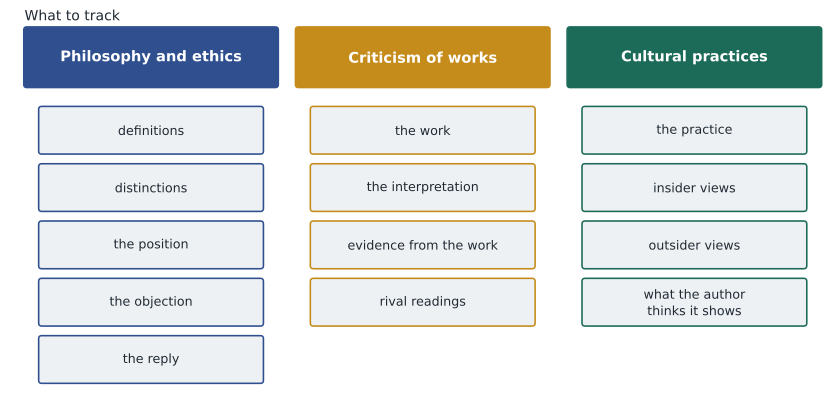
Philosophy and ethics passages
Philosophy passages typically introduce a concept (justice, beauty, consent, personal identity), draw a distinction within it, take a position, consider an objection, and reply. They are often built around a thought experiment: an imagined case designed to test an intuition. The thought experiment is not a story for its own sake; it is evidence. When a question asks why the author introduces a case, the answer is almost always about the intuition the case is meant to trigger and the claim that intuition supports.
The most important things to track are definitions and distinctions. If an author distinguishes “a reason for acting” from “a cause of acting,” every later sentence depends on that distinction, and questions will test it. Make the distinction part of your map, with a word or two for each side.
Criticism passages
Criticism passages discuss particular works: a novel, a building, a symphony, a film, a body of paintings. The author usually offers an interpretation of the work, or a judgment of its value, against a rival reading. Evidence takes the form of details from the work: a recurring image, the way a building meets the street, a change of key. The Elund passage in lesson 4 is a criticism passage.
Two cautions apply. First, do not let unfamiliarity with the work worry you; the passage will tell you everything you need. Second, separate the author’s reading from the work’s “facts.” When an author says a novel’s ending “betrays” its heroine, that is an interpretation, and a question may ask you to recognize it as one.
Passages about cultural practices
Passages in studies of diverse cultures, religion and popular culture often describe a practice, a festival, a style of music, a religious observance, and argue about what it means or how it should be understood. A common structure contrasts an outsider’s reading with an insider’s, or an older scholarly account with a newer one. Track who holds each view, and be careful not to supply your own beliefs about the practice. The gift passage in lesson 8 had this shape.
Practice passage: promises to the dead
Passage
Suppose that a woman, at her dying father’s bedside, promises to scatter his ashes on a particular hillside, a place he loved and she has never seen. After his death, she learns that the hillside is a long and expensive journey away, and that no one but she will ever know whether she went. Does she still have a reason to go?
Many people feel at once that she does. Yet it is surprisingly hard to say why. The usual account of promising holds that promises matter because of their effects on the person promised. When I promise you something, you come to rely on it, to plan around it and to trust me; breaking the promise harms you by frustrating those expectations. On this account, a promise to someone who can no longer rely on anything should lose its force. The father cannot be disappointed. He will not know.
One response is to say that the father still has interests even though he cannot experience their fulfilment, just as a living person can be wronged by a lie told behind their back that never reaches them. This view has defenders, but it asks us to accept that the dead can be harmed, which many find strange. I want to suggest a different route, one that does not depend on what the father can or cannot experience.
A promise is not only a prediction that the promisor offers to the person promised. It is also a way of binding one’s future self, and in doing so of shaping the kind of person one is. The daughter who promised did not merely tell her father what she would do; she made the scattering of his ashes part of what her future would contain. To abandon the promise because no one will know is to treat that commitment as if it had been made only for an audience. And a person whose commitments hold only when they are observed has a different character, and a thinner one, than a person whose commitments hold regardless.
This view has a cost. It seems to imply that every promise, however foolish, binds us for the sake of our character. But that does not follow. Character can be shaped as much by the wisdom to release oneself from a promise that has become absurd as by the strength to keep one that has become inconvenient. The daughter may conclude that the journey is beyond her means and choose another way to honour her father. What she should not conclude is that her promise vanished when he died.
Map
P1: thought experiment (promise to a dying father). P2: intuition that she still has a reason; the usual effects-based account, which implies the promise lapses (not the author’s view). P3: one response, the dead have interests; set aside; author signals a different route. P4: author’s view: a promise binds and shapes the promisor’s future self and character. P5: objection (would bind foolish promises) and reply (character also includes wise release). Main point: promises to the dead retain force because promising shapes the promisor’s character, not only because of effects on the person promised. Tone: careful, personal (“I want to suggest”), measured.
Questions
Question 1. The author introduces the case of the daughter primarily in order to:
- A. describe a common family conflict.
- B. elicit an intuition that the usual account of promising struggles to explain.
- C. show that the daughter should take the journey regardless of cost.
- D. argue that the dead can be harmed.
Answer: B. The case triggers the intuition (“Many people feel at once that she does”) and then paragraph 2 shows the usual account cannot easily support it. C contradicts paragraph 5, and D is the view the author sets aside in paragraph 3.
Question 2. According to the passage, the usual account of promising holds that promises matter mainly because:
- A. they shape the character of the promisor.
- B. they affect the expectations and plans of the person promised.
- C. they are legally enforceable.
- D. they are made in the presence of witnesses.
Answer: B, stated in paragraph 2. A is the author’s own view, a wrong-owner trap.
Question 3. The author’s attitude toward the view that the dead have interests is best described as:
- A. respectful but unpersuaded.
- B. contemptuous.
- C. wholehearted agreement.
- D. indifferent.
Answer: A. The author notes that the view “has defenders,” reports why many find it strange, and chooses “a different route” without attacking it.
Question 4. Which of the following situations would the author most likely regard as consistent with good character?
- A. A man breaks a promise to a late friend simply because no one would ever find out.
- B. A woman who promised to visit her mother’s grave every week, finding after a move that it is impossible, decides to visit on each anniversary and to fund a bench in her mother’s name.
- C. A student keeps a promise only when his teacher is watching.
- D. A man keeps an obviously harmful promise because he believes every promise must be kept.
Answer: B. The author says character includes the wisdom to release oneself from an impossible promise and honour the person another way. A and C treat commitments as holding only when observed. D is the objection in paragraph 5, which the author rejects.
Question 5. Which new claim, if true, would most challenge the author’s argument?
- A. People who keep unobserved promises are no more reliable in other respects than people who do not.
- B. Many people scatter ashes in places the deceased loved.
- C. Legal wills are often contested.
- D. Some promises are made carelessly.
Answer: A. The author argues that unobserved commitment reflects and shapes a fuller character; if keeping such promises made no difference to a person’s reliability elsewhere, that link would be weakened. D is addressed in paragraph 5, and B and C are irrelevant.
Worked problem
Translating an abstract claim into a concrete one
Elliot found paragraph 4 hard: “A person whose commitments hold only when they are observed has a different character, and a thinner one.” How can he make it concrete?
Show solution
- Ask: what would such a person do? Keep promises at work when the manager checks, break them when no one checks.
- Ask: what does “thinner” mean here? Less substantial: the person’s goodness is a performance for others.
- Restate: “If you only keep promises when watched, your honesty is shallow; keeping unwatched promises is what makes it deep.”
Answer: Translating an abstraction into an imagined case, then restating it plainly, turns a difficult sentence into a usable map line.
Strategies for abstract prose
Humanities passages are sometimes difficult at the level of the sentence. Three strategies help. First, translate: when a sentence is abstract, imagine a concrete case it would describe, as in the example above. Second, look for the opposite: authors often define a position by what it rejects, so asking “what is this sentence against?” can clarify it. Third, trust the structure: even when individual sentences are hard, the signals of lesson 2, turns, concessions, conclusions, usually remain clear, and they are often enough to answer most questions.
Do not slow down to admire the prose. Humanities passages can be beautifully written, and it is tempting to linger. CARS rewards the reader who notices that a beautiful sentence is a concession, not the reader who appreciates its rhythm.
Thandiwe’s humanities drill
Thandiwe set the group a two-week drill for humanities passages. Each day, read one essay or long review from a serious magazine or a university press blog on a humanities subject, and write a three-line summary: the author’s position, the position they argue against, and the single best piece of evidence. Devika found it pleasant. Elliot found it painful for the first four days and then, to his surprise, began to enjoy a long review of a production of a play he had never heard of. Ezequiel chose essays on music, because he played guitar, and found that he could follow arguments about chord progressions he had never named but had always heard.
Common mistakes
MistakeHumanities passages are vague, so any reasonable reading is acceptable.
InsteadThey argue precisely about meaning and value; answers still have to match the author’s claims and distinctions.
MistakeA thought experiment is a story to enjoy.
InsteadIt is evidence designed to trigger an intuition that supports or challenges a claim.
MistakeYou need to know the work being discussed.
InsteadThe passage supplies everything; your view of the work is irrelevant.
MistakeAn interpretation in a criticism passage is a fact about the work.
InsteadIt is the author’s reading, which may be contested by rival readings in the passage.
MistakeSlow down to savour well-written passages.
InsteadRead at a steady pace for structure; elegance does not change what a sentence does.
Summary and key terms
- Humanities passages argue about interpretation, meaning and value rather than cause, using readings, examples and thought experiments as evidence.
- In philosophy and ethics passages, track definitions, distinctions, the position, the objection and the reply.
- In criticism passages, track the work, the author’s interpretation, evidence from the work and rival readings.
- In passages on cultural practices, track insiders’ and outsiders’ views and what the author thinks the practice shows.
- Translate abstract sentences into concrete cases and ask what a claim is against.
- Steady reading for structure beats lingering on fine prose.
- Thought experiment
- An imagined case used to test an intuition about a concept or principle.
- Intuition
- An immediate judgment about a case, used as evidence in philosophical arguments.
- Distinction
- A line drawn between two senses or kinds of something, central to many philosophy passages.
- Interpretation
- An author’s reading of what a work or practice means.
- Criticism
- Writing that interprets and evaluates works of art, literature, music or architecture.
- Effects-based account
- In the promise passage, the view that promises matter because of their effects on the person promised.
Practice problems
Work each problem on paper first, then reveal the answer to check.
What is the author’s positive view of why promises to the dead still matter?
Show answer
Promising binds and shapes the promisor’s future self and character, so the promise does not depend on the father’s experience.
What objection does the author raise against their own view, and how is it answered?
Show answer
That it would make even foolish promises binding; the author replies that good character includes the wisdom to release oneself from absurd promises.
In a criticism passage, an author says a building “refuses the street.” Is this a fact or an interpretation?
Show answer
An interpretation of how the building relates to its surroundings.
What is the function of paragraph 3 in the promise passage?
Show answer
It presents and sets aside one response to the puzzle before the author offers a different route.
Give the three strategies for abstract prose from this lesson.
Show answer
Translate into a concrete case, ask what the sentence is against, and rely on structural signals.
Lesson quiz · 5 questions
Score 60% or more to complete this lesson.
Create a free account to save your progress, take quizzes and earn a certificate.