
MCAT-130 · Lesson 9 of 12 · 20 min
Social interaction and group processes
▶ Video coming soon A video version of this lesson is on the way.
Thandiwe began the session on social interaction by describing her first week teaching undergraduate labs. 'I wore a blazer and stood at the front, and nobody asked questions. The second week I wore a lab coat and walked between benches, and they asked me everything.' She asked the group what had changed. Devika said 'status cues'. Ezequiel said 'front stage, back stage'. 'Both,' Thandiwe said. 'We perform roles, and other people read the costume. Today is the sociology of everyday interaction.'
This lesson covers content category 8C, "Social interactions": the elements of social interaction, self-presentation, social behaviour such as attraction, aggression and altruism, and discrimination at the individual level. It also includes the group-structure ideas from 7B and 9A that help you analyse groups and networks. Sociology questions in this area often ask you to apply a term to a short scenario, so practise naming what you see.
Elements of social interaction
Sociologists describe social structure in terms of statuses and roles. A status is a recognized social position, such as student, parent or physician. An ascribed status is assigned at birth or involuntarily (age, race, sex at birth), and an achieved status is earned or chosen (paramedic, university graduate). A master status is one that dominates others and shapes how a person is seen in most situations; a serious illness or disability can become a master status, which is one reason clinicians are taught to see the person beyond the diagnosis.
A role is the set of expectations attached to a status. Role conflict occurs when the expectations of two different statuses clash, such as a student who is also a parent with a sick child on exam day. Role strain occurs when expectations within a single status conflict, such as a physician who must be both efficient and fully attentive to each patient. Role exit is the process of leaving a role, such as retiring or leaving a profession, and often involves forming a new identity.
Groups are two or more people who interact and share a sense of identity. A primary group is small, intimate and long-lasting, such as family and close friends; a secondary group is larger, more impersonal and goal-oriented, such as a workplace or a class. An in-group is one a person belongs to and identifies with; an out-group is one a person does not belong to. A reference group is a group used as a standard for evaluating oneself. Ferdinand Tönnies distinguished Gemeinschaft, community based on personal ties and shared values, from Gesellschaft, society based on impersonal and contractual relationships.
| Concept | Definition | Example |
|---|---|---|
| Ascribed status | Assigned at birth or involuntarily | Being the eldest child |
| Achieved status | Earned or chosen | Licensed paramedic |
| Master status | Dominates how a person is seen | A visible disability in a society that stigmatizes it |
| Role conflict | Clash between roles of different statuses | Student and parent on exam day |
| Role strain | Tension within one role | A teacher balancing strict standards and support |
| Primary group | Small, intimate, enduring | Family |
| Secondary group | Large, impersonal, goal-oriented | A company department |
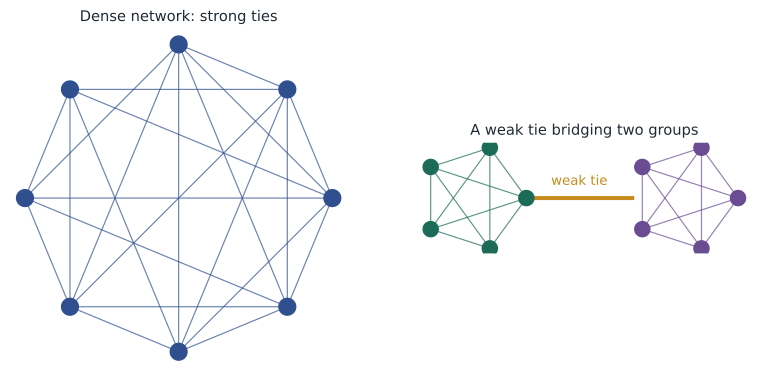
Group size matters. Georg Simmel noted that a dyad (two people) is intimate but fragile, because it ends if one person leaves, while a triad (three people) is more stable but allows coalitions and mediation. Network analysis describes the pattern of ties among people; dense networks share information quickly and enforce norms, while weak ties, links to acquaintances, often provide new information, such as job leads, as Mark Granovetter showed. Organizations can be formal, with explicit goals and rules. Max Weber described bureaucracy, an ideal type with a hierarchy of authority, clear division of labour, written rules, impersonality and advancement based on qualifications. George Ritzer's McDonaldization describes the spread of efficiency, calculability, predictability and control into many areas of life. Robert Michels's iron law of oligarchy states that organizations tend to become ruled by a small elite.
Self-presentation and impression management
Erving Goffman's dramaturgical approach describes social life as a performance. On the front stage, people perform roles before an audience and follow expected scripts. On the back stage, out of view, they relax, prepare and drop the performance. Impression management is the effort to control how others perceive us, through appearance, speech and behaviour. Strategies include self-disclosure, managing appearance, ingratiation (flattery), aligning actions (excuses and justifications) and alter-casting (assigning roles to others). Thandiwe's blazer and lab coat were costumes for front-stage performances; the teaching assistants' office where she ate lunch was back stage.
Emotional expression is part of self-presentation. Display rules, introduced in lesson 5, are culture-specific norms about showing emotion; they also vary by setting and status. Emotional labour, a term introduced by Arlie Hochschild, describes managing one's feelings as part of a job, such as a nurse maintaining calm warmth during a frightening procedure. Nonverbal communication, including eye contact, gestures, posture, facial expression and personal space, conveys much of the emotional content of interaction, and its meaning varies across cultures.
Symbolic interactionism, the sociological theory that underlies much of this lesson, holds that people act toward things based on the meanings they have, that these meanings arise from social interaction, and that meanings are interpreted and modified through interaction. Herbert Blumer named the approach and built on George Herbert Mead's work. W.I. Thomas's theorem summarizes a key idea: if people define situations as real, they are real in their consequences.
Attraction
Interpersonal attraction depends on several factors. Proximity (physical or online closeness) increases the chance of interaction, and the mere exposure effect means repeated exposure tends to increase liking. Similarity in attitudes, values and background predicts attraction more than complementary differences do. Physical attractiveness influences first impressions, and attractive people are often assumed to have other positive traits, the halo effect. Reciprocity of liking, the tendency to like people who like us, and self-disclosure also deepen relationships.
Attachment theory, developed by John Bowlby and studied by Mary Ainsworth using the Strange Situation procedure, describes infant attachment styles: secure (the infant explores, is upset when the caregiver leaves and is comforted on return), avoidant (shows little distress and avoids the caregiver on return), ambivalent or resistant (is very distressed and is not easily comforted) and disorganized (shows inconsistent, confused behaviour). Harry Harlow's studies of infant monkeys, which preferred a soft cloth surrogate mother to a wire surrogate that provided food, showed the importance of contact comfort in attachment. Adult relationship styles have been described in parallel terms, though the links between infant and adult attachment are modest.
Aggression and altruism
Aggression is behaviour intended to harm another. Biological contributors include genes, testosterone, the amygdala and reduced prefrontal control; alcohol lowers inhibitions. Psychological contributors include frustration (the frustration-aggression hypothesis), aversive conditions such as heat and pain, and learning through observation and reinforcement, as in Bandura's studies. Social and cultural contributors include norms about violence, media exposure and community conditions. Hostile aggression is driven by anger; instrumental aggression is a means to an end.
Altruism is helping others without expectation of reward. Theories of helping include the empathy-altruism hypothesis (C. Daniel Batson), which proposes that empathy can produce genuinely selfless helping; social exchange theory, which proposes that people help when the benefits outweigh the costs; and evolutionary explanations such as kin selection (helping relatives who share our genes) and reciprocal altruism (helping others who are likely to help in return). Social norms also encourage helping: the reciprocity norm and the social responsibility norm, the expectation that people should help those who depend on them. The bystander effect from lesson 8 describes situational limits on helping.
Social support, the perception that one is cared for and has help available, is linked to better health and lower mortality. It can be emotional, informational, tangible (practical) or companionship. Elliot mentioned an older man at the clinic who came every week, often without a medical complaint. 'He lives alone,' Elliot said. 'I think the waiting room is his social network.' Thandiwe said that loneliness and social isolation are recognized as health risks, and that a clinic waiting room can be part of the picture a social worker would map.
Communication and other species
Animal communication is often tested in Psych/Soc alongside biology. Animals communicate through visual displays, sounds, chemical signals (pheromones) and touch. Honeybees use a 'waggle dance' to signal the direction and distance of food. Vervet monkeys use distinct alarm calls for different predators. Animal signals tend to be fixed in meaning and limited in combination, unlike human language, which is generative: a finite set of words can be combined into an unlimited number of new sentences. Foraging behaviour, mating systems (monogamy, polygyny and polyandry) and mate choice are explained in evolutionary terms by their effects on survival and reproduction. Game theory models, such as the prisoner's dilemma, analyse when cooperation is a stable strategy.
Discrimination in interaction
Individual discrimination is unfair treatment by individuals in interactions. Institutional discrimination is built into the policies and practices of organizations and social institutions, whether or not individuals intend it, and is covered in lesson 11. Microaggressions are brief, often unintentional comments or actions that communicate negative messages to members of marginalized groups. Researchers study discrimination with audit studies, in which matched applicants who differ only on one characteristic, such as a name associated with a particular ethnic group, apply for the same jobs or apartments. Such studies have found differences in callback rates in several countries.
Devika asked whether discrimination by a well-meaning person counts. 'On the MCAT, discrimination is defined by the behaviour and its effect,' Thandiwe said. 'Prejudice is the attitude. You can have one without the other, and the test likes to check that you know which is which.'
Health and social interaction
Interaction concepts are used to study medicine itself. Talcott Parsons described the sick role, in which an ill person is exempt from normal responsibilities and not blamed for the illness but is expected to want to get well and to seek competent help. Critics note that the model fits acute illness better than chronic illness or stigmatized conditions. Patient-physician communication shapes adherence and satisfaction; shared decision making, in which clinicians and patients together weigh options and values, is now widely encouraged. Health literacy, the ability to obtain and understand health information, affects outcomes, and cultural humility, ongoing self-reflection about one's own assumptions, is emphasized in medical training.
Worked problem
Role conflict or role strain
A paramedic who is also a volunteer firefighter is paged by the fire department while on an ambulance shift. Separately, as a paramedic, she must work quickly while also comforting frightened patients. (Scenario invented for this course.) Which situation is role conflict and which is role strain?
Show solution
- Role conflict involves two different statuses with competing expectations.
- The pager situation involves two statuses, paramedic and firefighter: role conflict.
- Role strain involves competing expectations within one status.
- Working fast while comforting patients are both expectations of being a paramedic: role strain.
Answer: The competing pages are role conflict; the tension between speed and comfort within the paramedic role is role strain.
Common mistakes
MistakeRole strain is a clash between two different roles.
InsteadThat is role conflict; role strain is tension within one role.
MistakeA master status is always achieved.
InsteadA master status can be ascribed or achieved; it is defined by how strongly it dominates others' perceptions.
MistakePrimary groups are the first groups formed in an organization.
InsteadPrimary groups are small, intimate and enduring, such as family; secondary groups are impersonal and goal-oriented.
MistakeBack stage is where people perform for an audience.
InsteadFront stage is the performance; back stage is where people drop it and prepare.
MistakeHuman language and animal alarm calls differ only in vocabulary size.
InsteadHuman language is generative, combining words into new meanings; most animal signals are fixed.
Summary and key terms
- Statuses (ascribed, achieved, master) and roles organize interaction; role conflict, role strain and role exit describe role problems.
- Groups vary by intimacy, size and identification; networks, bureaucracies and organizations shape behaviour.
- Goffman's dramaturgy describes front-stage performance and back-stage preparation; impression management and emotional labour are part of self-presentation.
- Attraction depends on proximity, similarity, physical attractiveness and reciprocity; attachment styles describe early relationships.
- Aggression and altruism have biological, psychological and social explanations, and social support is linked to health.
- Discrimination is behaviour, distinct from prejudice; the sick role and patient-physician communication apply interaction concepts to medicine.
- Master status
- A status that dominates how others see a person.
- Role conflict
- Clashing expectations from two different statuses.
- Role strain
- Competing expectations within a single status.
- Dramaturgical approach
- Goffman's view of social life as a performance with front and back stages.
- Impression management
- Efforts to control how others perceive us.
- Mere exposure effect
- The tendency to like things more after repeated exposure.
- Kin selection
- Helping relatives because it promotes the survival of shared genes.
- Sick role
- Parsons's description of the rights and obligations of an ill person.
Practice problems
Work each problem on paper first, then reveal the answer to check.
A resident physician must be available to her hospital and to her young child on the same night. What is this called?
Show answer
Role conflict.
Which type of group is a university's admissions committee?
Show answer
A secondary group: formal, goal-oriented and relatively impersonal.
A server smiles warmly at every table despite feeling exhausted. Which concept describes this?
Show answer
Emotional labour, a form of impression management.
An infant explores happily with her caregiver present, cries when the caregiver leaves and is quickly comforted on return. Which attachment style is this?
Show answer
Secure attachment.
A person finds a job through a former classmate she rarely sees. Which network concept explains this?
Show answer
The strength of weak ties, which link to new information.
Lesson quiz · 5 questions
Score 60% or more to complete this lesson.
Create a free account to save your progress, take quizzes and earn a certificate.