
MCAT-130 · Lesson 12 of 12 · 21 min
Capstone: a Psych/Soc passage set
▶ Video coming soon A video version of this lesson is on the way.
For the last session of the Psych/Soc block, Thandiwe wrote a timed set in the format of the Psychological, Social, and Biological Foundations of Behavior section: three passages with five questions each and five independent questions, twenty questions in 32 minutes, close to the pace of the real section (59 questions in 95 minutes). 'This section punishes vague reading,' she said. 'Every passage gives you a study. Know the variables before you look at a single question.' The passages and questions below are original and written for this course; all data are invented.
Take the set under timed conditions before reading the explanations: about 9 minutes for each passage and 5 minutes for the independent questions. Mark any answer you are unsure of, then do a blind review, reconsidering marked questions without a time limit before you check the key. Each explanation names the reasoning skill involved, using the AAMC's four scientific inquiry and reasoning skills: knowledge of scientific concepts and principles (skill 1), scientific reasoning and problem solving (skill 2), reasoning about the design and execution of research (skill 3) and data-based and statistical reasoning (skill 4). Most Psych/Soc questions draw on skills 1 and 3, but data questions appear in nearly every passage.
Passage 1: sleep, stress and memory
Researchers studied whether sleep after learning protects memories from the effects of stress. Sixty undergraduates learned 40 pairs of unrelated words (for example, candle and river) at 9 p.m. until they could recall at least 60 percent of the second words when given the first. They were then randomly assigned to one of four groups in a 2 by 2 design. Half slept for eight hours in the laboratory with EEG recording (sleep groups); half stayed awake under supervision for the same period (wake groups). The next morning, half of each group completed a stressful public-speaking task in front of evaluators (stress groups), and half read magazines (control groups). Twenty minutes later, all participants were given the first word of each pair and asked to recall the second.
Salivary cortisol rose by a similar amount in both stress groups and did not rise in the control groups. In the sleep groups, the amount of slow-wave sleep was positively correlated with recall (r = 0.52).
| Group | Mean percentage of pairs recalled the next morning |
|---|---|
| Sleep, control | 71 |
| Sleep, stress | 68 |
| Wake, control | 58 |
| Wake, stress | 44 |
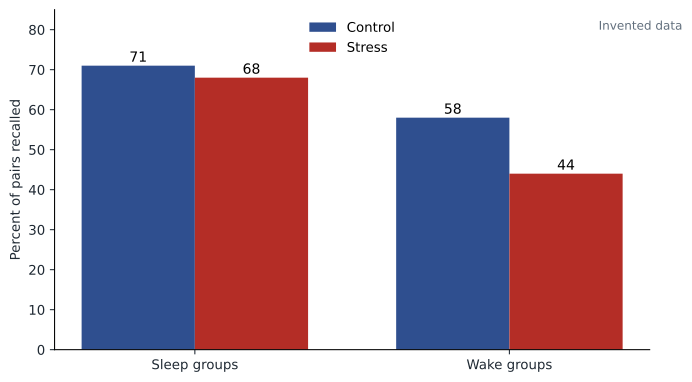
Questions 1 to 5 refer to passage 1.
1. Which result shows an interaction between sleep and stress? (A) Recall was higher in the sleep groups than in the wake groups. (B) Stress reduced recall much more in the wake groups than in the sleep groups. (C) Cortisol rose in both stress groups. (D) All groups recalled more than 40 percent of the pairs.
2. Why did the researchers train participants to a criterion of 60 percent before the delay? (A) To ensure that stress groups were more anxious. (B) To measure the effect of sleep on encoding. (C) To make the task harder for the wake groups. (D) To ensure that all participants had learned the pairs to a similar level before the manipulations.
3. What can be concluded from the correlation between slow-wave sleep and recall? (A) Participants with more slow-wave sleep tended to recall more pairs, but the correlation alone does not show that slow-wave sleep caused better recall. (B) Slow-wave sleep caused better recall. (C) REM sleep is not involved in memory. (D) Stress reduced slow-wave sleep.
4. Which brain structure is most likely involved in consolidating the word pairs as explicit memories? (A) The cerebellum. (B) The amygdala alone. (C) The hippocampus. (D) The basal ganglia.
5. The cortisol finding is most important for ruling out which alternative explanation? (A) That sleep improves all memories equally. (B) That the smaller effect of stress in the sleep groups occurred because the sleep groups found the speaking task less stressful. (C) That participants in the wake groups were tired. (D) That the word pairs were too easy.
Passage 2: community health workers and trust
A city health department introduced a program in which community health workers, residents hired and trained to support their neighbours, visited households with a member who had diabetes. Workers helped with appointments, medications and food access. Researchers compared two neighbourhoods with similar income and age structure: neighbourhood X received the program, and neighbourhood Y continued with usual care. Over 12 months, the share of residents with diabetes who had well-controlled blood sugar rose from 38 to 52 percent in X and from 37 to 40 percent in Y.
Researchers also interviewed 30 residents in X. Many said they trusted the workers because they 'spoke the same language' and 'had been through the same things'. Several older residents said they had avoided the local clinic for years after being treated dismissively, and that the workers had helped them return. Some residents of Y said that they had heard about the program from relatives and wished it were available to them.
Questions 6 to 10 refer to passage 2.
6. Which term best describes the study design? (A) A quasi-experiment comparing existing neighbourhoods without random assignment. (B) A randomized controlled trial. (C) A case study of one individual. (D) A cross-sectional survey at a single time point.
7. Which threat to internal validity is most important to consider? (A) Social desirability in blood sugar measurements. (B) Attrition bias in the interviews. (C) Differences between neighbourhoods other than the program, such as a new grocery store opening in X during the study. (D) The Hawthorne effect among researchers.
8. The residents' reports of avoiding the clinic after being treated dismissively most directly illustrate which concept? (A) Social loafing. (B) The mere exposure effect. (C) Role exit. (D) A barrier contributing to a health care disparity.
9. A sociologist argues that the program worked because workers and residents built shared meanings about diabetes and care through repeated conversations. Which perspective does this reflect? (A) Functionalism. (B) Symbolic interactionism. (C) Conflict theory. (D) Rational choice theory.
10. Residents of Y learning about the program from relatives could weaken the study by: (A) Causing some residents of Y to change their behaviour, which would make the comparison less clean. (B) Increasing the sample size in X. (C) Making the interviews more reliable. (D) Removing the need for a comparison group.
Passage 3: speaking up in surgical teams
Researchers studied whether junior team members voice safety concerns during simulated surgeries. In a simulation centre, 48 surgical residents each took part in a scenario in which a senior surgeon (an actor) prepared to proceed despite a clear sign that the wrong side had been marked. Residents were randomly assigned to one of three conditions. In condition 1, the senior surgeon introduced himself formally and did not invite input. In condition 2, the surgeon began by saying, 'If anyone sees anything that worries them, I want to hear it.' In condition 3, the scripted senior surgeon was absent, and the instruction came on a printed checklist. In all conditions, two other team members (also actors) remained silent when the error appeared.
Researchers recorded whether residents spoke up before the incision. In condition 1, 31 percent spoke up; in condition 2, 75 percent; in condition 3, 69 percent. In interviews afterward, several residents in condition 1 said they had assumed that the senior surgeon or the silent team members knew something they did not.
Questions 11 to 15 refer to passage 3.
11. The silent team members were included mainly to create what? (A) A control for the checklist. (B) A measure of residents' clinical knowledge. (C) A source of informational support for speaking up. (D) A unanimous group that might discourage speaking up.
12. The residents' explanation in condition 1 best reflects which process? (A) Normative social influence only. (B) Social facilitation. (C) Informational social influence. (D) Deindividuation.
13. Which conclusion is best supported by comparing conditions 1 and 2? (A) A leader's explicit invitation for input increased speaking up. (B) Checklists are more effective than any leader statement. (C) Senior surgeons cause wrong-site surgery. (D) Residents in condition 2 had more clinical knowledge.
14. Which concept from obedience research is most relevant to the low rate of speaking up in condition 1? (A) The mere exposure effect. (B) The influence of a close, legitimate authority figure. (C) Social loafing. (D) Learned helplessness.
15. What is the most important limit on generalizing these results to real operating rooms? (A) Random assignment was used. (B) The sample included only residents. (C) The actors were trained. (D) Residents may behave differently in a simulation than in real surgery, where stakes and relationships are real.
Independent questions
16. A patient who receives a serious diagnosis insists that the test results must belong to someone else. Which defence mechanism does this illustrate? (A) Projection. (B) Sublimation. (C) Denial. (D) Reaction formation.
17. A child is given a sticker each time she reads a book. After the stickers stop, she reads less than before the program began. Which effect does this illustrate? (A) The overjustification effect. (B) Spontaneous recovery. (C) Latent learning. (D) Stimulus generalization.
18. In a country, the crude death rate has fallen sharply over 20 years while the birth rate remains high. Which stage of the demographic transition is it most likely in? (A) Stage 1. (B) Stage 4. (C) Stage 5. (D) Stage 2.
19. A survey of 2,000 adults finds that those who report more social support have lower blood pressure (r = minus 0.25, p below 0.001). Which statement is most accurate? (A) Social support causes lower blood pressure. (B) The two variables are weakly to moderately associated, and the design cannot establish causation. (C) The correlation is too weak to be statistically significant. (D) Lower blood pressure causes people to seek social support.
20. A person notices a 1-kilogram increase when lifting a 20-kilogram box. According to Weber's law, about how much must be added to a 60-kilogram load to be noticed? (A) 1 kilogram. (B) 2 kilograms. (C) 3 kilograms. (D) 6 kilograms.
Answer key and explanations
1. B (skill 4). An interaction means the effect of one variable depends on the level of the other. Stress lowered recall by 3 points in the sleep groups and 14 points in the wake groups. Choice A describes a main effect of sleep.
2. D (skill 3). Training to a criterion equates initial learning so that differences the next morning reflect what happened after learning, not differences in encoding.
3. A (skill 4). A correlation shows association. Slow-wave sleep was measured, not manipulated, so the correlation cannot show causation; a third variable could affect both.
4. C (skill 1). The hippocampus consolidates new explicit (declarative) memories; the cerebellum and basal ganglia support procedural learning.
5. B (skill 3). Cortisol rose similarly in both stress groups, so the sleep groups did experience stress. Their smaller memory loss therefore cannot be explained by a weaker stress response.
6. A (skill 3). Neighbourhoods were not randomly assigned, so the design is quasi-experimental, with a before-and-after comparison in two groups.
7. C (skill 3). Without random assignment, other changes in one neighbourhood could explain the difference. Blood sugar measurements are laboratory values, so social desirability (A) is unlikely to affect them.
8. D (skill 1). Dismissive treatment that discourages people from seeking care is a barrier that contributes to a health care disparity. The other choices do not fit.
9. B (skill 1). Shared meanings built through interaction are the focus of symbolic interactionism.
10. A (skill 3). If residents of Y changed their behaviour after hearing about the program (contamination), the comparison group would no longer represent usual care, and the true effect could be underestimated.
11. D (skill 3). Silent confederates form a unanimous group, as in Asch's studies, which tends to discourage dissent.
12. C (skill 1). Assuming that others know something one does not is informational social influence; normative influence is conforming to be accepted.
13. A (skill 2). The only scripted difference between conditions 1 and 2 was the invitation for input, and speaking up rose from 31 to 75 percent.
14. B (skill 1). Milgram found that obedience was higher when a legitimate authority was present and close. A senior surgeon who discourages input is such a figure.
15. D (skill 3). Simulations may not capture real stakes, fatigue and relationships, which limits external validity. Random assignment (A) strengthens internal validity, not external validity.
16. C (skill 1). Refusing to accept reality is denial.
17. A (skill 1). An external reward for an already enjoyed activity reduced intrinsic motivation once it was withdrawn.
18. D (skill 1). Falling death rates with high birth rates define stage 2, a period of rapid population growth.
19. B (skill 4). A correlation of minus 0.25 is a weak to modest association; with 2,000 participants it can be highly significant. The survey design cannot establish causation in either direction.
20. C (skill 2). The JND is 1/20, or 5 percent, of the load; 5 percent of 60 kilograms is 3 kilograms.
The group's debrief
Ezequiel finished first and scored 17 out of 20 under time, 18 after blind review. He missed question 1, choosing the main effect of sleep, and question 10, which he had not thought of as a design problem. 'I read the table for the biggest number,' he said about question 1. Thandiwe asked him to add a line to his error log: 'interaction means a difference in differences'. He also missed question 19 under time and corrected it in blind review after rereading the statistics.
Elliot scored 16 timed and 18 after blind review. He picked choice A on question 7, thinking any survey-like measure could be biased, and missed question 12 by choosing normative influence; two other timed misses, questions 13 and 17, he fixed in blind review. His timing was better than on the biochemistry capstone: he finished with three minutes left and used them to check the independent questions. 'The CARS work helped,' he said. 'I actually read the interviews in passage 2.'
Devika scored 17 timed and 19 after blind review. Her only remaining miss was question 15, where she chose B because the sample was all residents; Thandiwe agreed that this was a real limitation but said the simulation itself was the bigger threat to generalization. 'Pick the limitation that the passage built in,' she said. Devika got question 20 right in under a minute. 'Ratio,' she said, smiling. 'Not a calculation. A ratio.'
Thandiwe closed the block by pointing out that Psych/Soc is the section where content review pays off fastest. 'There are a few hundred terms, and passages test them in predictable ways. Make flashcards for every term you missed today, use them with spaced retrieval, and do one passage set every other day.' She reminded the group that the CARS course would begin next, and that the reading habits from Psych/Soc passages, especially reading the design before the questions, would carry over.
Common mistakes
MistakeA main effect and an interaction are the same thing.
InsteadA main effect is the overall effect of one variable; an interaction occurs when the effect of one variable depends on another.
MistakeAny comparison of two groups is an experiment.
InsteadWithout random assignment, the design is quasi-experimental or observational, and confounding is a concern.
MistakeA statistically significant correlation must be strong.
InsteadWith a large sample, even a weak correlation can be significant.
MistakeAssuming others know better is normative influence.
InsteadThat is informational influence; normative influence is conforming to be accepted.
MistakeRandom assignment makes results generalizable to real-world settings.
InsteadRandom assignment supports internal validity; external validity depends on how realistic and representative the study is.
Summary and key terms
- Identify the independent and dependent variables, the design and the controls before reading the questions.
- Distinguish main effects from interactions, and correlations from causal effects.
- Use manipulation checks, such as cortisol in passage 1, to rule out alternative explanations.
- Apply sociological perspectives and concepts such as health care disparities to study findings.
- Name the social influence processes in a scenario: informational versus normative influence, authority and unanimity.
- Review misses by type: concept, design, data or timing, and turn concept misses into spaced flashcards.
- Interaction effect
- When the effect of one independent variable depends on the level of another.
- Manipulation check
- A measure confirming that a manipulation had its intended effect.
- Criterion learning
- Training all participants to a set level of performance before a manipulation.
- Contamination
- When members of a comparison group are exposed to the intervention or its influence.
- External validity
- The extent to which results generalize to other people, settings and times.
- Blind review
- Reconsidering marked answers without a time limit before checking the key.
Practice problems
Work each problem on paper first, then reveal the answer to check.
In passage 1, what would a main effect of stress look like without an interaction?
Show answer
Stress lowering recall by about the same amount in both sleep and wake groups.
How could passage 2's researchers strengthen causal conclusions?
Show answer
Randomly assign neighbourhoods or households to the program, or use several comparison neighbourhoods and track other changes during the study.
In passage 3, which condition is closest to a test of whether an impersonal prompt can replace a leader's invitation?
Show answer
Condition 3, the checklist with no senior surgeon present.
Which skill does a question asking you to compute a difference in differences from a table test?
Show answer
Skill 4, data-based and statistical reasoning.
Why is a correlation of 0.52 between slow-wave sleep and recall not evidence that sleep caused better recall?
Show answer
Slow-wave sleep was measured, not manipulated, so a third variable could explain both.
Lesson quiz · 5 questions
Score 60% or more to complete this lesson.
Create a free account to save your progress, take quizzes and earn a certificate.