
MCAT-130 · Lesson 3 of 12 · 24 min
Learning, memory and cognition: memory, thinking and language
▶ Video coming soon A video version of this lesson is on the way.
Before the third session, Thandiwe sent a list of fifteen words by group chat and asked everyone to read it once, then put it away. When the session began she asked them to write down as many as they could. All three remembered the first few and the last few words better than the middle ones. Two of them wrote 'sleep', which had not been on the list; the list had contained bed, rest, tired, dream, snooze and pillow. 'Two classic effects in one exercise,' she said. 'The serial position effect, and a false memory your brain built because the gist was sleep. Memory is not a recording. It is a reconstruction.'
This lesson covers the cognition, memory and language parts of content category 6B, "Making sense of the environment". These topics are heavily tested in Psych/Soc and also appear in research-design questions, because many classic memory experiments are simple and elegant. Know the vocabulary, know the models, and be ready to reason about what a given manipulation would do.
The stages of memory
Memory is often described in three processes: encoding (getting information in), storage (keeping it over time) and retrieval (getting it back out). Failures can happen at any stage. If you never paid attention to a name, you did not encode it; if you learned it but cannot recall it later, the problem may be storage or retrieval.
The Atkinson-Shiffrin multi-store model describes three memory systems. Sensory memory holds a brief, large-capacity copy of sensory input: iconic memory for vision lasts a fraction of a second, and echoic memory for sound lasts a few seconds. George Sperling showed, using a partial-report procedure, that people briefly hold more of a visual display than they can report in full. Attended information passes into short-term memory, which holds a limited amount (George Miller's estimate was seven plus or minus two items, and later research suggests a smaller number of chunks) for about 15 to 30 seconds without rehearsal. Information that is rehearsed or meaningfully processed may enter long-term memory, which has essentially unlimited capacity and duration.
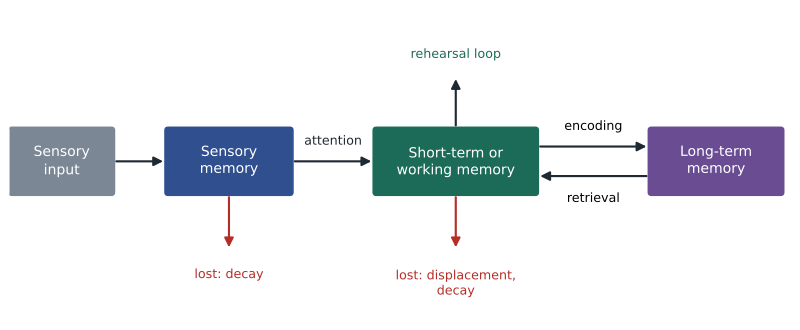
Alan Baddeley and Graham Hitch refined the idea of short-term memory into working memory, an active workspace with several components: a phonological loop for verbal and auditory information, a visuospatial sketchpad for images and spatial information, a central executive that directs attention and coordinates the others, and, added later, an episodic buffer that links working memory with long-term memory. Dual-task studies support the model: people can hold a list of digits while visualizing a route better than while repeating words aloud, because the two visual and verbal tasks use different components.
Chunking increases the effective capacity of short-term memory by grouping items into meaningful units. A phone number is easier to hold as three groups than as ten separate digits; a chess master remembers board positions as patterns. Maintenance rehearsal, repeating information, keeps it active; elaborative rehearsal, linking it to meaning and existing knowledge, is more effective for long-term storage.
Levels of processing and encoding strategies
Fergus Craik and Robert Lockhart proposed that memory depends on the depth of processing. Shallow processing focuses on physical features (is the word in capital letters?), intermediate processing on sound (does it rhyme with weight?) and deep processing on meaning (is it a type of fruit?). Deep processing produces better recall. The self-reference effect, better memory for information related to oneself, is an example of deep, elaborative encoding.
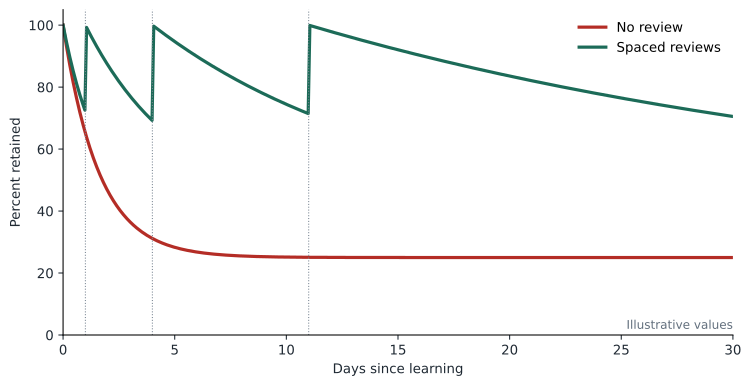
Other well-supported strategies include the spacing effect (distributed practice beats cramming for long-term retention), the testing effect (practising retrieval strengthens memory more than rereading) and mnemonic devices such as the method of loci, in which items are placed mentally along a familiar route. Thandiwe pointed out that the error log the group had kept since September is a testing-effect tool: each re-test date forces retrieval. Devika groaned. 'So the thing I hate is the thing that works.'
Types of long-term memory
| Type | Also called | Description | Example |
|---|---|---|---|
| Explicit | Declarative | Memory that can be consciously recalled and stated | |
| Episodic | Personal experiences tied to a time and place | Your first day of university | |
| Semantic | General facts and knowledge | Paris is the capital of France | |
| Implicit | Nondeclarative | Memory expressed through performance rather than recollection | |
| Procedural | Skills and habits | Riding a bicycle | |
| Priming | Prior exposure changes later processing without awareness | Recognizing a word faster after seeing it | |
| Classical conditioning | Learned associations between stimuli | Anxiety at the sound of a dentist's drill |
The distinction matters for lesion passages. Patient H.M. (Henry Molaison) had much of his medial temporal lobes, including the hippocampi, removed in 1953 to treat epilepsy. Afterward he could not form new explicit memories (anterograde amnesia) and lost some memories from the years just before surgery (retrograde amnesia), yet he could learn new motor skills, such as mirror drawing, without remembering having practised. This dissociation showed that explicit and implicit memory depend on different brain systems: the hippocampus for consolidating new explicit memories, and the basal ganglia and cerebellum for procedural learning.
Semantic memory is often modelled as a semantic network, in which concepts are nodes connected by associations. Spreading activation explains priming: activating one concept (doctor) partly activates related concepts (nurse), making them easier to retrieve. This also explains Thandiwe's opening exercise. Every word on the list activated the concept 'sleep', and the strongly activated but unseen word was recalled as if it had been presented. This procedure is known as the Deese-Roediger-McDermott paradigm.
Retrieval
Recall requires producing information with few cues; recognition requires identifying it among options. Recognition is usually easier, which is one reason multiple-choice questions feel easier than open-ended ones. Relearning, measured by savings, shows that even 'forgotten' information leaves traces: it is learned faster the second time.
Retrieval depends on cues. The encoding specificity principle states that memory is best when the retrieval context matches the encoding context. Context-dependent memory is improved recall in the same environment as learning; in a classic study, divers who learned words underwater recalled them better underwater than on land. State-dependent memory is improved recall in the same internal state. Mood-congruent memory is the tendency to recall information consistent with one's current mood.
The serial position effect has two parts. The primacy effect, better recall of early items, is attributed to extra rehearsal and transfer to long-term memory. The recency effect, better recall of the last items, is attributed to their still being in short-term memory. A delay filled with a distracting task removes the recency effect but leaves primacy, a result that supports the distinction between short-term and long-term stores.
Forgetting and memory errors
Hermann Ebbinghaus, testing himself on nonsense syllables in the 1880s, found that forgetting is rapid at first and then levels off, a pattern called the forgetting curve. Forgetting has several explanations. Decay is the fading of memory traces over time. Interference is disruption by other information: in proactive interference, old learning disrupts new (old passwords intrude when you try to recall a new one), and in retroactive interference, new learning disrupts old (learning a new phone number makes the old one harder to recall). Retrieval failure is the inability to access information that is stored, as in the tip-of-the-tongue phenomenon.
Memory is reconstructive. Elizabeth Loftus and colleagues showed that wording can change memory: participants who watched a film of a car crash and were asked how fast the cars were going when they 'smashed' into each other gave higher speed estimates, and were more likely to report seeing broken glass that was not there, than participants asked about cars that 'hit' each other. This misinformation effect has implications for eyewitness testimony. Source monitoring errors occur when people misattribute where a memory came from, such as believing they saw something they only heard about. Confidence and accuracy are not tightly linked: people can be highly confident in false memories.
Memory and the brain
At the cellular level, long-term potentiation (LTP), a lasting increase in synaptic strength after repeated stimulation, is a leading model of how learning changes the brain. LTP was first described in the hippocampus and depends on glutamate signalling. Memory consolidation, the stabilization of new memories, continues for hours to years and is helped by sleep. In aging, processing speed and working memory tend to decline, and some aspects of episodic memory decline, while semantic memory and vocabulary often remain stable or improve. Dementia is a clinical decline severe enough to impair daily life; Alzheimer disease, the most common cause, involves amyloid plaques, tau tangles and loss of cholinergic neurons. Korsakoff syndrome, linked to thiamine deficiency often associated with chronic alcohol use, causes severe memory problems and confabulation.
Cognition and cognitive development
Jean Piaget proposed that children actively build understanding through schemas, mental frameworks that organize knowledge. New information is assimilated into existing schemas or, when it does not fit, schemas are changed through accommodation. Piaget described four stages.
| Stage | Approximate age | Key features |
|---|---|---|
| Sensorimotor | Birth to 2 years | Learning through senses and actions; object permanence develops |
| Preoperational | 2 to 7 years | Symbolic thought and language; egocentrism; lack of conservation |
| Concrete operational | 7 to 11 years | Logical thinking about concrete events; conservation; reversibility |
| Formal operational | 11 years and up | Abstract and hypothetical reasoning |
Lev Vygotsky emphasized social and cultural influences on development. His zone of proximal development is the range of tasks a child cannot yet do alone but can do with guidance; scaffolding is the support a more skilled person provides and gradually removes. Later research has shown that children often reach Piaget's milestones earlier than he proposed, and that development is shaped by culture as well as by maturation.
Problem solving, decisions and heuristics
Problem-solving strategies include trial and error, algorithms (step-by-step procedures that guarantee a solution if one exists) and heuristics (mental shortcuts that are fast but can fail). Insight is a sudden realization of a solution. Obstacles include mental set (sticking with a strategy that worked before) and functional fixedness (seeing objects only in their usual use).
Amos Tversky and Daniel Kahneman described heuristics and biases that affect judgment.
- Availability heuristic: judging frequency or probability by how easily examples come to mind, so vivid events such as plane crashes seem more common than they are.
- Representativeness heuristic: judging probability by how much something resembles a prototype, which can lead people to ignore base rates.
- Anchoring: relying too heavily on an initial value when making estimates.
- Framing effects: choosing differently depending on how options are presented, for example preferring a treatment with a '90 percent survival rate' over one with a '10 percent mortality rate'.
- Confirmation bias: seeking and favouring information that supports existing beliefs.
- Belief perseverance: maintaining a belief after the evidence for it has been discredited.
- Overconfidence: overestimating the accuracy of one's judgments.
Elliot recognized the representativeness heuristic from his clinic Saturdays. 'A patient looks exactly like a textbook case of one thing, and you forget that something else is ten times more common,' he said. Thandiwe added the phrase physicians use for this: when you hear hoofbeats, think horses, not zebras. 'Base rates are the horses.'
Intelligence
Charles Spearman proposed a general intelligence factor, g, after finding that performance on different mental tests tends to correlate. Howard Gardner proposed multiple intelligences, including linguistic, logical-mathematical, spatial, musical, bodily-kinesthetic, interpersonal, intrapersonal and naturalistic; the theory is influential in education but has weak empirical support as a set of separate abilities. Robert Sternberg's triarchic theory describes analytical, creative and practical intelligence. Raymond Cattell distinguished fluid intelligence, reasoning with new problems, which tends to peak in early adulthood, from crystallized intelligence, accumulated knowledge, which tends to remain stable or grow with age. Emotional intelligence is the ability to perceive, understand and manage emotions.
Intelligence tests are judged by reliability (consistency of scores) and validity (whether they measure what they claim). IQ scores are standardized to a mean of 100 and a standard deviation of 15. Both genes and environment influence intelligence: twin and adoption studies suggest substantial heritability within populations, while nutrition, education and other environmental factors also matter. Average IQ scores rose substantially across the twentieth century in many countries, the Flynn effect, a change too fast to be genetic.
Language
Language has several components: phonemes (the smallest units of sound), morphemes (the smallest units of meaning), syntax (rules for combining words), semantics (meaning) and pragmatics (use in social context). Children move from babbling (around 4 to 6 months) to single words (around 12 months), two-word speech (around 18 to 24 months) and rapid vocabulary growth.
Theories of language acquisition differ in emphasis. The learning or behaviourist view, associated with B.F. Skinner, holds that language is learned through reinforcement and imitation. The nativist view, associated with Noam Chomsky, holds that humans have an innate capacity for language, sometimes called a language acquisition device, which explains how children master complex grammar from limited input and produce sentences they have never heard. The interactionist view holds that biological readiness and social interaction work together. Evidence for a sensitive period comes from studies showing that language learned after early childhood is less likely to reach native-like fluency, especially in pronunciation and grammar.
The linguistic relativity hypothesis, associated with Benjamin Lee Whorf, proposes that language shapes thought. The strong version, that language determines what we can think, is not supported. A weak version, that language influences perception and memory in some domains, such as colour categories and spatial descriptions, has some support.
Worked problem
A depth-of-processing experiment
Sixty participants saw 40 words. One group judged whether each word was printed in capital letters, a second group whether it rhymed with a target word and a third whether it fit a sentence. On a surprise recall test 20 minutes later, the groups recalled 15, 30 and 55 percent of the words. (Data invented for this course.) What is the independent variable, what result supports levels of processing, and what alternative should be ruled out?
Show solution
- The independent variable is the type of judgment, which sets the depth of processing (physical, sound, meaning).
- Recall increases with depth, consistent with Craik and Lockhart's model.
- A surprise test is important: if participants had expected a test, they might have used their own strategies regardless of condition.
- An alternative to rule out is time on task: deeper judgments may take longer. A design that equates exposure time strengthens the conclusion.
Answer: The type of judgment is the independent variable; better recall after meaning-based judgments supports levels of processing; differences in study time should be controlled.
Common mistakes
MistakeShort-term memory and long-term memory differ only in duration.
InsteadThey also differ in capacity and in the effects of delay and lesions, such as the loss of the recency effect after a filled delay.
MistakeProactive interference is new learning disrupting old memories.
InsteadProactive interference is old learning disrupting new; retroactive interference is new learning disrupting old.
MistakeConfident eyewitnesses are usually accurate.
InsteadConfidence and accuracy are only loosely related; memories can be confidently wrong.
MistakeAssimilation means changing a schema to fit new information.
InsteadAssimilation fits new information into an existing schema; accommodation changes the schema.
MistakeCrystallized intelligence declines sharply in older adults.
InsteadCrystallized knowledge tends to remain stable or grow; fluid reasoning declines more with age.
Summary and key terms
- Memory involves encoding, storage and retrieval across sensory, short-term (working) and long-term systems.
- Deeper processing, spacing, retrieval practice and elaboration improve long-term retention.
- Explicit memory (episodic and semantic) and implicit memory (procedural, priming, conditioning) depend on different brain systems, as patient H.M. showed.
- Retrieval depends on cues and context; forgetting reflects decay, interference and retrieval failure, and memory is reconstructive.
- Piaget and Vygotsky describe cognitive development; heuristics speed decisions but introduce predictable biases.
- Intelligence has general and specific components shaped by genes and environment; language develops through innate capacity and social interaction.
- Working memory
- An active system for holding and manipulating information, with a phonological loop, visuospatial sketchpad and central executive.
- Chunking
- Grouping items into meaningful units to increase the capacity of short-term memory.
- Encoding specificity
- The principle that retrieval is best when cues match those present at encoding.
- Serial position effect
- Better recall of items at the beginning (primacy) and end (recency) of a list.
- Misinformation effect
- Distortion of a memory by misleading information presented after the event.
- Long-term potentiation
- A lasting increase in synaptic strength thought to underlie learning and memory.
- Availability heuristic
- Judging likelihood by how easily examples come to mind.
- Functional fixedness
- Difficulty seeing an object as useful for anything other than its usual purpose.
Practice problems
Work each problem on paper first, then reveal the answer to check.
Participants recall a list immediately or after 30 seconds of counting backward. Which part of the serial position curve will change?
Show answer
The recency effect will disappear after the filled delay; the primacy effect will remain.
A student studies in the library and takes the exam in the same room. Which principle predicts better performance?
Show answer
Context-dependent memory, an example of encoding specificity.
After learning Spanish, a person has trouble recalling French vocabulary learned years earlier. What kind of interference is this?
Show answer
Retroactive interference: new learning disrupts old.
A child insists that a tall, thin glass holds more juice than a short, wide glass with the same amount. Which Piagetian stage is she most likely in?
Show answer
Preoperational; she has not yet mastered conservation.
People estimate that a city has more murders than suicides after a week of crime news, though the reverse is true. Which heuristic is involved?
Show answer
The availability heuristic.
Lesson quiz · 5 questions
Score 60% or more to complete this lesson.
Create a free account to save your progress, take quizzes and earn a certificate.