
MCAT-130 · Lesson 5 of 12 · 21 min
Emotion and motivation: emotion, motivation and stress
▶ Video coming soon A video version of this lesson is on the way.
Thandiwe asked the group to rate their stress about the MCAT from 1 to 10. Devika said 7, Elliot 5 and Ezequiel 6. 'Now rate how well you are performing,' she said. Elliot, the least stressed, admitted that he had been coasting on practice sets and making careless errors. Devika said she worked hard but froze on calculations. 'There is a curve that describes all three of you,' Thandiwe said. 'Too little arousal and you coast. Too much and you freeze. Today is about the middle.'
This lesson covers content category 6C, "Responding to the world", which includes emotion and stress, and the motivation subtopic of content category 7A. These areas mix biology (the autonomic nervous system, hormones and brain structures) with psychology (appraisal, coping and theories of motivation), so passages often ask you to link a physiological finding to a psychological theory.
Components of emotion
Emotions have three components: a physiological component (changes in heart rate, breathing, hormones and brain activity), a behavioural or expressive component (facial expressions, posture, actions) and a cognitive component (the subjective experience and the interpretation of the situation). Paul Ekman's cross-cultural research found that several facial expressions, usually listed as happiness, sadness, fear, anger, surprise and disgust, with contempt sometimes added, are recognized across cultures, which supports a universal, evolved basis for basic emotions. Cultures differ in display rules, the norms about when and how emotions should be shown.
Theories of emotion
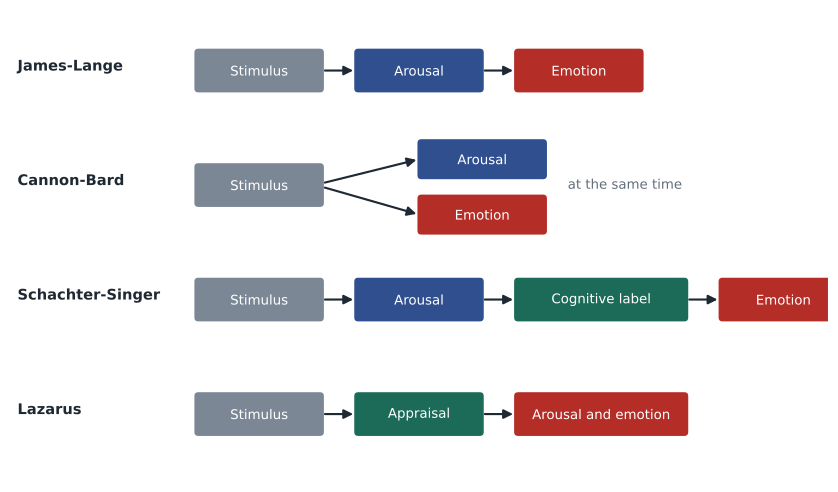
Four theories appear repeatedly. The difference between them is the order of events and the role of thinking.
| Theory | Sequence | Key idea |
|---|---|---|
| James-Lange | Stimulus, then physiological arousal, then emotion | We feel afraid because we notice our body trembling |
| Cannon-Bard | Stimulus, then arousal and emotion at the same time | The thalamus sends signals to the cortex and body simultaneously; different emotions can share similar arousal |
| Schachter-Singer (two-factor) | Stimulus, then arousal, then cognitive label, then emotion | Arousal plus an interpretation of its cause produces a specific emotion |
| Lazarus (cognitive appraisal) | Stimulus, then appraisal, then arousal and emotion | Our judgment of what the situation means comes first |
Stanley Schachter and Jerome Singer gave participants an injection of epinephrine (adrenaline) or a placebo and placed them with a confederate who acted either euphoric or angry. Participants who were aroused and not told to expect the drug's effects tended to report emotions matching the confederate's, presumably because they searched the situation for an explanation of their arousal. The misattribution of arousal is related: in a well-known study by Donald Dutton and Arthur Aron, men who crossed a high, swaying suspension bridge were more likely than those on a low, stable bridge to call a female interviewer afterward, which the researchers attributed to interpreting fear-related arousal as attraction.
The facial feedback hypothesis proposes that facial expressions can influence emotional experience: holding a pen in the teeth, which forces a smile-like expression, was reported in one classic study to make cartoons seem funnier. Large replication attempts have produced mixed results, so treat the effect as small and debated. Questions are more likely to ask you to identify which theory a finding supports than to judge the effect size.
The biology of emotion
The limbic system is central to emotion. The amygdala evaluates threats and is crucial for fear learning; people with amygdala damage may fail to recognize fear in others' faces and show weak fear conditioning. Joseph LeDoux described two pathways for fear: a fast 'low road' from the thalamus directly to the amygdala, which triggers a quick response, and a slower 'high road' through the cortex, which allows a more detailed evaluation. This is why you may jump at a curved stick before realizing it is not a snake.
The prefrontal cortex helps regulate emotions and plan responses. The hypothalamus coordinates autonomic and endocrine responses. The autonomic nervous system produces the physiological changes of emotion: sympathetic activation in fear and anger, parasympathetic activity during calm states. Specific emotions are not reliably linked to unique patterns of autonomic activity, which is one argument raised against the James-Lange theory, although some differences have been reported.
Motivation
Motivation is the set of factors that start, direct and sustain behaviour. Theories differ in what they say drives us.
- Instinct theory holds that behaviour is driven by innate, species-typical patterns. It describes behaviour well in many animals but explains little of human behaviour.
- Drive reduction theory, associated with Clark Hull, holds that physiological needs create unpleasant states of tension (drives) that motivate behaviour to restore homeostasis. Hunger motivates eating. It does not explain behaviours that increase arousal, such as riding roller coasters.
- Arousal theory holds that people seek an optimal level of arousal. The Yerkes-Dodson law states that performance is best at moderate arousal and falls at very low or very high arousal, and that the optimal level is lower for complex or unfamiliar tasks.
- Incentive theory holds that external rewards and punishments pull behaviour.
- Cognitive theories emphasize expectations and the value of outcomes (expectancy-value theory) and the role of goals.
- Need-based theories include Abraham Maslow's hierarchy of needs: physiological, safety, love and belonging, esteem and self-actualization. Maslow proposed that lower needs must largely be met before higher ones motivate behaviour. The hierarchy is widely taught but evidence that needs are satisfied in a strict order is weak.
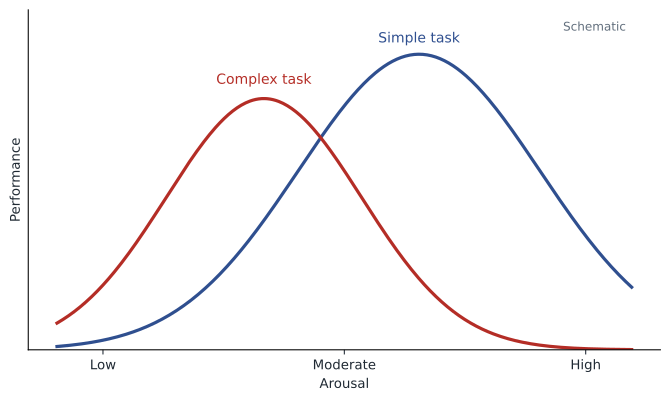
Thandiwe used the figure to address the opening question. Elliot's coasting reflected low arousal on familiar tasks; Devika's freezing reflected high arousal on complex calculations. 'Elliot needs stakes,' she said, 'so he times every set. Devika needs to lower the temperature on calculations, so she does untimed accuracy drills before timed ones.'
Self-determination theory, developed by Edward Deci and Richard Ryan, proposes three basic psychological needs: autonomy, competence and relatedness. Intrinsic motivation, doing something because it is inherently satisfying, flourishes when these needs are met. Extrinsic motivation is driven by external rewards or pressures. The overjustification effect is a decrease in intrinsic motivation when an external reward is introduced for an activity that was already enjoyed; in a classic study, children who expected a reward for drawing later spent less free time drawing than children who received no reward or an unexpected one. Rewards that are seen as informative about competence, rather than controlling, are less likely to undermine motivation.
Hunger and eating illustrate the interaction of biology and environment. The hypothalamus integrates signals: ghrelin from the stomach increases hunger, and leptin from fat cells and insulin from the pancreas signal satiety. In classic animal studies, lesions of the lateral hypothalamus reduced eating and lesions of the ventromedial hypothalamus increased it, though the modern picture involves networks rather than single 'centres'. Cultural norms, learned preferences, availability of food and social settings also influence what and how much people eat.
Sexual motivation involves hormones, brain systems and cultural norms. William Masters and Virginia Johnson described a human sexual response cycle of excitement, plateau, orgasm and resolution. Sexual orientation is believed to reflect a combination of biological and environmental factors and is not a choice in the sense of a deliberate decision; it is a topic the MCAT treats descriptively.
Stress
Stress is the process by which we perceive and respond to events, called stressors, that we appraise as threatening or challenging. Richard Lazarus described two stages of appraisal. In primary appraisal, a person evaluates whether a situation is irrelevant, benign-positive or stressful (harmful, threatening or challenging). In secondary appraisal, the person evaluates their ability to cope with it. The same event can be a threat for one person and a challenge for another, depending on these appraisals.
Stressors range from catastrophes (large-scale disasters) and significant life changes (moving, divorce, the death of a loved one) to daily hassles (traffic, deadlines). Thomas Holmes and Richard Rahe's Social Readjustment Rating Scale assigned points to life events, and higher totals were associated with a greater risk of illness. Daily hassles accumulate too and can predict health outcomes. Stress can be distress (negative) or eustress (positive stress from challenges such as a new job or a wedding).
Hans Selye described the general adaptation syndrome, a pattern of response to prolonged stress in three phases. In the alarm phase, the sympathetic nervous system activates and the body mobilizes resources. In the resistance phase, the body stays aroused, with continued release of stress hormones such as cortisol, as it copes with the stressor. In the exhaustion phase, reserves are depleted and the person becomes more vulnerable to illness. Walter Cannon earlier described the fight-or-flight response; Shelley Taylor later proposed that, especially among women, stress can also produce a tend-and-befriend response, seeking social support and protecting offspring.
| Effect | Description |
|---|---|
| Physiological | Raised heart rate and blood pressure; cortisol release; over time, links to heart disease, impaired immune function and poorer sleep |
| Emotional | Anxiety, irritability, low mood |
| Behavioural | Changes in eating, sleep and substance use; withdrawal from others |
| Cognitive | Difficulty concentrating; narrowed attention; rumination |
Chronic stress can impair immune function, which is why psychoneuroimmunology studies links between psychological states, the nervous and endocrine systems and immunity. Studies have reported, for example, slower wound healing in people under chronic stress. Type A behaviour, described as competitive, impatient and hostile, was once linked to heart disease; later research suggested that hostility and anger are the components most strongly associated with risk.
Coping and stress management
Coping strategies are often divided into problem-focused coping, which tries to change the stressor (making a study plan, asking for an extension), and emotion-focused coping, which tries to manage the emotional response (relaxation, seeking comfort, reframing). Problem-focused coping is generally more effective when the stressor is controllable; emotion-focused coping is useful when it is not. Perceived control is a major factor: stressors seen as uncontrollable produce stronger stress responses, which connects to learned helplessness from lesson 4. Social support, exercise, sleep, relaxation training, mindfulness practices and cognitive reappraisal all have evidence for reducing the effects of stress.
Defence mechanisms, described in psychodynamic theory, are unconscious strategies to reduce anxiety, such as denial, repression, projection, rationalization and displacement. They are discussed further in lesson 6. On the MCAT, distinguish them from deliberate coping strategies: coping is conscious, while defence mechanisms are described as unconscious.
Ezequiel described the debriefs EMT crews had after difficult calls. 'We were told to talk it through with each other and then sleep, eat, move,' he said. 'Social support and basics.' Thandiwe asked the group to identify the coping types in their own MCAT plans. Devika's untimed drills were problem-focused; Elliot's Saturday clinic, which he said cleared his head, worked as emotion-focused coping and as a reminder of why he was studying.
Worked problem
Interpreting a stress study
Researchers gave 80 undergraduates a difficult mental arithmetic task in front of evaluators. Half were told beforehand that their racing hearts would help them perform (the reappraisal group); the others received no instructions. Both groups showed similar increases in heart rate. The reappraisal group reported less anxiety and answered 20 percent more problems correctly. (Data invented for this course.) Which theory of emotion is most consistent with the results?
Show solution
- Note that physiological arousal was similar in both groups.
- The groups differed in how they interpreted that arousal and in their emotional experience and performance.
- A theory in which the interpretation of arousal determines the emotion fits the result. That is the Schachter-Singer two-factor theory; cognitive appraisal (Lazarus) is also consistent.
- James-Lange would predict similar emotions from similar arousal, so it fits least well.
Answer: The two-factor (Schachter-Singer) theory, with support for cognitive appraisal: the same arousal produced different emotional experiences depending on interpretation.
Common mistakes
MistakeCannon-Bard says arousal causes the emotion.
InsteadCannon-Bard says arousal and emotion occur at the same time; James-Lange says arousal comes first.
MistakeThe Yerkes-Dodson law says more arousal always improves performance.
InsteadPerformance peaks at moderate arousal, and the optimum is lower for complex tasks.
MistakePrimary appraisal is judging whether you can cope.
InsteadPrimary appraisal judges whether the event is threatening; secondary appraisal judges coping resources.
MistakeRewards always increase motivation.
InsteadExpected rewards for enjoyable activities can reduce intrinsic motivation (the overjustification effect).
MistakeThe resistance phase is when the body runs out of reserves.
InsteadResources are depleted in the exhaustion phase; in resistance, the body sustains arousal.
Summary and key terms
- Emotions have physiological, behavioural and cognitive components; basic facial expressions are recognized across cultures, while display rules vary.
- James-Lange, Cannon-Bard, Schachter-Singer and Lazarus theories differ in the order of arousal, appraisal and feeling.
- The amygdala, prefrontal cortex, hypothalamus and autonomic nervous system underlie emotional responses.
- Motivation theories include instinct, drive reduction, arousal (Yerkes-Dodson), incentive, Maslow's hierarchy and self-determination theory.
- Stress depends on appraisal; Selye's general adaptation syndrome has alarm, resistance and exhaustion phases.
- Problem-focused and emotion-focused coping, perceived control and social support shape the effects of stress.
- Two-factor theory
- Schachter and Singer's theory that emotion results from physiological arousal plus a cognitive label.
- Display rules
- Cultural norms about when and how emotions may be expressed.
- Drive reduction theory
- The theory that physiological needs create drives that motivate behaviour to restore homeostasis.
- Yerkes-Dodson law
- The principle that performance is best at moderate arousal.
- Overjustification effect
- Reduced intrinsic motivation after an external reward is introduced.
- Primary appraisal
- The initial judgment of whether an event is irrelevant, positive or stressful.
- General adaptation syndrome
- Selye's three-phase response to prolonged stress: alarm, resistance and exhaustion.
- Problem-focused coping
- Coping that targets the source of stress.
Practice problems
Work each problem on paper first, then reveal the answer to check.
A hiker sees a bear, notices her heart pounding and then feels afraid. Which theory does this sequence illustrate?
Show answer
James-Lange: arousal is perceived first and produces the emotion.
A student performs better on a simple typing test when slightly anxious but worse on a complex statistics test when equally anxious. Which principle explains this?
Show answer
The Yerkes-Dodson law: the optimal arousal level is lower for complex tasks.
A volunteer who loved reading to children starts being paid per session and soon volunteers less. What is this effect?
Show answer
The overjustification effect.
Facing an unexpected bill, a person creates a payment plan. What type of coping is this?
Show answer
Problem-focused coping.
Which brain structure is most important for the fast fear response to a sudden threatening shape?
Show answer
The amygdala, reached by a fast pathway from the thalamus.
Lesson quiz · 5 questions
Score 60% or more to complete this lesson.
Create a free account to save your progress, take quizzes and earn a certificate.